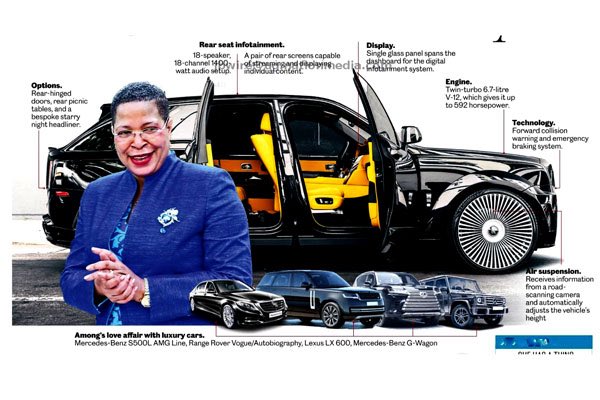
MS Albeity Limited - The Company that “gifted” Uganda’s outgoing Speaker of Parliament the latest 3.4BN Rolls Royce.
The company has been identified as a "briefcase firm" in several reports due to its low-key operational history, has listed the following individuals in official UK Companies House records over time.
Current Director
•Samir Tahir al-Kharusy: A British citizen (born 1972) who was appointed on August 13, 2018. Reports from https://t.co/xHlSb7bH3c have previously identified him as a postal worker.
Former Directors
•Nsibomana Ibrahim: Served as a director from December 2021 until his resignation in September 2022. He has been identified in reports as a truck driver.
•Youssuf Aden: A Somali nurse who resigned in September 2018.
•Abubakar Hassan: Resigned as both a director and secretary in September 2018.
The company gained notoriety in Uganda for securing high-value government contracts, including the procurement of luxury vehicles for the leadership of the Ugandan Parliament, despite its directors seemingly having no prior background in the automotive industry.
Financial Standing of Albeity Limited: According to the latest available filings at UK Companies House, the company is classified as a micro-entity. Its balance sheets have historically shown relatively modest net assets compared to the multi-billion shilling contracts it has secured in Uganda. QUESTION - How did Samir raise money to buy a luxurious car for gifting the Speaker?
Employment Background: Investigative reports by Daily Monitor previously identified Al-Kharusy as a postal worker in the United Kingdom, suggesting that his primary source of income may have been outside of large-scale international trade prior to the company’s involvement with the Ugandan Parliament.
Contractual Revenue: While Albeity Limited has handled transactions worth billions of Ugandan shillings—including the Shs2.4 billion Mercedes-Benz deal in 2022 and the recent Shs3.4 billionRolls-Royce delivery—these figures represent gross contract values or vehicle costs, not the personal income of the director. @IGGUganda@AnneTwino@DrOkiria Declarations concerning this “gift” should be made public
@SpireJim His conviction is that the "Nathan approach" yields better results while speaking to power! Janan Luwumu did it brutally and faced the death similar to that of John the Baptist.
Uganda’s proposed Sovereignty Bill is the ONLY law in the world openly attempting something this sweeping: it legally turns its own citizens abroad into “foreigners”.
The Bill is explicit. A “foreigner” includes “Ugandan citizens residing abroad”.
That single clause redraws the boundary of citizenship. It means diaspora money, relationships, and even family support can fall under foreign control rules.
So the implications are not abstract.
-A mother in Mbale receiving school fees from her son in London.
-A boda boda rider in Gulu financed by a brother in Dubai.
-A small shop in Mbarara stocked using capital sent from Boston.
All could, in theory, fall under foreign influence rules.
Then the net widens.
The definition of an “agent of a foreigner” includes anyone “directly or indirectly… financed or subsidised” by a foreigner.
Not directed. Not controlled. Simply funded.
-A journalist paid by a locally registered outlet that receives donor support.
-A researcher on a project with partial foreign grants.
-An NGO worker whose salary traces back, however distantly, to external funding.
All can be classified as “agents”.
Clause 22 then imposes a hard ceiling: “a cap on foreign funding of approximately UGX 400 million within any twelve-month period”, beyond which ministerial approval is required.
So:
-A private hospital built with diaspora investment.
-A school supported by an international foundation.
-A construction firm using a foreign loan.
Then comes the sharpest edge.
-Clause 13 creates the offence of economic sabotage, criminalising anyone who “publishes information… that weakens or damages the economic system”.
So:
-A newspaper reporting a currency slide.
-An analyst warning about debt stress.
-A civil society group highlighting inflation pressures.
Even if accurate, such reporting could fall foul of the law.
Finally, Clause 5 prohibits activities that promote foreign interests “against the interests of Uganda”, a phrase the law does not define.
Put together, these clauses do something unprecedented.
-They do not just regulate foreign influence.
-They redefine who is foreign.
-They extend control from politics into everyday economic and social life.
In most countries, including Ethiopia and Ethiopia, sovereignty laws manage outsiders.
Here, Uganda redefined outsiders to include its citizens, basically rewriting the 1995 constitution. Of course it’s in the preparatory and consultation stage and could change for better - or WORSE!
Uganda’s proposed Sovereignty Bill is the ONLY law in the world openly attempting something this sweeping: it legally turns its own citizens abroad into “foreigners”.
The Bill is explicit. A “foreigner” includes “Ugandan citizens residing abroad”.
That single clause redraws the boundary of citizenship. It means diaspora money, relationships, and even family support can fall under foreign control rules.
So the implications are not abstract.
-A mother in Mbale receiving school fees from her son in London.
-A boda boda rider in Gulu financed by a brother in Dubai.
-A small shop in Mbarara stocked using capital sent from Boston.
All could, in theory, fall under foreign influence rules.
Then the net widens.
The definition of an “agent of a foreigner” includes anyone “directly or indirectly… financed or subsidised” by a foreigner.
Not directed. Not controlled. Simply funded.
-A journalist paid by a locally registered outlet that receives donor support.
-A researcher on a project with partial foreign grants.
-An NGO worker whose salary traces back, however distantly, to external funding.
All can be classified as “agents”.
Clause 22 then imposes a hard ceiling: “a cap on foreign funding of approximately UGX 400 million within any twelve-month period”, beyond which ministerial approval is required.
So:
-A private hospital built with diaspora investment.
-A school supported by an international foundation.
-A construction firm using a foreign loan.
Then comes the sharpest edge.
-Clause 13 creates the offence of economic sabotage, criminalising anyone who “publishes information… that weakens or damages the economic system”.
So:
-A newspaper reporting a currency slide.
-An analyst warning about debt stress.
-A civil society group highlighting inflation pressures.
Even if accurate, such reporting could fall foul of the law.
Finally, Clause 5 prohibits activities that promote foreign interests “against the interests of Uganda”, a phrase the law does not define.
Put together, these clauses do something unprecedented.
-They do not just regulate foreign influence.
-They redefine who is foreign.
-They extend control from politics into everyday economic and social life.
In most countries, including Ethiopia and Ethiopia, sovereignty laws manage outsiders.
Here, Uganda redefined outsiders to include its citizens, basically rewriting the 1995 constitution. Of course it’s in the preparatory and consultation stage and could change for better - or WORSE!