Exceptional Gold Mohur of Ahom King Swargdeo Rajeshwar Singha
The Ahoms were ethnic group originating from the Tai people and founder of Assamese royal dynasty. They established a powerful state in the Brahmaputra Valley of Assam. They ruled the region for almost 600 years from 1228 to 1826. They are the harbinger of modern Assamese identity, and they are known for their unique governance structures, and their military resilience. There were total 41 Kings during they 600 years of dynasty's reign.
Ahom coinage are unique and known for its octagonal shape. It was believed that the shape of Ahom kingdom was Octagonal. Hence, most of the silver and gold coins are found in octagonal shape with legend in Ahom, Devanagari and occasionally in Persian. Few coins are found in rectangular shape. They always used Shaka dates on their coinage.
For more, https://t.co/gGTwB6XNOV
#coin #numismatics #money #ahom #mohur #assam #CultureUnitesAll #12YearsOfVikasBhiVirasatBhi #octagonal
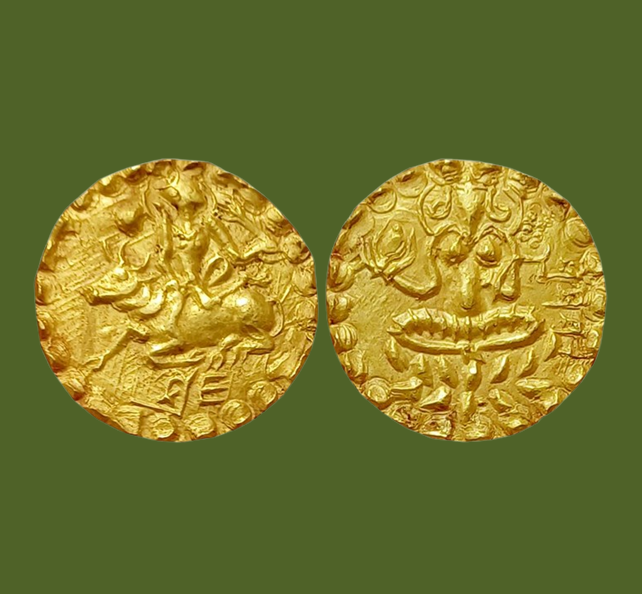
Rare and Beautiful Gold Dinar of Gauda Ruler Shashanka
The Gauda dynasty was an ancient kingdom in the Gauda region of Bengal. It emerged as an independent power in the late 6th to early 7th century CE, following the decline of the Gupta Empire. Its capital was Karnasuvarna, located near present-day Murshidabad in West Bengal. The Gauda dynasty is referenced in ancient texts such as the Arthashastra, the Puranas, and in the works of Panini and Varahamihira.
The coinage of the Gauda Dynasty is one of the significant sources of information about this early independent kingdom of Bengal. These coins were issued after the fall of the Gupta Empire and display strong Shaivite influences. Many coins depict Lord Shiva in various postures, often accompanied by symbolic elements. The inscriptions are in Brahmi script. The dynasty issued primarily gold dinars, along with a limited number of silver coins. Although their gold dinars are of relatively lower purity, they exhibit excellent artistic quality and typically weigh between 5.5 and 9.5 grams.
For more... https://t.co/GU46wWE5fE
#coins #numismatics #money #WestBengalDay #PaschimbangaDibas #BongVibes #CityOfJoy #CultureUnitesAll #12YearsofVikasBhiVirasatBhi #gauda #bengal #BengalDivas #JoyBangla #SonarBangla #IncredibleIndia
Chamundi Pavli of Mysore King Krishna Raj Wodeyar
The Mysore (Mahisuru) Kingdom was a major and important South Indian kingdom that was ruled by various Hindu dynasties till 1761. For a brief period the region was under Hyder/Tipu. Thereafter, Wadiyars(Wodeyar) became the rulers of Mysore and played a significant role in the history of Karnataka and southern India.
Krishnaraja Wodeyar III was the 22nd Maharaja of Mysore. Born on 14th July 1794 in Srirangapatna, he ascended the throne at age 5 in 1799 after the British defeated Tipu Sultan in the Fourth Anglo-Mysore War. His rule lasted nearly 69 years, the longest among Wadiyar rulers. From 1810 onwards, he attained the "age of discretion" and took direct and full control of the kingdom.
For more...https://t.co/ZokNljxEWG
#coin #money #numismatics #karnataka #wodeyar #mysore #chamundi #CultureUnitesAll #12YearsOfVikasBhiVirasatBhi
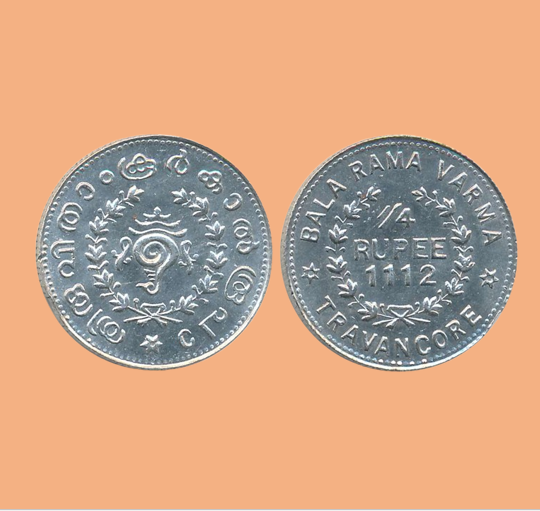
Silver Quarter Rupee Coin of Travancore Maharaja Bala Ram Varma II
Varma Kings of Kerala primarily refer to the royal families of Travancore and to some extent Cochin, who used "Varma" as their title. This is a Kshatriya surname common among Keralam’s royal lineages, especially in the southern kingdoms.
Travancore Royal Family is the most prominent Varma kings belonged to the Kulasekhara dynasty of Travancore. They ruled from the early 18th century onward and transformed a small principality into a powerful, modern princely state.
For more...https://t.co/QXyDthAHbx
#coin #money #numismatics #keralam #varma #padamanabha #travancore #cochin #CulturUnitesAll #12YearsOfVikasBhiVirasatBhi
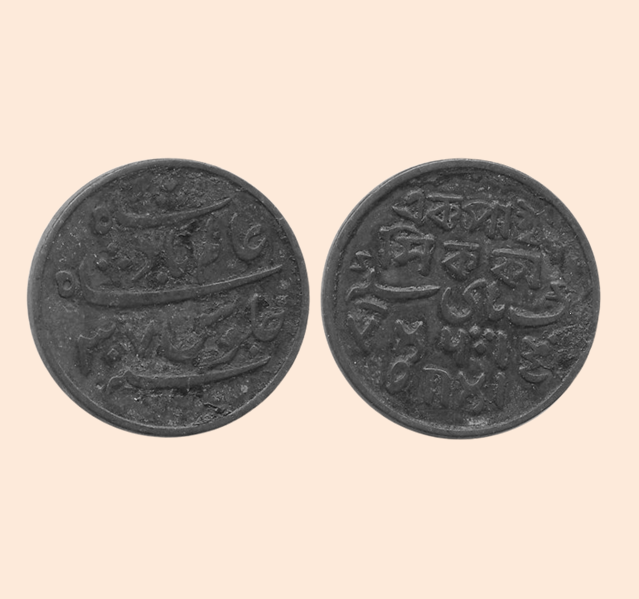
Multi-script, Multi-lingual Coin issued by Bengal Presidency
The East India Company (EIC) established trading posts in the Mughal Bengal Subah in the early 1600s. In 1690, Job Charnock founded a factory in the villages of Sutanuti, Gobindapur, and Kalikata on the banks of the Hooghly River. These settlements eventually grew into the city of Calcutta.
Fort William was constructed around 1696–1700 and became the administrative seat of the Bengal Presidency around 1700. It was one of the three major presidencies of British India. Bengal quickly emerged as the most lucrative due to its rich agriculture, thriving textile industry, and strategic trade networks.
For more... https://t.co/ChcIFlr31W
#coins #money #numismatics #bengal #onepice #CultureUnitesAll #12YearsOfVikasBhiVirasatBhi #Presidency
Multi-script, Multi-lingual 40 Cash issued by Madras Presidency
The Madras Presidency was one of the three major administrative subdivisions of British India. It covered much of southern India, Tamil Nadu, Andhra Pradesh, parts of Kerala, Karnataka, Odisha, and Telangana. It served as an important base for British trade and military operations in the region.
The coinage of the Madras Presidency under the East India Company (EIC) was among the earliest British-issued coins in India, beginning in the 1670s. It reflected a rich blend of local South Indian traditions, especially gold pagodas, Mughal-style silver rupees, and later European-influenced machine-struck coins. The principal mints were located at Madras or Fort St. George, Arcot, and Machilipatnam.
For more... https://t.co/5axz5zQAYu
#coins #money #numismatics #madras #tamilnadu #multilingual #40cash #Presidency #CultureUnitesAll #12YearsOfVikasBhiVirasatBhi
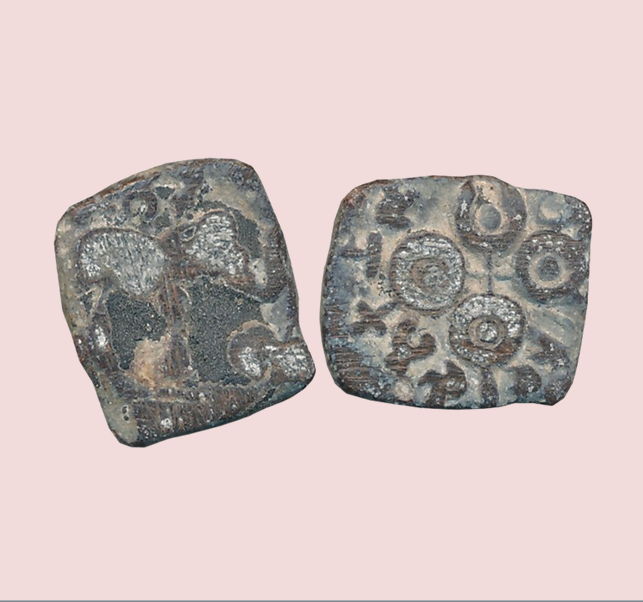
Lead Coin of Satavahana, Ruler Siri Satakarni
The Satavahanas were a major ancient Indian dynasty that ruled large parts of the Deccan i.e. southern, central and western India that comprises of modern Maharashtra, Andhra Pradesh, Telangana, Karnataka, and parts of Madhya Pradesh and Gujarat. They ruled approx. from the late 2nd century BCE to the early 3rd century CE. Sri Mukha, the founder of the dynasty overthrew the remnants of the Kanva dynasty and local powers and established his rule in the upper Godavari valley.
Satavahana coinage is one of the most important sources for understanding the dynasty. Their regional economies, trade, and cultural influences can be traced through its coinage. They issued coins in Lead, Potin, Copper, Bronze, Silver and Gold. Their important mints were located at Paithan, Nashik, Vidarbha. The legends on their coinage are found in Brahmi, Tamil/Telugu scripts.
For more... https://t.co/awNBMtyH1R
#coin #numismatics #money #satavahana #brahmi #satkarni #CultureUnitesAll #12YearsOfVikasBhiVirasatBhi #lead
Heavy Lead Coin of Hiranyakas, King Khadakama
The Hiranyakas were a local dynasty that rose in the mid-3rd century CE, in Rayalaseema region that includes south-western Andhra Pradesh and adjoining south-central Karnataka after the decline of the Satavahana Empire. They are known almost exclusively from their lead coins and a few inscriptions or references in the context of neighboring powers like the Ikshvakus. They ruled 250–350/400 CE, contemporary to late Ikshvakus and early Pallavas.
The Hiranyakas coins were made up of heavy Lead and Potin. It ranges from 8–17 grams. They were crude, thick, often irregular round or slightly square or rectangular. Most specimens of coins are found from hoards in Anantapur, Kurnool, and surrounding Rayalaseema areas.
For more... https://t.co/LSYpfH6XMm
#coin #numismatics #money #hiranyakas #brahmi #khadakama #CultureUnitesAll #12YearsOfVikasBhiVirasatBhi #lead
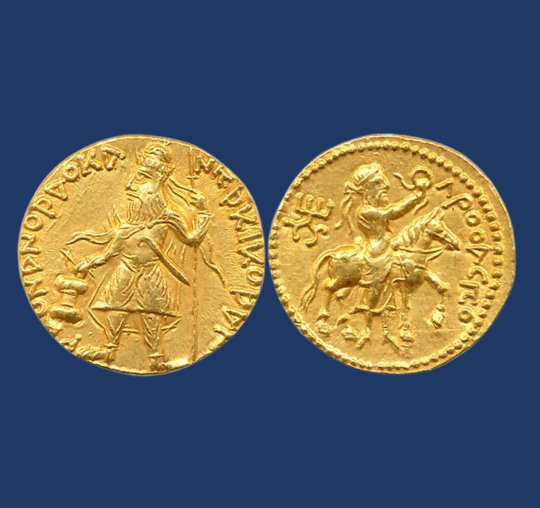
Rare LROOASP Type Gold Dinara of Kanishka
The great Khushana, Emperor Kanishka ruled for almost 23 years and is the most important ruler of the reign. He introduced unique forms of important deities on his gold and copper coins. A very important aspect of his coinage is mentioning the names of the deities by the image either on the left or right side of the figure.
Buddha, Oado, Nana, Mao (Moon), Miiro (Mihir sun), and Oesho are some of the famous deities depicted on his gold and copper coinage.
For more... https://t.co/8XHkO81NiW
#coins #money #numismatics #CultureUnitesAll #ancient #India #Kushana #Kanishka
Gold Nandi Gadyana of Nolambas
Nolambas served as important feudatories and local rulers in the Deccan region i.e. Andhara, Karnataka and Tamil Nadu rulers. They ruled parts of southeastern Karnataka, western Andhra Pradesh, and northern Tamil Nadu from c. ~735–1052/1055.
The kingdom known as Nolambavadi, covered areas of modern Tumkuru, Chitradurga, Kolar, parts of rural Bangaluru, Anantapur, Chittoor, and extended into Dharmapuri (Salem) in Tamil Nadu. Initially Chitradurga, later Hemavati (Henjeru) in present-day Anantapur district, Andhra Pradesh was their most prominent capital and a site with many inscriptions and temples.
For more... https://t.co/96riXFVEOp
#coins #money #numismatics #CultureUnitesAll #ancientindia #nolamba #karnataka #tamilnadu #nandi
Lead Coin of Vasisthiputra Kura of Kolhapur
The Kura dynasty was an ancient ruling family in the early historic Deccan. The Kuras were primarily associated with the Kolhapur-Belgaum region. They flourished roughly from 30 BCE to 65/100 CE during the post-Mauryan / early Satavahana period.
Their territories were extended to Brahmapuri and Madhavpur. Coins have also been found in Vadagaon, Shimoga, and Chandravalli, indicating their influence extended across these regions.
More at... https://t.co/hDSoYX6Leh
#CultureUnitesAll #coin #money #numismatics #12YearsOfVikasBhiVirasatBhi #ancientindia #LivingIndianHeritage
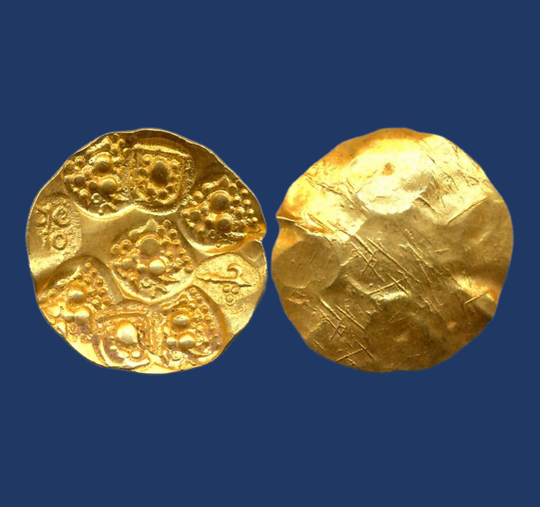
Debased Gold Dinara of Karakotaka King Vigraha
The Karakotakas/Karkota dynasty were a powerful Hindu dynasty that reigned over Kashmir for 230 long year - from approximately 625 to 855 CE. They presided over the Golden Age of Kashmir. The illustrious kings of the dynasty expanded their kingdom by military conquest and brought renewed prosperity to their kingdom. Their rule was marked by rich cultural flourishing, and building of grand temple renowned for impressive architecture.
The Karakotaka dynasty was founded by Durlabhavardhana who was also known as Prajnaditya, c.. ~625–661 CE. The name "Karkota" derives from this serpent lineage, common in Kashmiri lore, due to their association with Nagas.
More at... https://t.co/4LJQTKhsZZ
#CultureUnitesAll #coin #money #numismatic #12YearsOfVikasBhiVirasatBhi #ancientindia #LivingIndianHeritage
The Great Emperor Samudragupta (AD 344-378), has been referred to by historians as “Napoleon of India”.
I have thought about this label often, especially after the last book launch and feel it is time to revise this very old (colonial mindset) reference. Instead it would be more appropriate to refer to Napoleon as the Samudragupta of his times.
Attached is a Gold coin showing the King killing a Tiger with his bow and arrow and a page from the book -Treasures of the Gupta Empire) discussing this coin which was issued by a young Samudragupta while he was just starting to expand the Gupta Empire.
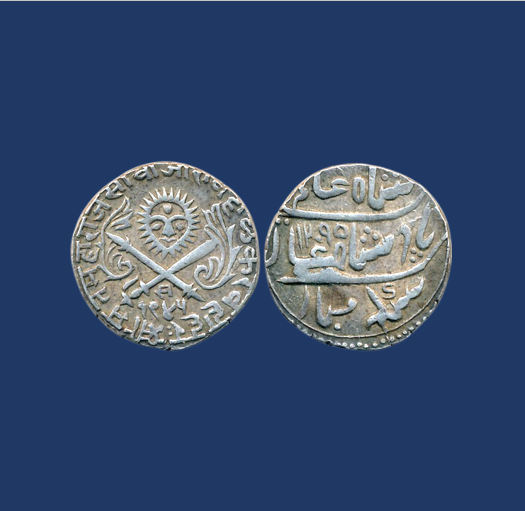
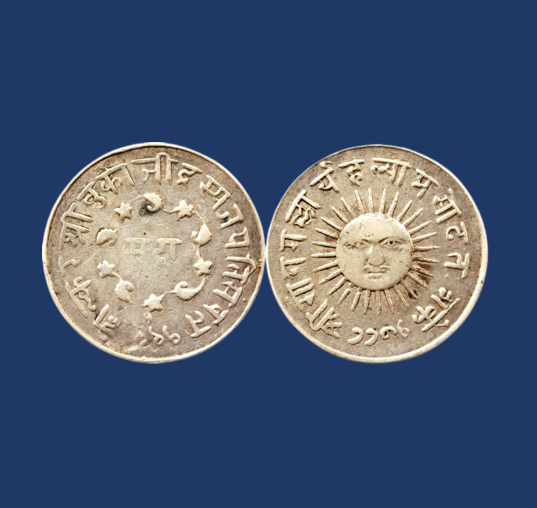
Indore King Shivaji Rao-III's Silver Rupee with Dual Date - FE and VS
Shivajirao Holkar - Shri Sir Shivaji Rao Holkar Bahadur XII was the Maharaja of Indore Holkar State from 1886 to 1903. He was the son of Tukojirao Holkar II.
Interestingly the above silver rupee depicts two different date system and dual script - devanagari and persian.
The obverse depicts sun in centre with legend in devanagari around and date in Vikram era Samvat 1945. The reverse mentions Fasli date 1295. To arrive at gregorian date from Vikram Samvat (VS) date, deduct 56 from VS date.
more at...
https://t.co/6jGm7pixSX
#coin #money #numismatics #indore #holkar #india
Nazarana Mudra of Indore Ruler Tukoji Rao II
Tukojirao Holkar II (Tukoji Rao II Holkar) was the Maharaja of Indore from 1844 to 1886. He belonged to the Maratha Holkar dynasty, which ruled the state of Indore in central India. The Holkars were of Dhangar = shepherd Maratha origin, traditionally linked to a village called Hol (or Hal) in Maharashtra near Jejuri, Pune district. The family name derives from "Hol-kar" (inhabitant of Hol). Malhar Rao Holkar, the founder, was born in 1693 (or 1694) in a Dhangar family. He rose through military service under Peshwa Baji Rao I.
more at...
https://t.co/igb6qriRsQ
#coin #money #numismatics #mudra #nazarana #indore #sun #india
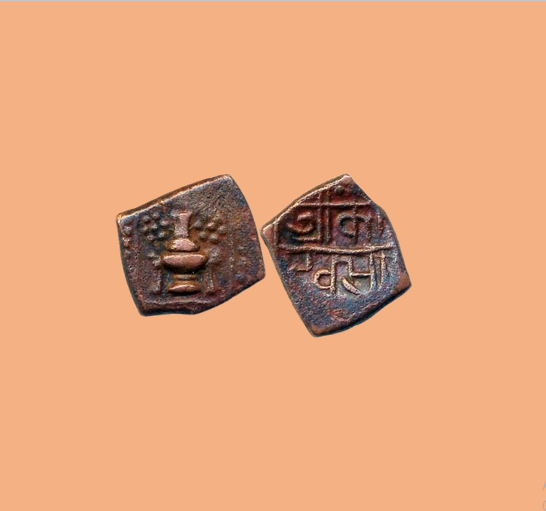
Karan Singh Waghela - His Copper Coin with Kumbha (Ghata)
2026-06-05 Fri
Karan Singh Waghela - c. 1296 – 1304 CE (also known as Karan Ghelo) remembered in Rajput and Gujarati history as a symbol of the last stand of Hindu Gujarat against the Delhi Sultanate’s expansion. He was brave in battle but ultimately unsuccessful due to internal weaknesses and superior invading forces.
more at...
https://t.co/1kC1fNMwD8
#coin #money #numismatics #medieval #india #gujarat #waghela
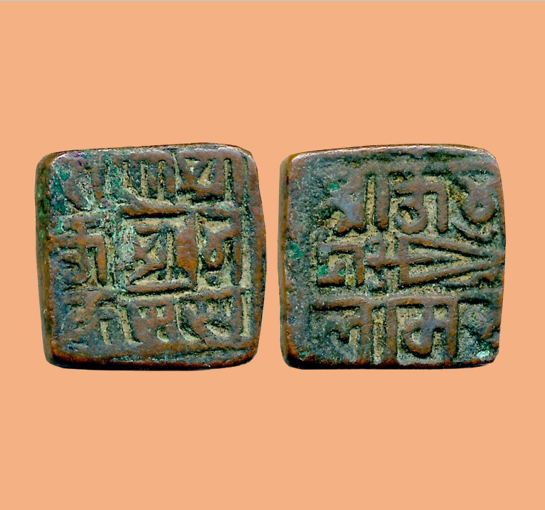
Mewar MahaRana Kumbha's Copper Coinage
Maharana of Mewar Kumbhakarna (c. 1417–1468 CE) was an illustrious warrior King. He was also known as Maharana Kumbha. He was from Sisodiya clan of Rajput dynasties of Mewar. He was not only a brilliant warrior, but also a strategist, a scholar, a musician, and a master builder who elevated Mewar to a position of major power in medieval India. Kumbhalgarh Fort built by him is a massive hilltop fortress with one of the world’s longest walls that is second only to the Great Wall of China. It is now a UNESCO World Heritage Site. Vijaya Stambha
the victory Tower at Chittorgarh was also built by him... more at...
https://t.co/ulwv6bsI3o
#coin #money #numismatics #medieval #india #mewar #rajput #kumbhalgarh #marwar #rajasthan #Maharana
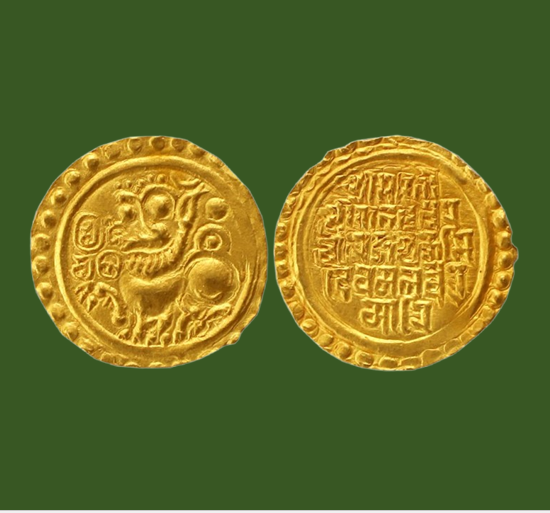
Gold Half Dinar of Chamhana Shakambhari King Vigraharaja Depicting Lord Rama
Chahamanas of Shakambhari refers to the prominent medieval Indian Chauhana dynasty, popularly known as the Chauhans of Sambhar or Chauhans of Ajmer. They ruled parts of present-day Rajasthan and adjacent areas from approx 6th to 12th centuries CE. Their original capital was Shakambhari and later Ajayameru = Ajmer.
Vigraharaja IV or Visaladeva (c. 1150-1164 CE) was known as a great Chauhana warrior, poet, and patron of arts. He expanded the kingdom of Shakambhari significantly and built structures like the Adhai Din Ka Jhonpra in Ajmer. He transformed the kingdom into a powerful empire through military conquests, cultural patronage, and resistance against invasions.
more at...
https://t.co/vecEY7XWZz
#coin #money #ancient #india #chauhan #shakambhari #ajmer #rajasthan
Kadambas of Goa - Gold Gadyana of Jayakeshi Deva
Kadambas of Goa were a prominent medieval dynasty that ruled Goa / parts of the Konkan coast from approximately c. 960 CE to 1340 CE. They were a branch of the ancient Kadamba dynasty of Banavasi of Karnataka. They are credited with making Goa a major maritime trading power and contributing significantly to its cultural and architectural heritage.
Kadmbas of Goa developed a strong navy and expanded maritime trade with regions like Zanzibar, Bengal, Gujarat, Sri Lanka, and beyond. They promoted Shaivism while also patronizing Jainism. They built impressive temples, including the famous Mahadev Temple at Tambdi Surla - 12th century, one of Goa's best-preserved ancient temples.
more at...
https://t.co/qCrfQLyqxL
#coin #money #numismatics #goa #Kadamba #gadyana #gold
Copper Punch Marked Coin of Satavahana King Satakarni - Vidisha Series
The Satavahana dynasty (c. late 2nd century BCE to early 3rd century CE) was an ancient Indian empire consisting of the area of Deccan region (Andhra Pradesh, Telangana, and Maharashtra), with the capitals at Pratishthana (Paithan of Maharashtra) and Amaravati (Dharanikota/Dhanyakataka of Andhra Pradesh). Under the rulers like Satakarni I, Satakarni II, and Gautamiputra Satakarni they extended control northward into parts of modern Madhya Pradesh (including the Malwa region), Gujarat, and Karnataka.
more at...
https://t.co/bOx06Lqjcc
#coin #money #numismatics #ancient #India #satavahana #vidisha #deccan