When the dream is gone, the only thing left is work.
The tyranny of routine.
The day-to-day grind of purposeless activity.
Around 600,000 businesses close their doors in the United States every year.
Tragically, those businesses become a mortuary for dead dreams.
Maturity is not an inevitable result of the Infancy and Adolescence phases of a business.
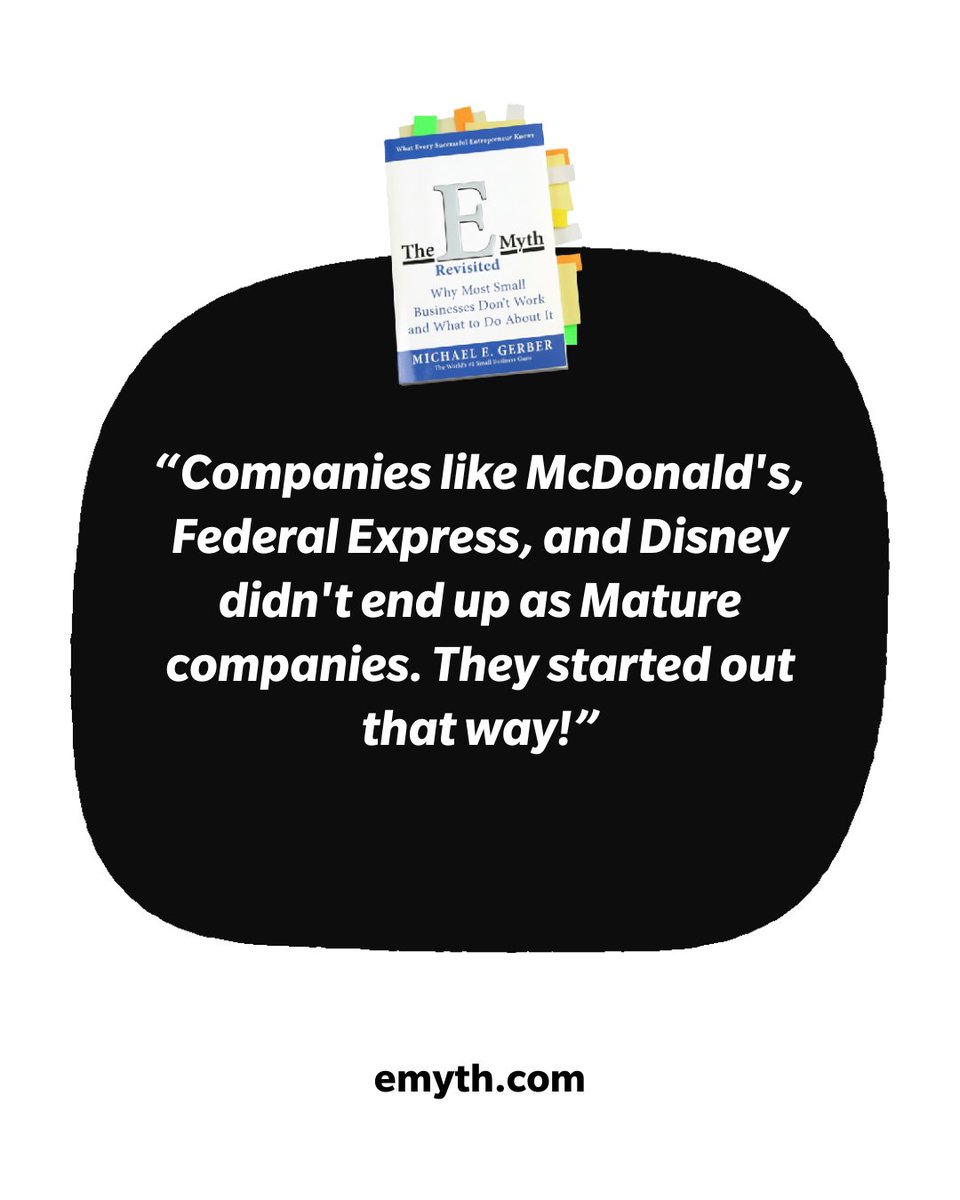
Companies like McDonald's, Federal Express and Disney didn't end up as Mature companies. They started out that way.
It's the Entrepreneurial Perspective that makes the difference.
Tom Watson Sr. said IBM succeeded for three reasons: First, he had a very clear picture of what the company would look like when it was done.
Second, he asked how a company like that would act.
Third, he acted that way from the very beginning.
Most businesses aren’t started by Entrepreneurs who risk capital for profit.
They’re started by Technicians under a Fatal Assumption:
“If I understand the technical work of a business, I understand a business that does that technical work.”
And, it’s just not true.
If you want your business to thrive, clarify how you want your life to look and, then, how your business needs to function to serve your life.
To serve your life, your business must be able to operate without you, with systems designed to produce results consistently.
Your business is a fully integrated system.
Everything affects everything else.
Your Primary Aim, Strategic Objective, Organizational Strategy, Management Strategy, People Strategy, Marketing Strategy and Systems Strategy are totally interdependent.
The process is dynamic because the world can’t tolerate a stationary object.
The world will collide with and destroy whatever you create that doesn’t evolve as the world evolves.
Innovation finds more effective ways by testing what works.
Quantification measures the results.
Orchestration documents what works for consistent, predictable results...until you find a better way.
Extraordinary businesses value all three.
Your People Strategy is how you communicate your Game Worth Playing to people from the start of your relationship with them.
The degree to which your people do things the way you want them done depends on how well you communicate the Game to them.
Most business owners stay stuck in Infancy.
They go out of business when demands become too much or limp along because they can't or won't change.
Those who work on their business not just in it lead it from infancy through adolescence to maturity.
Tactical Work is what Technicians do. Strategic Work is what Entrepreneurs and Managers do.
If your business is to thrive, you have to replace yourself in the Tactical Work so you're free to do the Strategic Work.
Building a business is a creative process of discovering what works for your customers, your team and yourself.
You can't build systems in a vacuum.
What works consistently can only be discovered through innovation, quantification and orchestration.
The same could be said for your employees.
If you want them to perform at their best, build a business that works, with predictability, and then support your employees in being exceptional at running your systems.
Most business owners abdicate accountability rather than delegate it.
Abdication is handing work to employees without systems or training—Management by Wishful Thinking.
Delegation is creating systems that reflect your values and setting employees up for success.
People buy to satisfy emotional needs: eliminating frustration or fulfilling a desire.
Noise-cancelling headphones eliminate discomfort.
Quality bedding enhances well-being.
Marketing starts with understanding the emotional needs your product satisfies.
The mature companies we see today got there because their founders had a clear vision of what the business would look like when it achieved their objectives, and operated daily as if it had already realized that vision.
Tom Watson Sr, IBM's first CEO in 1914, led for 42 years with a "people first" philosophy.
He paid well, trained extensively and built a strong corporate identity.
These became IBM's culture long before it became a great company.
When life matters more than business, you ask how to create a fulfilling life where business is a part but not the source.
There's a tragic cost to your customers, team, family and yourself in putting life in service of business rather than the other way around.
It's easy to get consumed by unexpected demands.
The result: a business taking over at your life's expense.
What if you put life first and built a business delivering exceptional customer experience and making the life you want possible?
The mature companies we see today got there because their founder went into business with a clear vision, a picture of what that business would look like when it had achieved the founder’s objectives and every day they operated as if the business had already realized that vision.