I am humbly begging people to stop acting like a drop in unintended pregnancies among teen girls is some great tragedy
Also to look at what the new NBER paper actually measured before making grand pronouncements about phones killing fertility.
The authors didn't measure how many people in their study areas actually had iPhones or whether birth rates actually dropped more among iPhone users. They just measured overall birth rates in areas with more or less AT&T mobile network coverage b/w 2007-2011.
There are *many* differences between places where mobile coverage was high and those where it wasn't. Are we really looking at iPhone effects, or just urban vs. rural fertility trends during the Great Recession?
And to whatever extent phones have contributed, it’s important to think about *how* they did so. People love blaming unhealthy porn & social media habits. What about phones spreading information & norms that empowered people — including those in isolated or highly religious or conservative countries and communities — to feel like they have more of a choice about when & whether to marry & have kids?
What about phones providing girls and very young women — among whom the birth rate drops were concentrated — with more access to and info about contraception?
Thank you @ENBrown for the insightful piece.
Like when I talked with the Times, we are now one step closer to giving more people a path to parenthood, and that definitely is something to celebrate.
A study that claimed a third of the birth rate decline was due to such-and-such individual thing was wrong and had bad methodology? What a shock.
Anyone who tells you the birth rate collapse is largely due to any single factor has an agenda to push.
@Nyadnar17 Yes, this 100 percent. It's the "well, everyone knows" phenomenon. No matter how much bad panic science is debunked, people will still tell you yes, but of course everyone knows cell phones are bad
I am humbly begging people to stop acting like a drop in unintended pregnancies among teen girls is some great tragedy
Also to look at what the new NBER paper actually measured before making grand pronouncements about phones killing fertility.
The authors didn't measure how many people in their study areas actually had iPhones or whether birth rates actually dropped more among iPhone users. They just measured overall birth rates in areas with more or less AT&T mobile network coverage b/w 2007-2011.
There are *many* differences between places where mobile coverage was high and those where it wasn't. Are we really looking at iPhone effects, or just urban vs. rural fertility trends during the Great Recession?
And to whatever extent phones have contributed, it’s important to think about *how* they did so. People love blaming unhealthy porn & social media habits. What about phones spreading information & norms that empowered people — including those in isolated or highly religious or conservative countries and communities — to feel like they have more of a choice about when & whether to marry & have kids?
What about phones providing girls and very young women — among whom the birth rate drops were concentrated — with more access to and info about contraception?
They say "the iPhone is estimated to account for 20–35% of the 2007–2011 decline in births to women aged 15–29," but Table 2 shows a t-stat of 14 across 3107 counties, which equates to a partial r of 0.24 and a r^2 of 6%. So, even if you take their model literally, the iphone explains 6% of the variation across countries, not 35%!
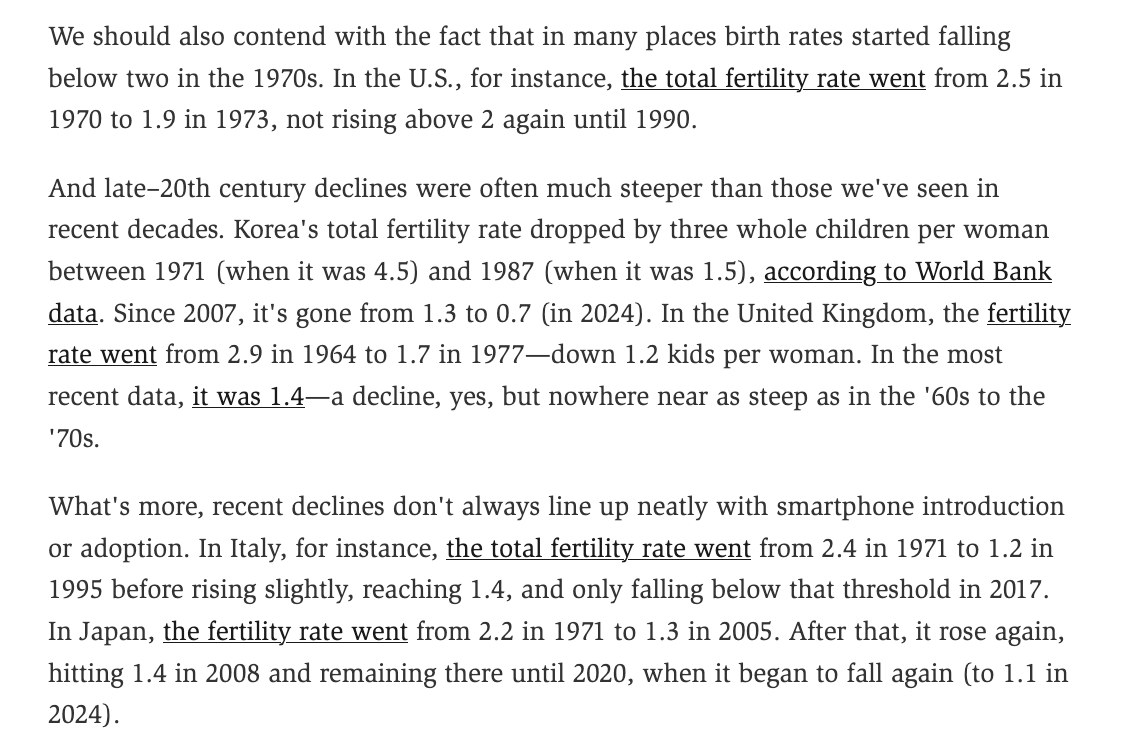
P.S. We should also keep in mind that fertility rate drops below 2 are not a super recent development in many places!
Many dips started in the 1960s and '70s and were much steeper late last century than post iPhone
@speakukorg and it all started with moral panic over porn and sex. nobody cared about government overreach when it came to sex workers, now people are getting arrested for their social media posts in the UK while porn is still accessible. insane. https://t.co/z5PIyMOqIE
Iran’s TFR is 1.3
This is an excellent example of why it’s wrong to look at conventional indicators of female empowerment - like female employment, attitudes or representation.
Even though Iranian women are highly unlikely to undertake paid work, many have still raised their aspirations and standards for marriage.
If women are free to choose, want more and men do not adapt, this creates a mismatch.
And that can occur in any society.
It wasn’t rare. High-end escorting has been a thing for as long as I can remember. You could find people who charged $72,000/weekend in NYC c. 2009.
Maybe there’s been inflation but the category has been around…
I see the idea of AI socialism is back in the news again today.
I’ll just reiterate what I’ve said here many times before: The idea of nationalizing AI – whether “hard” (complete govt ownership) or “soft” (equity stakes) nationalization – should be rejected in all its forms. It does not matter whether AI nationalization is being pitched by Bernie Sanders, national security hawks, or AI companies themselves – all flavors of AI socialism are poisonous and must be stopped.
Nationalizing AI, or even treating AI like a regulated monopoly or public utility, would have the same deleterious effects (and then some) that we have seen in countless other historical case studies. The entire history of nationalization and utility-style regulation is one of capture and cronyism, diminished innovation and consumer welfare, and censorial controls on speech in the case of information and communications technology (ICT) markets. Our nation would lose its competitive advantage in computation and algorithmic innovation if we took this disastrous path for AI. AI would become a Technology of Control instead of a Technology of Freedom.
Below you will find some journal articles and essays I’ve authored on the ugly history of soft nationalization and regulated utility economics and politics in the ICT policy world. We must not repeat this disastrous history with AI.
Refinery29's former fashion director is launching a new print magazine for teens, taking visual and editorial cues from '90s zines like Sassy and Tiger Beat. Drops this summer.✨
Sanders says he wants to "give the public a direct ownership" stake in AI companies, but that's just nice talk for "putting the government in control" of these companies.
The "American people" will not play a "direct role" in deciding AI futures, bureaucrats will
If this sounds familiar, it's because the Freedom Ship folks have been promoting this idea for three decades. Here's how their website looked in 1997: https://t.co/CubAk7KzRu (And that followed several similar ideas going back even further into the past: https://t.co/a7Bmcq52GU)