Two Raspberry Pis, one Ethernet cable. They can just talk… right?
Nope. That utterly fails.
Turns out "just talk" hides three very important questions. The first video from my little internet series gets that ping working, one layer at a time.
I have such _good feelings_ about the last month here at ngrok in particular, as complex and stressful as that has sometimes been. Had to sit and do quite a few Big Thoughts™ to find the way through.
Hoping for some quiet hours in the times to come so I can at least try to wrangle it into something I can say aloud.
The ngrok way is to teach people, as authentically and ambitiously as we can, about all the fascinating invisible layers between what we build and how we deploy them to the world.
So happy to have @samwhoo here making that idea a reality again and again and again.
What do a port of Kubernetes to TypeScript and a high-priority bug in the kubelet have in common? They both feature in @samwhoo's guide to probing, out now.
We're experimenting with what next-generation k8s education looks like, and we hope you love it.
Impossible to overstate how much of my soul is imbued into this post. I wanted to push the boundaries of the web as an education platform. Why _shouldn’t_ we run Kubernetes in the browser to demonstrate for-real what happens, and let you influence it?
Hope you love it. 🫶
The first part isn't very exciting: Every quarter gets an initiative, every content effort in that quarter is a project in said initiative with that writer/creator as the lead.
At ngrok every project lead has to write a weekly status update, so now the DevEd folks do, too. I find that's enough to keep me aware of who's working on what and how they're doing.
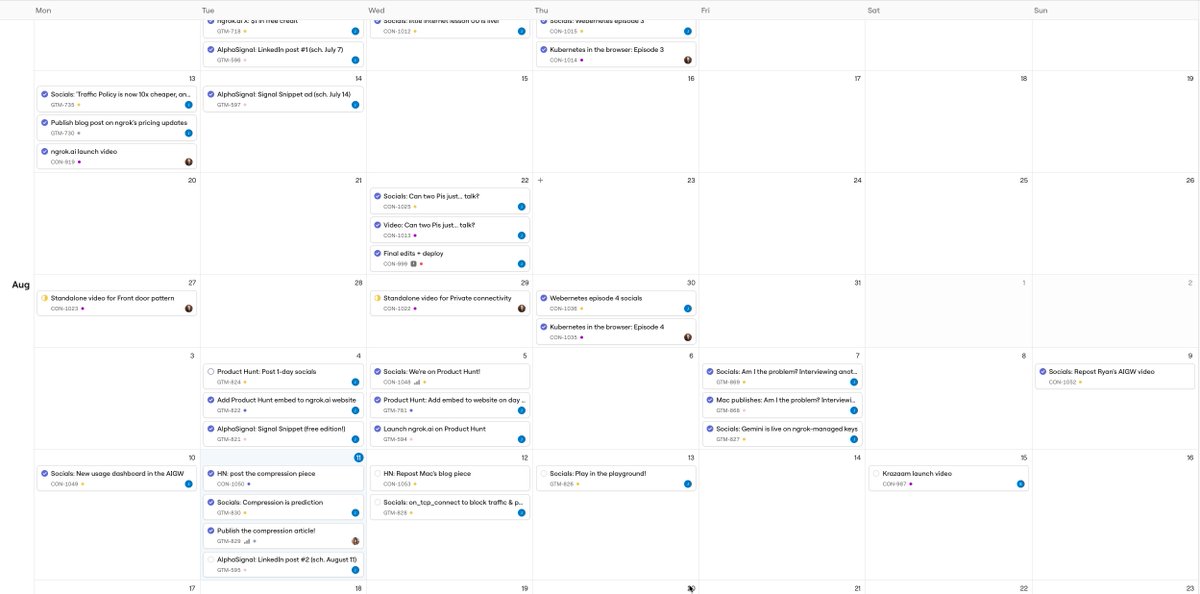
What really keeps me on track is the content calendar I built that uses the Linear API. It fetches issues from just the teams + tags I want and populates the calendar.
The setup is pretty hairy because I never expected anyone else would use it but me, but I would happily walk you through the details if you think you'd find it helpful: https://t.co/UlLMt5uEnb
The first of many future banger posts from Annie! I hope you'll read and learn as much as I have about the mystical layers of transforms, entropy coders, and beyond.
And the real cost, in bits, of getting the next prediction wrong.
Compression and LLMs are trying to solve the exact same problem: predicting what comes next.
@_anniebabannie_'s interactive essay walks us through the basics of compression to reveal its surprising overlap with every language model you've ever used.
Maybe my favorite part of my job is helping make delightful and delightfully weird projects like this happen. People make good shit when they have free reign and are having fun.
Mac Chaffee has argued with coworkers at every job they've had. So they interviewed our infra team about a contentious decision (adopt Argo Rollouts or build our own) to answer one question:
Am I the problem?
We let them publish whatever they found.
https://t.co/Iv2DCNOhC8
Fun fact: Earlier today I found a bunch of ngrok.com 404s that appear to be people copy+pasting links from agent output that are wonky or "polluted" with extra syntax-y bits, like:
/download** (betrayed by being bold!)
/download,
/download](https:/ngrok.com/download)
There's not a ton of volume behind these right now, but every one of them is a bummer for the user. I recommend folks check their own and see if you can't make your users' experience just one little bit better... even if you didn't create the problem.
Funner fact: Our ingress now regexes the heck out of these pollutants without affecting the actual routes. Turns out it's kinda nice being a gateway company when you have gateway-shaped problems.
This is now in the little internet repo.
A .scad file is the source of truth and GHA builds that into an .stl that's ready to print. I double-dog dare you.
https://t.co/SDONK184Xu
The little internet just got 100x cleaner. After a bit of a little prototyping I’m quite happy to say goodbye to all the awkward ways I was trying to tack down the OLEDs (as seen in the background).
The little internet just got 100x cleaner. After a bit of a little prototyping I’m quite happy to say goodbye to all the awkward ways I was trying to tack down the OLEDs (as seen in the background).
Two Raspberry Pis, one Ethernet cable. They can just talk… right?
Nope. That utterly fails.
Turns out "just talk" hides three very important questions. The first video from my little internet series gets that ping working, one layer at a time.
@SamCRichard Maybe alongside the second video I also make an add-on that walks through how to run it all? Obviously easier to run than buying the Pis and setting them up, but it's not exactly *simple*...
Got some more docs coming for this approach and we'll eventually start tearing down the veth lab I'd created initially. VMs all the way.
Then it's *finally* on to lesson 01, ft. the switch.
The little internet's VM lab got a dashboard.
Even though they're both pretend Pis, there's now a comfortable place to watch all the ARP-ness that happens when they find each other for the first time.
https://t.co/AOdE9Pw5WY
Kudos once again to @alarcritty!