Will Fable 5 be nerfed when it returns?
BridgeBench has every benchmark from the original June 12 Fable 5.
The moment access is restored, we are rerunning everything.
If the returning Fable 5 scores lower than the original, you will see it here first.
Independent benchmarks exist for exactly this moment.
Claude Fable 5 will be available again globally tomorrow.
After a series of productive conversations with the US government, we're redeploying the model with a new set of classifiers to target and block more cybersecurity tasks. In the near term, some routine tasks like coding and debugging will fall back to Opus 4.8. We’ll continue to refine these classifiers over the coming weeks to reduce false positives and better distinguish genuine misuse from legitimate requests.
We’ve also begun drafting a consensus framework—with Amazon, Microsoft, Google, and other Glasswing partners—for assessing the severity of AI jailbreaks and how AI developers should respond to them. We invite other industry partners and model providers to join us in this effort.
Finally, we’re scaling up our collaboration with the US government on model testing and safeguards. This will include pre-release access to models and safeguards for evaluation, information sharing on jailbreaks and misuse, and dedicated resources for joint research.
Thank you to our users for your patience, and to our partners across the government, industry, and the research community who worked alongside us to make Fable 5 available again.
Read our full blog: https://t.co/VHyum831ri
Since June 12, we’ve been working closely with the US government to restore access to Claude Mythos 5 and Fable 5. Today, the government notified us that Mythos 5, our strongest cybersecurity model, can be redeployed to a set of US organizations that operate and defend critical infrastructure.
We’re restoring access for these organizations quickly, and we’re continuing to work with the government to expand access to Mythos 5 and make Fable 5 available for general use again.
My thesis is:
If #Bitcoin holds the 200-Week MA and refuses to drop deeper, there's clearly not enough sell pressure despite:
- Iran war
- STRC Michael Saylor doomposting about FTX
- Outflows of the ETF
- Macroeconomic inflationary topics and no rate cuts
That's the sign that we're done already, and overall, the fact that many #Altcoins are showing resilience for the past month is a great sign in the first place.
Everything is going exactly as I told you.
Now Bitcoin is sitting at the level where bull traps end.
$59K → $65K → $62K → $55K → $47K → $200K
Next stops:
→ Dump to $55K (happening)
→ Market cycle bottom at $47K (next)
Reminder: I’ve called all the market tops and bottoms for the last 15 years, including the Bitcoin bottom at $16,000 and the top at $126,000.
The next call will be even more important. I’ll post it here publicly like I always do.
Turn notifications on. If you’re not following yet, you’ll understand why that was a mistake later.
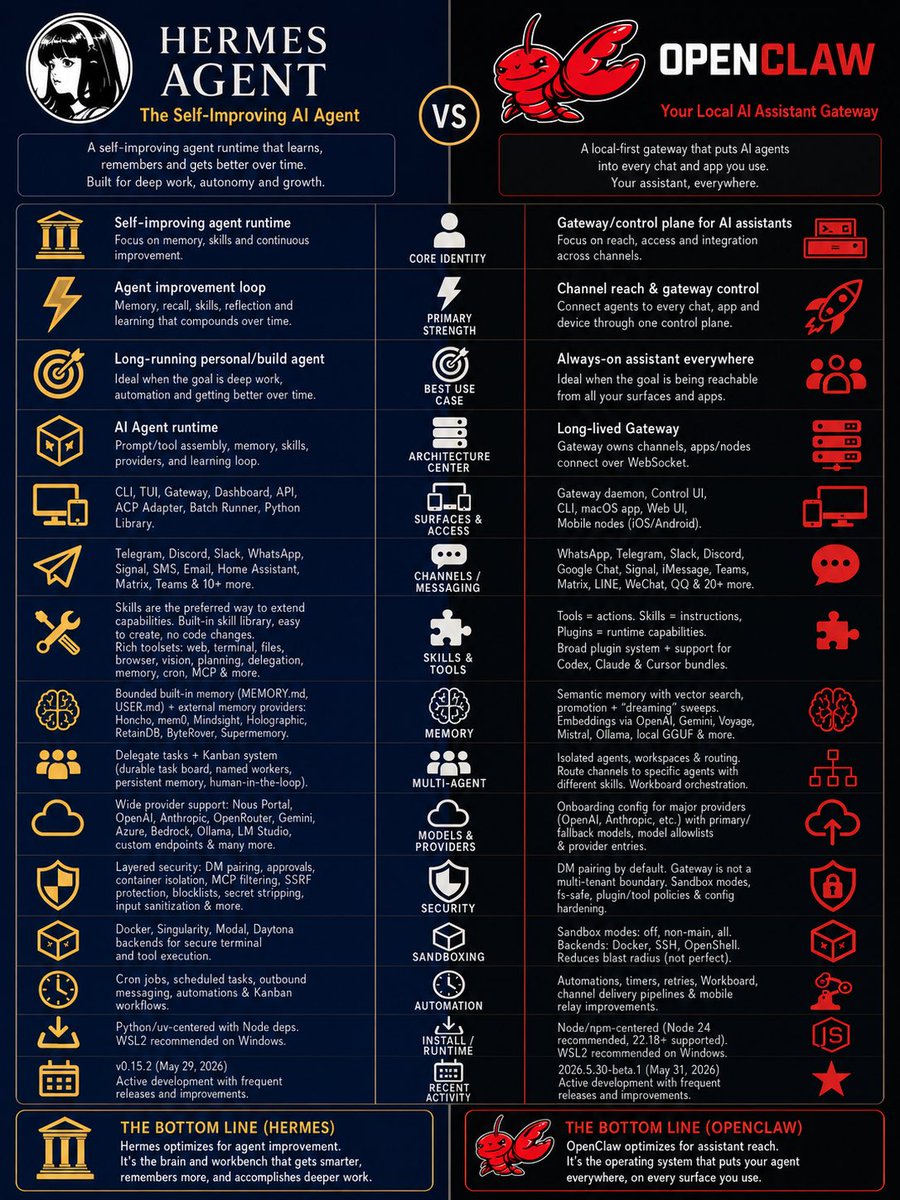
People are arguing Hermes vs OpenClaw like it’s Coke vs Pepsi.
It’s not.
🦞 OpenClaw is a gateway.
⚕️ Hermes is a self-improving agent runtime.
🦞 One is trying to put an assistant everywhere.
⚕️ The other is trying to make the assistant actually get better.
I don’t need my agent in 87 places if it still needs babysitting.
Give me memory, skills, Kanban, cron, delegation, and a learning loop.
Give me Hermes.
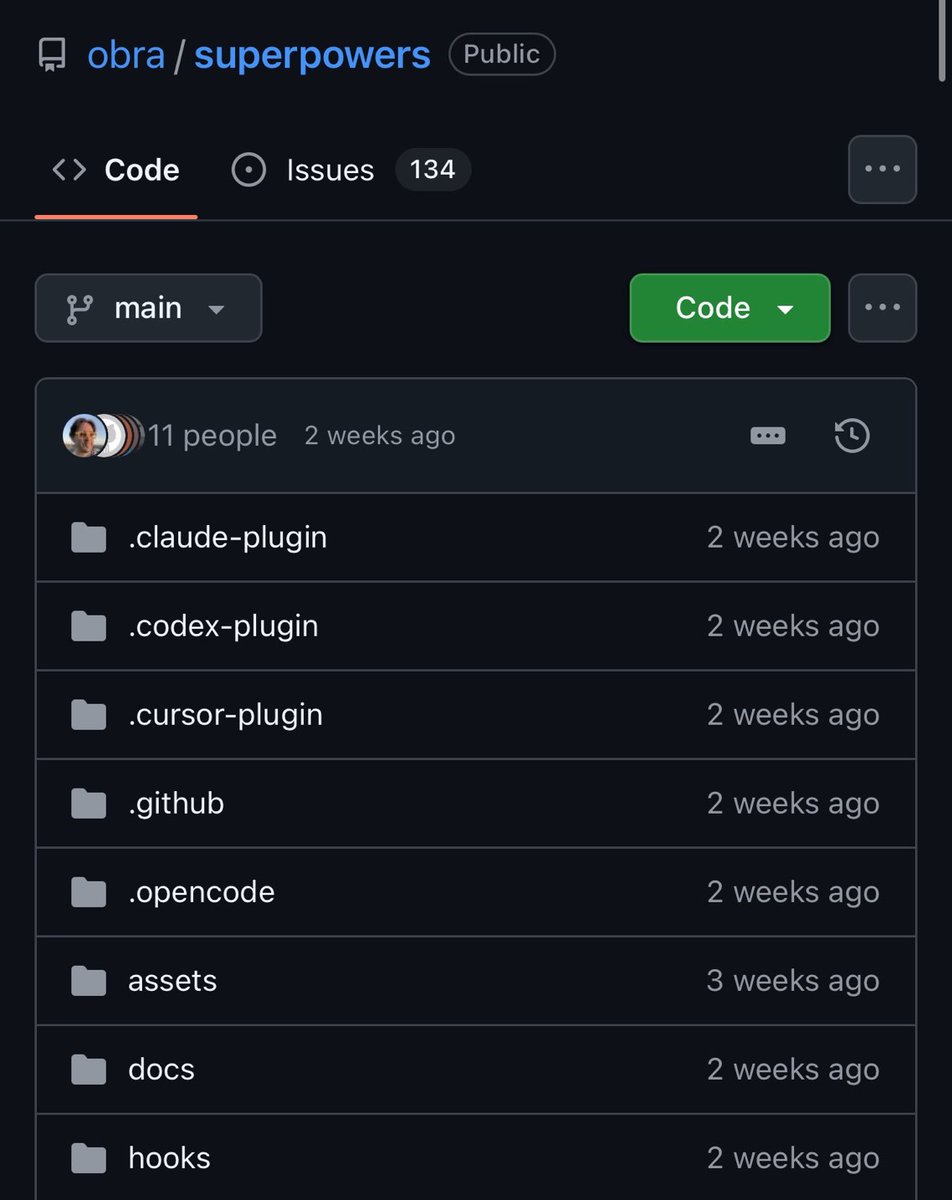
Acaban de convertir Claude Code, Codex y Cursor en un senior developer real.
Gratis.
Se llama Superpowers y ya tiene 204.000 estrellas en GitHub.
El problema con los agentes a partir de cierto tamaño de proyecto es siempre el mismo:
Van directo al código.
Debuggean a ciegas.
Abandonan los tests.
Y cuando el proyecto crece, empiezan a alucinar.
Superpowers lo resuelve forzando el proceso de un ingeniero senior:
→ Brainstorming siempre antes de escribir una sola línea
→ TDD red/green sin excepciones (borra el código si no hay test previo)
→ Subagentes en paralelo con git worktrees aislados
→ Contexto bajo control durante horas de trabajo autónomo
El flujo ya no es "prompt → código → rezar":
Brainstorm → Spec → Plan → TDD → Subagentes → Review → Ship
Cero código antes de tener tests pasando.
Compatible con Claude Code, Codex, Cursor, Gemini CLI, OpenCode y Copilot CLI.
100% open source. Licencia MIT.
Ya no escribes prompts a ciegas.
Tu agente trabaja como un senior.
Os dejo el link de la repo aquí ⬇️
Here's how to build a free AI agent team on your laptop in under an hour. 👇
No subscriptions. No expensive hardware. No code.
Step 1 → Install Hermes Agent OS (the dashboard)
Step 2 → Plug in free Claude Code via Open Router
Step 3 → Add the new Anti-Gravity 2.0 CLI from Google
Step 4 → Wire in Obsidian as your shared memory vault
Step 5 → Drop in Hyperframes for free AI video generation
That's it.
A Mac Mini with 16GB RAM runs the whole stack.
Save this post, you'll come back to it. 💾
Want the SOP? DM me.
Claude Code suddenly makes WAY more sense after installing this official Anthropic plugin 🤯
It reads your entire project and instantly tells you what you should actually enable, use, and configure.
The crazy part?
Most people using Claude Code don’t even know this exists.
→ Detects your stack automatically
→ Understands your codebase structure
→ Suggests the right workflows
→ Removes the confusing setup phase
→ Makes Claude Code feel 10x smarter
This is probably the real onboarding Claude Code needed 🔥
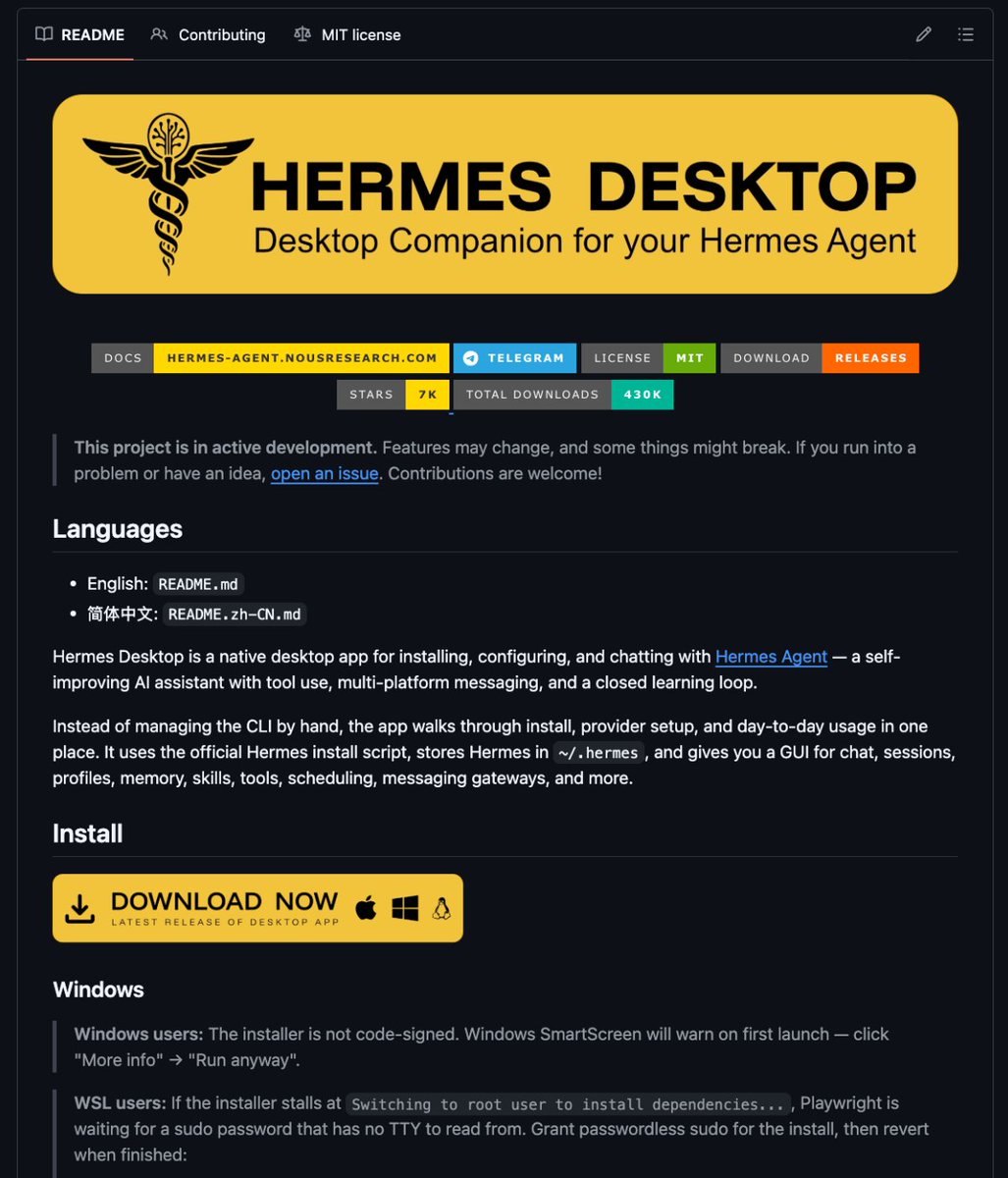
This open-source app turns Hermes Agent into something normal people can actually use.
It’s called Hermes Desktop.
Instead of managing an AI agent through the terminal, it gives you a real desktop interface for setup, chat, memory, tools, providers, and scheduled tasks.
Basically:
Hermes Agent = powerful brain
Hermes Desktop = control room
What it gives you:
• One place to install Hermes
• Provider setup
• Chat sessions
• Profile switching
• Memory management
• Skills
• Tools
• Scheduling
• Messaging gateways
• Logs
• Backups
Most AI agents are impressive on GitHub but annoying in real life.
They hide state in files.
Break quietly.
Force you into terminals.
Make simple things feel technical.
Hermes Desktop fixes the interface problem.
This is what open-source agents need more of.
GitHub: https://t.co/iHR9kQNJq1
Folks: when you write skills, ask your agent to be token efficient, relax grammer. I see too many skills that write books in the skill description, and all that crap is loaded into every context.
I wrote a skill that finds the worst offenders. https://t.co/kfaaJpxMXE
Claude Code can now self-improve with this plugin.
Introducing claude-smart — an open-source plugin that helps Claude Code learn from every session.
Memory helps Claude Code remember what happened.
claude-smart helps Claude Code improve what it does next.
Example:
Claude Code runs `npm test` without `--run`, and the command hangs in your repo.
Memory stores:
“npm test kept hanging.”
claude-smart learns:
“When running tests in this repo, use `npm test -- --run` because default watch mode hangs.”
claude-smart’s learnings are reusable and actionable, even across different projects.
It can also reduce unnecessary planning iterations and token use by 70%+ on similar future tasks.
Runs locally. 100% open source. No data is shared.
Install:
npx claude-smart install
With Codex:
npx claude-smart install --host codex
GitHub:
https://t.co/D4F0v5FnGk
Take a break from telling God everything that’s wrong. He already knows your needs. There’s nothing wrong with asking, but at some point, you need to switch over to thanking Him for what He’s promised.
So San Francisco. An @openclaw run vending machine.
Met @cvander who built it.
At @frontiertower which is a high rise in San Francisco stuffed with startups.