Why I’m becoming even more bullish on Ethereum:
A lot of the garbage L2s are dying off, projects like Abstract and Blast shutting down.
The lesson is simple: just build on Ethereum mainnet.
Stop spinning up unnecessary chains designed to extract value from your own community.
Once a year, the Ethereum ecosystem gets a physical address.
This year, it’s Mumbai. 🇮🇳
For four days, we'll all be in one place—the builders, researchers, and communities from around the world developing Ethereum and putting it to work.
Devcon 8. November 3–6.
At SMB, we build skilled active bionic discretionary traders- equities, options, some futures.
What does that mean?
It is not enough for our traders to be right on direction. Ex. SPCX is going to 160. Direction: SPCX is going higher.
SMB traders must also be right about timing. Ex. SPCX will reach 160 by EOD. We spot a setup and confirmation on the tape that allows us to time our trades. Timing: SPCX will be 160 by EOD.
But there is more.
SMB traders must be right about direction and timing, and also stay within their stop loss. Ex. My stop loss for SPCX is below 150. If your stop loss is hit, it doesn't matter where the stock goes after for that particular trade. Stop loss: 149.99 SPCX.
Skilled active bionic discretionary traders must be right about direction, time, and stop loss.
Ex. If SPCX hits 149.99 and then trades to 160 by EOD you have made a losing trade.
Ex. If SPCX closes negative by EOD, then you have made a losing trade.
Ex. If SPCX closes negative by EOD, but is 165 on Friday then you have made a losing trade.
This is the challenge for skilled active bionic discretionary traders.
#proptrading #trader #proptrader
“Don’t be a hero. Don’t have an ego. Always question yourself and your ability. Don’t ever feel that you are very good. The second you do, you are dead.” Paul Tudor Jones
I’ve been asked a lot: Why is Midnight live on only one market? why can’t Morpho Vaults allocate to it yet? why only one chain? Answers below:
1. Vaults
Morpho Vaults hold ~$5B in deposits but can only deposit in Blue markets, not Midnight markets yet.
Enabling vaults to allocate to Midnight takes one tx from the DAO, but opens the door to significant capital entering a protocol that launched just a few weeks ago.
We want curators and users to become familiar with Midnight, and give the ecosystem time to develop the tooling needed to support those allocations.
→ Expect Vault activation Q4.
2. More Chains & Markets
The initial deployment gives us a focused environment to observe behaviors, improve the experience, and prepare for broader adoption.
→ Expect Ethereum in the coming days, with more chains to follow.
→ Expect a few more markets next week, followed shortly by all Morpho Blue markets.
3. More Features
What launched onchain is the Midnight core contract. The app, SDK, API, and supporting contracts will progressively expose more of its capabilities.
We’ve already shipped Lend Callbacks and Secondary. Many (many) more functionality will follow, including support for bespoke offers, multi-collateral, rolling, rehypothecation, receivables, undercollat, etc…
4. But preserving a slow pace matters
Midnight introduces a new completely new lending paradigm. Its flexibility creates new amazing possibilities, and the ecosystem needs time to understand them and build the tooling, bots, and data infrastructure around them.
We’ve shipped multiple protocols over the years. One lesson has remained constant: there is no shortcut to security.
We want everything live, everywhere, as much as you do. But each step should give us the confidence to take the next, appreciate your patience!
STOP SETTING SMALL TRADING GOALS!
Want to know the most dangerous mistake ambitious developing traders make when setting career goals?
Hint: It isn’t aiming too high. It’s setting the bar way too low.
Let me share a story from our prop desk.
During a recent monthly review with Team Max, one of our traders announced his numbers: he pulled in $1 million in net trading profits in August.
When he first sat on the desk, his lifelong dream was to make $1 million in a year. Last month, he did it in 21 trading days.
Max had an even better month, and I wanted to get his reaction to his monster performance.
After the meeting, I reached out to Max directly on Gchat:
Me: "You ever think when you were starting you would make 2m plus in a month?"
Max: "Def not lol"
A couple of years back, we actually kicked around the idea of publicly tracking Max for the trading community to see if he could break $1M in a month. At the time, he hadn't broken this level yet. We ended up scrapping the project as we were worried it would focus on the wrong things. Fast forward to today: Max cleared over a couple of million dollars last month alone and is heading into his second consecutive 8-figure year. For him now, a million-dollar month isn't even close to the benchmark he aims for.
Yet during that exact same review, a couple of our younger traders who made solid six figures were lamenting their month. They felt dejected comparing their numbers to the seven-figure producers on the desk. Three years into their careers, an outcome that would stun 99% of independent traders felt unsatisfying to them.
That psychology reveals a critical truth about trader development:
Arbitrary P&L Goals are Self-limiting: When you fixate on a dollar target early in your career, you anchor your ceiling to who you are today—with your current limited skills, risk tolerance, and PlayBook.
The Process Multiplier: When you double down and triple down on your daily process, build technology, trade alongside elite traders, collaborate, and push size on your A+ setups, your growth becomes exponential. Your early career goals end up looking comically small in the rearview mirror.
Happy, But Never Satisfied: As Chris Mullin, former NBA Hall-of-Famer, used to say, and as we preach to our desk constantly. Even after pulling millions out of the market, this desk spent the meeting dissecting where they left money on the table: leaving 25% on the Bitcoin breakout, breaking down what worked on MRNA, and focusing on pumping the brakes during low-opportunity tape.
Trading can be a tough game at the start, but the upside is limitless when you stop capping your potential.
Don't let arbitrary dollar targets limit what you can accomplish. Double down on your process, surround yourself with peers who raise your standards, pump the brakes during slow markets, and aggressively press your A+ setups.
Your ceiling is far higher than your wildest imagination.
#Trading #DayTrading #SMBCapital #PropTrading #TradingPsychology
It’s summer. People are away, attention is elsewhere, and most people aren’t thinking much about crypto right now.
Honestly, I think that’s a good thing.
If you’re still here, paying attention and slowly accumulating, you’re already ahead of the crowd.
The next few months could be a great time to DCA and position yourself before the next bull run really gets going.
Because once the market starts moving, people will come back. They’ll start paying attention again when Bitcoin is at $80K, $100K or higher, and suddenly everyone will want exposure.
I also think the next cycle has some pretty big things working in its favor:
• Regulatory clarity with the CLARITY Act
• Tokenization of real-world assets
• Growing stablecoin adoption
• AI agents and the AI economy
• Potential capital flows from the AI boom into crypto
Crypto is becoming much more connected to the rest of the financial system and the broader technology landscape.
I don’t know exactly when the next bull run starts, or how high it goes.
But I do think the setup could be very different from the last cycle.
And I wouldn’t be surprised if the next one ends up being much bigger.
For me, the strategy is simple: stay patient, keep accumulating, and be positioned before the crowd comes back.
Dr Profit said it loud and clear
Called the dump before it appeared
The candles turned red, the margin ran dry
They ask "wen pump?" with a tear in the eye
Loved this interview with @ChrisCamillo. He shares my view that markets in recent years have become LESS efficient, not MORE efficient like most would suspect.
Even better is hearing about his views on philanthropy & involvement with @BeastPhilanthr! Respect 🤜🤛
Some of my perspective on where the @ethereumfndn is going.
First of all, this is only my own view. The board is not just me, and I have no extra special powers on the board that the other board members do not. @aerugoettinea is the one executing much of this transition. My input has been largely on technical questions. The board is in the process of expanding, and my own power within the org will continue to decrease, which is honestly what I want.
The 2025 era brought many important improvements to EF and its ability to execute. Many issues were resolved, and EF continues to benefit from its improved efficiency and greater focus on concrete goals to this day. And so with those problems resolved, early this year, the largest remaining hole that I perceived was something different nagging at me: I would regularly spot people saying things like "vitalik says these beautiful things about ethereum needing to be decentralized, and have privacy, and be a sanctuary technology, but why do the EF's actions not reflect that?"
Now, you may have been hearing something different. You may not have been sensing a feeling of crisis at all, and maybe were hearing people saying that finally we were taking execution and BD seriously and the main task for us is to keep going that way and be even better and faster. Then probably there is genuine difference between you and me, in what kinds of criticism I take most seriously, and what kinds of critics through their criticism are most able to make me feel pain.
As an analogy, let's briefly switch over to a different domain.
One belief you can have about Google is that it is a success story, and has brought a lot of good to humanity in organizing the world's information. Another belief you can have about Google is that they had a beautiful idealistic beginning, but at some point the corruption of mainstream corporate attitudes seeped in, and they slowly bit by bit completely abandoned the "don't be evil" slogan.
My belief on Google specifically is probably somewhere between the two. BUT, if you had taken me back in time to ~2008, and offered me a button to press to make Google one or two standard deviations more "dogmatic", eg. give Richard Stallman permanent veto power over some key policies, I would immediately press it.
Why? Because a choice for one company is not a choice for the world, or even one country. Google existed and exists in the context of a technology industry generally drifting away from early idealistic don't-be-evil roots and toward greed for financial gain, totalizing visions of accelerated superintelligence, infiltration by sociopaths, and craven capitulation to (or worse, active participation in) government pressure for ideological control, surveillance and war. And so *one company* doing something different, positioning itself to be what George Bernard Shaw calls the Unreasonable Man, resisting the trend of the times, would have been better for freedom, balance of power and stability of society as a whole, than *all* large companies bending to dominant trends. This is a part of my version of pluralism.
This line of thinking is not just mine, but I also is not too far off from what Aya and others had in mind with the Mandate.
Now how does this all get to the role of the EF?
EF is not a "center of Ethereum", rather EF is "one node, with a defined purpose, alongside other nodes". We've always said that the EF should be the latter, but many in the Ethereum ecosystem (and even within the EF) wanted us to be the former. Now, we are taking action to ensure that we will be the latter.
This is particularly important because EF is a limited organization, with limited resources and limited organizational capacity. The EF has only ~0.16% of all ETH (less than many other individual ETH holders), whereas among other blockchains it's common for "the central foundation" to have 10-50%. Fiscally, the EF was originally designed to fulfill a limited work scope defined in the token sale docs and other pre-launch materials (building the chain software; getting through Frontier, Homestead, Metropolis, Serenity), which was fully completed in 2022; it was not designed to be an eternal steward.
And so today, the EF is choosing to use its remaining resources to pursue longevity over breadth (yes, this means we sell less ETH). The EF focuses *specifically* on those activities critical to the success of ethereum as a censorship/capture-resistant, open, private and secure system, that would not happen otherwise. This means making hard choices, and in some cases even activities that we highly approve of and people that we highly respect becoming outside of the EF. People of great technical talent, public respect and even alignment with the mission and CROPS being outside of the EF is in fact necessary if we want important tasks to be able to attract outside capital. This also means the EF taking opinionated stands culturally.
This is all intended in cooperation with all other parts of ethereum. We recognize that many other parts of the ethereum world highly respect CROPS and related values. But highly respecting is not the same as choosing to specialize and totally dedicate to a domain (Compare in a different domain: I think reducing animal cruelty is important, and I like vegan food, but am not full unconditional vegan myself)
EF is still in a transition period, and we expect its new long-term form to stabilize over the next few months. What are the guiding principles of this new form? Again, I am only one person, but I can give my answer from a technical perspective (there are also critical non-technical aspects).
At the core, *Ethereum must be impressive*. We are living in an age of highly intelligent AI and all kinds of other technological acceleration. "Status quo EVM, with a hard fork or two a year to optimize for short-term needs of users" is not interesting.
To some, "impressive" means: 250ms latency and 1M TPS. I think Ethereum trying to go that route is a mistake. Being as fast and as scalable as possible, and only a small epsilon more decentralized than the others, is a route to mediocrity, and if we try it we will lose.
I think Ethereum should scale. But I think Ethereum should strive the hardest to be deeply impressive in a different dimension: the CROPS dimension. This means things like:
* Provably bug-free Ethereum. This is a goal that all cybersecurity researchers would have thought is absurd and impossible, up until roughly 6 months ago. Now, it's on the cusp of being possible, thanks to AI-assisted formal verification. So we should be frontrunners in doing this.
* Available chain consensus. Ethereum is, and with lean consensus will cotninue to be, the ONLY chain that has both (i) traditional-BFT style properties that it's safe under asynchrony up to a high level of fault tolerance, and (ii) the bitcoin PoW-style property that under synchrony it's safe up to 49% attackers. As far as I can tell, literally no other chain has this or is planning for it; bitcoin goes for (ii) only and most other chains go for (i) only. Some will remember I fought hard for this, Unreasonably insisting that it is not OK for ethereum to rely on social consensus and hard forks to rescue ethereum from 34% of nodes going offline. It's OK for chains like hyperledger, bnb, solana, tempo, etc. It's not OK for bitcoin or ethereum or eg. zcash.
* Intermediary minimization. The fact that smart contract wallets, protocols like railgun, etc have to send transactions through intermediaries to get included onchain is honestly embarrassing, and it's a constant point of fragility. Hence the work on FOCIL and EIP-8141 (and 7701 and years of work before) to make transaction sending intermediary-minimized with public mempool and strong inclusion properties, in a truly general-purpose way, that covers not just eg. secp256r1, but also privacy protocols and much more. Kohaku is pushing intermediary minimization at the user layer, pulling Ethereum away from the dystopian status quo world where our wallets don't even verify the chain, send our private data out to a dozen third-party servers, and toward a brighter CROPS future.
Some of these goals are Unreasonable - maybe Ethereum would be "fine" getting only 50% of the way - what if we depend on intermediaries, but make it easy to switch? But going 50% of the way would not make Ethereum Deeply Impressive in the CROPS way. So we push for 100%.
Fortunately all these goals are compatible with high TPS, this is a major focus of research (esp. on scaling the state). Well-designed L2s can also help, especially L2s optimized for specific applications (eg. high-volume trading, privacy...). These goals are even compatible with significantly lower slot times, thanks to Raul's work on erasure-coded P2P, and many other optimizations.
The most high-value "product" of the ethereum blockchain, financially speaking, is ETH the asset. Ethereum secures $250 billion of ETH. The types of properties of Ethereum that I mentioned above are very good for ETH the asset. Nearly 90% of my net worth is in ETH, and most of the remainder is ~$40m of onchain fiat of which every dollar has already been allocated for some open-source biotech or software or hardware initiative. That said, there are aspects of supporting ETH the asset - *necessary* aspects even - that are outside the scope of the EF. This is where we need other heroes (some of whom hold more ETH than the EF does) to step in and help. EF has been recently thinking more about how it will relate to other such organizations, and give them needed initial support.
EF will be a smaller ship than in previous years, a more opinionated one - in some cases more opinionated in ways that might be difficult to comprehend - but a longer-lasting one, and one suited to making sure that ethereum brings something meaningful to the world. We are grateful to all those inside and outside the EF who are helping to make this happen.
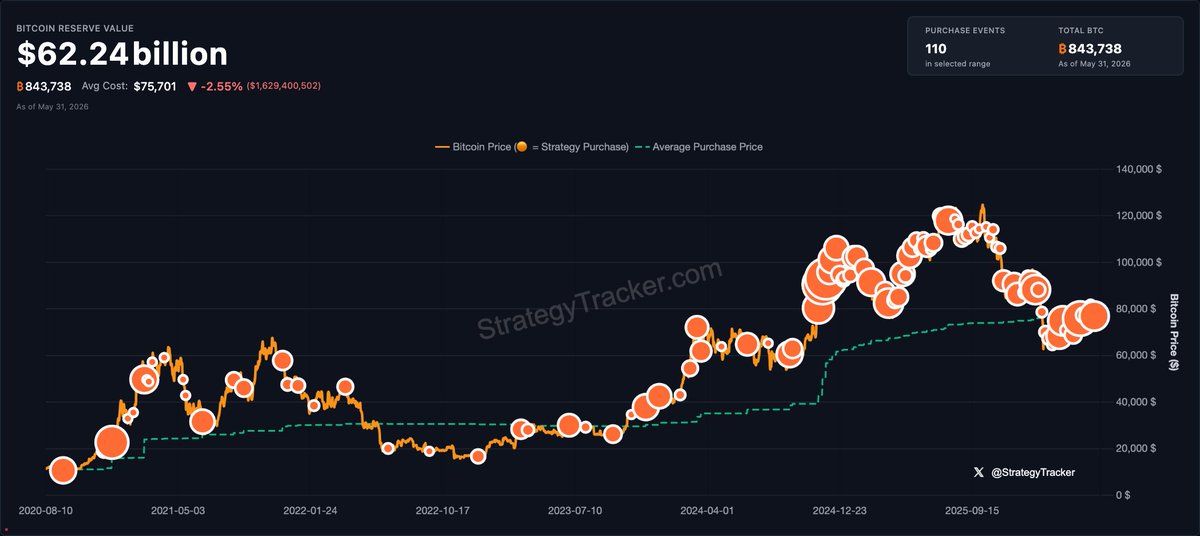
Strategy has acquired 24,869 BTC for ~$2.01 billion at ~$80,985 per bitcoin and has achieved BTC Yield of 12.6% YTD 2026. As of 5/17/2026, we hodl 843,738 $BTC acquired for ~$63.87 billion at ~$75,700 per bitcoin. $MSTR $STRC https://t.co/y1zvePEuym