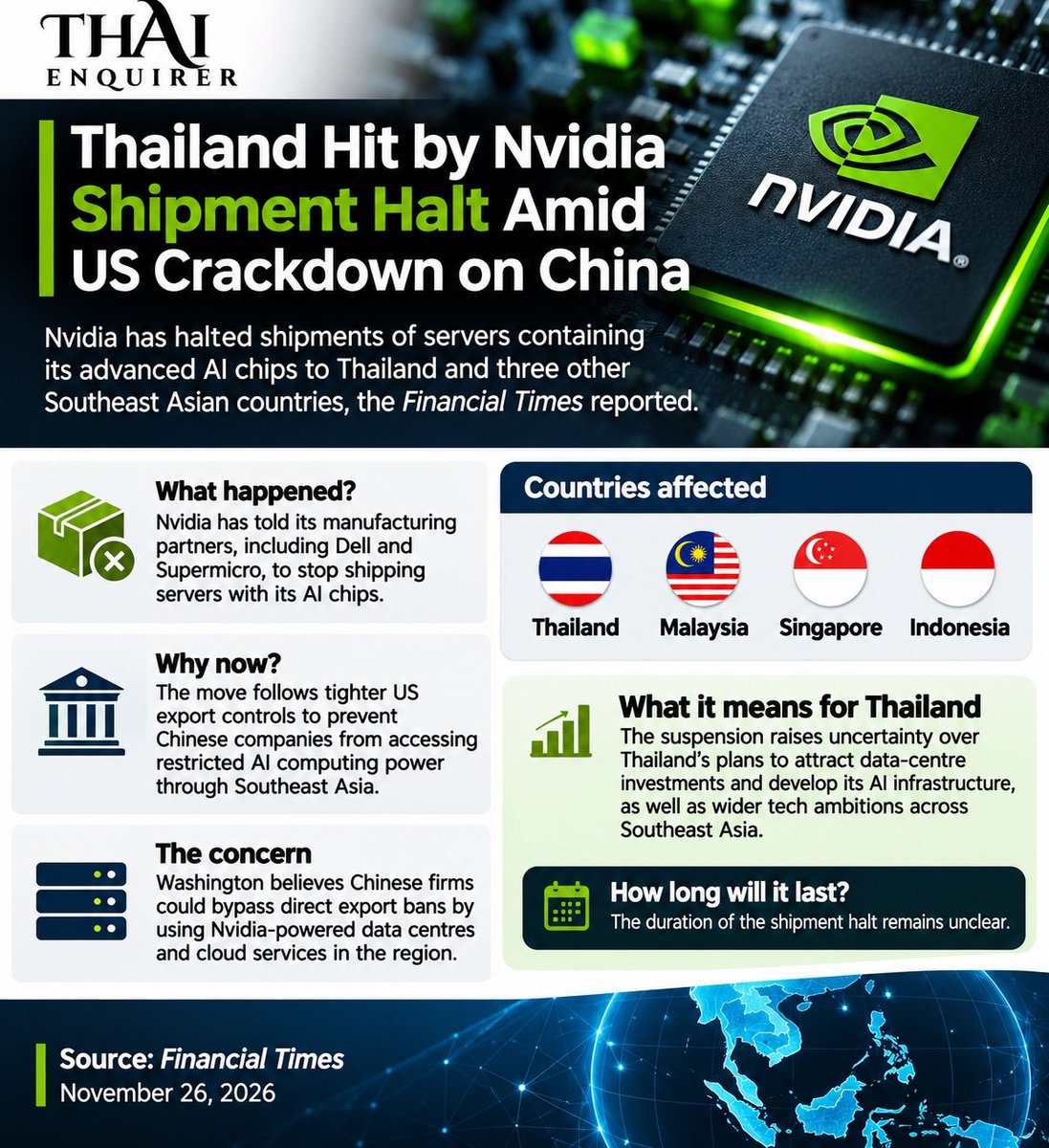
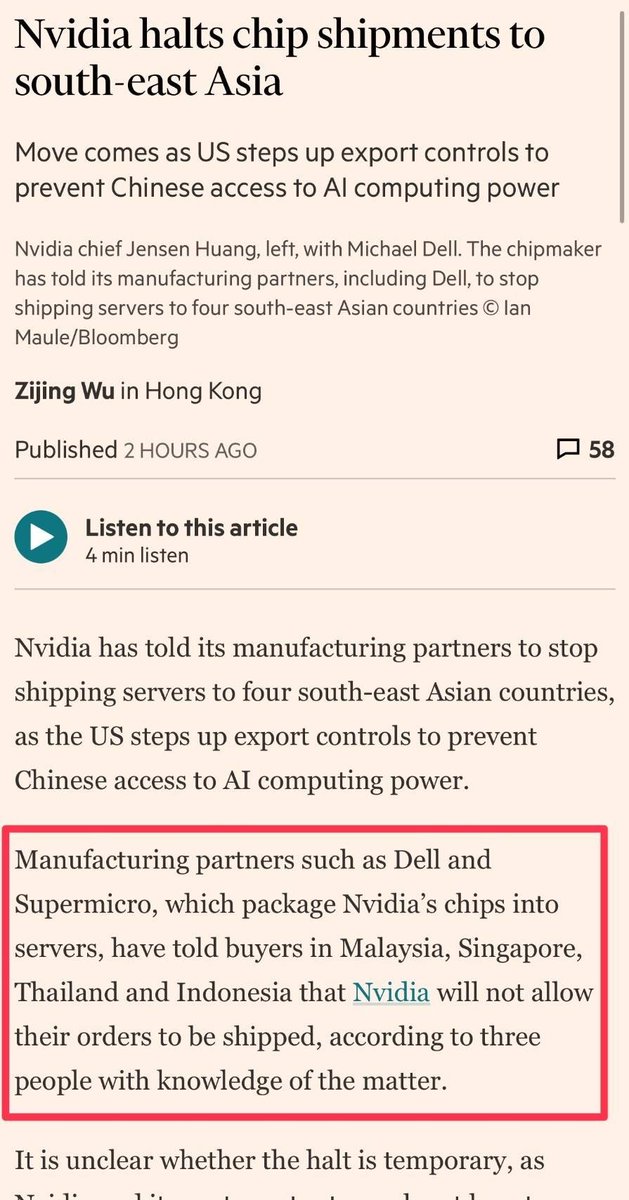
Thai buyers waiting for servers built with Nvidia chips have been told their orders cannot ship, the Financial Times reported.
The newspaper said Dell and Supermicro had also notified customers in Malaysia, Singapore and Indonesia. It remains unclear when deliveries could resume.
Thailand’s Commerce Ministry had warned before US chip controls took effect on 19 November that difficulty obtaining advanced processors could affect plans to build or expand data centres.
#Trade
Read more: https://t.co/uBTZVkrUlE
Sino-Thai Engineering and Construction won at least 48 Thai government contracts worth more than 40.1 billion baht from fiscal 2015 to fiscal 2026. Prime Minister Anutin Charnvirakul’s son and daughter own C.T. Venture, which holds 19.62% of Sino-Thai’s parent company, Stecon Group, making it the largest shareholder.
Sino-Thai’s recent contracts include a 1.48-billion-baht project to extend Chumphon Airport’s runway and expand its taxiway and aircraft apron. Asked on 24 November about the company’s recent government contracts, Anutin said he knew nothing about them and told reporters to ask the shareholders.
At the time of reporting, none of the companies named had faced a complaint over the procurement in question. This information is published solely in the public interest.
#SinoThai #AnutinCharnvirakul #PublicProcurement #TheNationThailand #TheNation
https://t.co/wK5ebDs1hb
Thailand Among Four Southeast Asian Countries Hit by Nvidia Chip Shipment Halt
Nvidia has halted shipments of servers containing its advanced AI chips to Thailand, Malaysia, Singapore and Indonesia, instructing manufacturing partners Dell and Supermicro to stop fulfilling orders the Financial Times reported today.
The move follows tighter US export controls aimed at preventing China from accessing restricted AI computing technology through Southeast Asian data centres. Washington fears Chinese companies are circumventing direct export restrictions by accessing Nvidia-powered computing capacity in the region.
The suspension raises uncertainty over Thailand’s ambitions to attract data-centre investments and develop its AI infrastructure, as well as the wider technology ambitions of Southeast Asia.
#thailand #nvidia #chips #semiconductor #china #singapore #indonesia #malaysia
I haven’t posted on X in a while, so this update is a little overdue. I defended my PhD at MIT in May and joined the Tesla Optimus team in August.
I now get to apply what I learned during my PhD at the intersection of machine learning, physics simulation, and sim-to-real transfer to humanoid robotics. It’s a field I’m deeply excited about, with so many challenging problems still to solve.
A few months in, one of the most rewarding parts has been working with a team that thinks from first principles, takes on ambitious problems, and moves fast. I feel very lucky to have landed my dream job.
BREAKING: Lukashenka suggests giving Russia back to Mongolia — by Putin's own logic
The Belarusian dictator commented on the Kremlin's historical arguments used to justify its territorial claims against Ukraine.
According to him, if territories are considered Russian simply because they once belonged to Russia, then perhaps it's worth looking a little further back in history.
“Russian lands once belonged to the Mongols and Tatars. Remember? Then we'd have to give all of Russia back to Mongolia,” Lukashenka said.
He added that Putin understands this perfectly well.
We agree. It's about time Mongolia started making territorial claims against Russia 😂
Trump’s USTR proposed new Section 301 tariff of up to 18% on Thai exports to USA
The Office of the US Trade Representative (USTR) announced on November 25, 2026, that it has concluded investigations into 14 economies over what it describes as structural excess industrial capacity, determining that their policies and practices burden or restrict US commerce.
Thailand faces proposed additional tariffs of up to 18%, alongside Malaysia, Indonesia, Cambodia and Bangladesh. Other proposed rates include China at 20%, the EU, Japan, South Korea, Taiwan and Switzerland at 15%, while Vietnam faces up to 35% and India up to 25%, with lower rates possible under negotiated trade arrangements.
This comes just days after Thailand’s Prime Minister Anutin Charnvirakul and US President Donald Trump singed off a Joint Statement on the Agreement on Reciprocal Trade (ART) ‘deal’ on November 17, 2026, in Manila, Philippines.
Under the Section 301 for Thailand, the key provisions are:
• The proposed 18% tariff is calculated net of existing Section 301 tariffs and will not simply be added to the existing 12.5% forced-labour-related tariff. Under the Thai article’s explanation, affected products would move from 12.5% to 18%, rather than 30.5%.
• The exemption list contains 2,121 product categories, compared with 2,120 under the previous measure. More than half of Thailand’s exports to the US by value are reportedly covered by exemptions.
• Exempted products include computers, servers, hard drives, data storage equipment and various computer components associated with AI and data-centre investment, as well as certain agricultural and food products.
• Important Thai exports, including rice, canned tuna, shrimp and pet food, are not currently included in the exemption list.
The USTR proposal also takes into account existing Section 301 and Section 232 duties, ongoing consultations with Thailand and commitments under the Framework for an Agreement between the US and Thailand on Reciprocal Trade.
The proposal is not yet final and tariffs are not being collected under this new measure at this stage.
USTR will accept written comments until January 5, 2027, with public hearings beginning January 25, 2027.
Economists view that the 2 potential consequences could be of a narrowing of Thailand’s tariff advantage over China could affect the competitiveness of Thai exports, while reducing the incentive for Chinese manufacturers to relocate production to Thailand.
Details of the announcement - https://t.co/Gqaq8GtmCr
#thailand #usa #trade #trump #anutin #ustr #china