Join Mark Berggren and Javier Ortiz, alongside other industry experts at the EA | MMSA International Methanol Conference 2026 (IMC 26), as they take a hard look at where methanol markets find themselves as 2026 draws to a close.
After months of subdued demand, squeezed margins, trade dislocation and persistent geopolitical tensions, our speakers will cut through the noise, assessing Middle East methanol supply, Europe's outlook, and the broader fallout from continued disruption of flows via the Strait of Hormuz.
Join us in Singapore, 3–5 November 2026, for the EA | MMSA International Methanol Conference 2026, bringing together the global methanol community for three days of expert insight, discussion and networking.
Secure your ticket: https://t.co/VLaGLXASmm
#IMC26 #Methanol #EnergyAspects
Europe Gas is now on EA Live!
Whether you’re at your desk or on the move, EA Live delivers sharp, timely market updates that help you assess developments quickly and act with confidence.
With Europe Gas EA Live, you will get:
- Rapid market insights that cut through the noise
- Timely updates on balances, data releases, long-term contract changes and policy shifts
- Expert analysis from our global team, tracking how worldwide developments hit European gas fundamentals
See EA Live for yourself – Request a trial: https://t.co/z70GpyBsUJ
#EnergyAspects #NaturalGas #EnergyMarkets
The Hormuz disruption has hit 100 days, and the resilience keeping energy markets afloat are starting to show cracks. In the latest EA Market Sparks, we assess what this means for oil, gas and the broader macro picture.
- China's role as global market solver may diminish. Beijing's aggressive response has bought the market time — but as refinery runs recover over the summer, this support will begin to ebb.
- US oil inventories are running dangerously low. PADD 3 stocks are on track to hit critical levels by end-August, and the government may need to act ahead of 4 July to avert a stockout.
- Macro resilience is limiting the Fed's options. May payrolls smashed estimates, leaving new Fed Chair Warsh little room to turn dovish.
Read the latest EA Market Sparks and subscribe for trusted insight into what comes next. https://t.co/9CevAuigQt
#EnergyAspects #EnergyMarkets #Hormuz
How quickly can you tell whether an LNG outage really changes the balance?
Energy Aspects’ new LNG Intelligence service, powered by @Kayrros, is built to answer that faster. By combining satellite and remote-sensing inputs with feed gas, flaring and shipping data, it gives analysts and data teams a timely plant-level view of global LNG supply.
Alongside real-time alerts, the service also offers historical context and forward-looking visibility.
Key features:
- 98% detection of outages and restarts.
- <20 hours average time to alert users to a new outage.
- 10+ years of historical train-level outage data.
- 18-month maintenance forecast horizon.
Headlines can flag disruption. The harder part is understanding scale, duration and market impact. This service is designed to help with exactly that.
Learn more about LNG Intelligence here: https://t.co/KfR2kFz7P9
#EnergyAspects #LNG #EO
"The infrastructure boom in terms of infrastructure work arounds has already started… In addition to just pipelines rerouting around that vital strait, we're also seeing tank additions."
Energy Aspects Global Crude Lead, Jeremy Irwin, joined @BNNBloomberg to discuss the oil markets, including:
- Infrastructure changes starting in the Middle East.
- Strategies from key Asian importers dealing with supply losses.
- Saudi price cuts amid disruption.
Watch Jeremy's interview here - https://t.co/2nLm8c9YVX
#EnergyAspects #Crude #OOTT
Earlier this week, Energy Aspects' Head of Upstream, Valeria Daza Cajigal, was honoured to speak at the 19th Technical Meeting of OPEC and Non-OPEC Countries Participating in the Charter of Cooperation.
Valeria discussed recent market developments and their impact on the short- and medium-term outlook for non-DoC liquids production, with a main focus on the crude production outlook for Brazil and Argentina.
#EnergyAspects #OPEC #OilMarkets
#Highlights of the 19th Technical Meeting of OPEC and non-OPEC countries participating in the Charter of Cooperation (CoC) held on 1 June 2026 in Vienna, Austria.
New from Energy Aspects: Crude Oil Inventories, powered by @Kayrros.
For anyone building crude balances, stock change is often where uncertainty creeps in. This new service helps reduce that noise with measured inventory data across the global storage system, giving analysts and data teams a stronger basis for balances, back-testing and regime analysis.
What sets it apart:
- 5.8bn barrels of storage capacity tracked.
- 92% of existing onshore crude storage covered.
- 13,000+ tanks across 1,000+ locations.
- 8+ years of point-in-time, back-testable history.
- 99% accuracy against SAR benchmarks.
Public data can be delayed, selective and revision-prone. This service is designed to improve coverage, speed and stability, without forcing the usual trade-offs.
Learn more about Crude Oil Inventories here: https://t.co/2SvUfWjacP
#EnergyAspects #Oil #Crude #EO
It has been a fantastic week at #Posidonia2026, with Energy Aspects' Maritime Analytics experts getting the opportunity to meet industry participants and discuss the latest energy and shipping market trends.
A key theme has been the reshaping of markets on the back of geopolitics, Middle East tensions and Hormuz disruption, keeping freight firm on rerouted, longer-haul flows, pushing owners toward longer-term charters to hedge the volatility ahead, and driving ship-ordering to multi-year highs even as energy security eclipses decarbonisation.
It's been a pleasure discussing how Energy Aspects helps clients navigate market disruption, including through our enhanced Maritime Analytics offering, which brings Cargo Tracking and Freight Analytics together on one platform.
Beyond Posidonia, our Athens office hosts a large team of analytics experts year-round, open to anyone who'd like to stop by for a live demo.
#Posidonia2026 #EnergyAspects #Freight #CargoTracking #Maritime
Will the EU-UK summit in July mark the start of a unified European carbon market?
The two sides are close to confirming ETS linkage, which would make allowances fungible across both systems and create the largest compliance carbon market outside China. UKA prices have already surged close to 5% on the news, but the full convergence with EUAs will take years.
We assess what the timeline looks like, why UK political uncertainty is a risk worth monitoring and how EU ETS reform proposals could reshape the price outlook before linkage even takes effect.
Read more: https://t.co/WewtdAzcec
#EnergyAspects #Emissions #CarbonTrading
Diesel is the pinch point. Hormuz is only part of the story. And equity markets may be missing the bigger repricing ahead.
In the latest EA Forum podcast, @ea_amrita and @CommodMkt unpack one of the biggest market dislocations in energy and commodities right now.
Key takeaways:
- The market is still conflating a deficit with a shortage and until that shifts, prices may not fully reflect the underlying reality.
- Even if the Strait of Hormuz reopened tomorrow, long-dated oil still needs to reprice on the structural set-up.
- Jeff argues this could be the biggest repricing opportunity across the commodity complex.
- Meanwhile, equity markets are in “la la land”, having repriced the energy halo lower while overlooking the broader hard asset story.
- Diesel remains the critical pinch point, with implications that feed through the entire system.
Watch the full episode now: https://t.co/fi9ii0WEwR
Recorded on 8 May, this episode features Energy Aspects Founder and Director of Market Intelligence Dr Amrita Sen and Jeff Currie, Co-Chair at Abaxx Exchange, Co-Founder of 1947 Oil & Gas Plc and Non-executive Director at Energy Aspects.
EA Forum brings together leading voices in global commodities and macroeconomics, offering unique perspectives and in-depth analysis from both EA and external experts.
#EnergyAspects #EAForum #EnergyMarkets
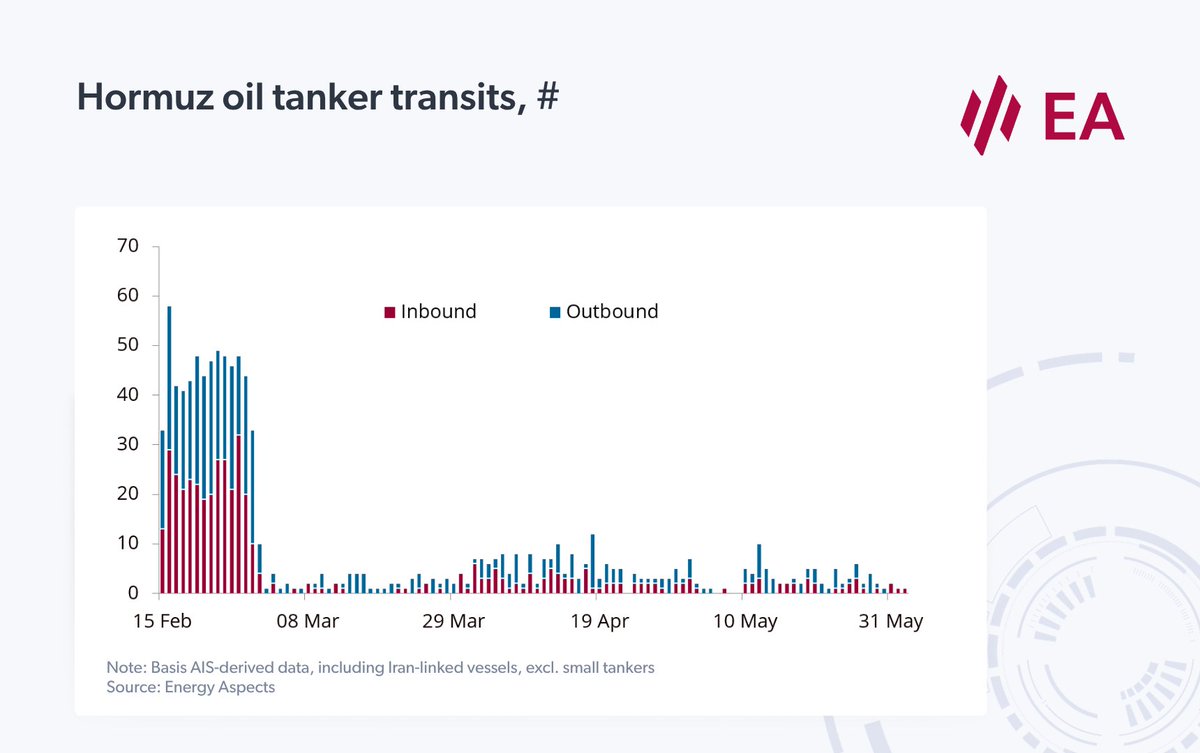
EA Maritime Analytics data show fewer than 50 laden non-Iranian tankers (excluding small tankers) have transited the Strait of Hormuz throughout May, amounting to less than one-tenth of pre-conflict flows of 20 mb/d.
An estimated 99 mb of crude and 37 mb of oil products remain on vessels within the strait as of 2 June, based on the latest available AIS update.
Even if a US–Iran MoU is signed, mine clearance, shipper confidence and vessel repositioning will take months. Isolated transits do not constitute a recovery in flows, the operational barriers remain substantial.
Read more: https://t.co/MFuoowuUoi
#EnergyAspects #Hormuz #Maritime #Crude
"We are looking at the biggest disruption in history when it comes to energy markets, we've got over 11 million barrels per day of production shut-ins in the Middle East".
Energy Aspects Founder and Director of Market Intelligence, @ea_amrita, joined @MackenzieInvest Get Sharpe podcast recently to discuss the ongoing disruption of the Strait of Hormuz and its effect on energy markets.
Amrita explains why physical cargo markets are trading ten to fifty dollars above published crude benchmarks, what that divergence means for gasoline, diesel, jet fuel, and LNG, and why a reopening of the strait would not restore flows anywhere near pre-conflict levels.
Listen to the podcast here.
Spotify: https://t.co/wYLYp5mhFx
Apple: https://t.co/Rl9J8JEwad
#EnergyAspects #OOTT #Hormuz #EnergyMarkets
Physical markets are suggesting weak demand. Our latest high-frequency work suggests the market may be reading the signal incorrectly.
Using EA proprietary trucking indices and @Kayrros’ high-frequency consumption data, we see little clear evidence of a meaningful drop in end-user demand. What looks like weak demand in April and May appears, in large part, to be destocking driven by extreme backwardation.
This is exactly where high-frequency data proves its value. Public data and market chatter may reflect sentiment, but they do not reliably distinguish between genuine demand destruction and inventory adjustment. Our new Middle East regional aggregate trucking index helps close that gap, leading diesel demand by around a month and offering an early signal on the direction of demand.
With Kayrros now part of Energy Aspects, we are strengthening our ability to track oil demand in near real time and identify turning points earlier.
Read the full insight to see what the current data is really saying. https://t.co/tJmzAoO0KN
#EnergyAspects #HighFrequencyData #Diesel
Will you be attending #Posidonia2026?
With the ongoing conflict in the Middle East and disruption in the Strait of Hormuz, the global energy and shipping industry is facing unprecedented challenges, making this year's Posidonia one not to miss.
Energy Aspects experts Giorgos Beleris, Anastasia Zania and Ranjith Raja will be in Athens for Posidonia next week to discuss the latest challenges and market trends.
Please reach out to Giorgos, Anastasia, or Ranjith if you would like to connect at Posidonia or get a live demo of EA's enhanced Maritime Analytics in our Athens office, which brings Cargo Tracking and Freight Analytics together on one platform.
We look forward to seeing you there!
#EnergyAspects #Freight #CargoTracking #Maritime
"We very much believe that the world is in a deficit right now. We are losing over a billion barrels of oil and it’s going to be needed"
Energy Aspects Founder and Director of Market Intelligence, @ea_amrita, joined @CNBCi recently as part of a #CNBCExplains on 'Why the UAE walked away from OPEC'. Amrita discusses:
- OPEC members raising production.
- Infrastructure damage across the Middle East.
- OPEC’s role in market stability.
- A global oil market still in deficit.
Watch Amrita from 5:30 here: https://t.co/NqlN9ffZoI
#EnergyAspects #OPEC #Oil #OOTT
LNG and regional gas markets are being shaped in real-time by supply side shocks, weather risk and inter-regional competition and marginal cargoes. Public data tells part of the story. It rarely gives you a complete market view.
The current Iran situation is also a reminder that geopolitical events can quickly affect gas and LNG pricing through risk sentiment, shipping concerns and cross-commodity spillover.
Energy Aspects’ Core Data service helps gas market participants make commercial decisions with greater clarity. It combines robust market data with analyst judgement so traders, analysts, portfolio managers and risk teams can work from a more coherent picture of supply, demand and pricing risk.
Explore more about Energy Aspects' Core data: https://t.co/NdfXx0SM4H
#EnergyAspects #Data #LNG #NaturalGas
Energy Aspects' Maritime Analytics is live: the next evolution of our Cargo Tracking service!
We have expanded our Cargo Tracking service to bring Freight Analytics into the same platform.
Why does that matter? Because vessel positions alone do not give you enough. Commercial decisions depend on knowing what’s actually loading, where it’s heading, and how freight is shaping the trade.
Maritime Analytics gives you:
- Near real-time cargo tracking across crude, products and LNG.
- Forward-looking flows nowcasts by origin and destination.
- Freight rate forecasts by route and vessel class.
- Fixture and loading pace metrics.
- Floating storage, oil-in-transit and voyage destination analytics.
Accessible via platform, API, Excel Add-in and Snowflake. Start your 2-week trial here: https://t.co/MymmSi6hsz
#EnergyAspects #Maritime #CargoTracking #Freight
Amrita Sen of Energy Aspects of says oil markets are in a "massive deficit," but not a shortage yet.
She is also worried because an anticipated reopening date for the Strait of Hormuz keeps getting pushed out https://t.co/Ol3PYYQhhf