The Gulf states have accelerated their search for new air-defence systems after suffering from thousands of Iranian missile and UAV attacks.
South Korea, Ukraine, the United Kingdom and the United States are among those countries that have been approached by Gulf states interested in near-term acquisitions, which include interceptor missiles, interceptor UAVs, point-defence systems, radar and surface-to-air missile systems.
➡️ Read the full analysis by @albert_vidal_: https://t.co/Wu0TiYr1oo
NEW: Iranian drone and missile strikes on Kuwaiti infrastructure, including Kuwait International Airport, killed one individual and injured at least 63 others. Iran’s attack on Kuwait is one of the largest attacks that Iran has conducted since the ceasefire went into effect in April. Iran claimed that it conducted the strikes in response to the United States’ enforcement of its blockade on Iranian ports and US self-defense strikes against Iran.
US forces disabled the Botswana-flagged M/T Lexie as it was transiting toward Kharg Island, which houses Iran’s largest oil export terminal, on June 2. US CENTCOM said that US forces fired a Hellfire missile at Lexie’s engine room after the vessel ignored repeated warnings from CENTCOM.
CENTCOM also announced that US forces shot down three Iranian drones that were targeting civilian mariners and struck a ground control station on Qeshm Island. Iran has repeatedly used force, including attacks on commercial vessels, to coerce vessels to comply with Iran’s transit protocols and use Iran’s illegal traffic separation scheme in the Strait of Hormuz.
Iranian forces subsequently attacked both Kuwait and Bahrain, which Iran claimed played a “direct and clear” role in the US strikes. CENTCOM stated that US and Bahraini air defenses intercepted three Iranian missiles launched at Bahrain. The Kuwait Army announced that it had intercepted 13 Iranian ballistic missiles and 17 Iranian drones.
Kuwait summoned Iran’s interim charge d’affaires and declared two Iranian diplomats persona non grata in response to the attack. An adviser to the Emirati president separately called on Gulf states to adopt a “firm, unified, and cohesive” stance against Iran. The adviser emphasized that Iranian “aggression does not target a specific state, but rather all of us.”
ISW-CTP will provide further analysis about the Iranian strikes on Kuwait and Bahrain in its June 3 update.
South Korea Aims to Triple Oil Imports from Canada This Year
South Korea will seek to more than triple crude oil imports from Canada to 16m barrels this year, from 4.88m barrels in 2025, with a goal of increasing shipments to as much as 20m barrels in the coming years, South Korea’s Industry Ministry said. (Bloomberg)
Another day, another clash in the gulf:
A. Without a deal, friction inevitably drives escalation.
B. In an environment already marked by high tensions, escalation can become uncontrolled, even when neither side actively seeks a broader conflict.
C. Iran continues to operate within its established deterrence framework, but recent statements by senior officials, including Mohsen Rezaei, suggest that the scope of potential retaliation may be expanding. This time, references have reportedly included the U.S. Fifth Fleet headquarters in Bahrain.
D. Through its actions, Iran is signaling that it will not allow a return to the previous status quo in the Gulf. From Tehran’s perspective, the regional landscape has changed, and any attempt to restore the old order will be challenged.
E. The continuation of the blockade creates an inherently unstable situation. Such a reality is difficult to sustain indefinitely without a direct confrontation at sea. As encounters between the parties become more frequent, the likelihood increases that an Iranian response will be more forceful and consequential.
Bottom line: another day, another incident, another round of restraint. But this pattern is unlikely to remain sustainable for long. The risk is not necessarily deliberate escalation, it is miscalculation, followed by a cycle of action and reaction that neither side initially intended.
#iran
#IranWar
The state of the Mideast war:
• Iran targeted Kuwait & Bahrain
• Kuwait suspended flights after airport damage
• The US hit Qeshm Island
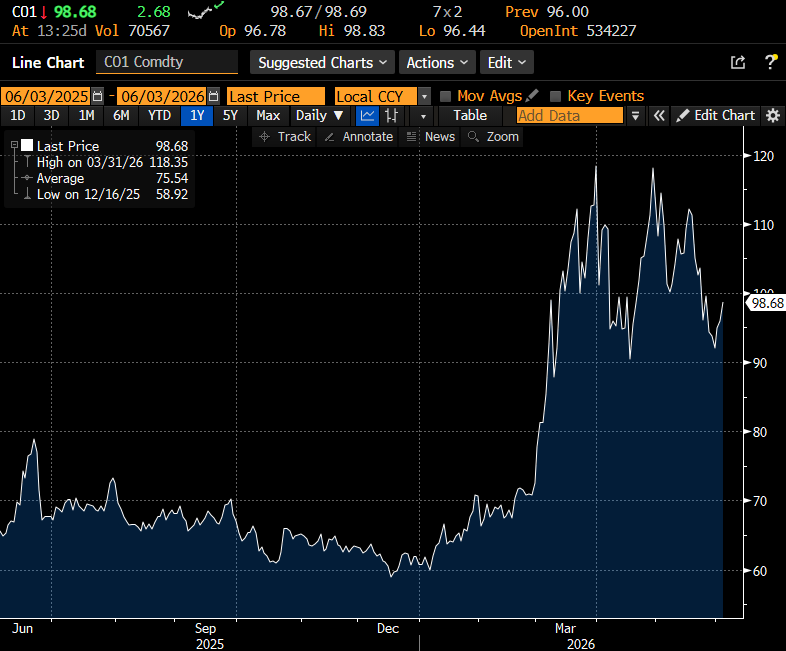
• Oil is at $99
https://t.co/hbFJDiT1IE
US Forces struck a sixth commercial vessel while disabling Iranian attacks on Gulf states and civilian vessels as the US-Iran ceasefire continues against a backdrop of growing uncertainty
https://t.co/TpFb0ehf1u
Kuwait's General Civil Aviation Authority announced that the overnight Iranian drone and missile attack targeting Kuwait caused severe damage to Terminal One at Kuwait International Airport and injured an unknown number of people, according to NewsNation. The airport has activated its emergency response plan, and all flights have been suspended or diverted.
From @TheAthleticFC: If referee calls had been correct, the Premier League title race would have entered the final match round with Manchester City two points clear of Arsenal, according to our analysis of key match decisions. https://t.co/FSWGZMMBRL
Refinery run rates are at 95% (literally full capacity) and are skipping maintenance, because there is no dent in demand, summer should be interesting >
US Crude Refiners Are Pushing Run Rates to Maximum Levels
US oil refiners are running their plants harder than usual, with some even putting off maintenance, as strong profits and steady demand for fuels tempt the processors to run plants near maximum capacity.
The industry has had one of its lightest maintenance seasons in years.
US summer driving season is just getting underway and underscores why domestic demand is expected to stay high. Refinery utilization rates are hovering close to 95%, which is considered effectively full operating capacity, and total US gasoline stockpiles are at multi-year seasonal lows, according to Energy Department data. (Bloomberg)
"Iran’s Islamic Revolutionary Guard Corps (IRGC) says it targeted the “US-owned”, Panama-flagged MSC Sariska V container ship with a cruise missile.
Iranian media said the IRGC’s move followed an attack on an Iranian ship near Oman.
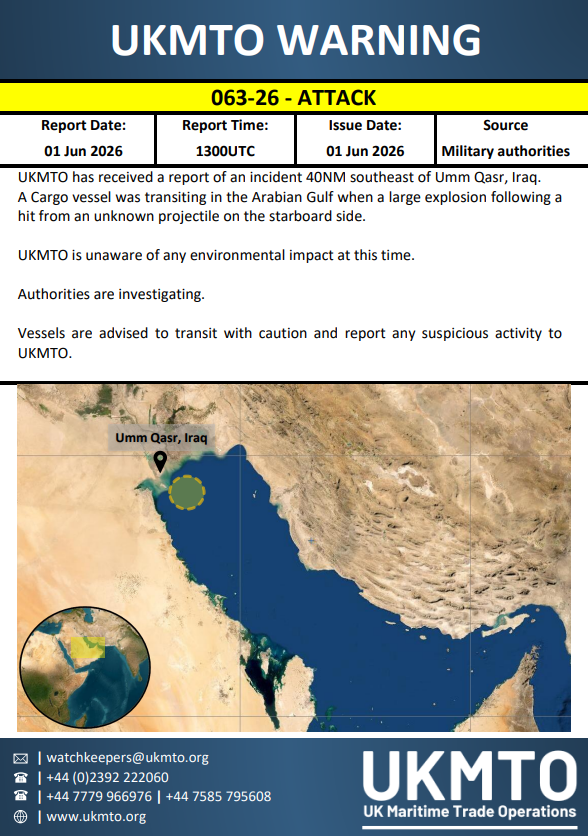
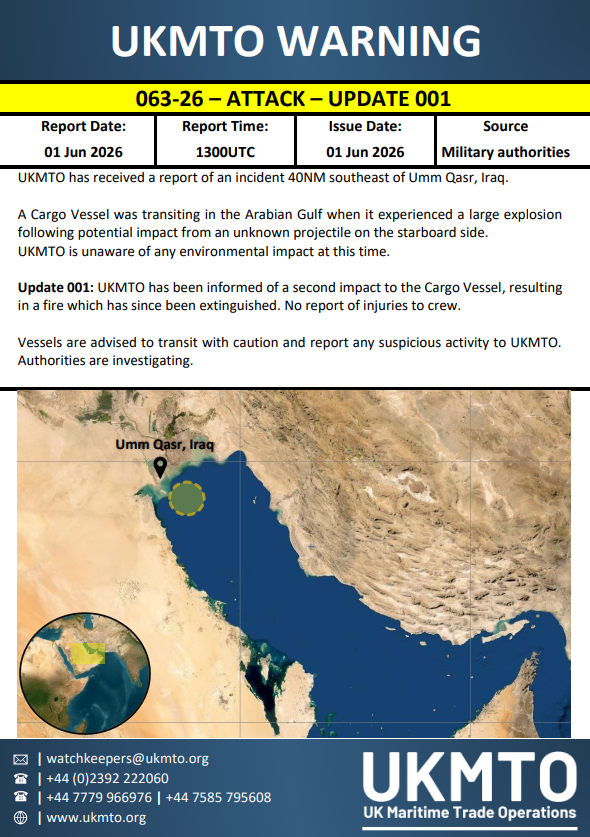
We earlier reported that a cargo vessel travelling in the Gulf was hit with a projectile around 40 nautical miles (74km) southeast of Umm Qasr, according to the United Kingdom Maritime Trade Operations (UKMTO).
UKMTO has not confirmed which vessel was hit."
UKMTO updates: