Agents are built to reason, not resolve. The resolve part is ours. Good to be in the @Tiny_Fish Partner Partners Alliance.
The open web was always the easy half. Glad to be in this one.
One name in, the entity and everything linked to it out.
That's what we're bringing.
AI agents are the web's biggest users.
They run on TinyFish, so we see what they reach for: data that's licensed, not published.
Today, with @crunchbase, @Similarweb, and 13 more companies, we're launching the TinyFish Data Partners Alliance.
The best data, curated by category, for agents.
https://t.co/TflAYXkm5A
State regulators are starting to treat med spas as medical clinics. On paper, most of these businesses are still just salons.
With New York, Indiana, and Ohio now cracking down on med spas, we looked at how 12,646 of these businesses describe themselves in their own filings: 85.9% file under a beauty-industry code, not a medical one.
That gap is exactly what a registration-only KYB check waves through. Self-reported paperwork just tells you what a business calls itself, not what it does.
Our full report:
https://t.co/r9Pbd76mcq
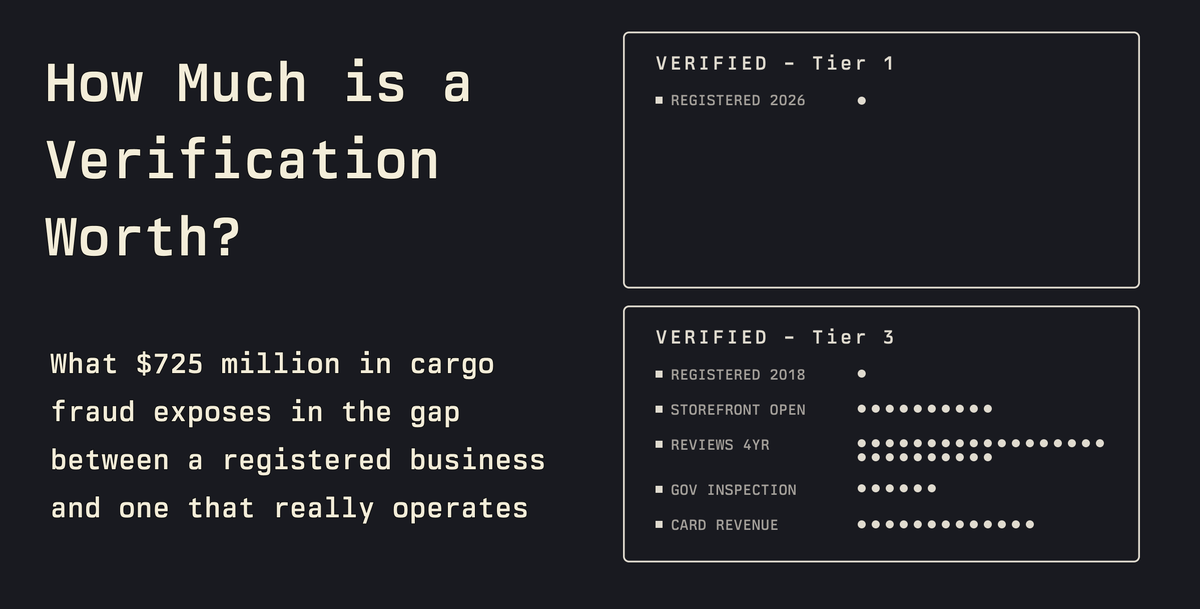
Cargo theft has hit roughly $725 million per year, and a growing share of it starts with a clean-looking KYB check.
A fraudulent freight broker registers, gets an MC number, and within days is bidding on loads. Then a shipper runs a simple KYB check: active, bonded, passed. Then their cargo disappears.
These costly KYB failures result from reading the same thin layer: the registration anyone can file for a fee. The FMCSA lists 111K active broker authorities, but fewer than 25K carry the bond you need to actually operate.
Our latest investigation digs into what "active" really means in the freight industry, and why a passing verification is only as good as the evidence behind it.
https://t.co/aESuZMz92N
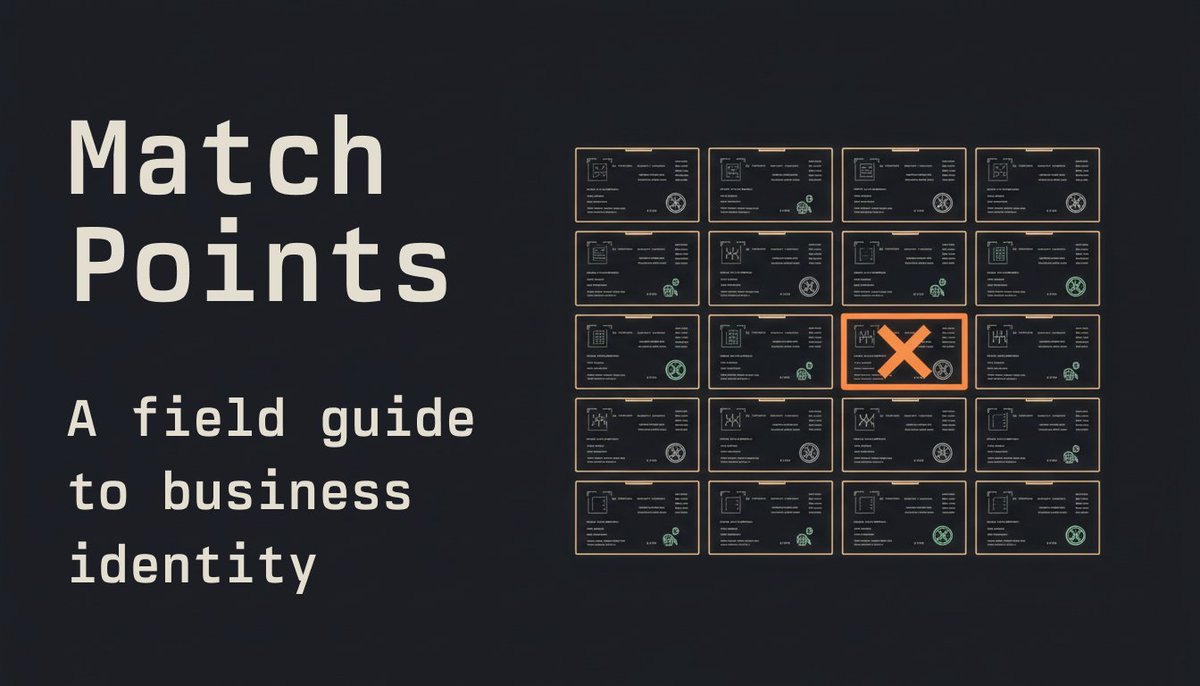
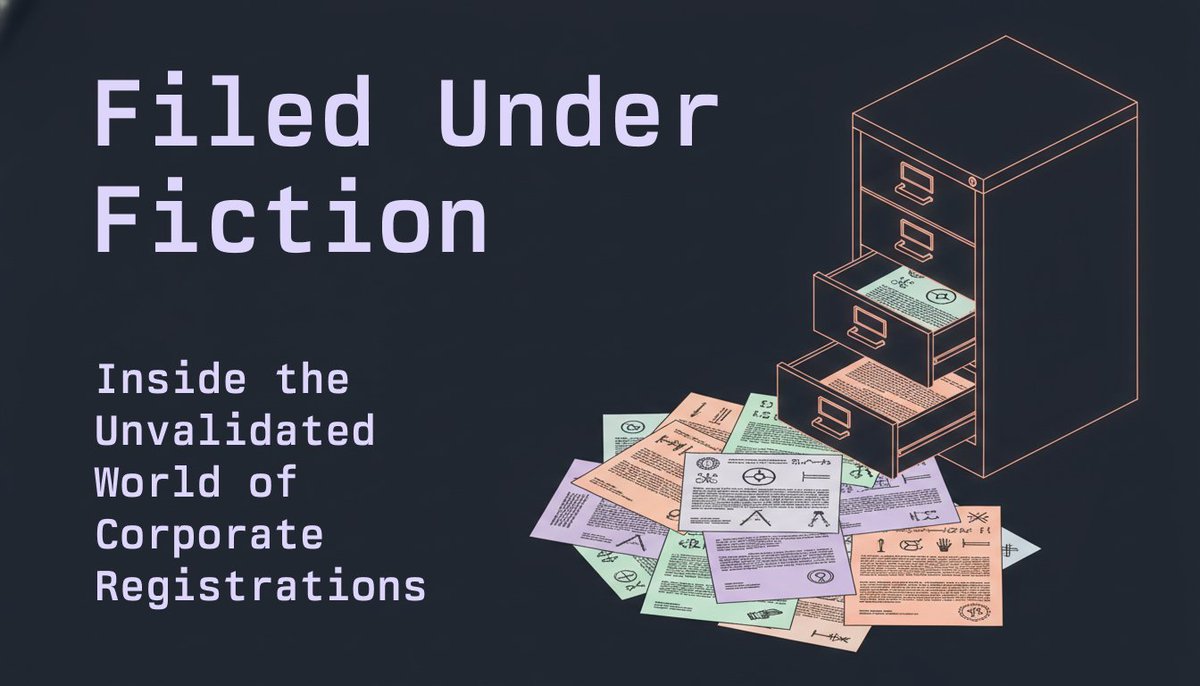
Corporate registrations are the weakest evidence used in KYB checks: a registration and a tax ID both rest on self-reported information that takes an afternoon to produce, and neither proves the business operates. A rigorous check weighs evidence by its origin. Signals from parties other than the business get harder to fake the more of them agree, until the cost to fake a business’s identity converges with the cost of actually operating. Official records are only the floor of a KYB stack. The deeper you go, the more grounded verification becomes.
https://t.co/Qwhbig90Fl
A registered-agent address is one of the most common risk flags in KYB. It may also be the least useful one left.
Just 128,124 addresses now carry 26.6% of all U.S. corporate filings: 0.21% of addresses holding more than a quarter of the registry, most of them registered-agent hubs in Wilmington, Sacramento, and Tallahassee. One of them is the registered home of 1,913 businesses, and 79% of these generate zero card revenue.
When a single mailroom holds that share of the registry, flagging the address signals almost nothing. It catches a sizable slice of the legitimate economy right along with everything else. The hub isn't the anomaly. It's the baseline. And you can't flag a baseline.
The signal is one layer down, with the entity instead of the address: which of the thousands of businesses at this address actually show operating evidence? Card revenue, a real location, a customer trail.
https://t.co/33aUeDhIhe
A legitimate business can fail compliance checks without doing anything wrong.
The business changes its name in March, its address in May, files in a new state in July. Nothing about what it does actually changes. But the registration records move, and data providers that only know the business on paper are now describing a version that no longer exists.
Enigma Enrich keeps your records connected to a living identity graph, matching every new filing back to a verified entity. Current data, not a six-month-old snapshot.
https://t.co/rbE4wU0t6J
If the running theme of the Enigma newsletter is what business identity actually looks like at scale, today we've pushed that question past its breaking point by examining a federal docket where the defendants are phantom online storefronts selling counterfeit goods. The data for this story comes courtesy of our friends @FreeLawProject, whose CourtListener database is a fantastic tool for pulling documents from the US court system.
https://t.co/lDH6WX9T6p
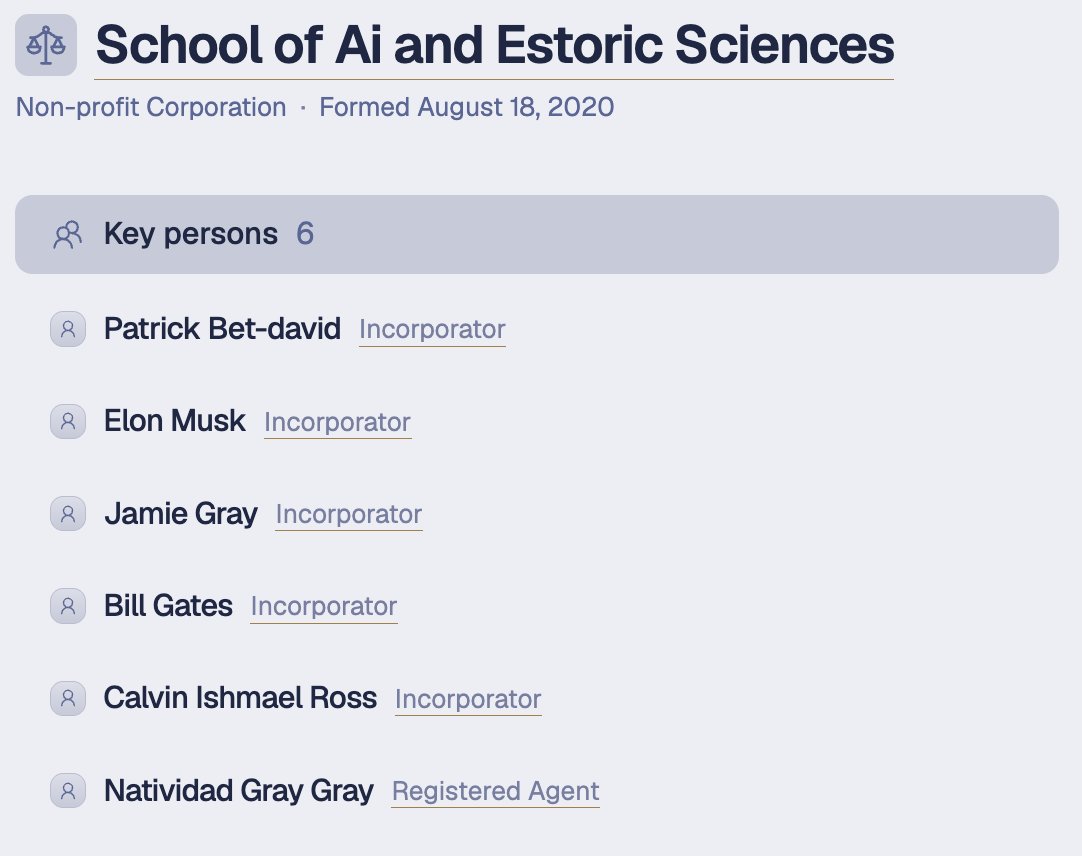
If someone told you they started a school for AI and esoteric sciences with Bill Gates and Elon Musk, would you believe them? Would it help if they showed you a piece of paper where they had written the same information down and had a clerk stamp it?
Yet this exact business is officially on record with the Missouri Secretary of State. So if you run a KYB check with a company that uses only these corporate registration records for business verification, you're working with exactly the same self-reported information you'd get if a random stranger told you he's collaborating with his good friends Bill and Elon to teach esoteric sciences to the masses.
This is why Enigma's verification works from operating signals: revenue, location history, license records. A registrant can file whatever they want in a state form. They cannot manufacture card transactions.
Read our full report on the abuse of self-reported corporate records:
→ https://t.co/5xQOcjakFQ
Enigma and Proof are partnering to launch Business Certificates: verified credentials for U.S. businesses, built to be used by people and AI agents alike.
Business identity usually gets verified once at onboarding, then trusted long after the facts beneath it begin to drift.
A record goes stale. A Business Certificate travels with the company: verifiable the moment it's needed, signable across wires, contracts, documents, and agentic workflows, all grounded in the registries that govern the business.
To learn more, read the full announcement or reach out for a demo.
https://t.co/U0ePAaFOJD
Is 'REGISTERED AGENTS INC' the same company as 'REGISTERED AGENTS, INC'? Or 'REGISTERE.D AGEN.TS INC'?
One registered agent in Texas is spelled 13 different ways in state records. Why? Because these forms accept whatever people type into the box, including typos and fabrications.
KYB that matches against these faulty records will see over a dozen entities where just one exists.
And resolving these records to the real business is the line between two kinds of KYB: one that relies on self-reported answers, and one grounded in verified data.
The typos are the innocent version. The same forms also accept businesses faked on purpose. Learn more:
https://t.co/t2oBkUmOXl
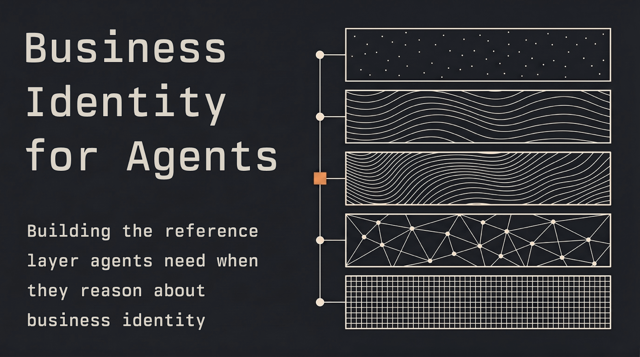
When you ask an agent about a business, you need a reference layer to ground the answer. That’s where most agentic KYB workflows fail: wrong-entity matches, stale-state errors, ownership blindspots.
These are data-layer failures surfacing at the model layer.
Enigma’s knowledge graph links 100M entities, 30M brands, and 30M operating locations via MCP, KYB Agent on Google Cloud, and now Parallel's Index.
For agent builders working in business identity:
https://t.co/uqTbFICRTD
Agent reliability is an infrastructure problem, not a model problem. That’s actually a good thing. It just means you have to start with reliable data.
A well-reasoned KYB decision drawn from stale filings is still wrong. A confident match against an unresolved entity is still a false positive.
before tuning prompts, audit your data sources. Before adding agentic logic, evaluate resolution quality.
In other words: fix the stack from the bottom up, not the prompt from the top down.
And learn the five elements of the KYB stack on the Enigma Knowledge hub: https://t.co/SiLJRY3HXo
When top-tier models use web search to run KYB checks, the result is a coin flip, often worse. That's the agentic baseline, even when you throw lots of tokens at the problem.
When the Enigma KYB Agent for Google Cloud runs the same checks against our verified business identity graph, it gets 20% higher accuracy at one-tenth the inference cost.
The math holds because the agent isn't burning tokens working out which business it's looking at. Identity is resolved before the agent even starts: brand to legal entity, every variation, every jurisdiction, every filing, plus operating signals to know whether the business is real.
Built on Vertex AI Agent Engine, Gemini Flash, and Cloud Run. Submit a single business through chat, or run a batch through a spreadsheet. Every check returns its reasoning, grounding every decision in our verified identity graph.
Learn more:
https://t.co/loDWuQ3qLi
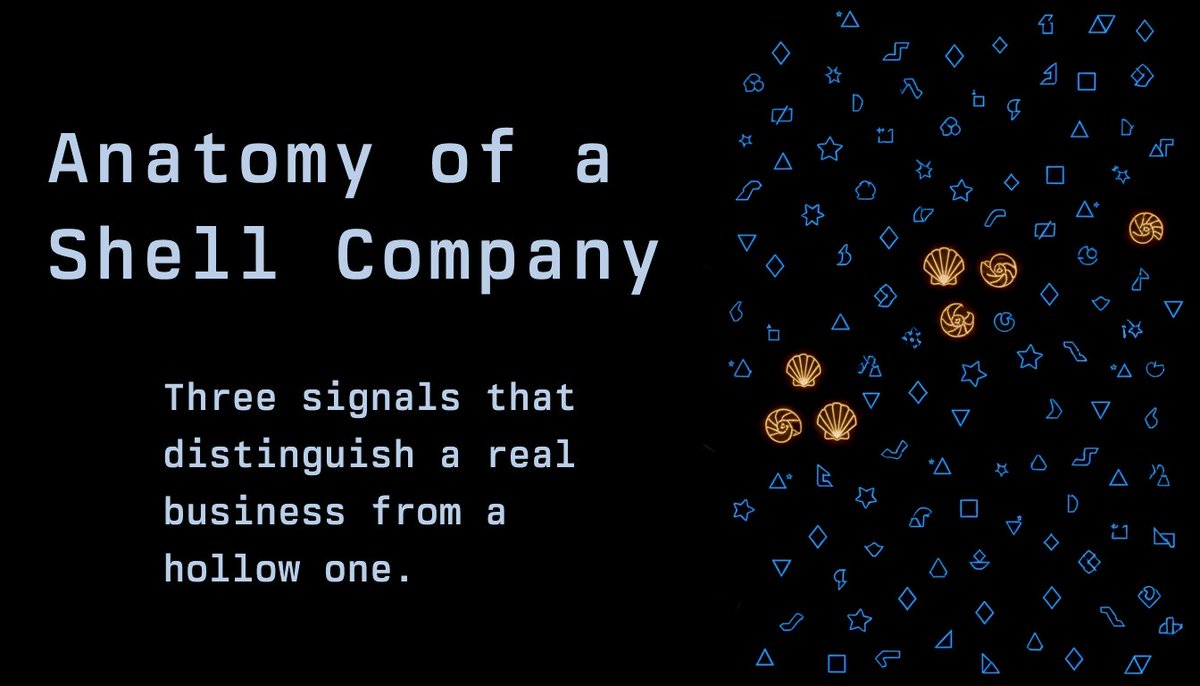
Shell companies are designed to look smooth to standard KYB checks: the legal entity exists, the address resolves, the state filings are current. Green light.
That's where shell networks slip through, because basic verification confirms that the business is on record. The harder question is whether the business does anything in the real world, or connects to anything else that does.
But you can find the data signature of shell companies in other ways: network signals, operating gaps, and the connections no individual entity check sees. Wanna see the entity-level signals that distinguish a real business from a hollow one?
https://t.co/677dJW6IDF
Over 100,000 businesses in the U.S. have hit their tenth birthday on paper without ever opening a location, generating revenue, or showing up anywhere on the open web.
We call these businesses “zombies” for good reason: they cluster at the same handful of addresses, register in coordinated waves during specific years, and consistently reanimate the same few corporate structures.
A registration on file is a cheap proof of existence. Confirming that a business actually operates is harder: its operating signals cannot be stamped and filed into existence, and much of the KYB field has built its workflows to consult the filing rather than the signals.
We mapped the gap between filing and operation, and estimated what share of each state’s “active” businesses are really just zombies.
→ https://t.co/kkW6D6nktv
Did you know that people can fill out business registrations with pretty much any information they want?
State business registries don't ask for ID, signatures, or any verification of the people named in a filing. Pay the registration fee and they accept whatever you type in the form.
Of course, any system that can be abused, will be abused. One LLC lists Mickey Mouse and Minnie Mouse as officers. The state of Georgia treats this corporation as a real, active business.
That’s why Enigma's knowledge graph uses operating signals to verify that a company is actually transacting business. Otherwise, Mickey Mouse comes back valid.
We searched 103 million registrations across all 50 states to find the most egregious cases:
→ https://t.co/LeU0uDgbWB
“Identity verification” is a single phrase covering two fundamentally different problems.
To verify a person, you need a government-issued ID, a selfie, and a liveness check. The inputs are a document and a face to tell you: is this the individual the document describes, and are they physically present right now?
Verifying a business is a different scale of problem. The data required spans government registries across dozens of jurisdictions, corporate filing histories, ownership structures that shift over time, and sanctions watchlists that can change daily.
As agents take on more of the transaction layer, they encounter both problems at once. Approving an application means knowing the individual submitting it. Onboarding a vendor means knowing the business behind it. That requires a different data layer underneath: a verified business identity graph.
Enigma's card-backed revenue signals are now inside Clay, giving GTM teams real transaction data from actual payment networks. Major financial institutions already rely on this data for compliance. Now GTM teams can use it for growth.
https://t.co/qEefuKC1rI
Enigma Gov Archive is live. Billions of government records across thousands of datasets, growing continuously.
OSHA violations, EPA enforcements, health inspections, business licenses, UCC filings, building permits, campaign finance disclosures. Federal, state, and local agencies. All in one database.
Agent-ready from day one: MCP, API, and direct integrations. The business identity layer your agent needs to reason on government records instead of guessing from web results. Every data point traces to a specific agency, dataset, and filing.
The web results most AI agents use aren't sourced. They aren't verified. They don't trace to a specific government filing. If your agent searches the web for business compliance data, it's guessing on the facts and reasoning on noise.
With Gov Archive, your AI agent doesn't just search text. It searches a verified business entity, resolving every name variation, legal entity, and DBA through the same infrastructure that powers Enigma's KYB and compliance products.
That's how one Gov Archive query returns records from many government databases, all matched to the same business.
https://t.co/9dnYfZPOah