#SoSoScholar2025@SoSoValueCrypto @massachainWhen
When Bitcoin Fell: A Comprehensive Analysis of the Recent November 2025 Dump
https://t.co/bhUxOfxuJ9
Date: November 15, 2025
Abstract
Bitcoin experienced a sharp decline in November 2025, breaking key technical support and triggering widespread deleveraging across the crypto markets. This research investigates the multifaceted causes behind the dump: macroeconomic pressures, leverage unwinds, technical breakdowns, and risk-off sentiment. Using a combination of on-chain, derivatives, and market data, the study reconstructs the dynamics that led to the correction and assesses whether this is a structural reset or a temporary adjustment. The conclusions highlight key risks and potential warning signals for future market cycles.
1. Introduction
Bitcoin’s recent decline marks a significant inflection point in its 2025 price cycle. After reaching fresh highs earlier in the year, BTC’s drop has raised questions about sustainability, leverage exposure, and macro dependency. Rather than attributing the decline to profit-taking alone, this analysis explores structural vulnerabilities that were exposed in the recent correction. Understanding these factors is critical for market participants who must navigate a landscape increasingly shaped by both macro capital flows and on-chain risk.
2. Key Drivers of the November 2025 Dump
2.1 Macro Liquidity & Rate Policies
One of the primary forces behind the correction was a deterioration in broader liquidity conditions. According to CoinSwitch analysis, investors reduced their risk exposure as the U.S. Federal Reserve signaled it may delay or scale back rate cuts. (CoinSwitch)
Tighter liquidity makes high-beta assets like Bitcoin less attractive, prompting funds to rotate out. (NewsBlock)
This macro backdrop revived risk-off sentiment, pushing capital toward safer assets and creating downward pressure on crypto.
2.2 Massive Liquidation Cascade
October 10–11, 2025, witnessed a historic forced deleveraging. Over $19 billion in leveraged positions were liquidated within 24 hours across the crypto derivatives market — the largest such event on record. (CoinDesk)
A significant portion of these were long positions, which amplified the downside for Bitcoin. (CoinDesk)
As liquidations piled up, open interest collapsed rapidly, tightening liquidity in futures markets and triggering further forced selling. (CoinDesk)
This cascade mechanism created a vicious feedback loop, where selling begot more selling.
2.3 Long-Term Holder (LTH) Sell-Off
Data from NewsBlock indicates that long-term Bitcoin holders — typically among the most conviction-driven participants — significantly increased their selling activity. About 815,000 BTC were moved by LTHs in the 30 days before the dump — one of the highest volumes since early 2024. (NewsBlock)
This behavior suggests waning confidence from foundational holders, rather than opportunistic profit taking. Their selling likely added structural downward pressure, especially as other participants de-risked.
2.4 Technical Breakdown
Technical triggers deepened the sell-off. Bitcoin broke below critical support zones around $110,000, causing margin calls and stop-loss cascades. (dropfinder)
Additionally, indicators like the Relative Strength Index (RSI) moved into bearish territory, signaling oversold conditions and weak buyer conviction. (dropfinder)
These breakdowns discouraged new buyers and reinforced liquidation flows.
2.5 Risk-Off Sentiment & Institutional Retracement
Investor psychology shifted quickly. According to DropFinder sentiment analytics, bearish narratives surged — including fear of prolonged high rates, concerns about regulatory tightening, and dwindling faith in ETF-driven inflows. (dropfinder)
Institutional demand also cooled. Let’s Talk Bitcoin reported that the pace of crypto ETF inflows slowed markedly, and large treasury holders (e.g. corporates holding BTC) began reducing exposure. (Let's Talk, Bitcoin)
This retracement of institutional capital removed a key support pillar for the Bitcoin rally.
2.6 Geopolitical Shock
A geopolitical jolt amplified the fragility. According to Medium research by Nicola Harvey, the crash coincided with a dramatic U.S.-China trade escalation — specifically, a surprise announcement of 100% tariffs on Chinese goods. (Medium)
This shock triggered cross-asset risk-off flows, hitting crypto particularly hard given its speculative nature.
3. On-Chain and Behavioral Evidence
3.1 On-Chain Realized Losses
Reddit-based on-chain analysis (using UTXO and realized PnL data) revealed that much of the dumping came from “younger” Bitcoin (held for less than a year), not older institutional bags. (Reddit)
In one hourly spike, nearly $200 million in realized losses were recorded, indicating panic selling rather than profit-taking by long-term holders.
3.2 Network Activity & Liquidity Rotation
Reddit sentiment data indicates that a portion of capital did not fully exit crypto but rotated into stablecoins. (Reddit)
This suggests that some traders saw the dump as a “liquidity flush” — deleveraging rather than capitulation.
4. Scenario Analysis & Forecast
Based on the evidence, here are two plausible medium-term scenarios:
Scenario A: Structural Reset + Leverage Purge
1. The market has purged excessive leverage.
2. Long-term holders may return cautiously once macro stabilizes.
3. If ETF inflows resume, Bitcoin could rebuild support around $105K–110K, assuming macro risk diminishes.
Scenario B: Macro-Driven Downtrend
a. Continued monetary tightening or geopolitical risk triggers renewed risk-off.
b. Leverage remains sensitive, and further large liquidations may recur on smaller shocks.
c. BTC could test $90K–95K if liquidity remains tight and demand doesn’t recover.
Key warning signals to watch: renewed surge in long liquidations, slowing ETF flows, or a reversal in macro liquidity conditions.
5. Risk & Methodological Limitations
a. Data reliability: While liquidation figures come from reliable sources (CoinDesk, DropFinder), exact on-chain flows depend on wallet classification, which may be imperfect.
b. Sentiment metrics: Sentiment analysis (Reddit, DropFinder) is subject to bias and may overrepresent retail behavior relative to institutional flows.
c. Correlation vs causation: While macro and liquidation data correlate with the drop, proving causality is challenging without access to proprietary institutional flow data.
d. Model uncertainty: Forecast scenarios assume stable behavior going forward. Unexpected macro events (e.g., rate surprises, geopolitical escalations) or shock inflows/outflows could drastically change the outlook.
6. Implications & Recommendations
For Traders & Investors
a. Use on-chain signals: Monitor realized loss by coin-age cohorts for early signs of capitulation.
b. Risk management: Given high leverage, manage exposure with tight stop-losses or non-levered allocations until clarity returns.
c. Portfolio positioning: If you believe in a structural reset, consider dollar-cost averaging; if you lean toward macro risk, hedging may be prudent.
For Institutions / Treasury Holders
a. Liquidity buffers: Maintain stablecoin or fiat reserves to deploy opportunistically.
b. Leverage discipline: Avoid heavily leveraged perpetual bets in uncertain macro conditions.
c. Governance readiness: Be prepared for regulatory shifts and macro interference which may impact ETF flows.
For Researchers & Analysts
a. Build early-warning systems: Combine on-chain realized loss metrics, macro liquidity indicators, and derivatives open interest to forecast dump risk.
b. Further investigation: Collaborate with analytics platforms (CoinGlass, DropFinder, Glassnode) to refine causal inference models.
c. Policy relevance: Explore regulatory frameworks that mitigate systemic leverage risk while preserving crypto’s growth potential.
7. Conclusion
The November 2025 Bitcoin dump was not merely a “sell-the-rip” correction — it was a complex confluence of macro liquidity tightening, record-setting leverage liquidation, LTH sell-off, technical breakdowns, and geopolitical shock. On-chain metrics and behavioral data suggest that both institutional and retail participants reduced risk, but not in a coordinated “exit to zero” fashion; rather, many participated in a deleveraging reset.
This event may represent a healthier purge of excess leverage, rather than a collapse of confidence — but the risk environment remains uncertain. How Bitcoin responds in the coming weeks to macro developments, ETF flows, and on-chain signals will be critical in determining whether this is a structural reset or the start of a deeper correction.
#Supra Blastoff Course
Topic : Blockchain 101
Subtopic : KYC in Crypto & Web3 Security
Course Quiz & Answers
1. What is the main goal of KYC procedures in financial institutions?
✅ To validate the identity of customers and ensure they are not involved in illegal activities
2. How can decentralized oracles help improve KYC compliance in Web3?
✅ By enabling continuous, private KYC checks while safeguarding user data
3. What challenge is associated with traditional KYC procedures?
✅ They are costly, cumbersome, and require periodic updates
4. What is the key benefit of Web3 KYC solutions compared to traditional methods?
✅ Web3 KYC offers seamless and private verification processes without compromising privacy.
5. Which of the following is a risk mitigated by using decentralized oracles in KYC procedures?
✅ The risk of criminal activities going undetected due to outdated or manual KYC checks.
https://t.co/MpYIi9lb4j #supra #DeFi #AMM #CryptoQuiz #Web3 #SupraNetwork
#Supra Blastoff Course
Topic : Blockchain 101
Subtopic : Public and Private Keys
Course Quiz & Answers
How Public Private Keys Differ From Web2
1. What is a primary characteristic of Web2 security?
✅ Centralized systems storing user credentials
2️. Which of the following is a vulnerability of Web2 security?
✅ Single points of failure
3. In Web3, what replaces traditional passwords for security?
✅ Public and private keys
4. What is a major advantage of Web3 security compared to Web2?
✅ Eliminates need for intermediaries
How Public/Private Keys Work
1. Why must a private key be kept secret?
✅ It grants access to digital assets
2. Which cryptographic algorithm is commonly used to generate key pairs?
✅ RSA
3. What process involves creating a digital signature for a transaction?
✅ Transaction signing
4. What is the primary use of a public key in Web3?
✅ To receive digital assets
Recovery Methods for Lost Devices, and Catastrophic Loss Scenario
1. How does a hardware wallet enhance security?
✅ By storing private keys offline
2. Which of the following is a benefit of using a multisig wallet?
✅ It enhances security and recovery options
3. What is a trade-off when using custodial services for key management?
✅ Reintroduction of centralization
4. What is a seed phrase used for in Web3?
✅ To recover access to a wallet
https://t.co/MpYIi9lb4j #supra #DeFi #AMM #CryptoQuiz #Web3 #SupraNetwork
Supra Blastoff Course
Topic : SupraTech
Subtopic : Powering the Supra Network: Moonshot Consensus Mechanism
Course Quiz & Answers
1. What does the phrase "time to finality" refer to in the context of blockchain?
✅ The time taken from when a block is proposed to when it is committed to the blockchain's ledger
2. Which of the following issues can latency cause in a blockchain network?
✅ Transaction delays and poor user experience
3. What is one key advantage of Supra's Moonshot Consensus protocol?
✅ It achieves deterministic finality in only 3 messages between nodes
4. What is unique about Supra's Moonshot Consensus compared to previous protocols?
✅ It permits the next leader to propose its own block as soon as it votes for the predecessor's proposal
5. How has the Moonshot Consensus protocol been formally verified for security?
✅ Using Microsoft's Ivy Verifier
https://t.co/MpYIi9lb4j #supra #DeFi #AMM #CryptoQuiz #Web3 #SupraNetwork
#Supra Blastoff Course
Topic : Blockchain 101
Subtopic : Use Cases and Examples of Smart Contracts
Course Quiz & Answers
Smart Contracts in Finance
1. What is a primary benefit of using smart contracts in DeFi applications?
✅ They allow direct transactions without intermediaries
2. What does MakerDAO's DAI stablecoin rely on to maintain its value?
✅ User collateral and automated adjustments
3. How do smart contracts contribute to financial accessibility in DeFi?
✅ By reducing fees and removing entry barriers
Smart Contracts in Supply Chain Management
1. How does IBM's Food Trust blockchain enhance transparency in the supply chain?
✅ By providing a verifiable record of each step from farm to table
2. What is a significant advantage of using smart contracts in supply chain management?
✅ Lowered administrative costs and fewer errors
3. How do smart contracts support ethical sourcing and sustainability?
✅ By tracking product origins and ensuring transparency
Smart Contracts in Real Estate Transactions
1. What is a major benefit of using smart contracts for real estate transactions?
✅ They allow immediate ownership transfer when conditions are met
2. How can smart contracts improve accountability in rental agreements?
✅ By issuing automatic warnings or penalties for non-compliance
3. What is a key challenge of integrating smart contracts into real estate?
✅ Lack of regulatory and legal compatibility
https://t.co/MpYIi9lb4j #supra #DeFi #AMM #CryptoQuiz #Web3 #SupraNetwork
When 20 percent of the web goes down, the real cost is not technical
Two days ago, a simple internal file error inside Cloudflare’s bot management system was enough to break a massive part of the internet. One corrupted file, pushed every few minutes, made websites flip between working and crashing with 500 errors. For businesses, that means one thing: lost trust, lost users, and lost revenue 💸
This incident is a reminder of a hard truth: if your entire online presence relies on a single centralized provider, you are one mistake away from a disaster. In other words, don’t put all your eggs in the same basket 🧺
A safer approach: distribute your presence
What most people don’t realize is that your website doesn’t have to live only on the clear web. Your frontend can also be mirrored on the DeWeb, giving you a resilient alternative path when major providers fail 🔗
Instead of a single point of failure, you get a distributed, censorship resistant, outage resistant presence. When Cloudflare, AWS, Azure or any other giant goes down, your users still have a way to reach you 🔄
For businesses that can’t afford downtime
If every minute offline means lost money, lost conversions or broken customer experience, DeWeb is not just an option, it’s a safety net 🛡️
Redundancy is not a luxury. It is a survival strategy ⚠️
#Supra Mission Hub
Topic : TradePort
Mission Quiz & Answers
Course Quiz & Answers
1. What primary challenge does TradePort solve for creators on Supra?
✅ It offers a seamless, no-code launchpad trusted by over 600 creators
2. Which feature allows traders to understand their NFT performance over time?
✅ Comprehensive portfolio analytics showing profit, loss, and asset value evolution
3. What gives TradePort its depth for serious traders?
✅ Advanced collection statistics such as floor walls, rarity distributions, and ranked deal discovery
https://t.co/MpYIi9lb4j #supra #DeFi #AMM #CryptoQuiz #Web3 #SupraNetwork
#Supra Blastoff Course
Topic : Blockchain 101
Subtopic : Towards a Multi-Chain World: Technological Hurdles and Enablers
Course Quiz & Answers
1. What is the primary reason a Nash equilibrium is valuable in Web3 network design?
✅ It creates stability by aligning incentives so no one benefits from dishonest behavior
2. Why are decentralized identifiers (DIDs) becoming increasingly important?
✅ They help ensure cryptographic identity verification in a decentralized manner
3. What makes Zero Knowledge (ZK) proofs valuable in Web3 applications?
✅ They allow users to prove a statement is true without revealing all underlying data
4. How does Supra’s Oracle architecture mitigate collusion and bad data?
✅ It uses rotating Tribes and Clans with periodic shuffling and anomaly detection
5. What is HyperNova designed to solve in the context of cross-chain communication?
✅ It eliminates the need for escrow-based bridges by relaying L1-verified data
https://t.co/MpYIi9lb4j #supra #DeFi #AMM #CryptoQuiz #Web3 #SupraNetwork
#Supra Blastoff Course
Topic : Blockchain 101
Subtopic : DApp Ecosystems & Programming Languages
Course Quiz & Answers
Overview of DApp Ecosystems
1. Which language is widely used in Ethereum’s ecosystem?
✅ Solidity
2. What is Solana known for in terms of transaction handling?
✅ Its ability to handle high transaction speeds and low fees
3. What feature does Move focus on to improve smart contract security?
✅ Resource tracking and protection against common errors
Key Programming Languages in dApp Development
1️. Which language was specifically developed for EVM-compatible chains?
✅ Solidity
2️. Why is Rust favored in dApp ecosystems such as Solana and Polkadot?
✅ Its suitability for applications with high performance and safety needs
3️. What does Move’s resource-oriented programming help prevent?
✅ Duplication or unintentional destruction of resources
Expanding dApp Development Beyond Ethereum
1. Which ecosystem is still the largest for dApp development despite emerging alternatives?
✅ Ethereum
2. What advantage does Supra bring to dApp ecosystems with the Move language?
✅ It prioritizes security with parallel transaction processing and resource management
3. Why is Solana’s use of Rust beneficial for high-frequency applications?
✅ Rust minimizes memory-related bugs and enhances security for high-throughput applications
https://t.co/MpYIi9lb4j #supra #DeFi #AMM #CryptoQuiz #Web3 #SupraNetwork
#Supra Blastoff Course
Topic : SupraTech
Subtopic : Turbocharged Transactions: Supra’s Parallel Execution Strategy
Course Quiz & Answers
1. What role do 'Clans' play in Supra's network architecture?
✅ They compartmentalize transaction batches for simultaneous processing
2. How does the read-write aware approach improve parallel execution?
✅ It identifies data dependencies in advance to reduce execution conflicts
3. What is the key function of Supra Containers in enhancing parallelism?
✅ They isolate related smart contracts to minimize cross-transaction conflicts
4. What hybrid technique does Supra use to optimize its execution engine?
✅ Scheduler-less STM-based execution with access specification analysis
5. Why is parallel execution difficult to implement on traditional blockchains?
✅ Transactions interacting with the same data require strict ordering
https://t.co/MpYIi9lb4j #supra #DeFi #AMM #CryptoQuiz #Web3 #SupraNetwork
#Supra Blastoff Course
Topic : Crypto Culture
Subtopic : How to Avoid Getting Scammed: Spotting Rugpulls, Phishing, and Other Web3 Red Flags
Course Quiz & Answers
1. What is a rugpull?
✅ A scam where developers abandon a project after taking users' money
2. Which of the following is a common phishing method in crypto?
✅ Sending fake links pretending to be trusted sites or wallets
3. Why is it dangerous to connect your wallet to a fake website?
✅ It could trigger transactions that steal your tokens
4. Which action is a major red flag in a supposed “free airdrop?”
✅ Asking you to send crypto to receive more crypto
5. What is the safest way to store large amounts of crypto?
✅ In a hardware wallet disconnected from the internet
https://t.co/MpYIi9lb4j #supra #DeFi #AMM #CryptoQuiz #Web3 #SupraNetwork
#Supra Blastoff Course
Topic : SupraTech
Subtopic : SupraNova Bridge Course
Course Quiz & Answers
The Problem and SupraNova as a Bridgeless Solution
1. What is the primary security flaw of traditional multi-signature bridges?
✅ Threshold number of compromised nodes can endanger the entire bridge
2. Why have traditional cross-chain bridges become lucrative targets for attackers?
✅ They act as centralized honeypots with locked funds
3. What trade-off do many consensus-based bridges make?
✅ Security for slower transaction speeds and limited scalability
4. What is SupraNova’s core advantage as a cross-chain framework?
✅ It combines trustless verification and high-speed bonding methods
HyperLoop – Speed with Bonded Security
1. What is HyperLoop’s primary focus compared to HyperNova?
✅ It emphasizes fast cross-chain transfers with economic security
2. Why are bridge nodes required to stake assets in HyperLoop?
✅ To ensure that they have financial incentives to act honestly
3. What function do sliding window circuit breakers serve?
✅ They impose time-based transfer limits to reduce double-spending risks
4. How does HyperLoop ensure user funds remain safe during extreme events?
✅ By pegging risk exposure to fully-backed insurance protocols
HyperNova – Trustless Cross-Chain Verification
1. How does HyperNova achieve trustless verification?
✅ By enabling destination chains to validate source chain events directly
2. What are the three core steps in HyperNova’s process?
✅ Event relaying, proof packaging, and validation on the destination chain
3. What role do relay nodes play in HyperNova?
✅ They monitor source chains and package events with proofs
4. How does HyperNova handle transaction rate limits?
✅ It removes rate limits entirely, allowing unlimited transfers
https://t.co/MpYIi9lb4j #supra #DeFi #AMM #CryptoQuiz #Web3 #SupraNetwork
#Supra Mission Hub
Topic : AI Garden
Mission Quiz & Answers
1. What is the defining feature of NFTs created in AI Garden?
✅ They evolve and develop memory through user interaction
2. How does AI Garden record and preserve each NFT’s growth and story?
✅ Directly on the Supra blockchain for full transparency
3. What kind of skills are required to create an NFT in AI Garden?
✅ None beyond connecting a wallet and using the interface
https://t.co/MpYIi9lb4j #supra #DeFi #AMM #CryptoQuiz #Web3 #SupraNetwork
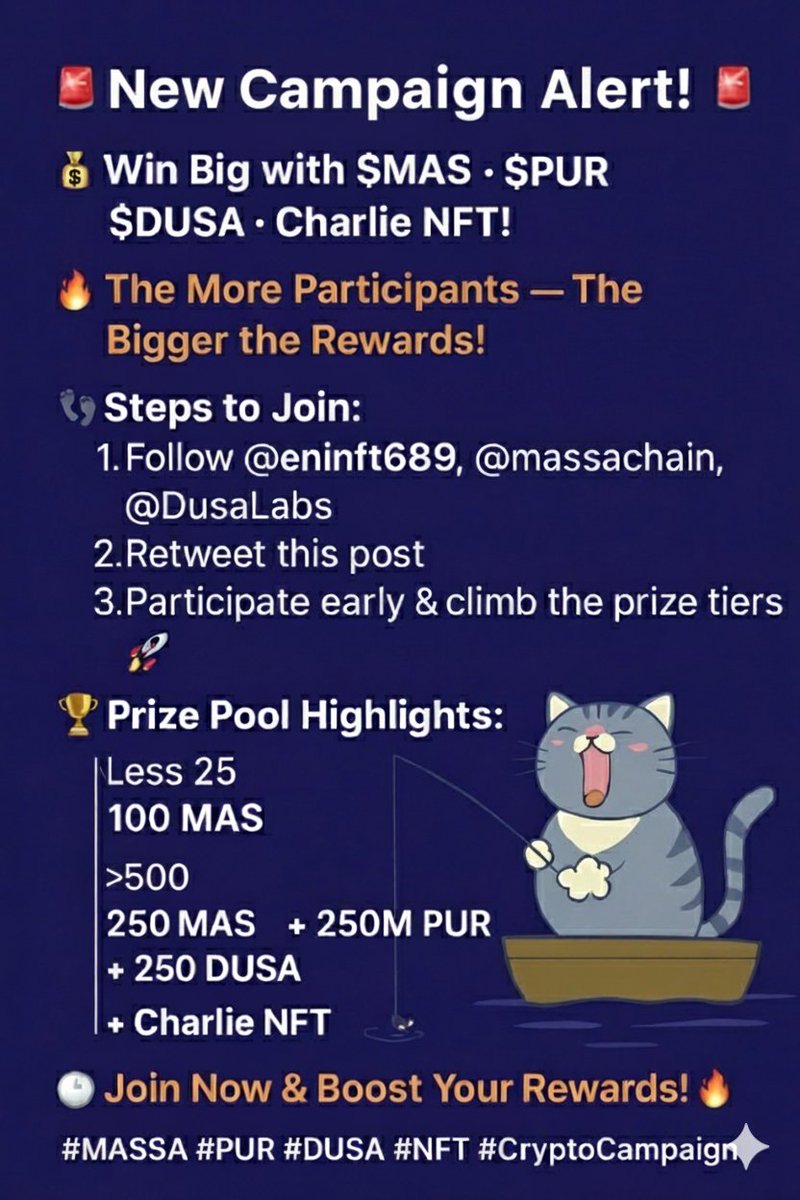
🚀 $Mas Giveaway Winner Announcement! - Week 03🚀
1/ First of all, a huge THANK YOU to everyone who joined our @eninft6896 #Massa giveaway 🎉
Your support means everything to us 💎
2/ After a fair random selection, we have our lucky winner 🏆
Total Participants - 6
🎁 100 $Mas goes to…
👉 [@p44646591680321
/ https://t.co/o754MRjj3x] 🎉👏
3/ Congratulations 🎊
Please check your wallet
4/ For everyone else – don’t worry! 🌟
More giveaways, campaigns & surprises are on the way. Stay tuned & keep engaging 🚀
5/ Let’s keep growing together with💎
#MASSA #PUR #DUSA #NFT #CryptoCampaign
@massachain@DusaLabs@PurrfectUniV
Massa will be at Devconnect from November 17 to 22, 2025, in Buenos Aires, Argentina! 📍
Our co-founders @damipator and @sebmassaf will be on site to meet builders, explore new collaborations, and exchange ideas about a freer and more open internet, one that can’t be shut down or censored.
With DeWeb and decentralized automation already live on the Massa network, MassaLabs is now working on Gossip, a highly decentralized messaging app🔥
If you’re around Devconnect, come say hi.
We’re always up for a good conversation about the future of the web.
See you in Argentina! 🇦🇷
#Supra Blastoff Course
Topic : SupraTech
Subtopic : The DeFi Revolution Flywheel: A New Era for On-Chain Markets
Course Quiz & Answers
1. What is the primary issue that Supra aims to solve in DeFi markets?
✅ Transaction execution quality, fairness, and efficiency
2. How does Supra prevent MEV (Maximally Extractable Value) exploitation?
✅ By using randomized execution with a cryptographic threshold signature
3. What role does enshrined automation play in Supra’s DeFi Flywheel?
✅ It enables transactions to be executed at the end of every block with zero delay
4. How does Supra’s automation revenue model benefit different stakeholders?
✅ Revenue is split among dApps, validators, and a decentralized treasury
5. Why is Supra’s DeFi Flywheel considered self-sustaining?
✅ Because execution quality leads to higher activity, which drives more revenue and further improves the ecosystem
https://t.co/MpYIi9lb4j #supra #DeFi #AMM #CryptoQuiz #Web3 #SupraNetwork
#Supra Blastoff Course
Topic : SupraTech
Subtopic : Supra L1’s Parallel Execution Strategy: Exploiting Parallelism for Extreme Performance
Course Quiz & Answers
Supra L1 – Built for Parallelization from the Ground Up
1. What structural element does Supra L1 use to divide transaction processing?
✅ Clans
2. How do Clans enhance parallel execution in the Supra network?
✅ They independently process different batches of transactions
3. What is the purpose of employing multiple Virtual Machines (VMs) within each Clan?
✅ To run transactions in parallel within specialized environments
4. Which approach does Supra use to minimize transaction conflicts in parallel execution?**
✅ Read-write aware execution with dependency analysis
5. What innovative algorithm does Supra employ to achieve efficient parallel execution?**
✅ A novel STM based scheduler-less algorithm
Why is Parallel Execution Difficult?
1. What is the main drawback of single-threaded execution in blockchains?
✅ It creates bottlenecks that limit throughput.
2. Why is the order of transaction execution important?
✅ It ensures that conflicting transactions produce the correct outcomes.
3. What is a key challenge in enabling parallel execution on blockchains?
✅ Balancing speed, order, and correctness while minimizing overhead.
4. Why is sequential processing still widely used in traditional blockchains?
✅ It guarantees a correct and consistent transaction order.
5. What can happen if two transactions affecting the same data are executed in the wrong order?
✅ The final blockchain state may become inconsistent.
Supra Containers and Scalability – Minimizing Conflict, Maximizing Parallelism
1. What is a Supra Container?
✅ A dedicated execution environment grouping related smart contracts
2. How do Supra Containers enhance parallel execution?
✅ By isolating transactions to reduce cross-interference
3. What additional benefit do Supra Containers offer to dApp developers?
✅ They provide custom gas tokens and fee pricing options
4. What does horizontal scaling in the Supra architecture involve?
✅ Adding more Virtual Machines and Containers to distribute transactions
5. How does combining vertical and horizontal scaling benefit Supra L1?
✅ It allows the network to achieve extreme performance without sacrificing security
https://t.co/MpYIi9lb4j #supra #DeFi #AMM #CryptoQuiz #Web3 #SupraNetwork
#Supra Blastoff Course
Topic : Blockchain 101
Subtopic : Post-Quantum Blockchain Security
Course Quiz & Answers
The Quantum Threat to Blockchains
1. What makes quantum computers different from classical computers?
✅ They process data using qubits that can exist in multiple states
2. What is the main risk of quantum computers to blockchain networks?
✅ They could break cryptographic algorithms and expose private keys
3. What is Shor’s algorithm known for?
✅ Breaking classical encryption like RSA and ECDSA
4. When is your public key visible on a blockchain?
✅ After sending a transaction
5. What is a quantum attack on blockchain most likely to target?
✅ Signature algorithms
Post-Quantum Cryptography (PQC)
1. What is the purpose of post-quantum cryptography?
✅ To secure data even against quantum computers
2. Which of the following is a post-quantum cryptographic approach?
✅ Lattice-based cryptography
3. Hash-based signature schemes are considered quantum-resistant because they:
✅ Avoid relying on number-theory problems
4. Which organization is working to standardize PQC algorithms?
✅ NIST
5. What is a challenge with implementing PQC in blockchains today?
✅ Larger signature sizes and slower verification
Strategies for a Quantum-Safe Blockchain Future
1. What is the purpose of address abstraction in blockchain?
✅ To reduce the visible exposure of public keys
2. Why are hybrid signature schemes important?
✅ They allow a gradual transition from classical to quantum-resistant cryptography
3. Which of the following is a strategy to transition blockchains to quantum security?
✅ Include upgrade paths for changing cryptographic algorithms
4. Quantum Key Distribution (QKD) is:
✅ technique for securely sharing encryption keys using quantum physics
5. What is a major trade-off when using post-quantum cryptography today?
✅ Larger signatures and slower performance
https://t.co/MpYIi9lb4j #supra #DeFi #AMM #CryptoQuiz #Web3 #SupraNetwork
🚀 $Mas Giveaway Winner Announcement! - Week 02🚀
1/ First of all, a huge THANK YOU to everyone who joined our @eninft6896 #Massa giveaway 🎉
Your support means everything to us 💎
2/ After a fair random selection, we have our lucky winner 🏆
Total Participants - 14
🎁 100 $Mas goes to…
👉 [ @sokorecords
/ https://t.co/PT6rCYJl60] 🎉👏
3/ Congratulations 🎊
Please check your wallet
4/ For everyone else – don’t worry! 🌟
More giveaways, campaigns & surprises are on the way. Stay tuned & keep engaging 🚀
5/ Let’s keep growing together with💎
#MASSA #PUR #DUSA #NFT #CryptoCampaign
@massachain@DusaLabs@PurrfectUniV