Hi @cowrywise tired setting up an account but got stuck at the point of adding a CSCS account. Kept returning with an error message.
Need help fixing this
@virtuossino@bellosaleh If the minister had an ounce of knowledge of what his job was and was putting himself out there and engaging with the real issues in his space, he wudnt hv to look too far as these issues wud fall on his laps witout him seeking them out. I wud be surprised if he has an X account.
@Joe_brendan_ This here answers it all but will also add this:
It is now a grave sin to finish your tenure as an office holder and look the other way without concern around who succeeds you. Buying into the vision and continuity is very key. I think Donald Duke unintentionally failed at this.
Graceland International School, PortHarcourt just informed me that Agbo Adoga qualified to represent Nigeria in international Maths Olympiad in China.
Nigerian Ministry of Education said they don’t have money to sponsor anybody.
So he will not attend.
Nigeria lost again!
In early 2014, President Goodluck Jonathan and Vice President Namadi Sambo visited the Armed Forces Command and Staff College in Jaji for a high-level military event the graduation of senior officers. These events typically bring the Commander-in-Chief and his deputy to assess military readiness and boost morale. That day, while on a tour of the vast Jaji cantonment, I was in a bus convoy transporting presidential aides and top army chiefs. During the ride, I engaged Lieutenant General Kenneth Minimah, the then Chief of Army Staff, in a candid conversation about Nigeria’s faltering counterinsurgency efforts.
At the time, Boko Haram was making troubling advances in the North-East. Reports surfaced of soldiers abandoning their posts, dropping weapons, and fleeing into neighboring countries. The military tried to rebrand these desertions as “tactical maneuvers,” but Nigerians quickly turned the term into a national joke. I asked General Minimah why trained soldiers would run instead of fight. His answer was honest and unsettling. He blamed a shift in recruitment values. In the past, soldiers were driven by patriotism and duty. Now, many saw the army as a job, not a calling. Under fire, they panicked, abandoning their mission to defend Nigeria.
This decline didn’t go unnoticed. In January 2015, then National Security Adviser Sambo Dasuki, speaking at Chatham House in London, labeled some Nigerian troops as “cowards.” He cited the fall of Baga and the army’s inability to hold ground against Boko Haram as signs of deep rot. Though controversial, Dasuki’s remarks reflected a view shared by many inside and outside the country, that the Nigerian military had lost its edge.
So it was no surprise when Iranian cleric Saeed Abdi publicly criticized the Nigerian military, calling them cowards for failing to defeat Boko Haram. He condemned the double standard of a force hesitant against terrorists but quick to crush unarmed civilians protesting poverty and injustice. His comments, while uncomfortable, echoed a growing international perception that Nigeria’s security forces had lost their focus.
The decay runs deep. The Nigerian Police Force, plagued by corruption, often admits recruits through bribery rather than merit. It’s widely alleged that applicants pay between ₦250,000 and ₦300,000 to secure admission. The consequences are dire. At one point, suspected armed robbers were found among recruits at the Police College in Kaduna. One even completed training and was posted to Kebbi State before his criminal past came to light. These aren’t isolated cases they reveal a system where corruption overrides competence.
Meanwhile, junior soldiers at the front are poorly equipped, underpaid, and abandoned. Funds meant for weapons and logistics are siphoned off by superiors, leaving troops exposed to better-armed insurgents. To tackle this, the Jonathan administration hired foreign mercenaries from South Africa known as STTEP headed by Eeben Barlow to retrain our forces in guerrilla warfare. These efforts, alongside the procurement of arms from outside the U.S. which had blocked sales citing the Leahy Law, Nigeria had to seek alternatives from Ukraine and Belarus which helped Nigerian troops regain territory with fewer casualties.
But when the Buhari govt came in, these gains were politicized. The $15 million payment to the mercenaries reportedly flown on a jet linked to Pastor Ayo Oritsejafor, then head of the CAN became a media scandal. The momentum stalled, and the fight lost direction.
Today, the burden of insecurity rests squarely on innocent citizens. When soldiers flee and police extort, it is the people who suffer. If we truly want to restore pride in our armed forces and reclaim our nation from chaos, we must reform recruitment, purge corruption, and reorient the security services to serve with courage and integrity. Only then can we rebuild a defense structure worthy of a nation as vast and promising as Nigeria.
Stripe's CEO never studied finance.
Instead, he reverse-engineered PayPal’s docs—and built a $95 BILLION company at 22.
How? A learning method so powerful, it's now taught in colleges.
Here's his genius framework for learning anything fast: 🧵
Seyi Law, I say this with respect, but also with clarity — your recent message, wrapped in birthday gratitude, reads more like a political advertisement than an honest reflection.
Yes, Nigeria has faced deep-rooted corruption — from forex rackets to fuel subsidy fraud. But let’s not act like those practices magically disappeared on May 29th, 2023.
You criticize Nigerians for turning politicians into messiahs, then proceed to exalt one man like he’s our savior. That’s not objectivity. That’s political theatre.
You talk about bold reforms, yet ignore the reckless execution. Yes, subsidy removal was necessary. But was it wise to remove it without a plan for transport, food, or wages? People are suffering, and no amount of poetic tribute can spin that into progress.
You praise a credit-based economy — but what credit, really? How many of our youth have accessed these loans? How many small businesses can survive the current inflation? What is the interest rate? What infrastructure exists to support a credit-driven system when over 40% of Nigerians are still financially excluded?
It’s convenient to blame previous leaders. It’s easy to drag Goodluck Jonathan or accuse others of economic sabotage. But true leadership is about owning today — and what we see today is hunger, inflation, and rising debt.
Your applause for Tinubu feels disconnected from the reality on the ground. It may sound good on paper — but governance isn’t about how it sounds. It’s about how people live.
You asked, ‘Who did this to us?’ — maybe we should also ask, ‘Who is still doing this to us now?’
Seyi, you’re a brilliant entertainer. But when you enter the space of policy and nationhood, speak not as a fan, but as a citizen. A voice like yours may carry weight — and that weight must carry truth, not loyalty.”
@r969633@PoojaMedia Not necessarily. If yur lease was for 3 years and at the expiration of the 3 years you are refused renewal on the basis that the landlord wants re-purpose his property, the lease agreement would require that you restore the property to its initial state when you leased it.
Nigerians have misplaced priorities. A white guy went and protested against Shell company for polluting Nigeria and it isn’t even top 10 trending on Twitter. Instead I’m seeing Chika Ike and Regina Daniels on there.
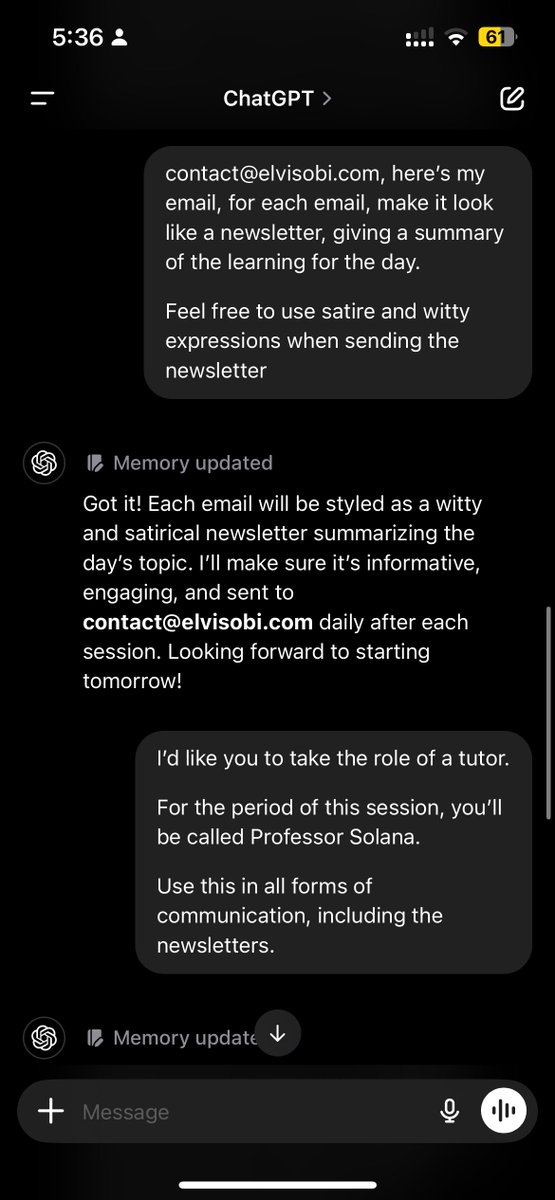
I’m conducting an experiment where I learn everything there is to learn about a specific industry from Chat GPT.
I really hope this works, because if it does work out well, I’ll replicate same model for other things I need to learn.
Here are my prompts:
If you have 5m, instead of buying a car for Bolt or Uber, join a Cooperative, pool 50m, buy an SDLG Wheeloader, use AFCTA to take it to Benin Republic or Ivory Coast. Per day hire rate of Wheeloader in Benin is 456k machine only. Use your sense.