O comentarista suíço David Lemos, encerrou a transmissão resumindo com precisão os problemas desta Copa do Mundo, ele foi perfeito.
🗣️"Não há dúvidas de que esta foi a Copa do Mundo mais comercial da história e também uma das mais politizadas."
"Não esqueceremos os preços que pessoas sem grande poder aquisitivo tiveram de pagar para viver sua paixão pelo futebol."
"Em alguns casos, sequer puderam entrar no país por causa de sua nacionalidade, fossem torcedores, jornalistas ou até árbitros, como o somali Omar Artan."
"Também lembramos do tratamento inaceitável dado à seleção do Irã, que não pôde defender suas chances de forma adequada durante o torneio."
"E há ainda o caso de Folarin Balogun. Vimos um presidente se vangloriar de ter ligado para o presidente da FIFA para conseguir retirar a suspensão de um jogador."
"A política se infiltrou no coração do futebol, embora a FIFA afirme querer mantê-la acima de tudo. Fica claro que isso só vale até certo ponto."
"Foi uma Copa do Mundo em que todas as partidas foram disputadas em quatro tempos, e cuja final teve um intervalo de quase 30 minutos."
"A crise tem dois nomes: dinheiro e poder. Hoje existe uma crise de confiança entre muitos dos envolvidos no futebol e a FIFA."
"Nas próximas semanas, muito dinheiro será distribuído a diversas federações e a muitos agentes do futebol, que serão educadamente convidados a permanecer em silêncio."
"Esperamos que tudo isso seja levado em consideração e que não volte a acontecer."
Israeli settlers attacked a foreign activist and another man as they blocked access to Palestinian farmland, before chasing the group of residents away with pepper spray and rocks.
🚨 WTF?! Prominent journalist Mehdi Hasan reveals a UN report confirming a Zionist quadcopter sniper intentionally shot a 10-day-old baby in the head.
The infant was being breastfed.
The UN confirms the Israeli operator clearly saw the mother and baby. Pure evil!
That time when an unarmed Iranian ship was invited to take part in an Indian naval exercise alongside the United States.
Its sailors were welcomed on land and paraded before Indian President Modi as a gesture of respect.
Then, at the last moment, the United States suddenly abruptly withdrew from the exercise,only to wait and torpedo the very ship it had just stood beside.
What followed was even more grotesque.
After attacking an unarmed vessel, the US refused to rescue the sailors it had blown into the sea, abandoning them to drown.
The grim work of recovering bodies was left to the Sri Lankan Navy.
This wasn’t warfare,it was treachery of the most disgraceful kind: an ambush carried out under the pretense of diplomacy, followed by a cold refusal to show even the most basic human decency to the dying.
It would represent a collapse of every norm that supposedly governs civilized conduct at sea.
And yet, instead of outrage, much of the American media response has been indifference or rationalization.
The bombing of a girls’ school is brushed aside; talk of carpet-bombing Tehran is floated as if it were just another policy option.
When atrocities are normalized and cruelty is laundered into “strategy,” the line between reporting and complicity begins to disappear......
i'm obsessed with what's happening in AI reforestation right now
this Franco-Brazilian startup called MORFO took a patch of land in Brazil that was rock-hard and compacted from years of cattle farming. they replanted it using a single drone. months later the ground was covered in grass, bushes, and small trees. the land came back to life.
here's how the whole thing works.
1. drones scan the terrain with high-resolution cameras and sensors
2. AI analyzes the imagery alongside soil samples, moisture levels, slope, and surrounding vegetation
3. the system picks from a catalog of 300+ native species, deciding exactly which plants will thrive in which specific spot
4. the drone fires biodegradable seed pods packed with seeds, nutrients, and moisture at 180 capsules per minute
5. satellite and drone imagery monitors regrowth over time, with AI tracking vegetation cover and biodiversity
6. two people and one drone cover 50 hectares a day. a person planting by hand manages about one hectare.
and MORFO isn't alone. AirSeed in Australia drops 250,000 seed pods per day into bushfire-scarred koala habitat, replanting swamp mahogany that koalas depend on to survive. Flash Forest in Canada fires 50,000 pods daily into wildfire-destroyed boreal forest, planning the replanting alongside Cree Indigenous communities. re-green won Prince William's Earthshot Prize after planting 6 million seedlings across 30,000 hectares of Amazon and Atlantic Forest.
five companies across four continents built this same approach independently. nobody coordinated. the physics of the problem demanded it.
knowing which seeds belong in which soil used to require years of ecological fieldwork, manual planting crews, and budgets that made large-scale restoration nearly impossible. now two people with a drone and an AI model trained on local soil data can replant 50 hectares before lunch.
this is the AI work that'll still matter in 50 years.
22 YEARS LATER AND NOBODY HAS ANSWERED FOR WHAT HAPPENED TO DR DAVID KELLY
His name was Dr David Kelly. Most people have forgotten him. They shouldn't.
He was a quiet, mild-mannered scientist who spent his career inspecting weapons facilities around the world.
He knew more about Iraq's arsenal than almost anyone alive.
In 2003, Tony Blair's @InstituteGC government published a dossier claiming Saddam Hussein could deploy chemical weapons within 45 minutes. That claim was used to justify a war.
Kelly knew the intelligence behind it was being exaggerated. He said so, privately, to a @BBCNews journalist.
That one conversation destroyed his life.
The government found out he was the source. Instead of protecting a man who had served his country for decades, they quietly let his name reach the press. He was publicly identified, dragged before two parliamentary committees, and grilled by his own employer.
His wife said he came home a broken man.
On the afternoon of 17 July 2003, he left his house for a walk in the Oxfordshire countryside. He was 59 years old. He never came back.
His body was found the next morning in woodland. A knife beside him. A blister pack of painkillers nearby.
Here is where it gets worse.
Tony Blair personally intervened to replace the normal coroner's inquest with a private inquiry run by Lord Hutton.
The original inquest was suspended before it even properly began. It was never resumed. To this day,
Dr David Kelly is the only person in England and Wales in living memory to have died in unexplained circumstances without receiving a full coroner's inquest.
Lord Hutton concluded suicide. Case closed.
Except eight senior doctors and a former coroner wrote to @thetimes saying the verdict was medically unsafe.
The wound found on Kelly's wrist, a severed ulnar artery, would not cause fatal blood loss in a healthy person.
There were no fingerprints on the knife. The painkillers found were not in a quantity that experts considered lethal.
The government's response, delivered by Attorney General Dominic Grieve in 2011, was essentially: the Hutton Inquiry was good enough, stop asking questions.
Think about that. A man quietly raised concerns about the biggest political deception in modern British history, a war that led to the deaths of hundreds of thousands of people. He was publicly exposed, professionally destroyed, and found dead days later and the government personally made sure there would never be a proper independent investigation into how he died.
Tony Blair went on to become a Middle East Peace Envoy. He has a knighthood.
Dr David Kelly got a private inquiry, a rushed verdict, and a sealed post-mortem report that was not released to the public for years.
Nobody was ever held accountable. Not for any of it.
This story should be on the front page every single year. Share it if you think it matters.
Sources: @BBCNews@guardian@thetimes@PrivateEyeNews
No one decides the future of Albania, but the Albanian president people!
We have outlasted every empire, division of our people by the West boundaries, survived Communism, poverty and genocide!
We were here and will be here till the end of time.
I’m curious given the current situation with the war in Iran. Why hasn’t the USA tried to breach the Internet blackout.
Surely this would be a much more cost effective approach to further bombings and would allow Iranians to organise and share information.
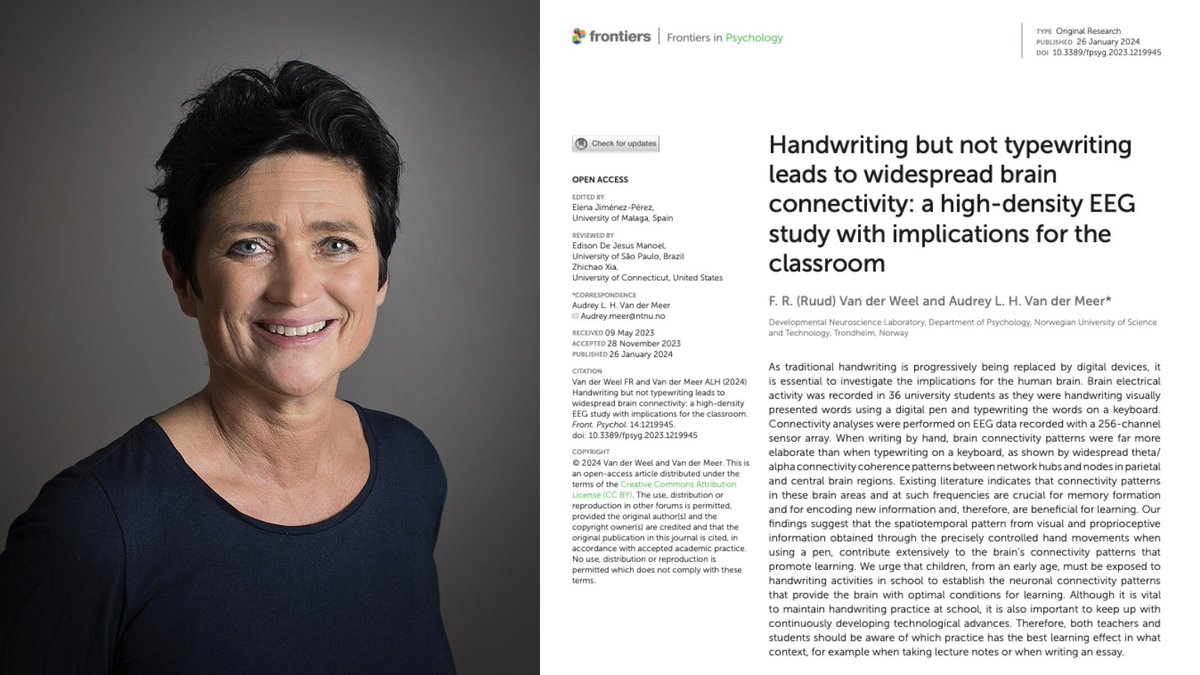
A Norwegian neuroscientist spent 20 years proving that the act of writing by hand changes the human brain in ways typing physically cannot, and almost nobody outside her field has read the paper.
Her name is Audrey van der Meer.
She runs a brain research lab in Trondheim, and the paper that closed the argument was published in 2024 in a journal called Frontiers in Psychology. The finding is brutal enough that it should have changed every classroom on Earth.
The experiment was simple. She recruited 36 university students and put each one in a cap with 256 sensors pressed against their scalp to record brain activity. Words flashed on a screen one at a time.
Sometimes the students wrote the word by hand on a touchscreen using a digital pen, and sometimes they typed the same word on a keyboard. Every neural response was recorded for the full five seconds the word stayed on screen.
Then her team looked at the part of the data most researchers had ignored for years, which is how different parts of the brain were communicating with each other during the task.
When the students wrote by hand, the brain lit up everywhere at once.
The regions responsible for memory, sensory integration, and the encoding of new information were all firing together in a coordinated pattern that spread across the entire cortex. The whole network was awake and connected.
When the same students typed the same word, that pattern collapsed almost completely.
Most of the brain went quiet, and the connections between regions that had been alive seconds earlier were nowhere to be found on the EEG.
Same word, same brain, same person, and two completely different neurological events.
The reason turned out to be something nobody had really paid attention to before her work. Writing by hand is not one motion but a sequence of thousands of tiny micro-movements coordinated with your eyes in real time, where each letter is a different shape that requires the brain to solve a slightly different spatial problem.
Your fingers, wrist, vision, and the parts of your brain that track position in space are all working together to produce one letter, then the next, then the next.
Typing throws all of that away. Every key on a keyboard requires the exact same finger motion regardless of which letter you are pressing, which means the brain has almost nothing to integrate and almost no problem to solve.
Van der Meer said it plainly in her interviews.
Pressing the same key with the same finger over and over does not stimulate the brain in any meaningful way, and she pointed out something that should scare every parent who handed their kid an iPad.
Children who learn to read and write on tablets often cannot tell letters like b and d apart, because they have never physically felt with their bodies what it takes to actually produce those letters on a page.
A decade before her, two researchers at Princeton ran the same fight using a completely different method and ended up at the same answer. Pam Mueller and Daniel Oppenheimer tested 327 students across three experiments, where half took notes on laptops with the internet disabled and half took notes by hand, before testing everyone on what they actually understood from the lectures they had watched.
The handwriting group won by a wide margin on every question that required real understanding rather than surface recall.
The reason was hiding in the transcripts of what the two groups had actually written down.
The laptop students typed almost word for word, capturing more total content but processing almost none of it as they went, while the handwriting students physically could not write fast enough to transcribe a lecture in real time, which forced them to listen carefully, decide what actually mattered, and put it in their own words on the page.
That single act of choosing what to keep was the learning itself, and the keyboard had quietly skipped the choosing and skipped the learning along with it.
Two studies. Two countries. Same answer.
Handwriting makes the brain work. Typing lets it coast.
Every note you have ever typed instead of written went into your brain through a thinner pipe. Every meeting, every book highlight, every idea you captured on your phone instead of on paper was processed at half depth.
You did not forget those things because your memory is bad. You forgot them because typing never woke the part of the brain that would have made them stick.
The fix is the thing your grandmother already knew.
Pick up a pen. Write the thing down. The slower road is the faster one.
This is beyond horrifying.
New data shows Israel has killed over 680,000 Palestinians in Gaza.
Among them:
• 380,000 infants under 5
• 99,000 children over 5
That’s 479,000 children murdered by Israel.
Israel isn’t “defending itself.”
It is wiping out Palestinian life.
Here is to beauty, despite all the calamity. Here is to moments that stir the soul and awaken our shared humanity.
Here is to wonder. Here is to surprise. Here is to the small miracles that reopen our eyes.
Here is to laughter that lightens heavy days, To awe and connection in unexpected ways.
And here is to all the things, simple, sacred, and true That remind, us despite the challenges, life is a gift and we are lucky to live it through.
What Gaza taught me about human beings is that people can remain profoundly beautiful even inside unimaginable suffering.
I was working in resuscitation bays so hot that sweat would drip off my arms while we worked on children torn apart by bombs.
And still, families would tap me on the shoulder to hand me water.
The cook at the hospital learned that I loved fried eggplant. Whenever he made it, he would come find me somewhere in the hospital, sometimes in the middle of chaos, just to hand me one small piece because he knew it made me happy.
People who had lost almost everything still wanted to take care of someone else.
Sometimes a person would simply take my hand and quietly walk with me to sit down for a moment so we could just exist together as human beings for a minute before going back into the horror.
And one moment will stay with me forever.
I told a father that I was American. That my country had paid for the bombs that killed his child.
And instead of anger, he hugged me.
He rejected the idea that I carried personal blame for what had happened to him. He gave me kindness at the exact moment when I felt least deserving of it.
I went to Gaza thinking I was going there to help people survive genocide.
Instead, they helped me survive it too.
Gaza showed me something devastating and beautiful about humanity itself.
That even surrounded by death, grief, fear, hunger, destruction, people still reached toward each other.
Still shared food.Still offered comfort.Still protected tenderness.
And to walk away from that was much harder than I ever imagined.
–doctormarkbrauner/IG
He was eating with his girlfriend when his dad who is a delivery driver, walked in and saw him.
His dad quietly asked him not to show that they knew each other, so as not to embarrass him, but the son proudly hugged his father and introduced them.