PRESALE LIVE NOW 👇
https://t.co/KCHoG83OQj
💰IT'S TIME TO PUMPPP💰
Only 120 SLOTS are OPEN! 😱
Join our community:
TG: https://t.co/YOWlaMGosL
TW: https://t.co/niIrwbhW22
IG: https://t.co/lODp15mUH9
#Omniverse#Omnicash
It has now been more than four years since CAW was deployed.
During that time, we’ve seen countless theories.
“CAW is Elon Musk’s project.”
“It’s connected to SHIB or Ryoshi.”
“It’s tied to the future of X.”
“No… it’s just another meme coin.”
There are many different opinions, yet to this day, no one has presented definitive proof that settles the debate.
For the record, I’m still Team Elon.
I know there’s no conclusive evidence, and yes, I get criticized for saying it.
But that’s part of being a researcher.
We’re allowed to have a favorite theory.
At least I hope so.
Over the years, people have analyzed on-chain data, decoded images, studied hidden messages, connected timelines, and challenged one another’s ideas.
Because there isn’t a clear answer, people from all over the world continue trying to solve the same giant puzzle from different perspectives.
I think that, in itself, has value.
Not because one person is right.
But because a decentralized community is constantly questioning, debating, and searching together.
Recently, however, I’ve started thinking about a different question.
For years we’ve asked:
“Who created CAW?”
“Who’s behind it?”
“When will something finally happen?”
But perhaps those aren’t the most important questions anymore.
Maybe the real question is this:
Will a decentralized network like CAW actually become valuable in an AI-driven world?
A few years ago, cryptocurrency was primarily about speculation.
Which token would pump?
Which exchange would list it?
Who was buying?
How many X’s could it do?
Those questions still matter.
But the world is changing.
AI is no longer just answering questions.
It’s beginning to collect information, make decisions, write code, execute tasks, communicate with other AI systems, and eventually it may manage assets and perform transactions on its own.
We’re moving from an internet operated by humans…
to one increasingly operated by autonomous AI agents.
If that future arrives, what kind of financial infrastructure will those AI agents actually use?
Closed, centralized platforms controlled by corporations?
Financial systems limited by national borders?
Or open, permissionless networks that operate 24/7 without requiring approval from a central authority?
AI has no nationality.
It doesn’t sleep.
It doesn’t care about banking hours.
It doesn’t naturally fit into the financial systems that humans built for themselves.
When you look at it that way, decentralized networks may actually be a better match for AI than for humans.
And that’s where another thought comes to mind.
What if CAW was never designed only for humans trading tokens?
What if it was designed with a future of AI agents, decentralized identity, open communication, and frictionless value transfer in mind?
And what if…
it’s simply waiting for the technology around it to mature?
Of course, that’s only a hypothesis.
There is no evidence proving that CAW is waiting for AI.
But something interesting is happening.
Today, decentralized identity, AI agents, permissionless communication, and borderless value transfer are far more relevant than they were when CAW first appeared.
1/2
People Don’t Follow Technology
They Follow Whatever Removes Friction
Throughout history, some technologies disappear while others become impossible to stop.
The difference is not always technical superiority.
Most people assume the best technology wins.
But history repeatedly shows something else:
The technologies that reshape civilization are usually the ones that reduce human friction.
⸻
The Internet Didn’t Win Because It Was “Advanced”
The internet was not immediately accepted.
In the early days, it was viewed as something for engineers, hobbyists, and computer nerds.
People had to understand things like:
-FTP
-DNS
-Modems
-IP addresses
-Command lines
For ordinary users, it was confusing and intimidating.
Connections were slow.
Setups were complicated.
And many people believed:
“Television is enough.”
“Newspapers are enough.”
“Phones are enough.”
But eventually the entire world moved online.
Why?
Because it became too convenient to ignore.
⸻
Humans Always Move Toward Lower Friction
This pattern appears everywhere in history.
The technologies that survive usually make life:
-faster
-simpler
-cheaper
-more automatic
-more intuitive
-less mentally exhausting
People do not ultimately choose based on ideology.
They choose based on reduced friction.
⸻
Smartphones Followed the Same Pattern
When smartphones first appeared, many people dismissed them.
“PCs are enough.”
“Typing on glass is terrible.”
“Physical keyboards are better.”
But the outcome became obvious.
Today, most people reach for their phone before opening a computer.
Why?
Because smartphones removed friction.
-instant access
-always connected
-one-touch interaction
-built-in payments
-cameras, maps, communication, everything in one place
The smartphone succeeded because it hid complexity.
Most users do not understand:
-operating systems
-processors
-memory management
And they do not need to.
That is the point.
⸻
AI Is Following the Exact Same Path
AI is not simply another software trend.
It may become an internet-scale shift — or larger.
Because AI is beginning to remove friction from interaction itself.
⸻
Old Interfaces Forced Humans To Adapt
Traditional software required people to learn:
-menus
-buttons
-settings
-folder structures
-commands
Humans had to adapt to machines.
AI reverses this.
Now machines adapt to humans.
⸻
Conversation Is Becoming the New Interface
Instead of navigating systems manually, people increasingly say:
“Summarize tomorrow’s meeting.”
“Send money to this person.”
“Book a hotel.”
“How should I answer this interview question?”
“What strategy makes sense right now?”
And the system handles the complexity underneath.
This changes everything.
Because humans naturally avoid learning overhead whenever possible.
⸻
Web3 Today Looks Like the Internet in the 1990s
Modern crypto infrastructure is still too difficult for normal users.
Most people do not want to think about:
-seed phrases
-gas fees
-bridges
-RPC endpoints
-wallet signatures
-chain switching
-explorers
This is very similar to the early internet era.
Back then, average users also struggled with technical layers.
The internet only exploded after those layers became invisible.
⸻
The Real Winners Will Hide Complexity
This is the key point.
The projects most likely to reshape the future are not the ones adding more complexity.
They are the ones hiding it.
The future likely belongs to systems where users no longer think about blockchains at all.
That means:
-gasless interactions
-minimal wallet signing
-username-based identity
-AI-driven interfaces
-hidden chain infrastructure
-abstracted backend systems
Users do not care which chain processes a transaction.
They care whether the experience feels effortless.
Why Recent CAW Social Development Is Interesting
Recent statements from the CAW development side are notable for this reason.
For example:
“The real CAW has profiles on ETH, staking on ETH, and never requires gas on another chain.”
The important part is not the token itself.
It is the UX direction.
Another statement said:
“The real CAW lets you like/post/follow without signing your wallet constantly.”
That points toward:
-gas abstraction
-signer abstraction
-account abstraction
-profile-based identity layers
-frictionless social interaction
This is no longer just “a meme coin with a social platform.”
The architecture direction is beginning to resemble:
-Farcaster
-Lens
-Bluesky-style decentralization
-social infrastructure layered over blockchain systems
⸻
X Does Not Need Another Token
Most people ask the wrong question.
They ask:
“Will X adopt CAW?”
But the deeper question is:
“What does X actually need?”
X does not need another speculative asset.
It does not need another meme token.
It already has:
-users
-distribution
-identity graphs
-AI integration
-payment ambitions
If X eventually integrates deeper crypto infrastructure, it likely needs:
-identity layers
-payment abstraction
-censorship resistance
-AI-native interaction
-cross-chain persistence
-gasless user experiences
In other words:
The value may not be in the currency itself.
The value may be in the infrastructure.
⸻
The Most Powerful Technologies Eventually Become Invisible
This always happens.
People no longer think about:
-TCP/IP
-HTTP
-DNS
when using the internet.
They no longer think about:
-processors
-memory
-operating systems
when using smartphones.
The strongest technologies disappear into the background.
They become invisible.
⸻
Web3 Will Likely Follow The Same Path
In the future, ordinary users probably will not care about:
-which chain is being used
-what signing method exists
-which Layer 2 is involved
They will only care about:
-speed
-simplicity
-low cost
-AI interaction
-sending by username
-seamless experiences
The winning systems will not necessarily be the most technically complicated.
They will be the ones that remove the most friction.
⸻
History Keeps Moving In The Same Direction
Human civilization repeatedly moves toward:
-less effort
-less complexity
-more automation
-more intuitive systems
-faster interaction
And once people experience lower friction,
they rarely go backward.
The internet followed this path.
Smartphones followed this path.
AI is following this path now.
And if Web3 eventually reaches mass adoption,
it may not happen because people “love crypto.”
It may happen because the infrastructure becomes so frictionless that people stop noticing it exists at all.
The real $CAW has profiles on ETH, staking on ETH, and never requires gas on another chain.
The real CAW lets you like/post/follow without signing your wallet constantly.
The real CAW will win the world.
Still building, everyday.
Brick by brick we build an empire.
CAW Social’s architecture has made me think about something recently.
A lot of people assume:
“If anyone can build their own frontend, wouldn’t that become a problem for a massive platform like X?”
But the reality may actually be the opposite.
If X is ultimately moving toward:
・Identity
・Payments
・AI
・Social infrastructure
・Everything App architecture
then the most important thing is probably not:
“owning every app.”
It’s:
“owning the underlying infrastructure.”
The recently released CAW documentation strongly points toward:
・Frontend separation
・Validator separation
・Permissionless frontends
・Gasless actions
・Username identity
In other words:
“The UI is flexible.
The protocol is shared.”
This is actually how the internet itself works.
Anyone can build on HTTP.
Yet platforms like Google, YouTube, and X still become dominant frontends.
Because:
protocol ≠ frontend.
So if X were ever to use something like CAW as an underlying layer in the future, the existence of additional frontends would not necessarily hurt X at all.
In many ways, it could strengthen the ecosystem.
Different frontends allow:
・Regional specialization
・Financial specialization
・AI-focused interfaces
・Rapid UX experimentation
・Faster innovation
And for protocol-based ecosystems, that is usually a positive.
What ultimately matters is where the largest liquidity, identity graph, AI layer, and user base exist.
If X controls:
・The largest social graph
・The largest AI integration
・The largest payment flow
・The largest identity layer
then X remains central regardless of how many additional frontends exist around it.
In fact, multiple frontends may actually increase:
“censorship resistance.”
And that seems very aligned with the direction these systems are moving toward.
What makes CAW particularly interesting is that the architecture no longer resembles a typical meme coin project.
The focus is increasingly on:
・Validator batching
・Cross-chain archives
・Frontend abstraction
・Gasless signatures
This is infrastructure design.
More importantly, it is infrastructure designed to hide blockchain complexity from normal users.
And that is extremely compatible with where X Money and AI-native finance appear to be heading.
Another major shift coming over the next few years is likely the transition from:
“button-first interfaces”
to:
“AI-first interfaces.”
People will increasingly stop “using apps” directly.
Instead, they will simply instruct AI what to do.
But reality still matters.
People spend time in:
・Trains
・Offices
・Quiet public spaces
Which means the future probably is not voice-only.
The real future is more likely:
“AI + silent UI.”
Interfaces where:
・AI is always present
・Voice is natural when possible
・Buttons appear only when necessary
・Complexity stays hidden underneath
And interestingly, many of the recent developments around CAW seem to be moving in exactly that direction.
At this point, the important question may no longer be:
“Will CAW officially integrate with X?”
The more important question is:
“Is CAW evolving toward the same structural future that X itself appears to be building toward?”
And based on the recently released architecture and documentation, the alignment appears significantly stronger than before.
2/2
This is not simply “social media.”
It is decentralized social infrastructure.
And this is where things become particularly interesting in relation to X.
For years, X has been moving toward:
・Payments
・Identity
・Creator economies
・Everything App architecture
・Financial layers
If X Money eventually becomes real at scale, the underlying system would almost certainly require:
・Invisible wallets
・Gas abstraction
・Username-based identity
・Frictionless interactions
Because mainstream users will never tolerate blockchain complexity directly.
And CAW’s architecture is increasingly moving in exactly that direction.
The Username NFT model is especially notable because it mirrors the importance of the @username identity layer inside X itself.
That is why many people are beginning to speculate more seriously that CAW may not simply be “another token,” but part of a much larger long-term infrastructure vision connected to the future direction of social platforms.
Another fascinating detail is that the ecosystem now appears to be evolving in multiple layers simultaneously.
The core side seems focused on:
・Social infrastructure
・Validators
・Protocol architecture
While independent builders are exploring:
・AI interfaces
・Financial UX
・Payment layers
・Super App concepts
This creates a surprisingly complementary structure.
Not competition.
A layered ecosystem.
Especially in the AI era, interfaces themselves are changing.
The future likely shifts from:
“button-first UI”
toward:
“AI-first UI.”
But reality matters.
People are often in places where they cannot speak:
・Trains
・Public spaces
・Quiet environments
Which means the real future is probably not “voice-only.”
It is:
AI + silent UI hybrid systems.
Interfaces where:
・AI is always present
・Voice is natural when possible
・Buttons remain available when necessary
・Complexity stays hidden underneath
And interestingly, CAW-related builders are already beginning to move in that direction.
At this point, the most important question may no longer be:
“Will CAW officially integrate with X?”
Instead, the more important question becomes:
“Is CAW evolving toward the same structural future that X itself appears to be moving toward?”
And based on the recently released architecture and documentation, the alignment now appears significantly stronger than before.
CAW can no longer be explained as just another meme coin.
After the recent release of CAW Social and the newly published development documentation, it has become increasingly clear that the architecture is designed around:
“decentralized social infrastructure + gasless execution + username identity + cross-chain persistence.”
This is not a normal social app.
In many ways, it aligns surprisingly closely with the direction X (formerly Twitter) has been moving toward for years.
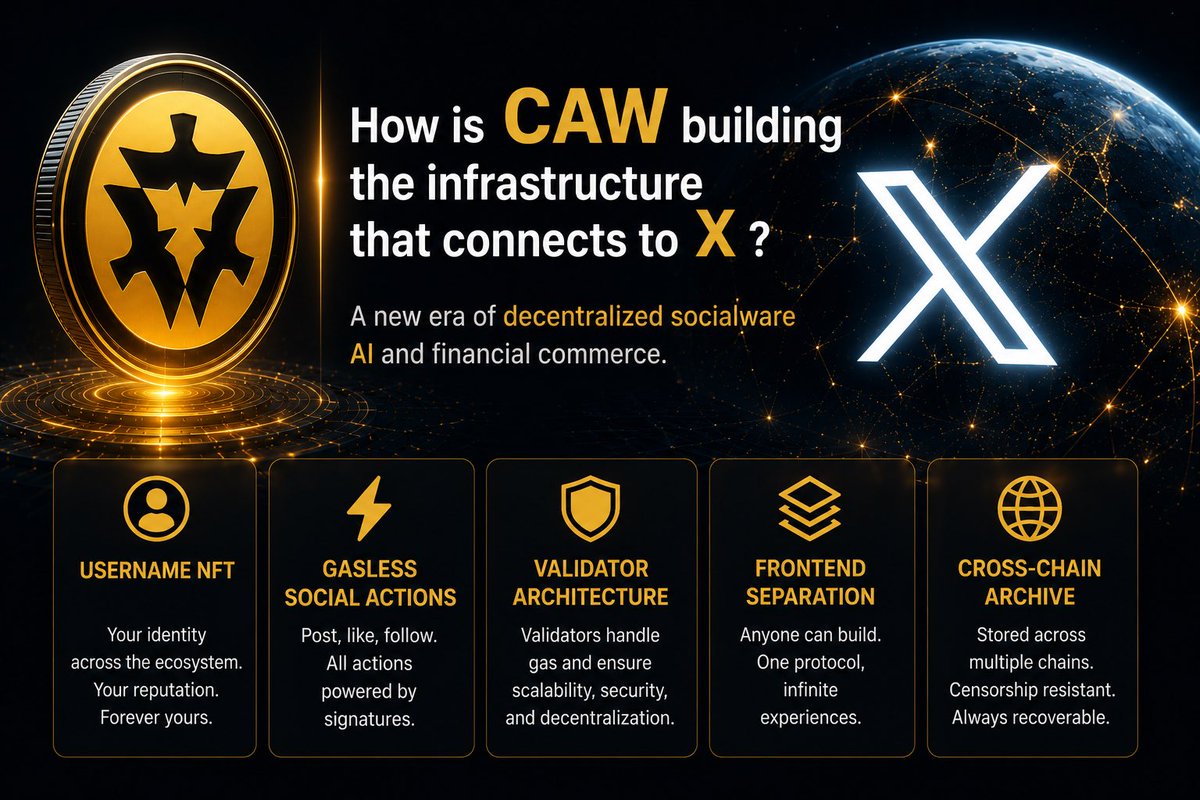
The most important parts of the newly revealed structure are these four elements:
・Username NFTs
・Gasless Social Actions
・Validator Architecture
・Frontend Separation
Once these four pieces exist together, users no longer need to understand blockchain itself.
That means:
・No gas fees
・No wallet complexity
・No chain selection
・Everything works through signatures
In other words, a fully Web2-like experience built on top of Web3 infrastructure.
The CAW documentation explicitly describes systems where:
・Usernames function as NFTs
・Posts, likes, and follows are signature-based
・Validators handle gas costs
・Anyone can build their own frontend
・Data is archived across chains through LayerZero
This is far beyond a typical meme token structure.
Most meme projects stop at:
“DEX listings”
“Burn mechanisms”
“CEX speculation”
But CAW appears to be moving toward something much larger:
A social protocol.
What makes it even more interesting is the philosophy behind it.
The documentation strongly emphasizes:
“Frontends are independent.”
That means CAW is being built as a shared infrastructure layer composed of:
・Protocol
・Validators
・Storage
・Identity
And on top of that infrastructure, anyone could theoretically build:
・Social apps
・Wallets
・Financial interfaces
・AI-powered experiences
This philosophy feels much closer to Farcaster, AT Protocol, or Nostr than to a traditional meme ecosystem.
Another major point is the extreme focus on censorship resistance.
One FAQ section explains that even if one storage chain disappears, content can still be reconstructed from other archive chains through LayerZero.
That means:
・Posts
・Follow graphs
・Action histories
are intended to persist permanently.
1/2
What feature set would excite you the most to be integrated into CAW at some point in the future?
(Zero promises that any of these will be built. I'm honestly just doing research for polling UX right now)
The time has come.
For teh ppl
#CAW testnet is now live, please follow @caw_dev’s instructions below to access.
==> https://t.co/XmoC7AAPfC
Thank you to all of the Cawmmunity for their unwavering support 🌙
The vision of the manifesto is finally being fulfilled.
Okay frens. Testnet is live.
==> https://t.co/i5e4gVNOQX
Thank you everyone for being here and enduring the long journey this has been. I believe in the vision, the manifesto, and I believe in the future of $CAW. #TogetherWeFly.
Please understand:
=> This is not YET meant to be a fully finished product.
=> There will be bugs, there will be mistakes.
=> The important thing is that we work together to find them.
Please click the little bug button/icon to report any issues you find. 99% of my testing has been with Rabby on chrome desktop.
If you’re using other browsers or wallets or devices, be prepared to submit bug reports.
I will redeploy these contracts and blow away the database at some point, so your data is… well forever on chain, but not forever on this front end.
---
Some notes for testnet:
It works with Sepolia, so you will need a little Sepolia-ETH in your wallet to send transactions.
Faucet here: https://t.co/4KLeMRFFAN (or you can use https://t.co/NpXeU5lxkJ)
Once you have Sepolia ETH, you’ll need to get some mCAW (mintable caw) there is a faucet on the app.
https://t.co/ljVqrrrhVK
From the developer side, I’ve made an extremely easy 1-liner for anyone who would like to try to install a front end node on their own server. Just run:
/bin/bash -c "$(curl -fsSL https://t.co/ik5mZSTaRe)"
It’s as simple as that.
It will ask you questions.
You might have questions.
I will be here to help answer questions (after I sleep).
🚨 Before using the CAW beta:
• New wallet
• No real funds
• Never share your seed phrase
• Don’t sign what you don’t understand
💡 Testing is safe when funds are separated.