And people were asking me why I cried. This win was for my mom, who had to endure days when I’d starve because Arsenal lost, who made me Afang to celebrate the last time we were champions and who is no longer here.
And this win is also for Leo who fought his own title fight and is now starting his journey at Arsenal with a trophy.
This is more than football. This is life, and we are The Arsenal.
Congrats Leo. Many more wins to come.
To understand Trump's greatness - the number of times America has defeated a country.
Germany - 2 times (1918, 1945)
Japan - 1 time (1945)
Iran - 18 times (2025-2026)
I know it’s 12:20. But please take your time and listen to this Vincent Kompany statement about the racism incident around Vini Jr. against Benfica. Succinct, differentiated and absolutely on point. Brilliant words.
There’s a French sociologist who explained this. His name was Pierre Bourdieu. In his book “Distinction: A Social Critique of the Judgement of Taste” he explained how the taste scale is manipulated by the rich and powerful by culturally engineering good-bad tastes, because the power lies solely in their hands to rationalize what their wealth can afford over the less fortunate as good taste. He later argued that anything can be regarded as “good taste” as long as it’s associated with the elites as even when their original taste became easily afforded, they move in the opposite direction of materialism. For instance, when the ordinary people could afford loud luxury, they elites moved onto quiet luxury.
As with El Dee’s example here, BWM will “cast” not because it’s no longer BMW, but because the value is tied to how many people can afford it. It’s all social engineering. Jazz music is not objectively a better music taste than other genres, neither is golf objectively more exquisite than any other sport. It’s all manipulation, and so unfortunate that the poor are helping them establish this artificial segregation.
He pounded Boko haram so hard that many northern elements started complaining.
Lieutenant General Azubuike Patrick Ihejirika (rtd.)
1. He Created the 7th Infantry Division (7 Div) in Maiduguri
Before he came in, the Army had no division focused solely on the Northeast.
He established 7 Division Nigerian Army in 2013
2. He Introduced New Military Hardware
Ihejirika invested heavily in:
•Armored Personnel Carriers
•Mine-resistant vehicles
•Rocket-propelled artillery
•Surveillance and communication equipment
These upgrades gave troops better protection and firepower for counter-terror missions.
3. Ihejirika’s forces reclaimed about 90 towns and villages and killed roughly 1500 Boko Haram fighters during his tenure.
No bro, your take is not rigorous enough and you’re missing my point. There is something fundamentally wrong with turning an impulse into a principle. The impulse to judge people by their looks is pre-rational. It’s a flicker of instinct, a biological alert system reacting to novelty, difference, or perceived threat. It is automatic and unchosen. A principle, on the other hand, is post-rational. It’s a deliberate, conscious rule you endorse as a lens through which to interpret the world. To collapse the former into the latter is very silly. You cannot canonize an impulse because an impulse hasn’t yet passed through the filters of scrutiny, context, or moral responsibility.
When you see someone dressed in an unusual way, your mind sends a signal that something is “off.” That is not judgment. That is a nervous system reacting to unfamiliar data. The mature response is to suspend that reaction long enough for reason to intervene, leaving space to evaluate the person on their actual merits. It’s the same distinction between having thoughts and thinking. Thousands of thoughts pass through the mind each day but they only become judgments when you endorse them.
This is how you confront racism, tribalism, bigotry, or any other form of instinctive bias. You cannot say “judge people by how they look,” because that turns a reflex into a rule. Judgment is a conscious act. It’s an imposition of your prejudice onto someone else. And if we were all judged immediately and absolutely by appearance, none of us would benefit. By the same logic, the state would be justified in arresting you on sight simply because your appearance deviates from someone’s personal standard of “conventional.” That is the absurdity this thinking leads to.
In a multicultural, heterogeneous world, our minds are constantly making micro-assessments about appearance, tone, posture, belief temperament etc. But these subtle assessments are not judgments; they are intuitions. They are invitations to investigate further, not permissions to conclude.
Also, judgments based on appearances are the worst of all judgments. The range is extreme and the margin of error is catastrophic. Appearance is the least reliable proxy for character because it reflects the conditions of a person far more than the constitution of a person. It tells you what they could afford, what they inherited, what their culture normalizes, what their anxieties mask, or what their aesthetics prefer, not who they are, what they value, or how they behave.
@FinPlanKaluAja1, sorry to pop into your TL again. After spending a lot of productive time in the last few days on this “CristianGenocide” brouhaha, I wanted to stay off X to recover from the the trauma of senseless attacks from ill-informed data-bots. But on this Venezuelan issue, I have to speak up. I hope my contribution helps to provide your followers with some context.
First, the link you shared is old news — a 2018 article hidden behind a paywall. Most of your followers won’t be able to access it, so if it is there to provide some context, it would clearly fail to do so.
The Venezuela situation is complex and cannot be reduced to a few flippant lines on social media that resemble beer-parlour analyses. I should know: from late 1998 (a few weeks after Chavez first came to power) to 2003, I was a young expatriate oil engineer working in Venezuela’s oilfields, witnessing the conflict between Hugo Chavez’s government and Venezuelan oil workers firsthand.
Yes, when Pedro Tellechea, the ex-military man, became Chairman of PDVSA in January 2023, a prayer session may have been held — Venezuela, like Nigeria, is a deeply religious country that is about 90% Catholic - so that prayer in itself is not out of place.
But he served as Executive President of the national oil company, overseeing the country’s vast oil reserves and operations until August 2024, when Hector Obregon took over as Executive Vice President. Obviously, he was not merely on his knees praying for 20 months.
If you ever become the governor of Nigeria’s CBN, I hope your first act is to pray for success — even with unconventional prayer points, like finding miraculous ways to increase our foreign reserves. May your prayers be answered if you ever do that.
Now, let’s look at 2002–03. Hugo Chavez didn’t just wake up one day and sack all oil workers. Similar to what happened recently between Dangote and NUPENG/PENGASSAN, unions became political and resisted his oil reforms, asking workers to down tools and halt exports. On a Sunday, Chavez issued a widely broadcast ultimatum: return to work or be fired. Some returned, others didn’t. Production dipped from 3 to 2 million barrels per day, but returning engineers and managers soon restored it back to 3MBPD.
You are also economical with the truth about the military replacing sacked PDVSA staff. Chavez dismissed 50% of the 36,000 employees who refused to return. New recruits included fresh intakes, loyalists and retired or serving military officers, totaling about 20,000, with fewer than 10% of them being military personnel (engaged mainly in managerial positions). Chavez even sought assistance from other OPEC countries for personnel and countries like Iran and Algeria sent workers to help Venezuela stabilise their national oil company. Anyone reading your post would be forgiven to assume only Venezuelan military personnel replaced the 18,000 sacked workers, which is grossly misleading.
As a professional in your field, you know there is a wide gap between propaganda and facts. Simplistic summaries like yours are propaganda-friendly. Venezuela, like Zimbabwe, Haiti, Yemen, and Sudan, has faced economic difficulties in recent years - some visited on them by the same countries spreading such misinformation.
This renewed attention to Venezuela, echoed by people like you and other US right-wing propagandists, signals the US’s desperation to engage the country militarily. A waning superpower, saddled with multi-trillion-dollar debt, is eyeing a country weakened by sanctions and polarised by politics but sitting on the largest hydrocarbon reserves in the world — conveniently close to Washington.
Recent US drone strikes on alleged drug boats, the military buildup along Venezuela’s northern coast, and Venezuelan opposition leader Maria Machado’s recent Nobel Peace Prize are all dots on a timeline pointing toward the potential “Libya-nisation” of Venezuela — unless another power intervenes.
Even the PDVSA strikes and sackings only occurred after the failed US-sponsored coup attempt against Chavez in April 2002 — this is long-term geopolitical maneuvering. Sad, that your five short paragraphs omit all this context.
I captured my nearly five-year stint in Venezuela in a eulogy for Hugo Chavez after his death in 2013: You and your followers can access it here, https://t.co/9wzRsyAOTR, if interested.
I can only hope that, in my lifetime, my country, Nigeria, finds a leader as patriotic and courageous as Hugo Rafael Chavez Frias. He made mistakes, like we all do, but he loved his country deeply.
✌️
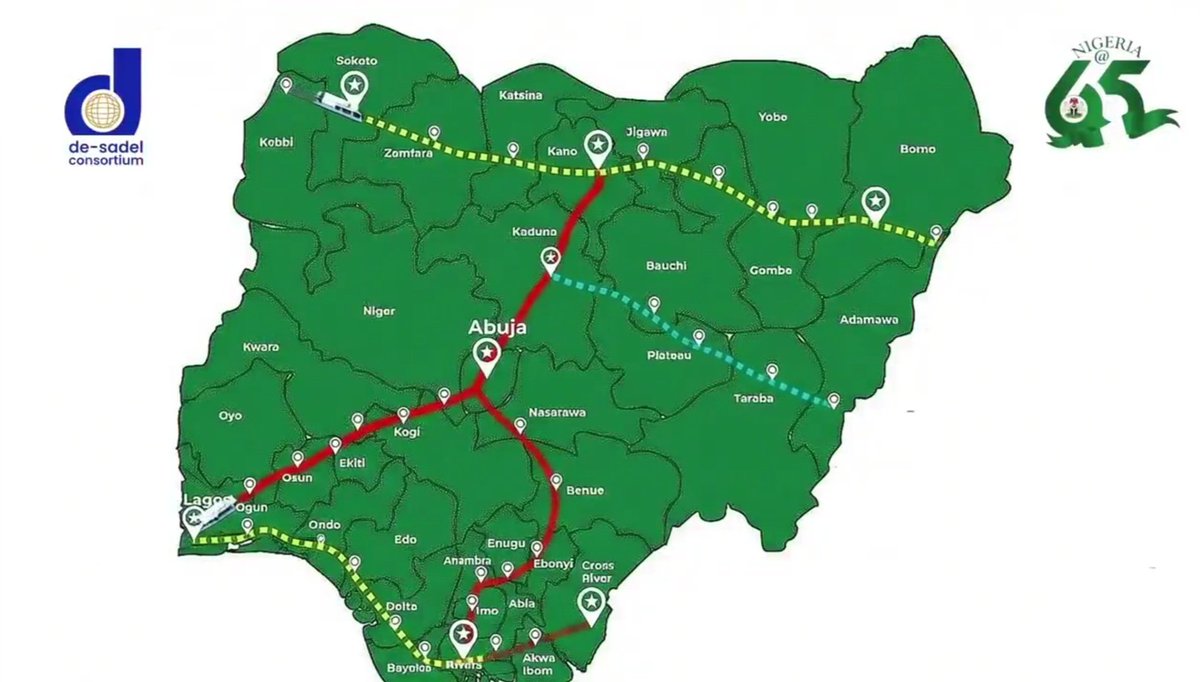
Designing a national rail network and prioritizing phase 1 (red) shows that they did not consider actual traffic patterns.
Lagos-Onitsha is the busiest traffic corridor but gets no direct connection in this plan.
Also, HSR from Sokoto to Mauduguri (top yellow) is LOL.