if you’re an iOS platform or mobile infra team with 10+ engineers, how much do you pay for macOS runners?
making something that cuts those costs by at least 3x fold
would be happy to hear other bottlenecks too
if you’re an iOS platform or mobile infra team with 10+ engineers, how much do you pay for macOS runners?
making something that cuts those costs by at least 3x fold
would be happy to hear other bottlenecks too
when reviewing PRs these days, I tend to always note to remove some specific mentions of Jira like tickets or overly commented code
and same when writing new code, I have agents to either comment in generalised way or not comment at all
so yes, comments are mostly bloats
• comments go stale very quickly and confuse agents and people
• they are often used by agents to explain workarounds that would've been better off actually fixing the code instead
• they are not enforceable and waste your agents' tokens
my point is that moving prose (comments, rules, agent.md, skills) into deterministic lint rules, better API design/types, is far more effective, enforceable, and token efficient.
comments are simply a crutch that agents will happily misuse
New on our Engineering blog: Creating in-house source control.
In May, we merged around 2,500 code changes per day. In September, we merged more than 30,000 per day. As a result, we became bottlenecked by developer infrastructure built for human (rather than agent) scale.
Here, we share how we built a new version control system—and fully migrated our monorepo from git—in five months: https://t.co/wzNkwHs7IN
yep, people outside of tech - which is the majority of the world - don’t care about software, SaaS, agents, LLMs and other tech world stuff
they care about their problems being solved and that’s it
if it’s agents solving your stuff with minimal interface and on schedule almost like your bills being auto-paid in your daily life, that’s it
I’m really trying to pretend this is true so RC doesn’t get steamrolled, but the more I think about it, the less I buy it.
1. Historically, the production of many types of goods have decreased dramatically in complexity and it didn’t transition to everyone just building it themselves. When electric tools were invented, did everyone transition to making their own furniture? Did the word processor end the book industry? Did the camera end the art industry? None of these quite match what we’re seeing but I haven’t found a case where humans have de-specialized.
2. Most consumers are exactly that, consumers. They are much lower agency than your average software person, probably lower creativity, and aren’t going to start building their own novel solutions to problems all of a sudden. Perhaps the models get so good they can do it somewhat transparently, but that would still require dictating requirements to the models, which itself is not something most consumers will be great at. And part of making “good” software is being opinionated. Models, due to the efforts of alignment, are limited in what they can say no to. The user asks for something that makes the software worse? “You’re absolutely right!” I’m not sure that taste and alignment are fully compatible.
3. Nothing ever happens. I think software will evolve, and what was a successful app three years ago will be very different three years from now, but it just doesn’t seem likely that after 10,000 years of increasing specialization and craftsmanship, humans will just resort to self reliance all of sudden. We want the expert opinion of other humans. We are interested in novel tools and experiences. Software products often bring with them community and identity that won’t go away. I just think an amplified version of the current trajectory more plausible than a complete reversal.
Tell me why I’m wrong!
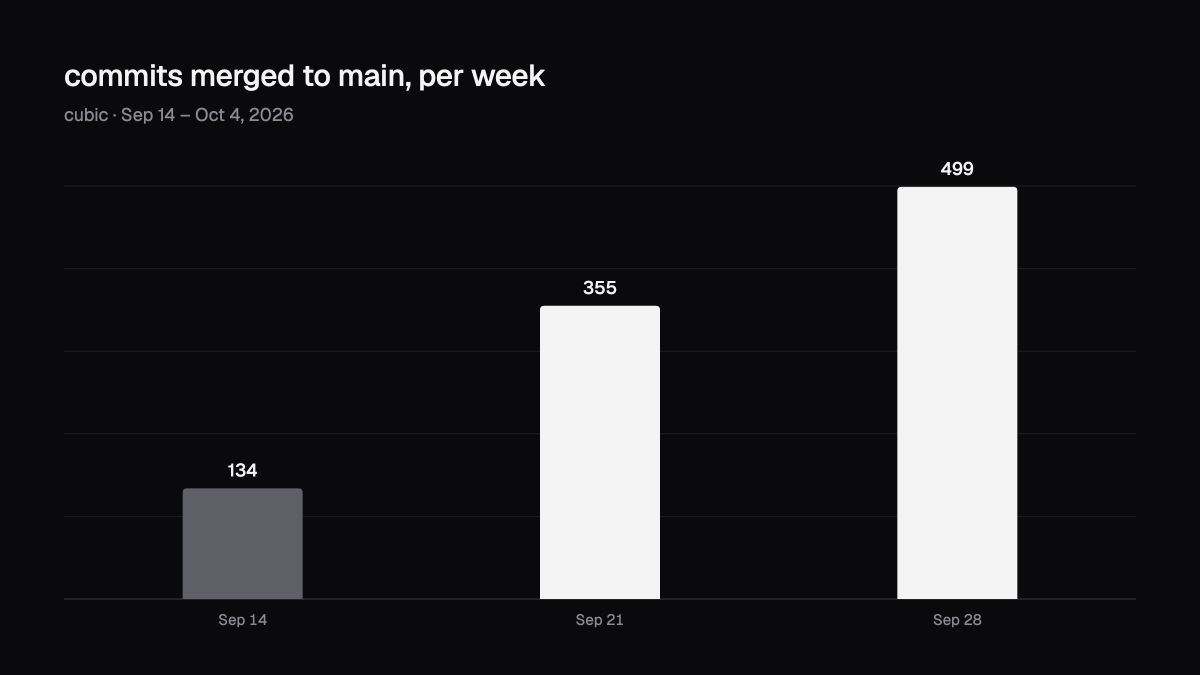
we merged 4x more commits last week than we did a month ago (thanks opus 5.5). our dev setup and CI couldn't keep up, so we reworked both:
• lint: 4x faster
• memory per agent session: half
• CI setup step: 50x faster
• CI type check: 10x faster
we often run 10+ agents at once locally, and each one runs its own lint, type checks and tests.
from time to time, several agents would run these at the same time and block each other.
a 64 GB MBP would run out of memory and crash. so most of the work was making things faster and lighter, or getting rid of them
we revamped our local setup to make checks faster and use less memory:
• oxlint and oxfmt instead of eslint and prettier, and type-aware lint only runs in CI. linting a changed file went from over 10s to a few seconds
• a hook formats every file an agent edits, so agents don't have to take a turn to format it
• typescript 7's native LSP instead of tsserver. each agent session uses about half the memory
• agents run one check script after each change. it installs missing packages and env files first, then lints, type-checks and runs the tests for what changed
• only 3 type checks or big test runs can run at once across all worktrees, so they don't slow each other down
we revamped our CI to make it faster:
• every CI job installs pnpm before it can install our packages. the standard github action for this (pnpm/action-setup) installs pnpm through npm, and that hung for 3-7 min on most of our test jobs. we now download the pnpm binary from github releases, which takes about 4s
• our type check needs about 9.5 GB of memory. github's standard runners have 8 GB, so it ran out of memory and took 206s. on a 16 GB machine it takes 20s
• vercel builds type-check with typescript 7 (85s to 45s), and previews only build for PRs that change the database
if you're running lots of agents, look at what they're waiting on. for us it was mostly lint, type checks and CI setup