Environment and Security is making the move over to Bluesky. Stay connected and follow us there at https://t.co/OMWulChz4M #ClimateSecurity#peacebuilding
Explore @cfnwan's new literature review which examines the three main frameworks that are being used to analyze how the confluence of climate change and geopolitics intensifies farmer-herder conflicts in West Africa
https://t.co/PEgI5CGhHA
With ongoing conflict between nomadic herders and farmers intensifying in Nigeria @Dan_Tuki’s new article seeks to quantify how perceptions of religion shape this issue and impact support for a new policy that would ban open grazing of livestock
https://t.co/tH2XGu6uHP
Check out Aleksandra Balinskaia’s new literature review which focuses on environmental peacebuilding papers that tackle interstate issues and finds natural resource management to be a key factor in reducing conflict and fostering peace
https://t.co/avrl8fp8e2
Check out Trine Marielle Wik and @AndrewWNeal’s analysis of how climate change is addressed in national security documents around the world and how a majority of the 94 countries they analyzed overlook the impacts of climate change on national security
https://t.co/dBgSr22BBu
Check out this thread by @KittyyKim and then read her new article about how community resistance to dam projects was fostered amid the violent conflict in Myanmar
https://t.co/P2PITNolIB
🌍 New Research Alert! 🌍
What happens when mega dams are planned in conflict zones? How do affected communities respond? Surprisingly, numerous dams are currently in development in regions grappling with conflict, posing significant security risks to local populations. 🧵1/n
As conflicts involving Nigerian security forces often occur in natural areas, a new study by @Greatdengis@EseimokumoA and Adah Miriam Uben analyzes how Nigerian security operations and policies degrade the environment and contribute to climate change
https://t.co/jjM3tAfhp0
While most climate security research examines the impacts of climate change on the current international system @KenConca and @geoffdabelko's new article identifies three ways the current system leads to climate related instability and conflict
https://t.co/Zg5EwIeVmE
As Iraqi oil revenues collapsed from 2014-2021 substantial shifts occurred in the political economy resulting in a more democratic society. Read @ShahlaKli@JaredMiller06 and Alex De Waal’s investigation on the effects of decarbonization on Iraq https://t.co/ZLfsRqjP21
Despite both experiencing similar hardships due to the oil shock of 2014-2015 the petro-states of Venezuela and Ecuador reacted in opposite ways. Read Katrina Burgess and @jcorrales2011’s analysis of the three main variables that affected these responses
https://t.co/HMPENdSilm
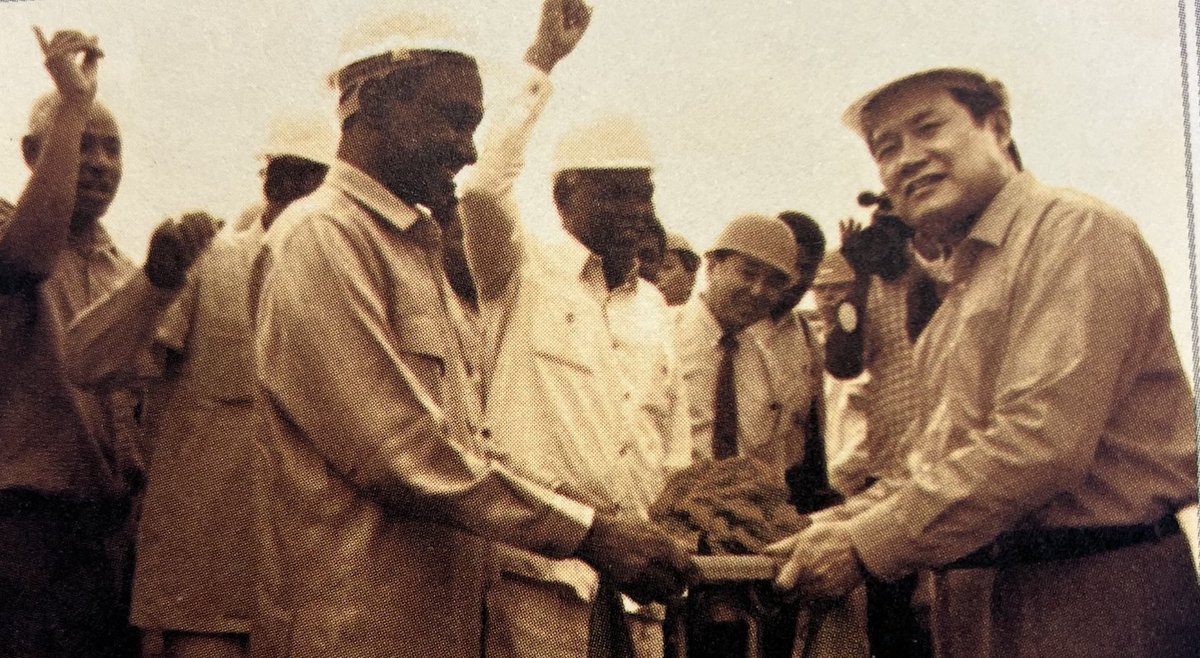
Learn about the history of oil in Sudan and then read @LukePatey's article about the impact of decarbonization on Sundan's political economy and foreign policy https://t.co/kK8c7ccZ1x
In July 1999, Sudan’s vice-president & China’s future security czar turned a valve to make the African country’s oil dream a reality. In these heady days of China-Africa relations, with Beijing's $50 billion promises at FOCAC, it is important to look at how individuals matter 🧵
South Sudan provides a lens into how decarbonization may affect an oil-based economy. Read @joshua_craze’s analysis of how Kiir’s coalition government has maintained power even as South Sudan’s political economy has shifted away from being powered by oil
https://t.co/DeaQCJ0U7W
Examine how decreases in oil prices from decarbonization efforts may lead to increased conflict and unsuccessful peacemaking efforts in @jan_pos1's new article in Environment and Security
#environmentalpeacebuilding
https://t.co/OD3yQ4y4Zr
As climate change threatens the stability of US homeland security, Jeremiah Asaka proposes a new methodology that identifies climate change as a threat multiplier. Read more in Environment and Security #environmentalpeacebuilding#homelandsecurity
https://t.co/MaNlhgBxAt
Explore William Morrisey’s analysis of the four different scenarios that could arise following the global adoption of stratospheric aerosol injection and the potential geopolitical implications in Environment and Security #environmentalpeacebuilding https://t.co/uI4FSxGEAl
Discover the three key factors that Daniel Abrahams and Kayly Ober identify that allow conflict mitigation policies to act as a framework for climate change adaptation. #environmentalpeacebuilding#conflictmitigation
https://t.co/5shmC9tzxT
Explore Tobias Böhmelt’s quantitative analysis on which factors determine whether UN peacekeeping missions have an environmental orientation based on case studies in Africa #environmentalpeacebuilding#peacekeeping
https://t.co/jUQbeZgS5Q
Find out how hydrological and satellite analysis links extreme weather events to increased conflict in the Bangsamoro region of the Philippines in Environment and Security Journal #environmentalpeacebuilding
https://t.co/GlkqbrnABz
Read about @AsakaJ’s proposed conceptual framework for U.S. Homeland Security that addresses climate change as a threat multiplier in Environment and Security #environmentalpeacebuilding#climatesecurity
https://t.co/MaNlhgC5q1