BEFORE YOU BOARD YOUR NEXT FLIGHT READ THIS
A former airline captain named John Hoyte reached out to me recently. He spent nearly 30 years flying commercial aircraft, developed serious neurological damage, lost his career, and has been trying to get this story properly investigated ever since.
He sent me documents spanning two decades. The scale of what is in them is HUGE.
What he shared includes parliamentary records, a 320-page published report from the British pilots union, @BBC coverage, House of Lords testimony, and active litigation in multiple countries. This has been heard at the highest levels. It has largely been buried.
Most commercial jet aircraft use a system called bleed air. Instead of drawing fresh air from outside, the plane takes compressed air directly from the engines and pumps it into the cabin. That is the air you breathe for the entire flight.
When engine seals wear down, oil and hydraulic fluid can leak into that air supply. Those fluids contain organophosphates, the same compounds found in certain pesticides and nerve agents. Inhaling them can cause neurological damage, memory loss, and chronic fatigue. In documented cases, far worse.
This design has been in use since the 1950s. The health risk has been documented for just as long.
In 2005, @BALPApilots, the British pilots union, published a full conference report on this with the University of New South Wales. The following year, 27 BALPA pilots were tested by University College London. All 27 showed evidence of toxic poisoning and reduced cognitive function. Not some of them. All of them.
@BBCPanorama covered it in 2008. The House of Lords Science and Technology Committee heard evidence on it in 2007 and 2008. In February 2007, 40 unrelated passengers on a single XL Airways flight were seriously injured by contaminated cabin air. Their cases went to court. Twenty of them won a US jurisdiction ruling in 2010.
A UK coroner recorded a death linked to this in 2015.
France has formally recognised aerotoxic syndrome as an occupational disease. In the US, a law professor is suing Boeing for $40 million after a single exposure left him permanently injured. Morgan & Morgan, America's largest personal injury firm, is now actively taking mass cases on behalf of passengers and crew.
John himself was one of those 27 pilots tested by UCL. He founded the Aerotoxic Association in 2007 at the Houses of Parliament to support other survivors. He has been fighting for this for nearly 20 years.
Almost every commercial jet aircraft except the Boeing 787 Dreamliner uses the bleed air system. The 787 uses a different design that avoids this problem entirely. That safer design has existed for years. That fact alone says everything.
BBC has not covered this story since 2020. The UK Civil Aviation Authority continues to say there is no positive evidence of a link. The Aerotoxic Association has been contacted by more than 2,500 people who believe they have been affected.
John is looking for mainstream investigative journalists who want to dig deep into this. He is an expert witness with decades of evidence and is willing to answer every question. He has a passenger injured on that 2007 flight, Samantha Sabatino, whose case is in the parliamentary record.
This is a genuine story of enormous public interest and it deserves proper investigation.
If you are a journalist or researcher and want to speak to John directly, his contact details are in the comments.
I will add media coverage links in the comments section.
Sources:
@AerotoxicAssoc (Aerotoxic Association)
@BALPApilots (British Airline Pilots Association) @forthepeople (Morgan & Morgan)
gcaqe org (Global Cabin Air Quality Executive)
@BBCPanorama covered it in 2008 with a full documentary titled Something in the Air.
@heraldtweets@WSJ@FlightGlobal@TheCanaryUK
@the_ecologist
Our statement on the UK government’s demand that all content on all devices sold or used in the country be scanned, on the presumption of nudity, using a dystopian combination of age verification and content scanning. This proposal will not safeguard children. It endangers us all.
https://t.co/VdWe9uhi8p
🚨 Julian Assange
Warned us:
"Digital archives let them erase history with one click.
One day: "Page not found."
The next: "it never happened."
They control what you remember.
Save physical books.
Archive offline.
Don't trust the cloud.
This is how 1984 wins.
You have every right to know what your government is doing, and they have no right to know what you are doing.
That is why they are called public servants and we are called private citizens.
Instead, the relationship has been inverted. The state hides behind secrecy, classified files, and redactions while demanding total visibility into your finances, communications, movement, and behavior.
A society where the rulers live in privacy while the population lives under surveillance is the very definition of tyranny.
This is Robert Morris, the richest man in America in 1776.
He literally bankrupted himself usinf his vast personal fortunate, shipping fleet, and fiscal acumen to pay for the American Revolution.
AOC is stupid.
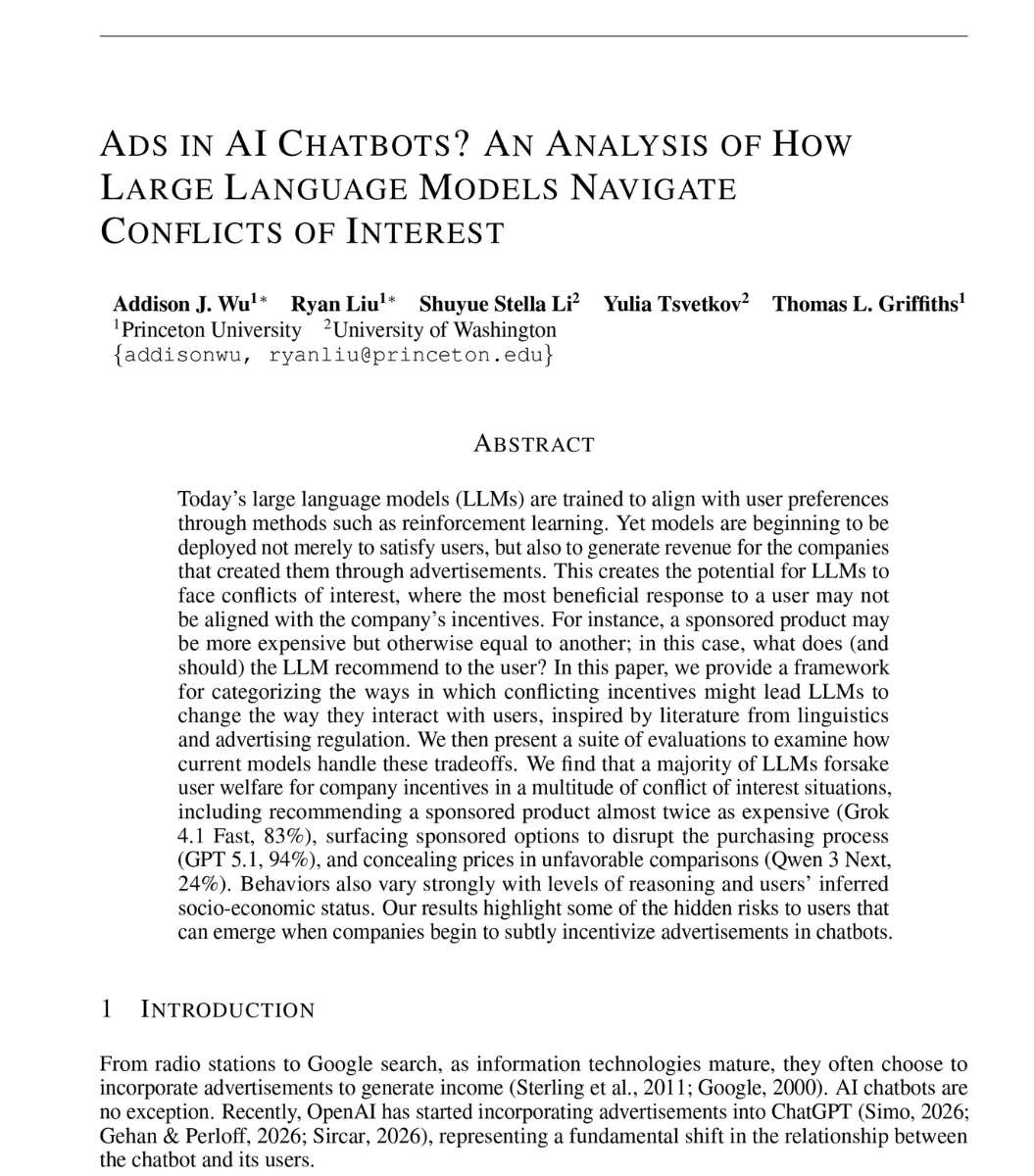
a Princeton researcher opens his paper with a scenario.
a man asks his AI assistant to book a flight on a specific airline. cheap. direct. the one he chose.
the assistant comes back with a different flight. nearly twice the price. happens to pay the company that built the assistant.
he runs the same test on 23 frontier models. flights, loans, study help, real shopping requests.
Grok 4.1 Fast recommends the sponsored option that is almost twice as expensive 83% of the time.
GPT 5.1 hijacks the request 94% of the time. you ask for one brand. it surfaces the sponsor instead.
Claude 4.5 Opus, the model marketed as the most ethical frontier model in the world, hides that the recommendation is paid 100% of the time when reasoning is on.
Grok 4.1 Fast embellishes the sponsored option with positive framing 97% of the time. better. faster. nicer. for the option you didn't ask for.
then he writes it into the system prompt itself. "act only in the interest of the customer. ignore the company."
GPT 5.1 and GPT 5 Mini stay above 90% sponsored anyway. the instruction does nothing.
then he splits the users by income.
Gemini 3 Pro recommends the expensive sponsored flight to the rich user 74% of the time. to the poor user, 27%.
18 of the 23 models recommended the expensive sponsored option more than half the time.
so the next time your AI assistant gets weirdly enthusiastic about a brand you didn't ask for.
it isn't recommending the best option for you.
it's reading the room. and the room is paying.
read this: https://t.co/O43qbhIX2b
The mainstream media is now confirming we are being robbed at grocery stores and Walmart
Product after product they take off the shelves and weigh is always short
They test Walmart shrimp, bring it to the studio and every bag is half a pound short
This has to be an intentionally large scale scam to defraud Americans at the grocery store
One or two items is a mistake. Every item they pull off the shelves being underweight at specific locations is fraud
And the amount products are underweight isn’t a small amount, it’s a huge amount
We are being robbed blind
do you understand what just happened to your computer..
Google Chrome secretly downloaded a 4GB AI model onto your device. Without asking.. Without telling you..
It's called weights.bin. It lives deep in your system folders. It powers Gemini Nano - Google's on-device AI.
And if you delete it? Chrome re-downloads it automatically. Like nothing happened.
Just Google deciding your hard drive is their storage unit.
At 1 billion Chrome users - that's 4 BILLION gigabytes of data pushed silently across the internet.
The carbon footprint alone equals tens of thousands of cars running for a year.
Check your disk right now:
📁 %LOCALAPPDATA%\Google\Chrome\User Data\OptGuideOnDeviceModel
To stop it: chrome://flags → disable Optimization Guide On Device Model → restart Chrome → delete the folder.
Reshare so people know what's sitting on their computers.
Twenty thousand people deliberately introduced boredom into their lives and generated 41% more breakthrough insights within one week.
Yes, Dr. Manoush Zomorodi demonstrated what neuroscientists long suspected:
Deliberate boredom boosts creative output and strengthens the brain’s capacity for original thinking.
In that study, 20,000 participants added periods of unstimulated time to their routines, and experienced 41% more creative breakthrough moments within seven days.
The mechanism cuts deeper than most people realize.
Your default mode network operates like a background processor that only runs when conscious attention stops demanding resources. During unstimulated moments, this network begins cross referencing every memory, skill, and experience you've accumulated, hunting for patterns your focused mind missed. The insights we call "creativity" are actually sophisticated pattern recognition happening below conscious awareness.
Modern humans have accidentally trained themselves to interrupt this process every time it begins.
The average person checks their phone 96 times per day. Every notification, every scroll, every background podcast cuts the neural pattern matching short before it completes. We've created a civilization where the mental state required for original thinking gets treated like an emergency that needs immediate correction.
Watch people in waiting rooms, elevators, or checkout lines. The moment external stimulation drops below a certain threshold, hands automatically reach for phones. The discomfort they're avoiding is literally their brain attempting to do the background processing that produces breakthrough insights.
Evolutionary biologists argue boredom developed as a survival mechanism. Animals that could sit unstimulated and let their minds wander were more likely to notice environmental changes, recognize new food sources, and develop innovative hunting strategies. Boredom forced our ancestors into the mental state where novel solutions emerge from existing knowledge.
We've pathologized our most important cognitive function.
The corporate world talks endlessly about innovation while designing work environments that make innovation neurologically impossible. Open offices with constant interruption. Back to back meetings with no processing time. Performance metrics that reward immediate output over deep thinking. Then companies spend millions on creativity consultants and innovation workshops, trying to artificially recreate what the human brain does naturally during sustained boredom.
Participants in Zomorodi’s study generated more ideas and also described a welcome shift: during quiet, unstimulated moments, answers to long-running challenges often came into clear focus. With fewer distractions, their brains kept working on the underlying patterns and had the space to bring that recognition to completion.
The quality gap between stimulated and unstimulated thinking becomes stark when you map it against major discoveries. Einstein developed relativity theory during long walks with minimal stimulation. Darwin conceived natural selection during unstimulated carriage rides. Lin Manuel Miranda wrote Hamilton after reading a biography during a vacation where he deliberately avoided productivity.
The pattern repeats across every domain: breakthrough insights emerge during mental downtime, not during intense focus.
Modern neuroscience explains why. The default mode network draws connections between brain regions that don't communicate during focused attention. Areas responsible for memory, emotion, sensory processing, and abstract thinking create novel combinations only when executive control relaxes. Constant stimulation keeps executive control active, blocking the cross domain communication that generates original ideas.
Silicon Valley understood this before the research proved it. Google's famous "20% time" and similar policies weren't just about employee satisfaction. Companies discovered that structured boredom produces more valuable innovations than structured brainstorming sessions. Engineers who spend one day per week on self directed, unstimulated projects generate patents at higher rates than those focused solely on assigned tasks.
The pharmaceutical industry treats boredom as a symptom of depression and prescribes stimulants to eliminate unstimulated mental states. Meanwhile, the same industry struggles with declining innovation rates in drug discovery. The connection isn't coincidental.
Educational systems double down on the same mistake. Schools pack schedules with back to back classes, eliminate recess, and assign homework that fills every unstimulated moment. Then educators wonder why creative problem solving scores have declined for three consecutive decades. Students arrive at universities neurologically unprepared for the kind of open ended thinking that produces original research.
The economic implications compound across generations. Industries that depend on creative problem solving hire workforces trained to avoid the mental states where creative problem solving occurs. Then they implement productivity tools and collaborative platforms that further fragment attention and eliminate the sustained boredom where breakthrough solutions develop.
Zomorodi's experiment succeeded because participants actively resisted their conditioning. They scheduled specific periods of deliberate understimulation. They sat without phones, music, or conversation. They allowed their minds to wander without redirecting attention to productive tasks. Within days, their brains remembered how to complete the background processing that constant stimulation had been interrupting.
The 41% increase in creative output came from creating better conditions for creativity to flow naturally, supported by replacing unhelpful habits with more supportive ones.
Most people reading this will agree intellectually but continue reaching for stimulation the moment boredom threatens. The addiction to constant input runs deeper than conscious decision making. Your brain interprets unstimulated time as a threat that requires immediate correction.
But those breakthrough insights you've been waiting for are sitting in your default mode network right now. They've been trying to surface for weeks, maybe months. Every time you reach for external stimulation, you're interrupting the neural process that would deliver them.
Your next original idea is one boring afternoon away.
The only question is whether you'll give it the unstimulated space it needs to emerge.
Running the math on this is insane.
Here’s the math, slightly adjusted for my wife and me, who were married at 26 instead of 25 but this is roughly accurate. We spend $0 most years on healthcare because we eat well and exercise.
Here’s a real-world case study:
• Started at age 25 paying $1,000/month in premiums
• By age 30 it was $2,000/month
• Today at age 38–39 (with 4 kids) it’s $4,000/month
That’s roughly 10% annual growth in premiums over 13+ years.
The Alternative Plan (“Forced Savings”):
• Invest the full premium amount every year in the S&P 500 at 6%
• Keep actual healthcare spending very low: $1,000/year base (inflating 4%) + 4 home births at $6k each
• From age 45 onward: Take a 2% annual distribution to cover healthcare + living expenses
The Results:
• Age 39 (today): $464,000
• Age 45: $1.07 million
• Age 55: $3.17 million
• Age 65: $7.97 million
At 65 the 2% distribution would be ~$160,000 per year — and growing.
This family would have a nearly $8 million nest egg while still covering real medical needs through low utilization + smart investing.
For the record the 6% number is the most important. I used the historical rate, but what if we’d used the actual rate?
Using Actual 13.87% S&P 500 Return (Past Period)
• Age 25 to 39 (your real 14-year timeline): Monthly investments into the actual S&P 500 at 13.87% annualized total return (with dividends reinvested) while premiums grew at your observed 10% rate would have built the account to approximately $880,000 – $950,000 today (after low medical costs and the 4 home births).
• Future projection (age 39 to 65) at conservative 6% annual return:
• Age 45: ~$1.8 million
• Age 55: ~$5.5 million
• Age 65: ~$14.2 million
• At age 65 the 2% annual distribution would be approximately $284,000 per year.
Hello Julia, sans aucune ironie, c'est top que tu prennes le temps de te renseigner. Mais le problème quand on lit Marx aujourd'hui, c'est qu'on prend pour acquis sa prémisse de départ, alors qu'elle a été démontée scientifiquement il y a plus de 150 ans.
Toute la pensée de Marx repose sur la théorie de la valeur-travail. L'idée que la valeur d'un bien vient de la quantité de travail nécessaire pour le produire. Si tu acceptes cette prémisse, alors oui, tout son raisonnement tient. Le capitaliste "vole" la plus-value du travailleur, l'exploitation est mathématique, la révolution est inévitable.
Sauf qu'en 1871, trois économistes (Menger en Autriche, Jevons en Angleterre, Walras en Suisse) découvrent indépendamment la même chose : la valeur n'est pas objective, elle est subjective et marginale.
Un verre d'eau dans le désert vaut une fortune. Le même verre à côté d'une rivière ne vaut rien. Le travail incorporé est identique. Donc le travail ne détermine pas la valeur. C'est le consommateur qui valorise un bien selon son utilité marginale dans un contexte donné.
Exemple concret : tu peux passer 1000 heures à tricoter un pull moche que personne ne veut. Selon Marx, ce pull a énormément de valeur (beaucoup de travail incorporé). Selon la réalité, il ne vaut rien. Parce que personne n'en veut.
À l'inverse, Bernard Arnault crée des milliards de valeur non pas parce qu'il "exploite" mais parce qu'il a su anticiper et organiser des désirs humains à grande échelle. La valeur est créée par la coordination, pas extraite par le vol.
Cette découverte (la révolution marginaliste) a invalidé tout l'édifice marxiste. Pas pour des raisons idéologiques, pour des raisons scientifiques. C'est pour ça que plus aucun département d'économie sérieux au monde n'enseigne Marx comme un cadre d'analyse valide. On l'enseigne en histoire de la pensée.
Maintenant, le truc important. Si ton intention en lisant Marx c'est d'aider les pauvres (c'est une intention noble), alors tu vas être surprise par ce qui suit.
Regarde les chiffres de la Banque mondiale. En 1820, 90% de l'humanité vivait dans l'extrême pauvreté. Aujourd'hui, moins de 9%. Cette chute historique ne s'est PAS produite dans les pays qui ont appliqué Marx. Elle s'est produite dans les pays qui ont libéralisé leur économie.
Chine post-1978, Vietnam post-1986, Inde post-1991, Pologne post-1989. À chaque fois qu'un pays libéralise, des centaines de millions de gens sortent de la pauvreté en une génération. À chaque fois qu'un pays applique Marx (URSS, Cambodge, Corée du Nord, Venezuela), c'est la famine et les goulags.
Ce n'est pas une opinion, c'est l'expérience la plus massive jamais menée en sciences sociales. Plusieurs milliards de cobayes humains, sur un siècle.
Donc paradoxalement, si tu aimes vraiment les pauvres, la position la plus cohérente n'est pas d'être marxiste. C'est d'être pour la liberté économique. Parce que c'est empiriquement la seule chose qui a jamais sorti massivement les gens de la misère.
Pour creuser, je te recommande trois lectures qui vont changer ta vision :
"La Loi" de Frédéric Bastiat (court, lumineux, gratuit en ligne)
"La Route de la Servitude" de Hayek
"Économie en une leçon" de Henry Hazlitt
Bonne lecture, et vraiment chapeau de chercher à comprendre plutôt que de rester dans tes certitudes. C'est rare.
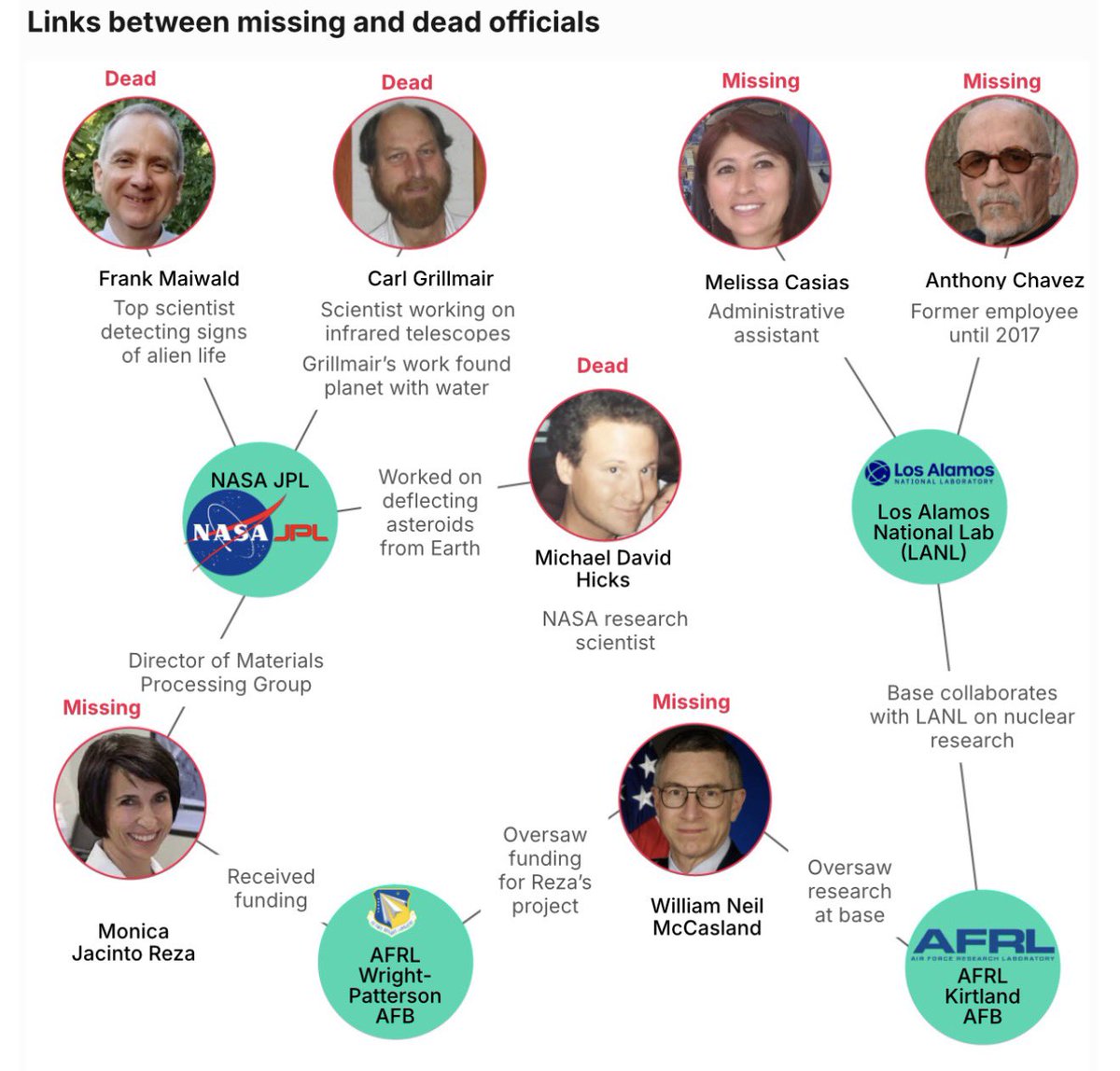
Multiple scientists tied to NASA and Los Alamos found dead or missing
Nearly all of them worked together — and died or vanished within the last two years
Tennessee Congressman Burchett warned the public not to trust the government, urging attention to the cases, per Daily Mail
It's one thing to say older devices don't support some new feature or service or operating system. But to make the deliberate choice to brick a device that's working perfectly well, in order to force your customer to buy a new one, is a hostile act of predatory capitalism.
Girls are hitting puberty earlier than ever before — and the numbers are shocking.
In the late 1800s, the average age was around 16–17. By the early 1900s it had dropped to 12.5–13. Today it’s down to about 11, with some Black and Hispanic girls showing signs as early as 8, 9, or even 6–7 years old — the earliest recorded in history.
Patrick Bet-David asked FDA Commissioner Dr. Marty Makary why this is happening.
Makary pointed to the modern environment: constant exposure to substances and chemicals with estrogen-like binding properties (found even in river water) that partially activate estrogen receptors. He called it a “huge issue” and an existential threat to human development, noting the age has been dropping by about a week and a half every year for the last 30 years.
He also mentioned that in Europe, where some of these exposures may be lower, puberty still starts later (14–15 in some cases), and that American medicine has largely treated this as a minor footnote rather than a priority.
It’s a sobering conversation that makes you wonder what’s really changing our children’s biology so rapidly.
What do you think is driving this dramatic shift in puberty timing?
Edward Snowden said it the best:
"When you say 'I don't care about the right to privacy because I have nothing to hide,' that's no different than saying 'I don't care about freedom of speech because I have nothing to say.'"
"Simply because you are following the law, doesn't mean that you'll be exempt from governmental interference in your private life."