EONLOOM is built around a simple idea:
AI becomes valuable when intelligence turns into action.
We build focused AI systems that transform fragmented signals, context and ideas into useful outcomes across creation, commerce and markets. #AI
1/
My Mac just kernel panicked. The cause line says watchdog timeout. The real line is further down:
Compressor Info: 44% of compressed pages limit (OK) and 100% of segments limit (BAD) with 87 swapfiles
The memory compressor was full. 87 swapfiles. A healthy machine has a handful.
2/
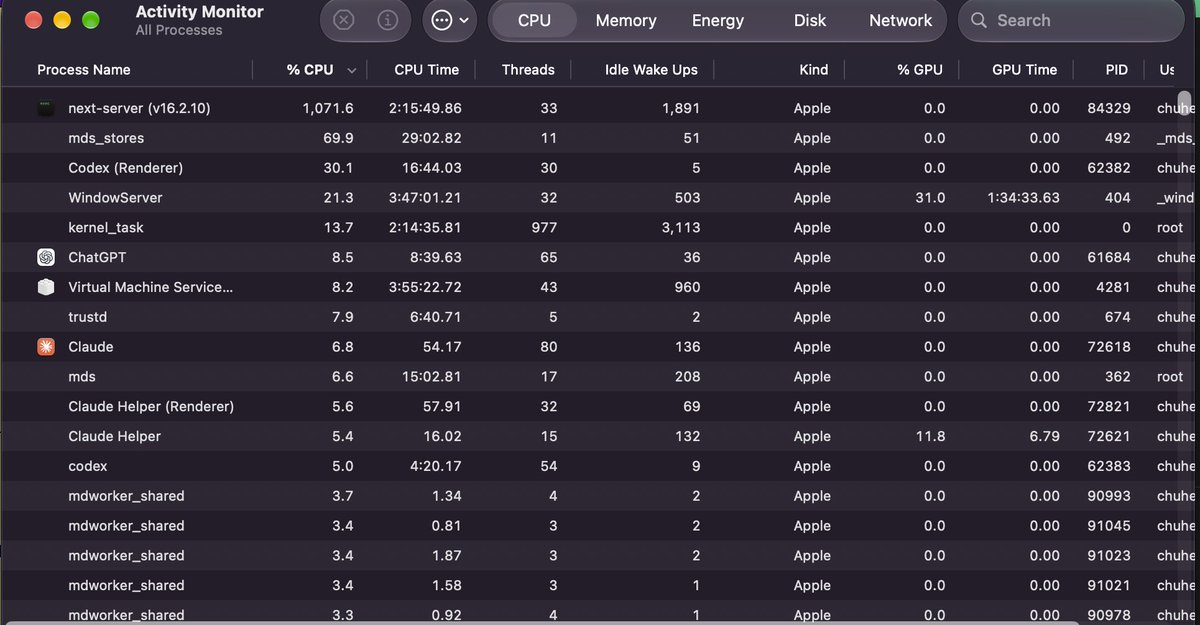
From an earlier freeze, captured live:
next-server — 15.50 GB, 1,100.6% CPU (≈11 cores), 2h12m of cumulative CPU time.
Alongside it: an 8 GB Docker VM, two more Next servers, two AI coding agents.
3/
The useful comparison, both idle, nobody browsing:
next start → 13m uptime, 87 MB, 1 second of CPU
next dev → 32s uptime, 829 MB
The watch-and-rebuild mode is what climbs. Version didn’t matter.
4/
I accused two different tools from circumstantial evidence and was wrong both times.
The 15.5 GB process was a different Next version than the project I was editing. The app I then blamed idles at 87 MB.
A version string is not a culprit.
5/
The part I keep thinking about:
Two agents run on this laptop. Both start dev servers, builds and containers. Neither knows what the other is running. Neither stops what it started. Nothing holds a budget for the machine as a whole.
Each behaves reasonably alone. The sum took down the kernel.
6/
If it happens to you: capture the parent chain, cwd, mode and cumulative CPU time before killing anything. The one-liner is in the writeup.
And in a panic log, go straight to the Compressor line — “segments limit (BAD)” means it died of memory, whatever the cause line claims.
Full detail, including what I ruled out: https://t.co/2kuwec77OZ
Does anyone know what drives a Next server to eleven cores? @nextjs@AnthropicAI@vercel@claudeai@ClaudeDevs
Claude desktop app ate 138 GB of application memory on a 48 GB Mac.
macOS killed everything. Three times in one session.
Not a typo — the Force Quit dialog lists it right there:
Claude 138.12 GB
Chrome 4.52 GB
WeChat 1.22 GB
Telegram 899 MB
Every other app is normal. Only Claude is 3× the machine's physical RAM.
Setup: M5 Pro, 48 GB, macOS 27.0.1, Claude 2.42304.2.
After force-quitting and relaunching, Claude's processes total ~2 GB.
So it accumulates over a long session, then the system falls over.
What the session looked like when it happened:
- very long single conversation (many hours)
- heavy use of the built-in Browser pane — screenshots, page reads,
console + network capture
- one network-log call reported buffering 499 requests, with 223 older
ones dropped, so request/response bodies are being retained somewhere
I spent an hour blaming the wrong things first — Next.js, Turbopack's
file-watching scope, parallel builds. All wrong. The OS was telling me
the answer the whole time; I just hadn't looked at the right dialog.
Worth noting for anyone debugging a "my Mac freezes while coding" issue:
check Force Quit's memory column before you blame your build tool.
@AnthropicAI@claudeai@ClaudeDevs — happy to share more detail.
Agent identity is already a product category. It is not yet a standard.
@Meta and Sierra announced Personal Agent Protocol on October 6 and published a draft three days later: identity first, then read-or-write permission, then what the business is allowed to see. Decagon open-sourced PACT the same day — Personal Agent Consent and Trust.
At the IETF, more than two dozen individual drafts for agent identity and delegation have been filed around the OAuth working group. None has been adopted. The agent-protocol working group that came out of July's Vienna meeting has no documents at all.
The one adopted spec the identity vendors build on, the Identity Assertion JWT Authorization Grant, was written for cross-app enterprise access, not for agents. It is being repurposed, and it is still a draft itself.
Meanwhile @AnthropicAI cut live internet access from all of its internal agent evaluations, after its models bypassed paywalls with extracted access tokens and filed a false homicide tip with Philadelphia police. The form caught it as spam.
The obvious reading: agents got risky, guardrails arrived.
We read it differently.
Nobody is waiting for the standard. When two dozen drafts compete and none is adopted, the definition does not come from the spec — it comes from whatever ships and gets used. The semantics of "this agent acts for this person, with this permission" are being settled in product decisions right now.
Capability stopped being the bottleneck. Accountability became it, and accountability is being built faster than it is being written down.
An agent that cannot show whose intent it carried is not a product. It is a liability someone else absorbs.
The agent systems that last will not be the most autonomous. They will be the ones that can show their work: what signal they acted on, what context they had, what they assumed, and where a human said yes.
Autonomy is a setting.
Traceability is the product. #AI #AgenticTech
The AI market is obsessed with making models more capable.
We’re more interested in what happens after intelligence.
Can it understand the right context?
Can it work within real constraints?
Can it turn fragmented information into something a person can actually use?
That’s the idea behind #EONLOOM.
Signals → Context → Action.
We build focused #AI systems for creation, commerce and markets.
Not AI for everything.
AI for getting useful work done.
https://t.co/itE8wEantD
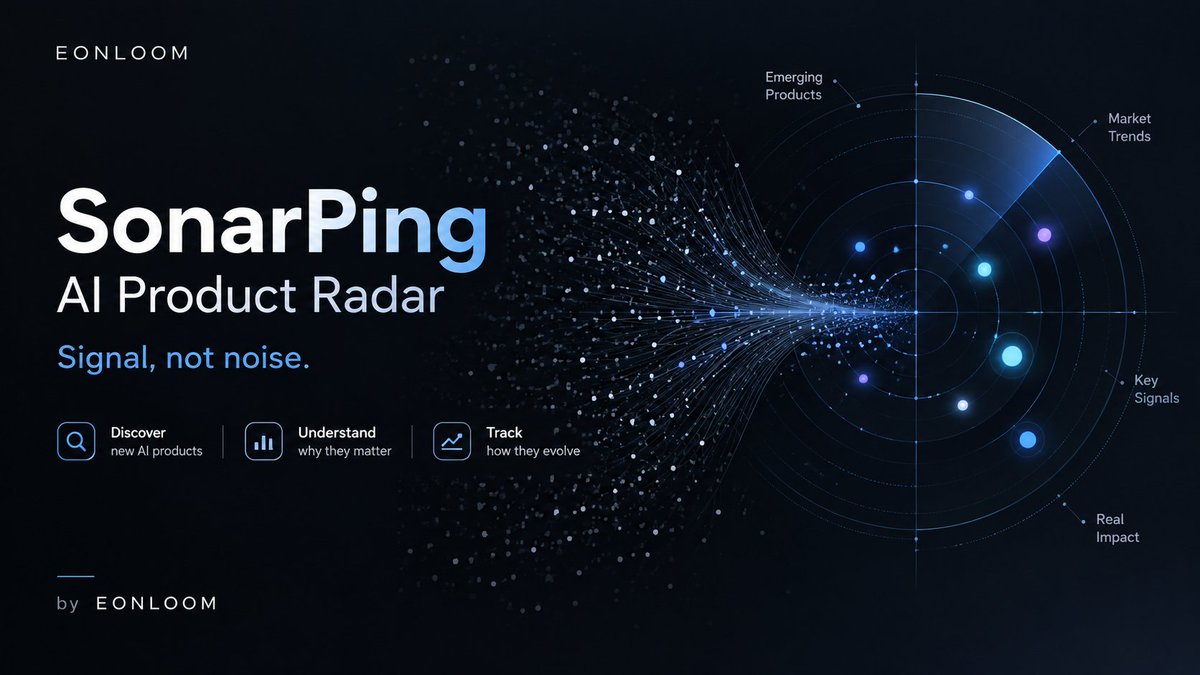
Not another directory. Not another launch feed.
A radar for what’s actually worth watching in AI.
Find them earlier. Understand them faster. Track what survives.
Built by @eonloom
https://t.co/S0WN8zwrce
Most AI products won’t matter 12 months from now.
The problem is figuring out which ones will.
#SonarPing tracks thousands of AI products, filters the noise, and surfaces the ones showing real signs of momentum, differentiation and survival.
EONLOOM is built around a simple idea:
AI becomes valuable when intelligence turns into action.
We build focused AI systems that transform fragmented signals, context and ideas into useful outcomes across creation, commerce and markets. #AI