$OUST
Ouster CEO Angus Pacala replying to customers on LinkedIn who are waiting for their lidars from Ouster:
"Significantly expanded quantities this quarter"
I like the sound of that. They seems very busy :)
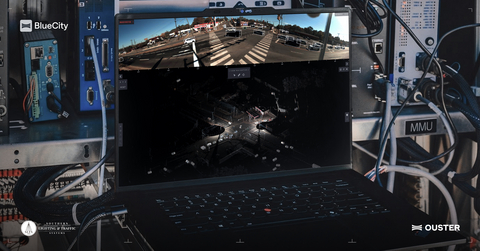
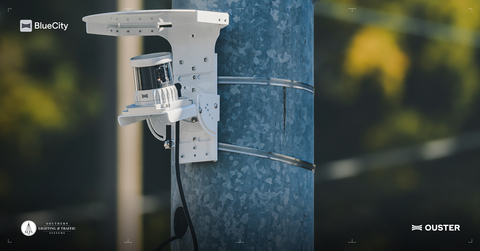
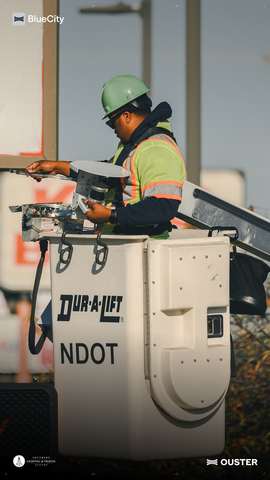
@ousterlidar today announced a SECOND major deployment expansion of its Ouster BlueCity solution across 100 additional intersections in Nashville, Tennessee. This latest contract brings the total number of contracted Ouster BlueCity deployments in Nashville to 200+ intersections and roadway locations. $OUST
https://t.co/yvKHuTfcEm
I still believe I'll finish 2026 break even on $EOSE and well in profit on $OUST.
$EOSE debacle made me cautious n accumulating capital (whatever i could).
Best ideas in Space is $VOYG n $NBIS among neocluds, imo. They might continue to go down but I feel good entrying here.
I'm back: bought 100 shares of Voyager $VOYG + 25 shares of $NBIS
Portfolio update:
750 $OUST: 27.51$ av price
2500 $EOSE: 6.89$ av price
25 $NBIS: 118.64$ av price
100 $VOYG: 20.20$ av price
Cautious n patience paid off.
No, not a trader. Plan is to not sell anytime soon.
Indeed. Not only difficult; in my case, increasingly unreasonable, once I found Ouster.
Not an easy decision but today I sold 1750 shares of $EOSE to buy 250 shares of $OUST at 38$.
Portfolio now:
750 shares of $OUST (av. 27.51$)
2500 shares of $EOSE (av. 6.89$)
$OUST I am continuing my review of Ouster's Q3 results, looking beyond the headline numbers and examining what is happening underneath.
What I see is substantial cash being deployed into working capital, inventory, and manufacturing capacity as the company transitions its LiDAR portfolio toward a higher class of sensors. I see an explosive increase in camera volumes, continued growth in LiDAR shipments, and ongoing royalty revenue from intellectual property ownership. Those royalties alone are becoming meaningful enough to exceed the entire quarterly revenue of some other names in this industry.
I frequently use comparisons in my analysis, partly to avoid the appearance of bias arising from my ownership of $OUST shares. But the more I examine the operating performance, technology portfolio, financial position, and commercial execution, the harder it becomes to find a meaningful comparison.
There is no competition here. None that I see operating at this combination of scale, technological breadth, and financial strength.
For me, this remains a long-term investment, which has delivered on expectations for the past 15 quarters. Stock prices can be capricious, emotional reflections of short-term impulses, but over time, operating performance establishes the direction. And the longer-term pattern is becoming increasingly clear.
As I continue reviewing today's earnings call, two statements particularly stand out.
On competing with Chinese manufacturers:
"Now you add in that we're getting the volumes, and we can be competitive on a margin standpoint too. We have no problem taking the Chinese on head-to-head in Western markets."
On automotive and robotaxi opportunities:
"We have a portfolio that is ready and willing to go meet that automotive segment. We have no problems participating within the robotaxi segment, especially with the new Rev8 and the products that we have coming out. We are geared and ready when the automotive industry in the Western world is ready to go tackle that problem. We will be there for it."
These are powerful statements, particularly coming from a company that has spent years building its technology, acquiring complementary capabilities, expanding manufacturing capacity, and establishing a commercial presence. However, it has largely kept its views to itself, and when expressed, they have always been delivered in a manner best described as conservative.
The significance is not simply that Ouster believes it can compete. It is that management is increasingly discussing its ability to compete on volume, margins, product breadth, and readiness, rather than technology alone.
There is a substantial difference between having a promising product or, as is the case with others, mostly having a story to tell about it, and having a business capable of delivering it at scale.
And we are still early; for many, too early to notice.
But Physical AI is moving from technological promise toward industrial execution, and if you see Ouster, you are part of it.
Know what you own.
$EOSE
Opinion:
- Indensity will have much lower COGS than the cubes.
Some facts I'm willing to share with you:
- The current plan is for Indensity production to launch in Q1.
- There is a backlog of orders for Indensity.
- If you want to order Indensity today and are willing to put down a chunk of change (like 25%) to secure your position, you still wouldn't get it for another year.
- I've seen extremely detailed engineering drawings for Indensity projects.
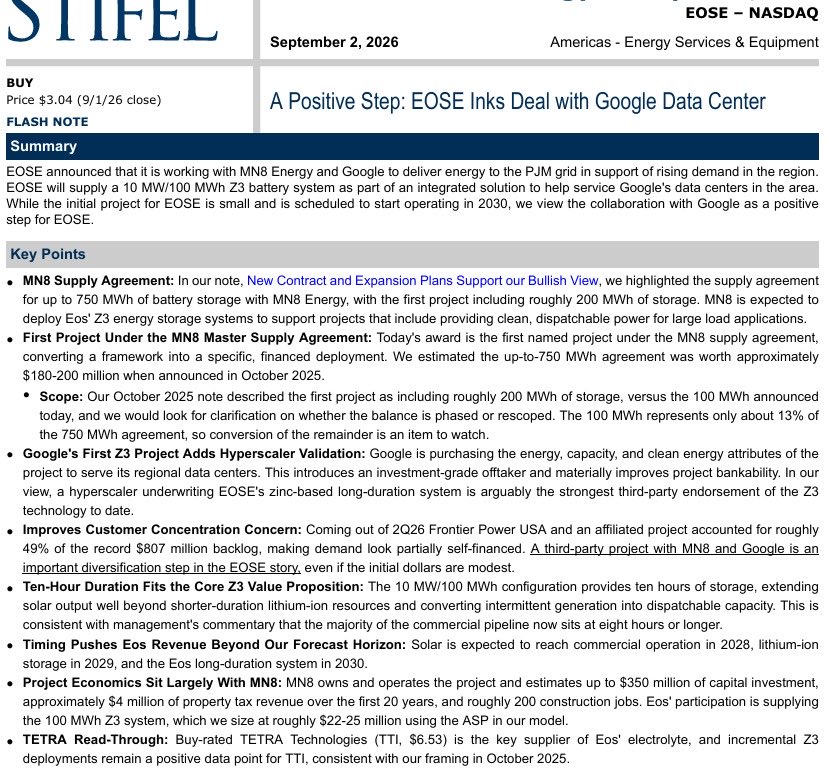
$EOSE Frontier Power USA was selected by the U.S. Army to develop new power generation and battery storage at Pennsylvania’s Tobyhanna Army Depot.
The project will be privately financed at no capital cost to the government and plans to use American-made battery storage.
$OUST
New interview with Ouster CEO Angus Pacala!
This is exactly why I'm so incredibly bullish on Ouster and why I believe we're going to see accelerated growth as the company moves further up the value chain:
"Now we're pushing into providing unified sensing platforms to our customers.
Instead of just sensors, we can provide lidars, cameras, edge compute, and the algorithms that make sense of it all to take more and more of the hard problems off of a customer's plate, allow them to handle the business logic of deploying a machine at scale, and Ouster can handle the technology of perception.
So in five years we'll be a perception company more than just a LiDAR provider."
h/t @Dietl_rd
@Dietl_rd If the physical AI ramp up everybody is expecting materialises, I believe there is almost zero chance $OUST is important to it and doesn't reach 25B+ MC in 2030, and I believe $OUST will be very crucial to it.
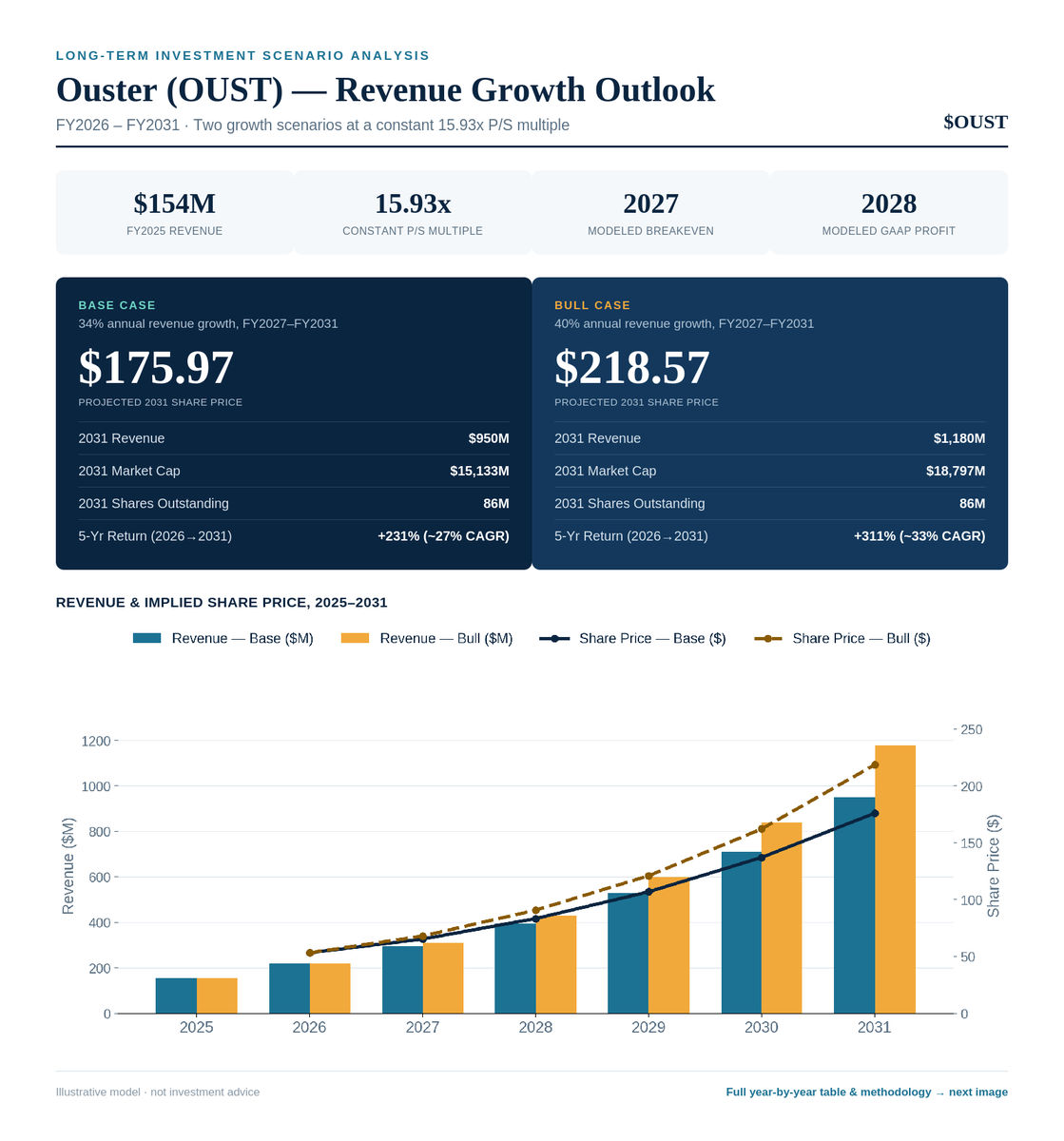
$OUST, Ouster, mapping out a 5-year revenue growth path.
This year marks my five years of investing in Ouster. I put together a long-term scenario for the next 5 years holding shares in the company.
We're still early in the physical AI opportunity, but it's becoming clear Ouster is taking a leadership role with its LiDAR and camera products. Exciting to see the company sitting on $454M in cash—fully funded and on the cusp of breakeven just a year from now, with profitability targeted for 2028.
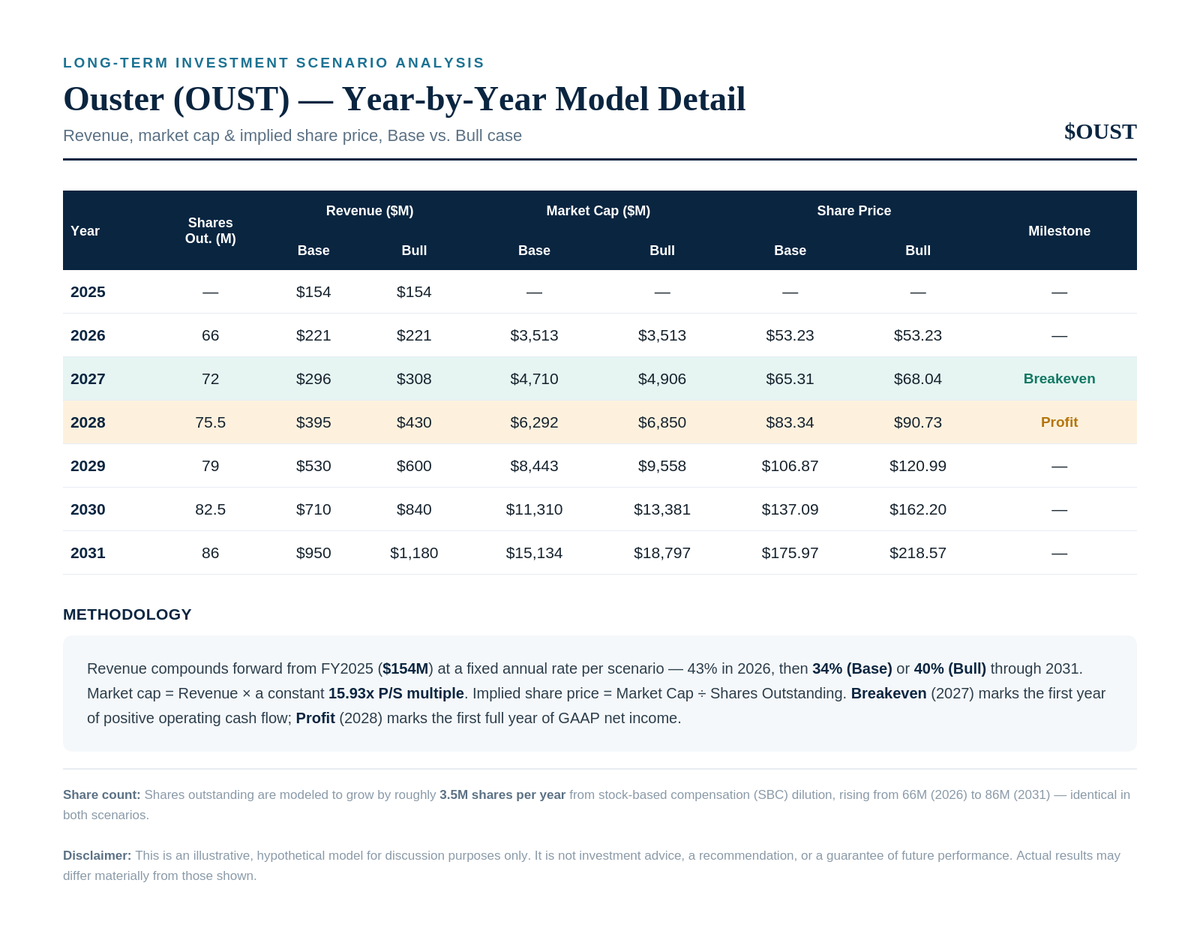
Ouster did $154M in revenue in FY2025. I modeled two scenarios out to FY2031, holding the P/S multiple constant at 15.93x:
🔹 Base Case (34% growth): $950M revenue → $175.97/share (+231%)
🔹 Bull Case (40% growth): $1.18B revenue → $218.57/share (+311%)
Both paths hit operating breakeven in 2027 and GAAP profitability in 2028.
Full model + methodology in the second image 👇
Illustrative model, not financial advice. Numbers are projections, not guarantees.
$EOSE published a technical paper about how their zinc halide battery millisecond response time matches the AI data center rapid and large load fluctuations. Solves this.
Congrats to the @ousterlidar team! I believe BlueCity is now deployed at over 1,000 intersections across North America. $OUST
In the U.S. alone, there are over 300,000 signalized intersections that could potentially be equipped with LiDAR and BlueCity software.
Add Europe, Japan, South Korea, Canada, Australia and other developed markets, and the total opportunity could easily exceed 1 million intersections.
Note that the initial hardware revenue is about $20K per intersection, plus mandatory annual software subscriptions for around 10 years. I would estimate software revenue at roughly $2K–$5K per intersection per year.
Just for smart intersections, the TAM could exceed $20B for hardware, plus another $20B–$50B in 10-year software subscription revenue, bringing the total TAM to roughly $40B–$70B.
And this is a high-gross-margin, highly sticky, near-monopoly market for Ouster.
CEO Angus commented on the earnings call:
"That's a great question. There's a lot going on. We've actually invested a huge amount into BlueCity this year and the go-to-market, and we're starting to see the payoff of that. Rev8, I can't stress it enough, the [ OS1 Max ] advanced detection, long-range detection opens up about half the market. And the market, as a reminder, in North America, there are 300,000 signalized intersections. In North America, we have hundreds -- rapidly moving to thousands of intersections deployed. But it's still a very small fraction of the total market that we can go and capture. So we're not going to be gated by the market size in the foreseeable future, and we have the best product in the market. I'm convinced of that."
"So yes, I think that the first 6 months of this year have been a huge inflection point for our BlueCity business, given the investments we've made in the go-to-market strategy and the product development on the software side, and then integrating this new Rev8 RGB OS1 Max capability."
$TTI call
$EOSE
“We're encouraged by Eos Energy's progress with our new automated manufacturing line and their confidence in having their stated capacity of 4 GWh by year end and heading into 2027…
“Demand for TETRA PureFlow zinc bromide electrolyte that we manufacture also continued to accelerate during the quarter, supported by expanding customer manufacturing capacity and increasing customer backlog. We believe the growing requirement for grid resiliency, reliable power infrastructure and long-duration energy storage are expanding the addressable market for zinc bromide. Battery technology adoption is also increasing across defense and critical infrastructure markets…
“as we move into 2027, and assuming they are at their 4 GWh capacity, it is a material shift for us in ‘27. If they get to their 8 GWh before 2030, which is what they've stated — their objective is well before that — it will take up a meaningful part of our capacity of our new plant.”
Why I think $OUST has the best risk/reward profile among these Physical AI names @wliang :
$AMBA is a solid company with excellent technology, especially in edge AI vision. However, it faces intense competition from much larger semiconductor companies like NVIDIA, Qualcomm, Mobileye, TI, and NXP.
AMBA is a leader in its niche, but the competitive landscape is becoming increasingly crowded. Unlike Ouster, AMBA benefits less from geopolitical tailwinds because most of its major competitors are also U.S. or allied semiconductor companies.
$CCXI is an interesting humanoid robotics play through Agility Robotics, but it is still a very early-stage investment story.
Beyond the SPAC structure and potential future share supply, the bigger question is when Agility can truly scale manufacturing and reduce costs to a level where humanoid robots become economically attractive. Building a working robot is one challenge; achieving mass production, reliability, and better ROI than existing automation solutions is a much bigger one. That transition will take years.
$VPG is an excellent company and an absolute leader in its niche. Its precision sensing technology could benefit from the growth of robotics, but humanoid robotics is not its core business today. The key question is when robot-related demand can become a meaningful revenue driver.
What makes $OUST different is that it is already commercializing the "eyes" of Physical AI.
Ouster already has real-world deployments across industrial automation, robotics, mapping, smart infrastructure, and other applications. It is not just betting on a future market; it is already selling products into existing markets.
The long-term opportunity is bigger than just selling LiDAR sensors. With advances in perception software, AI, and spatial intelligence, Ouster has the potential to become a broader perception platform combining hardware, software, and AI.
Another important factor is the geopolitical environment. As governments pay more attention to critical sensing technologies and supply chain security, Ouster could benefit from being a U.S.-based LiDAR company in a market where competitors are exposed to geopolitical risks.
$OUST has already proven commercial traction, delivering 13 consecutive quarters of revenue growth while maintaining a strong gross margin profile. The company is no longer just a technology bet — it is scaling a real business in the Physical AI ecosystem. Among these names, I believe OUST offers the best combination of technology leadership, commercial validation, market opportunity, and geopolitical tailwinds.
$eose part 2 of the Springfield Utilities discussion around their new EOS system
Non flammable.. Non flammable.. Non flammable 😍
https://t.co/L5HL3TUgCw
$EOSE
Joe, John, and Allesandro:
I know you'll ignore almost all this, but I'm guaranteed of not getting additional info on these things unless I ask. So, here goes.
Things I want to hear about on the next earnings call:
- A more fulsome discussion about the retrofit of Z3 cubes to DawnOS; what was said on the last call was very helpful, but can be expanded further; what do the ribbon cuttings at Viejas, LES, and CU mean going forward and what you have learned since they went online; directly address head on and debunk false and malicious rumors from FUDsters about systemic issues with batteries that have plagued the stock in a vacuum of information.
- Expand on your plans for the software hub and its role in growing the company and improving product performance; what theoretical average RTE and standard deviations over a range of discharge durations do you think can be achieved with enhanced software over time? And what have you already achieved across the whole fleet?
- Last year you talked about making investments to make the manufacturing line more like a truck assembly line (in the context of containerization of the modules); what progress if any have you made on this? Are you planning to automate the Indensity containerization? If not, why not? And if so, what's the schedule for doing that? Will Line 2+ be dedicated to Indensity? Are you actually capable of producing significant Indensity cores this year, or is this still a science project?
- You have talked about how much more efficient the Thornhill line would be, but so far you have not described any future lines having greater capacity than 2 GWh/yr. Why? If the containerization could just keep up with the automated cadence of the module production (9 to 10 second cycle time), that means over 3 GWh/yr per line. What's the problem with achieving this? Or are you sandbagging. Give license to Mahaz to have a full discussion about this, and explain it to us like we're a small child or a golden retriever (full range of challenges, hard limitations, opportunities).
- What are the limiting factors for achieving profitability on the lines? Do you plan on shutting down Turtle Creek at some point, and if so, at what point and under what conditions? Based on everything you've learned so far, what is the maximum theoretical capacity of the line at Turtle Creek, in comparison to that for a line at Thornhill?
- Is Project AMAZE and the DOE loan past Line 2 still a thing? What about Factory 2 Works, and overseas lines? Don't just say it depends on demand. Talk us through some various realistic scenarios and the conditions that would either accelerate or stall line expansion so investors can make up their own minds about the probability of each outcome and model it appropriately.
- Expand on the financial mechanics of FPUSA. Once the initial equity + 4x leveraged debt is drained on working off backlog and developing those projects, how fast does money get reinvested to develop more products? (Waiting on profits from fully operating sites is an eternity.) Do completed projects unlock more investor equity and more debt on better terms? Help us understand the cadence of the flywheel unlocking the huge pipeline, so we can model various scenarios.
- Provide some discussion about remaining domestic supply chain issues; e.g. the graphite felt (working with DOE on graphite felt supply from recycled wind turbine blades); shells for Indensity cores, etc.
We can handle the whole truth, and at this point there's not much downside to providing it. But much upside if it provides needed clarity to investors. I hope you consider some of these and incorporate it into your messaging.
I've been on vacations since the beginning of the month (close to Sicily, actually). Came back home on Saturday. Life's good but $EOSE price must behave better. I am still holding my 2.500 shares (50%+ down now) cause I believe good news are coming during earnings. Last chance.