@megbasham I have a lot of respect for you, but one of the main issues with the SBC is its almost sole focus on this issue and not recognizing the many roles of women in the Bible. In addition, it’s not dealing with greater issues such as the sexual abuse among leadership.
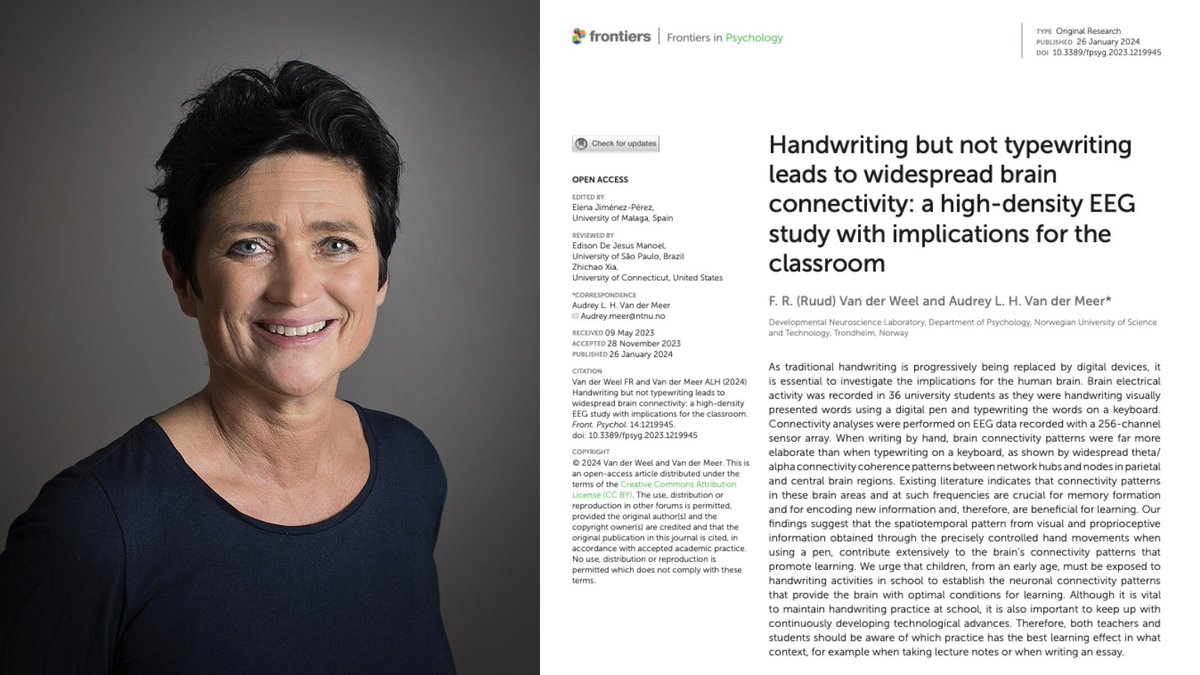
A Norwegian neuroscientist spent 20 years proving that the act of writing by hand changes the human brain in ways typing physically cannot, and almost nobody outside her field has read the paper.
Her name is Audrey van der Meer.
She runs a brain research lab in Trondheim, and the paper that closed the argument was published in 2024 in a journal called Frontiers in Psychology. The finding is brutal enough that it should have changed every classroom on Earth.
The experiment was simple. She recruited 36 university students and put each one in a cap with 256 sensors pressed against their scalp to record brain activity. Words flashed on a screen one at a time.
Sometimes the students wrote the word by hand on a touchscreen using a digital pen, and sometimes they typed the same word on a keyboard. Every neural response was recorded for the full five seconds the word stayed on screen.
Then her team looked at the part of the data most researchers had ignored for years, which is how different parts of the brain were communicating with each other during the task.
When the students wrote by hand, the brain lit up everywhere at once.
The regions responsible for memory, sensory integration, and the encoding of new information were all firing together in a coordinated pattern that spread across the entire cortex. The whole network was awake and connected.
When the same students typed the same word, that pattern collapsed almost completely.
Most of the brain went quiet, and the connections between regions that had been alive seconds earlier were nowhere to be found on the EEG.
Same word, same brain, same person, and two completely different neurological events.
The reason turned out to be something nobody had really paid attention to before her work. Writing by hand is not one motion but a sequence of thousands of tiny micro-movements coordinated with your eyes in real time, where each letter is a different shape that requires the brain to solve a slightly different spatial problem.
Your fingers, wrist, vision, and the parts of your brain that track position in space are all working together to produce one letter, then the next, then the next.
Typing throws all of that away. Every key on a keyboard requires the exact same finger motion regardless of which letter you are pressing, which means the brain has almost nothing to integrate and almost no problem to solve.
Van der Meer said it plainly in her interviews.
Pressing the same key with the same finger over and over does not stimulate the brain in any meaningful way, and she pointed out something that should scare every parent who handed their kid an iPad.
Children who learn to read and write on tablets often cannot tell letters like b and d apart, because they have never physically felt with their bodies what it takes to actually produce those letters on a page.
A decade before her, two researchers at Princeton ran the same fight using a completely different method and ended up at the same answer. Pam Mueller and Daniel Oppenheimer tested 327 students across three experiments, where half took notes on laptops with the internet disabled and half took notes by hand, before testing everyone on what they actually understood from the lectures they had watched.
The handwriting group won by a wide margin on every question that required real understanding rather than surface recall.
The reason was hiding in the transcripts of what the two groups had actually written down.
The laptop students typed almost word for word, capturing more total content but processing almost none of it as they went, while the handwriting students physically could not write fast enough to transcribe a lecture in real time, which forced them to listen carefully, decide what actually mattered, and put it in their own words on the page.
That single act of choosing what to keep was the learning itself, and the keyboard had quietly skipped the choosing and skipped the learning along with it.
Two studies. Two countries. Same answer.
Handwriting makes the brain work. Typing lets it coast.
Every note you have ever typed instead of written went into your brain through a thinner pipe. Every meeting, every book highlight, every idea you captured on your phone instead of on paper was processed at half depth.
You did not forget those things because your memory is bad. You forgot them because typing never woke the part of the brain that would have made them stick.
The fix is the thing your grandmother already knew.
Pick up a pen. Write the thing down. The slower road is the faster one.
@EmmanuelMacron@JamesMelville The Norman French conquered England in 1066 and forever changed Old English. King Charles is the one who needs a history lesson here.
THE POPE IS WRONG
The pope is wrong.
I'm not talking about the pissing match between him and Trump, an embarrassment arising from two men with problem egos.
I'm talking about the gospel. He's wrong about that.
On Palm Sunday, presiding at the altar, dressed in his vestments and regalia, standing above the body and blood of Christ, proclaiming as the bishop of Rome the gospel, he said, "Jesus does not listen to the prayers of those who wage war -- but rejects them."
Let that sink in.
"Jesus does not listen to the prayers of those who wage war -- but rejects them."
That is preposterous, and conflicts directly with the Bible, the teachings and history of his own Roman Catholic Church, and the very nature of the Lord Jesus Christ.
In the Bible, there are six separates Psalms written as prayers by David while he was waging war. In these prayers he asked God to bless his efforts and defeat his enemies.
Does the pope want us to believe that the Lord ignored those prayers and rejected David as he offered them? Should those Psalms be removed from the Bible canonized by his own church four times over more than a thousand years?
What about Jehoshaphat, Elisha, Joshua and Hezekiah -- as well as the entire tribes of Reuben, Gad and Manasseh -- who all while waging war prayed fervently to God to deliver them and subdue their enemies?
God ignored them, too, and rejected them?
That's a little hard to swallow given that each one of them was blessed with success in battle and rejoicingly thanked the Lord for it.
That's what the Bible says.
As far as the doctrinally authoritative Catechism of the Catholic Church, the church declares the principle of "just war" -- based on the teachings of saints Augustine and Thomas Aquinas -- and Catholic tradition specifically calls on those waging war to ask for victory in justice and protection for Catholic troops.
And what of the Catholic chaplains in our Armed Forces? Should they tell young men and women waging war in their country's service that their prayers are pointless, as they will be ignored and rejected by their Savior? Isn't that what the Holy Father said?
Finally, there is the matter of Constantine as he prepared for the Battle of the Milvian Bridge. A pagan who was about to wage war, he asked God to bless him with victory. At that point, he saw a cross in the sky and words that told him to march under its banner. That led to his conversion, the embrace of Christianity by the Roman Empire, the Nicaean Creed, and the official governmental sponsorship that made the Catholic Church one of the most powerful and wealthy institutions in the western world.
Is the pope saying that the Lord turned a deaf ear to Constantine? Was that all a mistake or misunderstanding? Should we still be worshipping the sun god?
Of course not.
But this isn't about history or doctrine, soldiers or even the Bible.
It's about Jesus Christ.
"Jesus does not listen to the prayers of those who wage war -- but rejects them."
Nothing could be further from the truth. Jesus listens to everyone's prayers, and Jesus rejects no one.
The Lord loves us all, no matter who we are, no matter what we have done, no matter how far we have fallen. God loves us all, and waits like the adoring Heavenly Father he is for us to reach out to him. He rejoices when we pray, he embraces us when we pray, he pours out his blessings upon us when we pray.
Even if we are waging war.
Even if we are in the depths of sin. Maybe especially if we are in the depths of sin.
"The Lord is near to all who call upon him," David said. And that is true, no matter what Leo said.
God always loves us, God is always there for us, God will always hear our prayers.
It's unfortunate the vicar of Christ seems confused on that point.
@realRobertArmel@MichaelARothman Fair point. Paul writes that “some have fallen asleep” in I Cor. 15. Their manner of death isn’t described, but given the general persecution of Christians under Nero, it’s likely that *some* were martyred. The Caesars weren’t tolerant of worship of any other deity.
@michaeljknowles Not sure what your point is as it’s somewhat of a false dichotomy. Are you trying to prove that Protestants are stupid? Luther believed in the perpetual virginity of Mary. I trust Scripture on this.
@JamesMelville I agree that what is happening in Gaza is terrible. However, Tucker Carlson is completely crazy at this point in time. I wouldn’t listen to a single thing that he says. I used to follow him, but have unfollowed him because so much of his narrative is completely off base.
@TartanLutheran@Rblv73 You are correct. I had this same discussion with a dear friend who listens to Father Mike. There are some truths Father Mike conveys, but this is not one of them. Luther and others long before him questioned some books, but he never removed them.