As a member of the House Transportation and Infrastructure Committee, I will be offering the Railway Safety Act as an amendment to the BUILD America 250 Act.
We must never allow a tragedy like the derailment in East Palestine, Ohio, to ever happen again.
We must take legislative action to enhance safety programs and modernize critical protections to ensure our rail network operates safely and efficiently.
I encourage all of my colleagues on the House Transportation and Infrastructure Committee to vote “YES” on my amendment.
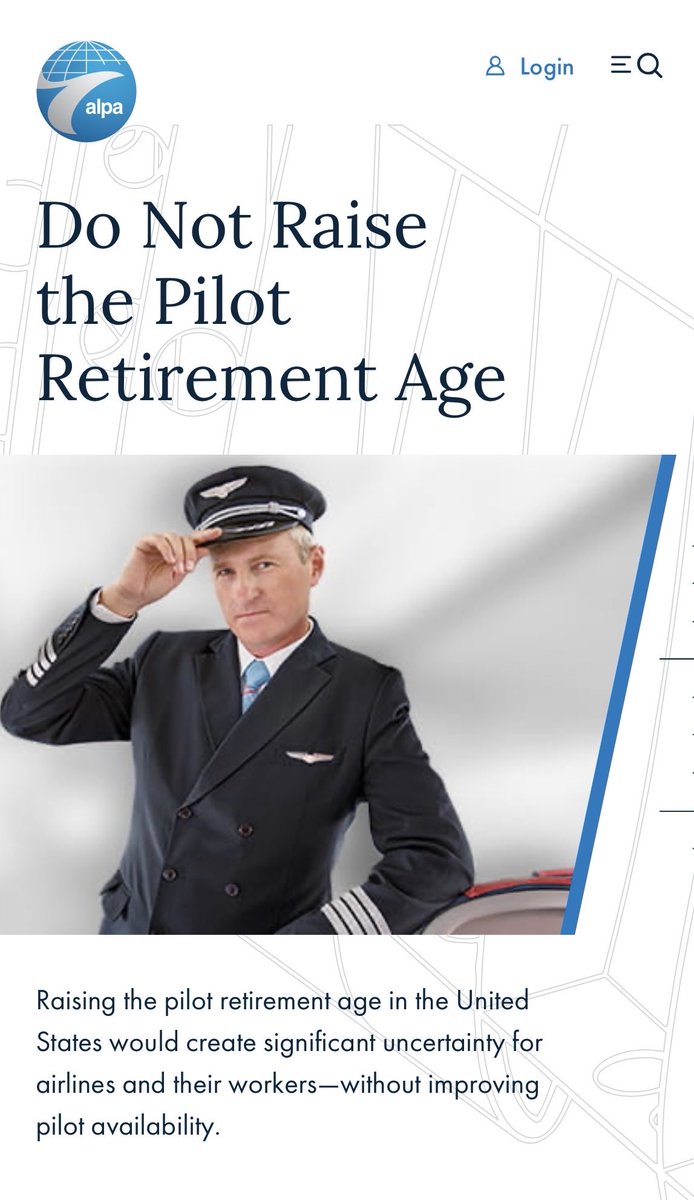
Did you know commercial pilots are forced to retire at the age of 65?
Every time a pilot is forced to retire at 65, we lose proficient aviation professionals with invaluable knowledge and skills, and ultimately, the traveling public pays the price.
It's time for Congress to pass my bill, the Let Experienced Pilots Fly Act, and keep experienced pilots in our skies.
Read my op-ed in @WashTimesOpEd:
ALPA Abandoned Experienced Pilots.
Congress Ignored the Retirement Gap. AARP Has Yet to Lead.
Part 121 Pilots Deserve Better.
Part 121 pilots are forced to retire at 65 by federal law — then denied full Social Security benefits until 67.
That creates a federally imposed retirement gap.
Pilots over 60 already pass: ✈️ FAA medicals ✈️ Sim checks ✈️ Line checks
Experience is not the problem.
#EPAS #AviationSafety #FAA #ALPA
EPAS STRATEGIC UPDATE: May 2026
Over the past several years, EPAS has maintained a disciplined and methodical strategy focused on one objective: restoring experience, safety, and fairness to the professional pilot workforce by eliminating the arbitrary age-65 mandatory retirement rule.
As we are all aware, there are currently numerous international "balls in the air," and global focus has frequently shifted toward these emerging issues. However, we must look at the "signal through the noise." While headlines fluctuate, the fundamental mission to modernize pilot retirement remains a critical pillar of aviation safety and workforce stability.
The pilot shortage of "experienced and capable" pilots has never been more critical than today. We see this reflected in persistent staffing issues, aggressive hiring cycles, and the "death by a thousand cuts" regarding aviation mishaps currently plaguing our industry. EPAS has remained committed to a long-term forensic approach that filters out the distractions and focuses on the core developments that will solve these crises.
Today, three major signals are converging simultaneously validating the strategic framework EPAS established years ago.
1. The International Pathway (ICAO WP106)
The international pathway continues to advance through ICAO Working Paper 106 (WP106). EPAS recognized early that lasting change cannot occur solely through domestic legislation. Because ICAO standards directly influence international legislation and operations, we have consistently emphasized that reform requires engagement at the international governance level first. Our persistence with WP106 ensures that domestic changes will be supported by global standards.
2. Executive Leadership
The President of the United States has nominated an Ambassador to ICAO who understands and recognizes the issues at hand. Captain Jeff Anderson knows the operational realities of commercial aviation and supports the integration of experienced aviators. His leadership would provide the U.S. with a strong, pro-aviation voice at the ICAO Council table, ensuring that American interests are no longer sidelined by foreign bureaucracies.
3. Legislative House and Senate Alignments
For the first time in this fight, both the House and the Senate have taken time to introduce legislation to raise the pilot’s retirement age. EPAS has been instrumental in this result, providing the technical expertise to move the needle. Following the reintroduction of the Let Experienced Pilots Fly Act (H.R. 5523) by Representative Troy Nehls, the introduction of a companion bill in the U.S. Senate introduced by senators Grahm and Kelly that this has evolved into a serious, bipartisan national priority.
Disciplined Approach to Raising the Age
EPAS has been deeply engaged throughout this process, working effectively behind the scenes through research, policy engagement, and direct legislative advocacy. Our organization has approached this issue professionally, factually, and strategically.
Our position remains firm:
•Maintain existing medical, training, and proficiency standards.
•Prioritize safety by retaining our most experienced mentors.
•End arbitrary age discrimination that removes highly qualified pilots from service.
These efforts are not isolated developments. They are the three interconnected points of the EPAS strategy. Together, they form the comprehensive framework necessary to achieve a durable modernization of the pilot retirement age.
The signals are clear. We need to pay attention and focus effort. All hands on the rope, brothers and sisters!
EPAS Leadership Team
Read the articles about what is driving the hiring.
PILOT RETIREMENTS- Are any of us surprised? Let’s go people…. We have to raise the age. NOW.
https://t.co/TVlpvbmV4R
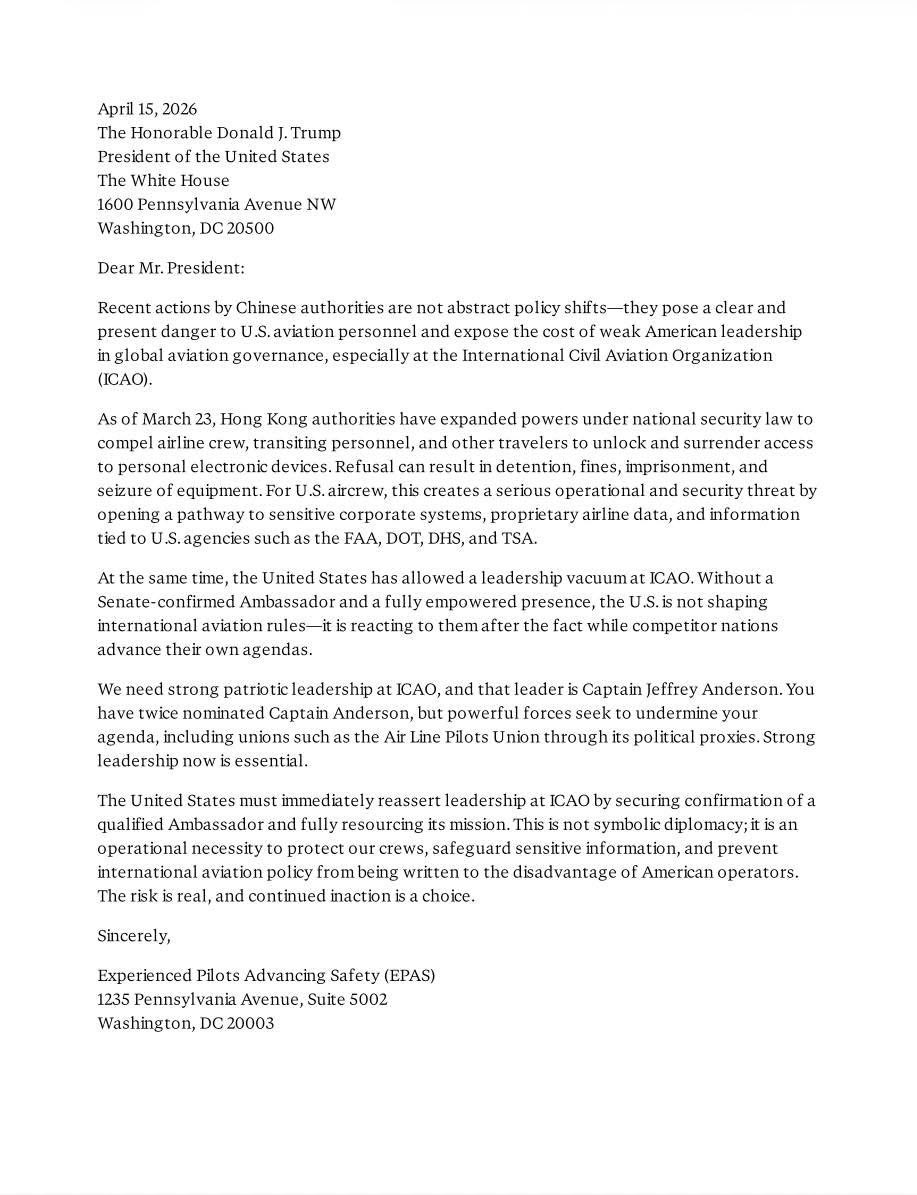
Experienced Pilots Advancing Safety Raises Concerns Over Hong Kong Device Access Rules and U.S.
Representation at ICAO
Group says expanded electronic device inspection powers in Hong Kong raise operational and data protection concerns while renewing calls for stronger U.S. representation at ICAO
Washington, DC - Experienced Pilots Advancing Safety (EPAS) issued a statement regarding recent actions by Chinese authorities and their potential implications for U.S. aviation personnel, data security, and American representation at the International Civil Aviation Organization (ICAO).
Effective March 23, Hong Kong authorities were granted expanded powers under national security provisions to require airline crew members, transit personnel, and other travelers to unlock and provide access to personal electronic devices. According to EPAS, refusal may lead to detention, fines, imprisonment, or seizure of equipment. The organization said the policy presents concerns for U.S. flight crews, particularly in relation to access to sensitive corporate systems, proprietary airline data, and information connected to U.S. regulatory and security agencies, including the FAA, DOT, DHS, and TSA.
“American crews are being placed in harm’s way in legal environments that do not respect U.S. standards for privacy, due process, or data protection,” EPAS stated. “This is a real-world strategic vulnerability that goes straight to national security and the integrity of our aviation system.”
EPAS said the issue also highlights what it described as limited U.S. representation at ICAO, the United Nations agency responsible for establishing international aviation standards and policies. The organization pointed to the absence of a Senate-confirmed U.S. Ambassador and said the current level of representation reduces the country’s influence in international aviation policymaking.
“When the United States is absent at ICAO, competitor nations fill the vacuum,” EPAS continued. “They advance their own strategic, economic, and regulatory agendas, often at the expense of American operators, American workers, and American security.”
EPAS called for immediate action and urged U.S. officials to strengthen the American mission at ICAO.
“We need strong patriotic leadership at ICAO, and that leader is Captain Jeffrey Anderson,” the organization said. “President Trump has twice nominated Captain Anderson, but powerful forces seek to undermine President Trump’s agenda, including unions such as the Air Line Pilots Union through its political proxies. Senator Risch, please do what is in AMERICA’S best interest and confirm Captain Anderson NOW.”
According to EPAS, confirming Captain Anderson and increasing support for the U.S. mission to ICAO would help address concerns related to crew safety, data protection, and U.S. participation in international aviation policy discussions.
“The risk is real,” EPAS concluded. “Continued inaction is a choice – and it is a choice America cannot afford to make.”
Media Contact:
Jim Riehl
Experienced Pilots Advancing Safety
1 (202) 470-5597
https://t.co/8yRb5UNDr8
✈️ Meet the voices turning aviation strategy into action at GISS 2026. Hear from global leaders sharing real-world perspectives on how policy, operations, infrastructure, and financing deliver results.
Learn more about the speakers: https://t.co/QKTOOcocBr
Recent Near-Midair Collision Highlights Urgent Need for Confirmed U.S. Leadership at ICAO
On the evening of March 24, 2026, United Airlines Flight 589—a Boeing 737-800 carrying 168 passengers and crew from San Francisco—narrowly avoided a catastrophic midair collision while on final approach to John Wayne Airport (SNA) in Santa Ana, California. A U.S. Army National Guard UH-60 Black Hawk helicopter (callsign Knife 25), conducting a routine training mission, crossed directly through the airliner’s approach path.
Flight data shows the aircraft came within approximately 525 feet vertically and 1,422 feet laterally—well inside margins that leave no room for error—triggering a Traffic Collision Avoidance System (TCAS) Resolution Advisory. The United pilots executed flawlessly, leveling off and avoiding disaster by seconds. This was not a margin of safety—it was a near failure of the system.
This incident follows the January 2025 midair collision near Washington, D.C., that killed 67 people and exposed dangerous gaps in how military helicopter operations intersect with high-density commercial airspace. That tragedy was supposed to be a wake-up call. Instead, the same risks persist.
These are not isolated events. They are symptoms of a system under strain—where airspace complexity, mixed operations, and inconsistent coordination continue to create preventable hazards.
These exact issues—airspace integration, separation standards, and military-civilian coordination—are governed at the international level by the International Civil Aviation Organization (ICAO). Yet the United States remains without a Senate-confirmed Representative on the ICAO Council, effectively sidelining American leadership at the very moment it is most needed.
This is not a procedural delay. It is a leadership failure.
Every day without strong U.S. representation at ICAO is another day where global aviation standards evolve without decisive American input—standards that directly impact the safety of U.S. crews, passengers, and airspace.
The Senate Foreign Relations Committee must act immediately to confirm Captain Jeffrey Anderson as U.S. Representative to ICAO with the rank of Ambassador. Delay is no longer a neutral act—it carries real-world risk.
The next near-miss may not end the same way.
EPAS Leadership Team
Update
Every day, expectations of pilots who lose their job change entirely. Every day, individuals on the precipice of losing theirs lower. So your request has to be answered in the context of the general mission - to raise the age.
If every congressional member and staffer that we and LEPF talked to during FAA Reauth had acted and voted according to what they said they factually believed about the issue, this would have been done long ago. But ALPA leveraged partisan politics over the virtue of good policy - a situation that favored Democrats in just the Senate - and defeated the measure. It was very helpful to ALPA’s argument that passing the age increase would have placed the domestic regulation at least temporarily out of harmony with the international standard.
Fast forward to today. At least until next January we have openly supportive Republican majorities in both chambers of Congress, but a quiet ICAO and no pressing umph to legislatively raise the age. Life must be breathed into both. While Captain Anderson would not be headed to Montreal simply or primarily to raise the age standard, our issue is known to be recognized by the White House as a matter of aviation safety and industry reliability.
The industrial facts are on our side. While the political balance is to our favor, the congressional advocacy campaign will be simple and swift once the lamp is lit. The challenge is getting it lit before the midterm elections potentially hurt us. And no secret, THAT is ALPA’s play. It’s the reason ALPA is willing to falsely smear a respected colleague in order to prevent or at least terminally stall his ICAO appointment.
If the midterms change the partisan balance in either house, there is still the fact that EVERYONE in Washington KNOWS it is the right thing to raise the age. In that case, we need even more for ICAO to take leadership on the matter and elevate or eliminate the global benchmark. Once that happens, there will be no serious debate about the U.S. matching the rest.
EPAS has seen all of this from the start. It is the reason for our formation - to deal with the tactical landscape as it is; not how we wish it would be, and to use effective strategies and tools others wouldn’t. Regardless, we’re still David to ALPA’s Goliath, and we’re fighting in Goliath’s swamp.
Again, no secret worth hiding … Senate Foreign Relations Committee Republicans, chaired by Sen Risch of Idaho, MUST be made to understand RIGHT NOW that they are ignorantly contributing to a weakening of America’s position in global aviation and overall air safety by falling prey to ALPA’s sponsored attacks on the ICAO Ambassador nominee, Jeff Anderson. Either way, whether it’s this year with strong congressional support, or sometime in the more distant future after ICAO leadership pulls our own legislators forward, THIS IS THE BATTLE.
Your enemy, ALPA, is all-in on it. EPAS leadership is all-in on it. So where are we? This will be the big push this summer to get movement on a bill. It needs a Senate sponsor. We don’t have a timeline on that piece which is needed to have any chance of a bill passing this summer.
I’m just about to turn 65. I’ve been employed as an airline pilot for 36 years. I’m reasonably intelligent, but admittedly far from a wunderkind, and with no offers to work for the JPL or NASA. Pretty much an average guy who’s outstanding at being humble. At at age 64, I had to learn how to fly the most complex and advanced airliner currently in service, the Airbus A350. I had flown the relatively simplistic Boeing 767 for the past 25 years, and had never flown an Airbus, which is completely different in almost every way from a Boeing. I was the oldest person to attempt going through the Delta’s A350 Initial Qualification training program. I was warned that even much younger pilots were finding the training to be extremely challenging, and that because of my age, success might not be an option. It was an extremely complex airplane. The training manual is literally 7000 pages long. Countless Training videos, 6 weeks of simulators, extremely difficult electronic and oral exams. “It can’t be done, old guy”, many said.
BULLSHIT! I went through the training and actually had an easy time of it. It was no more challenging than when I went through MD-11 training in 1991, at age 34, even though the A350 was a much more difficult training program. I had no decline in my learning ability in 30 years, and aced the very challenging program without any trouble. If I can maintain my ability to easily learn complex tasks into my mid-60’s, hell, anyone can.
To answer the question: For some it might be age 30, or 40, or 50, etc, etc. However, everyone is different. Some people are still extremely lucid and able to learn well into their 90’s. Don’t assume. Don’t count yourself out at any age. Don’t be prejudiced against older people and sell them short, because many of them are still as sharp or even sharper than you. Treat all people well, especially older people, because in the blink of an eye you’re going to be one of them, and you’re going to love it when someone treats YOU with dignity and a little bit of respect.
Credit to the respective owner ✍️