I wrote a piece in The Guardian exploring Nigeria’s digital growth and the rising stakes of cybersecurity.
As our systems scale, so do the risks. The real question is not if threats will occur, but how resilient our systems are when they do.
Read the full story 👇🏽
The widening gap between the official and parallel market rates suggests that FX demand and supply are still searching for equilibrium.
A ₦29.54 spread is not alarming by historical standards, but it is a reminder that exchange rate stability requires more than reforms, it...
The gap between Nigeria's official and parallel exchange rates just widened to N29.54.
The naira weakened at both windows this week, with the official NFEM rate depreciating to N1,370.46 and the parallel market rate falling to N1,400. The spread between both rates widened to N29.54, a signal that FX supply and demand pressures are not yet fully aligned across the two markets.
This highlights how energy markets are evolving beyond national borders. What Dangote is building is not just refining capacity, but a regional supply network, with Lomé emerging as a strategic distribution hub for West Africa’s fuel trade.
Lomé, the port city in Togo, is becoming a key trading and redistribution hub for fuel from the Dangote Petroleum Refinery.
A significant portion of Dangote's fuel output is sold offshore via Lomé before being shipped to various West African markets, including Nigeria🇳🇬.
Between March and May 2026, over 70-80% of Nigeria's🇳🇬 seaborne imported fuel originated at Dangote and was rerouted through Lomé.
Lomé's ship-to-ship (STS) operations allow for the blending, storage, and redistribution of fuels to smaller ports across West Africa, increasing market efficiency and access.
The CBN’s UBO disclosure requirement is a significant step toward strengthening transparency in Nigeria’s financial system.
Knowing who ultimately owns and controls regulated entities helps reduce the risks of money laundering, regulatory arbitrage, and hidden ownership...
The Central Bank of Nigeria recently issued a circular requiring fintechs and other regulated financial institutions to identify, verify, and disclose their Ultimate Beneficial Owners (UBOs). https://t.co/b9Q9lG6gkk
An undervalued naira may sound negative, but it also suggests the currency could have room to strengthen if economic fundamentals continue to improve.
The IMF’s assessment is a reminder that exchange rates are driven by more than policy reforms. Sustained FX inflows,...
IMF says naira is 25% undervalued despite FX reforms
The International Monetary Fund (IMF) says the naira remains undervalued by 25.6 percent despite recovering some ground against the US dollar following Nigeria’s foreign exchange (FX) reforms.
An undervalued currency means the exchange rate is weaker than what economic fundamentals would ordinarily support.
https://t.co/I7344HZkhc
The lesson here is that conviction and concentration often outperform constant trading.
Great investors don't just find opportunities, they have the patience to stay with them.
To Investors
Everyone wants to invest like Otedola. Nobody wants to do what Otedola actually does.
He picks a sector, builds a dominant position, scales it to the ceiling, then exits at a time and price of his choosing.
That is the full strategy. It sounds simple because it is. It is just not easy.
Most retail investors in Nigeria are doing the opposite. Buying small positions in ten different stocks so nothing hurts too much. Selling the moment a stock dips 8%. Taking profit at 20% on an asset that was going to 200%.
Otedola held Geregu from ₦250 billion to ₦2.9 trillion before he moved. That kind of patience does not come from a hot tip. It comes from conviction built on research, and the emotional discipline to sit still while the thesis plays out.
You do not need $750 million to invest like him. You need one good idea, enough courage to size into it properly, and the patience to let time do the work.
The money is not the secret but the mindset is.
The challenge now is sustaining the momentum through stronger exports, investment inflows, and broader economic productivity rather than relying on temporary capital flows.
A reserve position approaching $50 billion is a positive signal for external stability. It strengthens the CBN’s ability to manage volatility, support market confidence, and meet external obligations.
This is why power sector reform in Nigeria is far more complex than simply “raising tariffs.”
The sector had actually begun showing measurable progress before the FX liberalisation shock dramatically increased dollar-linked costs. Once the naira weakened, the financing gap...
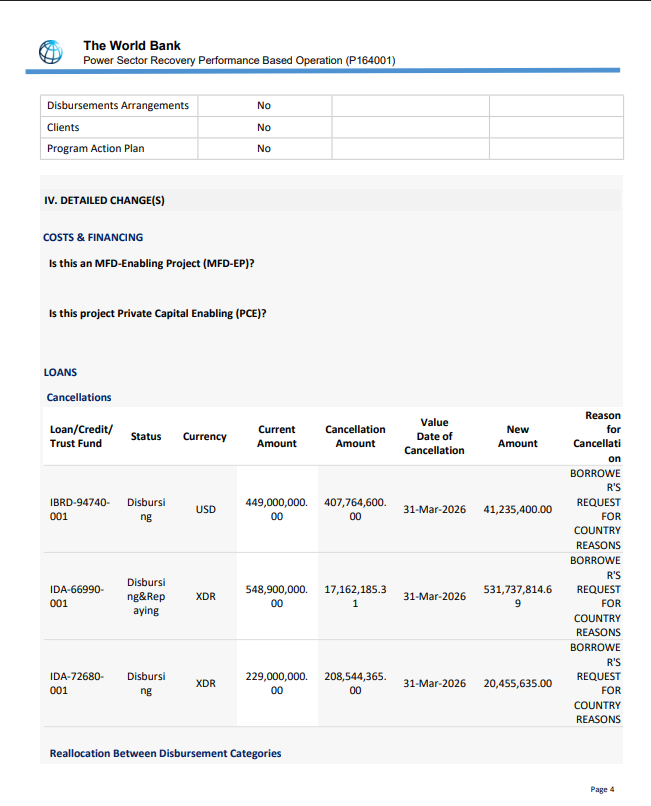
Based on my reading about the cancelled World Bank loan, it appears that:
1. The World Bank (WB) stated there was a "persistent mismatch between power sector revenues and costs," which created "recurrent financing gaps," most notably in the form of "tariff shortfalls." In simple terms, Nigeria was not generating enough revenue to sustain its power sector.
2. In 2021, Nigeria developed a Power Sector Recovery Programme (PSRP), funded by the WB with US$20 million. The implementation was "satisfactory, brought substantial results." The results are listed below:
2.1 Between 2019 and 2022, tariff shortfalls decreased by 71% (from N581b to N166b).
2.2 Regulatory cost recovery increased from 56% to 94% during this period.
2.3 Annual electricity supplied to the distribution grid grew by 13% between 2018 and 2021.
3. Based on this success, a new US$750 million loan was approved on 9th June 2023.
4. However, in June 2023, Nigeria liberalized its foreign exchange market, meaning it needed more Naira to pay for local gas priced in USD. "This effectively increased tariff shortfalls from a low of N140b in 2022 to an estimated N1.9 trillion in 2024 and 2025, exerting serious pressure on the limited fiscal space of the Federal Government of Nigeria (FGN)."
5. According to the World Bank, while "prior results have been achieved and verified," the "broader disbursements under the Additional Financing have not materialized as expected, due to the increase in tariff shortfalls".
In summary, Nigeria devalued its currency thus could not cover the cost of gas priced in $, resulting in soaring power liabilities. Also only Band A tariffs were raised. As a consequence, the World Bank withdrew the loan, citing that progress remains "Moderately Unsatisfactory."
Exactly. Strong capital inflow numbers look impressive, but composition matters more than headlines.
An economy driven mainly by short-term portfolio flows remains vulnerable because that capital is highly sensitive to interest rates, FX movements, and market sentiment.
🗣️ Dear Nigerians,
Nigeria pulled in a record $23.22bn in foreign capital inflow in 2025, and on the surface, that sounds like very good news.
But there’s more to the story.
For every $1 that came into Nigeria as long-term investment that can build factories, businesses, infrastructure, and jobs, $21 came in as short-term financial flows like stocks, bonds, and treasury bills.
In simple terms, most of the money entering the country is quick money.
Money that can come in today and leave tomorrow.
The numbers may be big, but long-term growth needs investment that stays, builds, creates jobs, and improves people’s lives.
#GetInvolved #FollowTheMoney
Clearing salary backlogs is more than a fiscal update, it directly affects household stability, consumer spending, and worker morale.
The bigger win is consistency. Sustainable welfare improvements matter more when workers can rely on predictable and timely payments.
The Central Bank of Nigeria (CBN) conducted one of its most aggressive single-session Open Market Operations (OMO) auctions on May 21, 2026, mopping up a combined N3.692 trillion across two instruments in a dramatic escalation of its liquidity tightening campaign. https://t.co/qJLkp0OxeX
The Minister of Industry, Trade and Investment, Dr Jumoke Oduwole, has announced a major expansion of Nigeria’s implementation of the African Continental Free Trade Area (AfCFTA) through a new strategic partnership with RwandAir for the Nigeria–East and Southern Africa Air Cargo Corridor.
In a statement by the ministry, it was noted that before the establishment of the corridor, many Nigerian exporters faced cargo costs ranging from US$3 to as high as US$10 per kilogram for goods sent to East and Southern Africa.
The statement said: “This situation made the cost of trade prohibitive and reduced the price competitiveness of Nigerian goods. On Africa Day 2025, the Federal Ministry of Industry, Trade and Investment launched the Nigeria–East and Southern Africa Air Cargo Corridor through a partnership with Uganda Airlines.
T+1 settlement is a quiet but important upgrade for Nigeria’s capital market.
Reducing settlement time from two days to one improves liquidity, lowers counterparty risk, and brings the NGX closer to global market standards.
These are the kinds of structural improvements that,,,
T+1 settlement takes effect on the Nigerian Exchange on June 1, 2026, one week away.
Currently: sell shares today, receive cash in two business days (T+2).
From June 1: sell shares today, receive cash the next business day (T+1).
T+1 is not just an operational change. It is a structural upgrade that makes the Nigerian capital market more competitive, more efficient, and more attractive to international institutional investors.