I wrote a piece in The Guardian exploring Nigeria’s digital growth and the rising stakes of cybersecurity.
As our systems scale, so do the risks. The real question is not if threats will occur, but how resilient our systems are when they do.
Read the full story 👇🏽
The lesson here is that conviction and concentration often outperform constant trading.
Great investors don't just find opportunities, they have the patience to stay with them.
To Investors
Everyone wants to invest like Otedola. Nobody wants to do what Otedola actually does.
He picks a sector, builds a dominant position, scales it to the ceiling, then exits at a time and price of his choosing.
That is the full strategy. It sounds simple because it is. It is just not easy.
Most retail investors in Nigeria are doing the opposite. Buying small positions in ten different stocks so nothing hurts too much. Selling the moment a stock dips 8%. Taking profit at 20% on an asset that was going to 200%.
Otedola held Geregu from ₦250 billion to ₦2.9 trillion before he moved. That kind of patience does not come from a hot tip. It comes from conviction built on research, and the emotional discipline to sit still while the thesis plays out.
You do not need $750 million to invest like him. You need one good idea, enough courage to size into it properly, and the patience to let time do the work.
The money is not the secret but the mindset is.
The challenge now is sustaining the momentum through stronger exports, investment inflows, and broader economic productivity rather than relying on temporary capital flows.
A reserve position approaching $50 billion is a positive signal for external stability. It strengthens the CBN’s ability to manage volatility, support market confidence, and meet external obligations.
This is why power sector reform in Nigeria is far more complex than simply “raising tariffs.”
The sector had actually begun showing measurable progress before the FX liberalisation shock dramatically increased dollar-linked costs. Once the naira weakened, the financing gap...
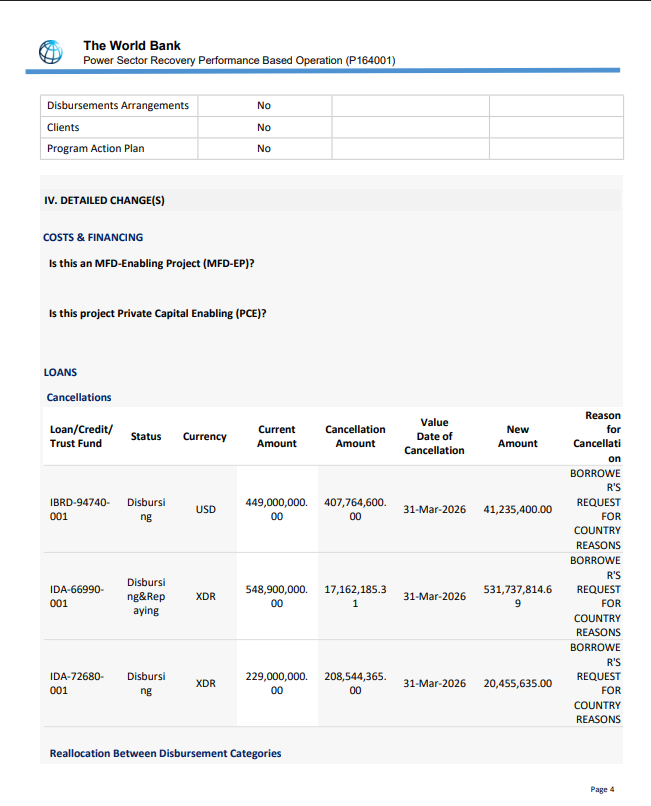
Based on my reading about the cancelled World Bank loan, it appears that:
1. The World Bank (WB) stated there was a "persistent mismatch between power sector revenues and costs," which created "recurrent financing gaps," most notably in the form of "tariff shortfalls." In simple terms, Nigeria was not generating enough revenue to sustain its power sector.
2. In 2021, Nigeria developed a Power Sector Recovery Programme (PSRP), funded by the WB with US$20 million. The implementation was "satisfactory, brought substantial results." The results are listed below:
2.1 Between 2019 and 2022, tariff shortfalls decreased by 71% (from N581b to N166b).
2.2 Regulatory cost recovery increased from 56% to 94% during this period.
2.3 Annual electricity supplied to the distribution grid grew by 13% between 2018 and 2021.
3. Based on this success, a new US$750 million loan was approved on 9th June 2023.
4. However, in June 2023, Nigeria liberalized its foreign exchange market, meaning it needed more Naira to pay for local gas priced in USD. "This effectively increased tariff shortfalls from a low of N140b in 2022 to an estimated N1.9 trillion in 2024 and 2025, exerting serious pressure on the limited fiscal space of the Federal Government of Nigeria (FGN)."
5. According to the World Bank, while "prior results have been achieved and verified," the "broader disbursements under the Additional Financing have not materialized as expected, due to the increase in tariff shortfalls".
In summary, Nigeria devalued its currency thus could not cover the cost of gas priced in $, resulting in soaring power liabilities. Also only Band A tariffs were raised. As a consequence, the World Bank withdrew the loan, citing that progress remains "Moderately Unsatisfactory."
Exactly. Strong capital inflow numbers look impressive, but composition matters more than headlines.
An economy driven mainly by short-term portfolio flows remains vulnerable because that capital is highly sensitive to interest rates, FX movements, and market sentiment.
🗣️ Dear Nigerians,
Nigeria pulled in a record $23.22bn in foreign capital inflow in 2025, and on the surface, that sounds like very good news.
But there’s more to the story.
For every $1 that came into Nigeria as long-term investment that can build factories, businesses, infrastructure, and jobs, $21 came in as short-term financial flows like stocks, bonds, and treasury bills.
In simple terms, most of the money entering the country is quick money.
Money that can come in today and leave tomorrow.
The numbers may be big, but long-term growth needs investment that stays, builds, creates jobs, and improves people’s lives.
#GetInvolved #FollowTheMoney
Clearing salary backlogs is more than a fiscal update, it directly affects household stability, consumer spending, and worker morale.
The bigger win is consistency. Sustainable welfare improvements matter more when workers can rely on predictable and timely payments.
The Central Bank of Nigeria (CBN) conducted one of its most aggressive single-session Open Market Operations (OMO) auctions on May 21, 2026, mopping up a combined N3.692 trillion across two instruments in a dramatic escalation of its liquidity tightening campaign. https://t.co/qJLkp0OxeX
The Minister of Industry, Trade and Investment, Dr Jumoke Oduwole, has announced a major expansion of Nigeria’s implementation of the African Continental Free Trade Area (AfCFTA) through a new strategic partnership with RwandAir for the Nigeria–East and Southern Africa Air Cargo Corridor.
In a statement by the ministry, it was noted that before the establishment of the corridor, many Nigerian exporters faced cargo costs ranging from US$3 to as high as US$10 per kilogram for goods sent to East and Southern Africa.
The statement said: “This situation made the cost of trade prohibitive and reduced the price competitiveness of Nigerian goods. On Africa Day 2025, the Federal Ministry of Industry, Trade and Investment launched the Nigeria–East and Southern Africa Air Cargo Corridor through a partnership with Uganda Airlines.
T+1 settlement is a quiet but important upgrade for Nigeria’s capital market.
Reducing settlement time from two days to one improves liquidity, lowers counterparty risk, and brings the NGX closer to global market standards.
These are the kinds of structural improvements that,,,
T+1 settlement takes effect on the Nigerian Exchange on June 1, 2026, one week away.
Currently: sell shares today, receive cash in two business days (T+2).
From June 1: sell shares today, receive cash the next business day (T+1).
T+1 is not just an operational change. It is a structural upgrade that makes the Nigerian capital market more competitive, more efficient, and more attractive to international institutional investors.
Alaoji Power Plant Not Just To Serve Abia State But Nigeria — Adighije
The Alaoji power plant is back on. We have 3 mechanically available units there now, which amount to 375MW which is readily available to dispatch to the grid. Our power plants are grid tight, so the energy we generate is exported to the national grid and can be transported allover the country.
Jennifer Adighije, MD/CEO, NDPHC
Nigeria’s fuel market has shifted.
Improved domestic supply has reduced shortages, but at a serious price. In the past, subsidies masked global shocks and FX pressures, often causing scarcity.
Today, with refineries and policy changes, Nigerians are paying ‘correct prices’—yet questions remain: would subsidies have returned if imports still dominated?
Watch the full episode on YouTube @nairametrics.tv
https://t.co/vfcFN10LUt
Drinks and Mics is proudly sponsored by @ledropnigeria , @mandilasgroup , @uacfoodsng .
...fiscally unsustainable.
The challenge now is ensuring that the gains from subsidy removal translate into visible economic improvement, because reform without tangible impact will always struggle to gain public trust.
The difficult truth is that fuel subsidy was consuming resources that should have gone into infrastructure, healthcare, education, and productivity.
For years, Nigeria spent trillions sustaining consumption while underinvesting in the foundations of growth. That model was...
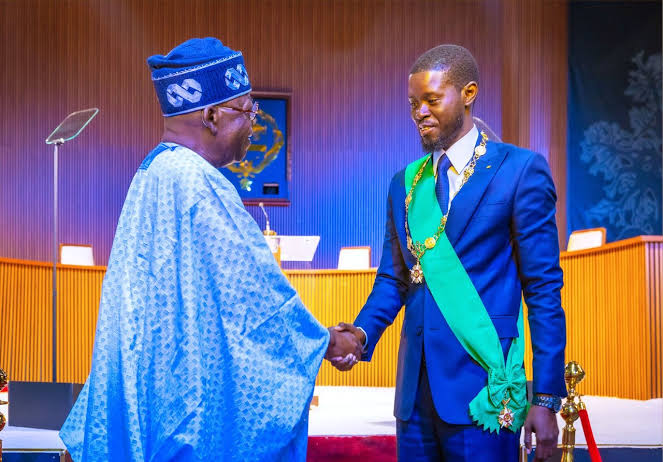
WE COULD HAVE BEEN SENEGAL TOO
Shall I Begin?
The night before the dawn of 2022, Nigeria had already written her own obituary - the budget told the ugly truth our rulers were too shy to admit.
Nigeria initially budgeted for N443 Billion for fuel subsidy payment. Before the year shut its eyes, the government returned seeking an additional N4.39 Trillion Naira. Ten billion dollars.
For appropriate context:
The entire national budget for year 2022 under review was N17.3 Trillion.
A staggering N4.39 Trillion of that was budgeted just for an unproductive, wasteful and retrogressive subsidy regime.
Approximately 20% of our national budget squandered just to sustain an expensive lie of a cheap fuel to earn the applause of a largely ignorant population.
For a more effective context and this is where it gets interesting or should I say annoying:
The budgetary allocation for:
Health - N711B
Education - N1.3T
Infrastructure (Transport, Works, Power, etc) - 1.45T
Housing - N500B
COMBINED - N3.97T
But Fuel Subsidy alone was N4.39 Trillion - Far higher than the 4 most critical sectors of the economy combined.
The rot was more expensive than the remedy. The poison was better funded than the cure. Generation after generation, we fed the trap and called it governance.
By 2023, the calculations had grown obscene. N18.4 Billion per day.
Not for teachers. Not for surgeons. Not for asphalt or electricity or the crying farmer under a failed irrigation system. Just - fuel subsidy. Every single day.
Madness.
No wonder our Universities were poorly funded and went on strike for a cumulative 59 Months between 1999 - 2023.
No wonder our infrastructure decayed without renovations and reinvestment and no federal road was motorable.
No wonder our hospitals became glorified mortuaries due to poor funding and inadequate investment.
No wonder km long fuel queues consistently plagued us.
No wonder State governors became professional beggars going bowls in hand to the Villa for bail outs just to meet salary obligations.
No wonder that even at the height of our oil prosperity, we still couldn't record formidable achievements.
Until a true leader emerged and did what cowards catalogue as impossible. He took the bull by the horns - bare-handed, in broad daylight, before a nation that had mistaken poison for provision. He damned the consequences. Risked the applause. Staked his re-election on an altar and courageously pulled the trigger.
He removed the subsidy.
And with that singular, seismic, long-overdue act - he did not just balance a budget. He lanced a boil that had been festering for four decades. He healed the nation of its fastest-spreading cancer, even as the patient screamed that the surgery was the disease.
Without that decision, Nigeria today would not merely be struggling. Nigeria would be a cautionary tale that other cautionary tales whisper about - worse than Senegal.
And yet - it was Senegal who got the young president. The photogenic revolutionary. The crowd's favourite. The one Twitter fell in love with.
Good Evening Severally...
...it’s about controlling industrial connectivity across a fast-growing region.
At this scale, the conversation shifts from entrepreneurship to economic architecture.
This is bigger than business expansion. It’s regional infrastructure strategy.
Dangote is positioning across the entire value chain, refining, fertiliser, logistics, and now cross-border energy transport. The Ethiopia-Djibouti pipeline project is not just about fuel or gas,...
Dangote just got the green light to build a cross-border oil and gas pipeline between Ethiopia and Djibouti.
Think about what this means. Ethiopia has almost 140 million people and no coastline. For decades, fuel has had to come in by truck from Djibouti. And the 7 trillion cubic feet of gas under the Ogaden Basin? Sitting there since the 1970s with nowhere to go.
He is solving both problems at once.
The first pipeline brings refined fuel from Djibouti's port into Ethiopia. The second sends Ethiopian gas and crude out to the world through the Red Sea.
This is on top of his $4 billion fertiliser plant in Ethiopia, which he just doubled in size, and the 650,000 barrel-per-day refinery Museveni publicly backed him on.
A fertiliser plant, a refinery, and now a pipeline that connects all of it. The man is not building businesses anymore. He is building infrastructure for a region.