"An exit to eternal summer slacking, but where were we going without ever knowing the way?"
Probably, if given a choice between endlessly drifting on a raft in the ocean and keeping a course toward a desirable destination, you'd at least bring an oar?
https://t.co/QgPx9zwTvn
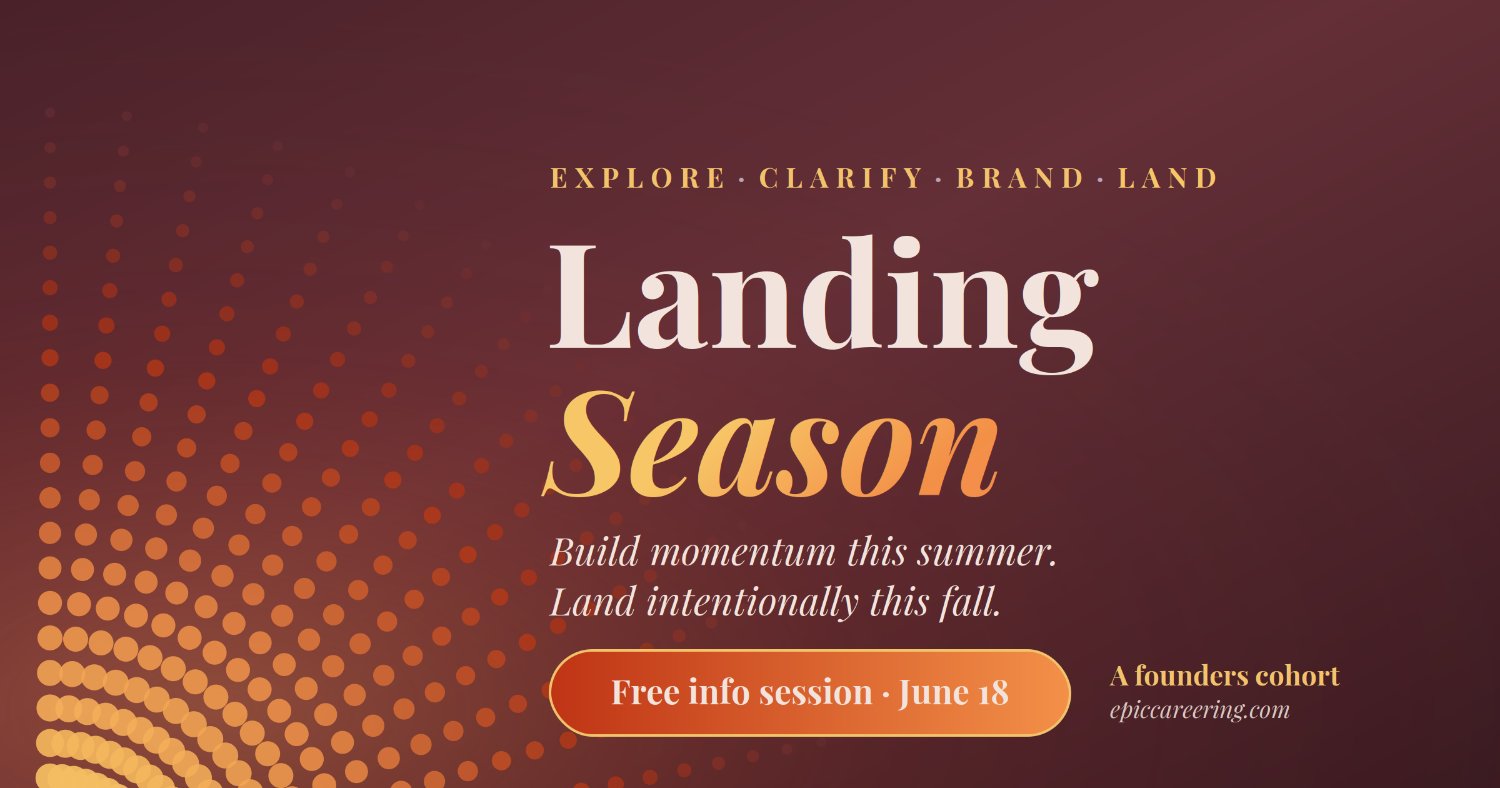
Want to know how to enjoy your summer WHILE laying a foundation to harvest top opportunities come Labor Day?
Join me for a free 1-hour info session tomorrow at 1 PM ET.
Register here: https://t.co/qLKEOvbnBn
#jobsearch#summerjobsearch#landinSeptember#smartnothard
@it_unprofession Let you know if your résumé is going to be parsed correctly by ATS, if it will illicit a response from a recruiter, and if it will impress a hiring manager and give you a competitive advantage.
@it_unprofession Is because ATS systems are still somehow horribly bad at passing all the correct information and there are even more questionably-intentioned résumé shops selling non-ATS friendly templates. Click follow, because we will launch our Epic Résumé Score system very soon. It will …
@TheAIWorld22 I went through the first several, already skeptical, because 1) experiences with Robert Half and 2) I am an expert rèsumè and LinkedIn writer with 20+ years of experience and I have been training my own LLM, and know the distinction between what generic AI spits out and …
A Carnegie Mellon professor walked onto a stage in 2007 and gave an hour-long lecture to 400 people about achieving your childhood dreams. He did not tell the room that the entire talk was actually written for his three kids, who would grow up without him.
His name was Randy Pausch. The date was September 18, 2007. The video has since passed 20 million views, and the book that followed spent more than a hundred weeks on the New York Times bestseller list.
Pausch was 46 years old, had been diagnosed with terminal pancreatic cancer a month earlier, and had been told he had three to six months of good health left.
He did not walk onto that stage to talk about dying. He walked onto it to teach a single lesson hidden inside another one.
Here is what I missed the first time I watched it.
Pausch opened by doing push-ups on stage. He told the audience he was in phenomenally good shape, in better shape than most of them, and anyone who wanted to cry or pity him was welcome to get down and match him. The room laughed. Then he said the line that sets up the entire hour to come. We cannot change the cards we are dealt. Just how we play the hand.
That was the frame. Everything after it was a demonstration.
The lecture was officially titled Really Achieving Your Childhood Dreams, and Pausch did spend the first 40 minutes working through his actual childhood list. Zero gravity. Playing in the NFL. Writing an entry in the World Book Encyclopedia. Being Captain Kirk. Becoming a Disney Imagineer.
He walked the audience through which ones he got, which ones he didn't, and what the gap between wanting and getting had actually taught him.
The framework inside those 40 minutes is the part most people remember, and it is the one Pausch delivered with the most force.
He called it the brick wall. He said the brick walls in your life are there for a reason. They are not there to keep you out. They are there to give you a chance to show how badly you want something. They are there to stop the people who do not want it badly enough. They are there to stop the other people.
Read that again slowly. He is not saying brick walls are a test you have to pass. He is saying brick walls are a filter nature uses to separate the people who actually want a thing from the people who only like the idea of wanting it. That is a completely different claim. Most people treat obstacles as unfair. Pausch argued obstacles are the mechanism by which desire gets proven, and without that mechanism the whole concept of wanting something would be meaningless. Every dream he achieved, he achieved by treating the wall as a signal that he was close, not a signal that he should stop.
The second framework he taught the audience is the one almost nobody teaches in any classroom. He called it the head fake. He pulled it from football. Coaches teach young kids to tackle by having them run drills that look like they are about tackling, but the real lesson being embedded is teamwork, grit, how to take a hit and get back up. The kid thinks they are learning football.
They are actually learning something much larger, and they will not realize it until years later. Pausch said the best teaching in the world is head fake teaching. You get people to learn the thing they need by dressing it up as the thing they already want.
This is the technique behind Alice, the programming software he built at Carnegie Mellon. Kids thought they were making animated movies and games. They were actually learning to code. Pausch said one of his proudest claims to fame was that he had taught programming to a generation of students who had no idea they were being taught programming at all.
And then, with about three minutes left in the lecture, he ran a head fake on the room.
He asked the audience if they had figured out the first head fake of the talk itself. The room went quiet. He said the lecture was never actually about how to achieve your childhood dreams. It was about how to lead your life. If you lead your life the right way, the karma takes care of itself and the dreams come to you anyway.
Then he asked if they had figured out the second head fake. Even quieter.
He said the talk was not for the four hundred people in the room.
It was for his three kids.
Dylan was six. Logan was three. Chloe was eighteen months. They would grow up without their father, and he knew it. Pausch had spent an hour on stage pretending to give career advice to strangers because he needed to record something his children could watch when they were old enough to understand who their dad had been.
The entire architecture of the lecture was a message in a bottle disguised as a keynote. The filtered brick-wall philosophy, the football stories, the dreams he chased and the ones he missed, the line about playing the hand you are dealt, all of it was something a father wanted three small children to internalize after he was no longer there to say it in person.
That is the moment the video stops being a lecture and starts being something else entirely.
Pausch died on July 25, 2008, ten months after giving it. His final sentence on stage was that he had given the talk tonight, and then he walked off. The applause lasted nearly a minute before the camera cut.
Most professors spend their entire careers trying to say one true thing their students will remember for a week.
He said one true thing his children will remember for the rest of their lives, and the rest of the world is still watching the footage.
but Intuit is bleeding customers and ensuring people who had been subscribers for years will never return. The average person can now vibe code a better tool in hours.
@QuickBooks How nice that you have a "policy" to protect you from having to refund customers who had been subscribers for years but have had bad experiences lately
Your product hasn't been able to properly sync my bank. I have issues every year. It cost me more time and money
than many other comparable products.
Intuit has grown too big for its britches and has to resort to overcharging to make money. I see discussions all the time of people who are leaving your platform. You may think you have gotten the benefit of my money in the short term,
@Atlassian In spite of me BEING active in my (free) Jira account a lot in 120 days, my subscription was still deactivated. What gives? I had so much research stored there. Guess I can't rely on Jira to share research and instructions with my team. What's the point?
The challenge that most job seekers have with including these details is how to measure their results if they are not in a revenue-producing role, and how to make it all fit and maintain reader-friendliness. These are challenges we are experts at overcoming.
Two points:
1) I predicted this rebound. All disruptive technologies follow this pattern. Yrs 1-3: we overestimate what they’re going to do and replace humans; Yrs 3-5: we realize limitations and scramble to course correct; Yrs 5+: we underestimate the long term implications.
All the headlines say the job market is cooked, but Robert Half's most recent earnings report tells another story.
Robert Half, one of the largest recruiting agencies in the world, just posted its first quarter of positive sequential growth in over three years. Three years of contraction, and the bleeding finally stopped in Q4 2025.
60% of hiring managers plan to add permanent staff in H1 2026. 55% plan to use contract talent for project needs. 38% of workers say they plan to job hunt in early 2026, up from 29% last year.
They're calling it the "Great Thaw." Workers who have been hunkered down for two years are starting to look around. Employers running skeleton crews are realizing they can't keep delaying critical projects.
But here's the catch. 65% of employers say finding skilled talent is harder than a year ago. Part of the reason? AI generated resumes are flooding applicant pools, making it harder to identify genuinely qualified candidates.
The market is waking up. The noise is getting louder at the same time.
2) people who do a lot of hiring are already inherently, skeptical, if not cynical. Job seeker underestimate the standards to which they are being held. Clients challenge me on including specific details, but these details offer evidence that you not only performed, but well.
The godmother of AI just delivered the reality check Silicon Valley refuses to hear. She has the standing to say it.
Li: “Silicon Valley as a whole tends to mistake clear vision with short distance.”
Seeing the destination clearly has nothing to do with how hard it is to reach.
Self-driving cars were first demonstrated in 2006. Twenty years later Waymo is barely on the road.
The vision was never the problem. The distance was.
Clarity of destination gets mistaken for proximity to arrival. That’s the mistake the industry keeps making. And keeps making.
Li: “I consider myself a scientist in my heart and I actually really don’t like hyping.”
In an industry running at maximum temperature, Fei-Fei Li is one of the few people at the top willing to say that publicly.
Not because the technology isn’t real. Because the gap between what’s visible and what’s required is being systematically underestimated.
Large Language Models dominate the conversation. Text to text. Comparatively contained.
The harder problem is spatial intelligence. AI that reasons about and acts within the physical three-dimensional world. Hardware. Physics. Data that doesn’t exist yet. Real-time adaptation to chaos.
A robot that can clean a bathroom requires understanding every surface, every object, every force, every exception.
That’s not a software update. That’s a civilizational research problem.
Li: “I don’t call it hype. I call it a misleading sentiment. We don’t want to replace human creators.”
The second place the industry gets it wrong is creativity.
The narrative has hardened around replacement. AI takes the jobs. AI tells the stories. AI makes the art.
Li considers that not just wrong but destructive.
Wrong because AI doesn’t replicate creativity. Destructive because believing it can devalues the humans creating culture.
Human creativity isn’t a process to be automated. It’s fundamental to what we are as a species.
The goal is augmentation. Tools that make human creators faster and more capable. Not systems that generate output in the style of human work and call it creation.
That distinction matters more than most people in the industry are willing to sit with.
Precision of imagination is not proximity to reality.
Li has spent her career in the gap between those two things. The map isn’t the territory. The journey is long. The hurdles are deep.
And the scientist who built the foundation this era stands on is telling you the timeline everyone is selling is wrong.
We’ve been almost there with self-driving for twenty years.
The pattern doesn’t change just because the destination looks different.
@danaparish This is wildly messed up. Employers act like there will never be another candidate market. Didn’t the last 25 years teach us anything can happen?
If your time is your marketing budget, spend it on opportunities most likely to convert into offers.
Spend 80% of your time/budget *proactively* pursuing roles and companies where you get to apply the skills you shine in.
Unveil your brilliance.
Rèsumè must: Your strongest skills need to be found in the context of what you achieved with them.
Notice I am not saying: customize each rèsumè to include the required skills.
That is madness!
The #1 piece of feedback I've gotten from hiring managers over my 10+ years in recruiting:
"If it's not in the work experience, it didn't happen"
This means while listing X skill in your summary or skills section is great to get found, it may not hold as much weight when the hiring manager actually reads your resume.