Rosetta's final image of comet 67P, 30 September 2016. After two years flying alongside the comet, ESA put the spacecraft on a slow collision course and had it transmit all the way down. It is still lying there today.
If Earth had rings like Saturn, you would always see them in the exact same spot, because rings sit over the equator and hold position. At the equator they would be edge-on, a line splitting the sky, bright enough to read by.
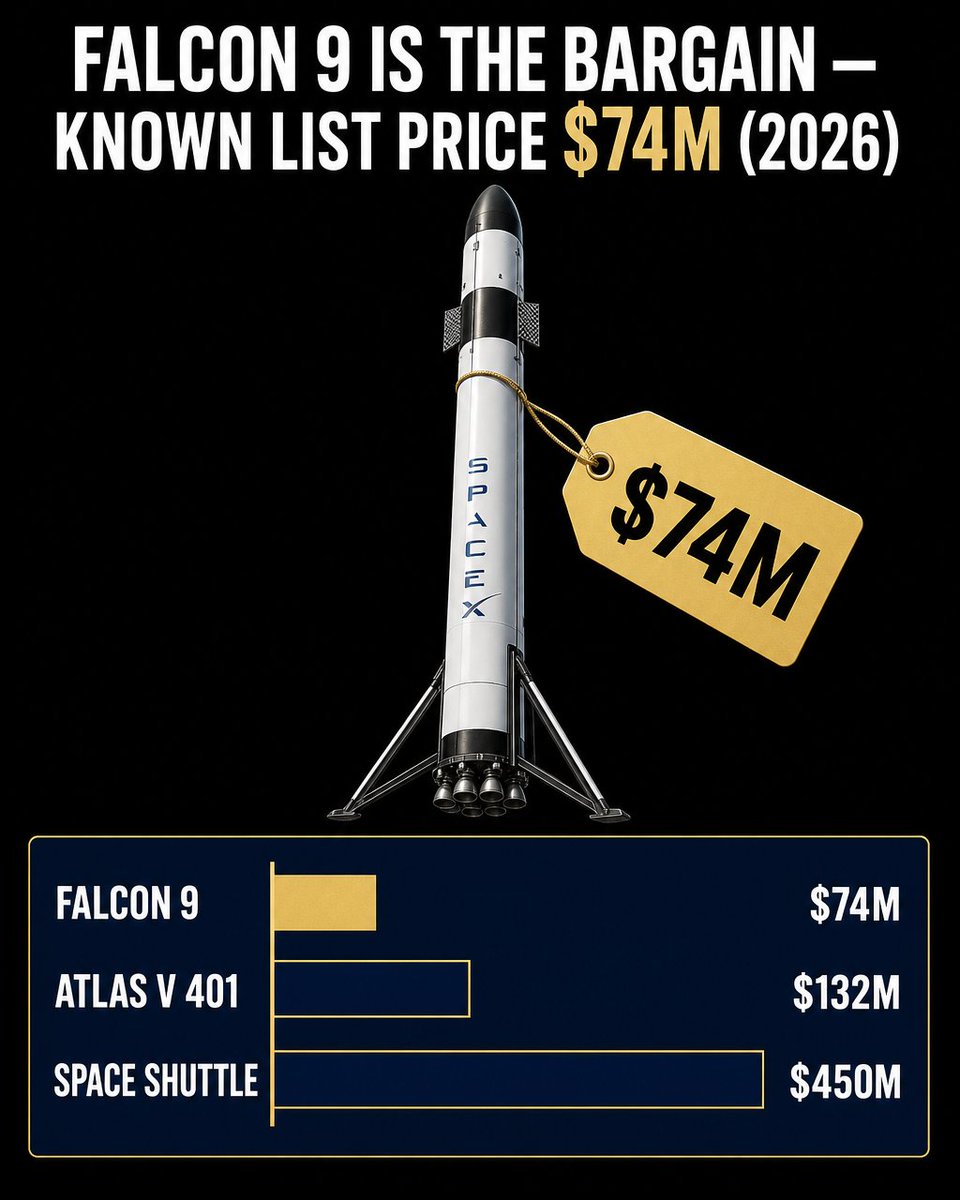
The Falcon 9 is cheap and efficient, all things considered. It lists around $74M a launch, against roughly $132M for an Atlas V 401 and near $450M per Space Shuttle flight. The first stage comes back and flies again.
MYTH: "Human exposure to vacuum makes the body instantly explode." It does not. Skin and blood vessels hold you together, and oxygen starvation takes consciousness in about 15 seconds. Cold is barely a factor, because vacuum insulates.
On 12 April 1961, 27-year-old Yuri Gagarin became the first human in space aboard Vostok 1, orbiting Earth once in 108 minutes. He had almost no control of the craft and ejected to parachute down separately, landing in a field.
Opportunity's last image from Mars, 10 June 2018, as a planet-wide dust storm blocked the Sun and starved its solar panels. Built for 90 days, it lasted almost 15 years and drove 45+ km before going silent mid-transmission.
The gold in a ring predates Earth. It is too heavy to form in a normal star; most was forged when two neutron stars collided. In 2017 astronomers watched one, GW170817, ~130 million light-years away, and saw fresh gold and platinum in the afterglow.
If Andromeda sat 20 times closer, it would stretch about 55 degrees across the sky, more than a hundred full Moons wide, a glowing pinwheel over the horizon. In reality it is already about six Moons wide right now, just too faint for our eyes to see.
MYTH: "The Moon has a permanently dark side." Every part of the Moon gets sunlight. The far side we never see is tidally locked away from us, not stuck in darkness; it runs through the same two weeks of day and two weeks of night.
A Virgin Galactic seat runs an estimated $750,000 for a few minutes of weightlessness and a suborbital view. Against the rest of spaceflight it looks cheap: a private space-station seat is ~$55M, a crewed rotation ~$405M, a NASA deep-space launch $4B+.
Voyager 1, launched in 1977, is still transmitting from more than 25 billion km away on computers weaker than a key fob. Its signal takes nearly a day to reach Earth, and engineers keep shutting systems down to stretch its fading nuclear battery.
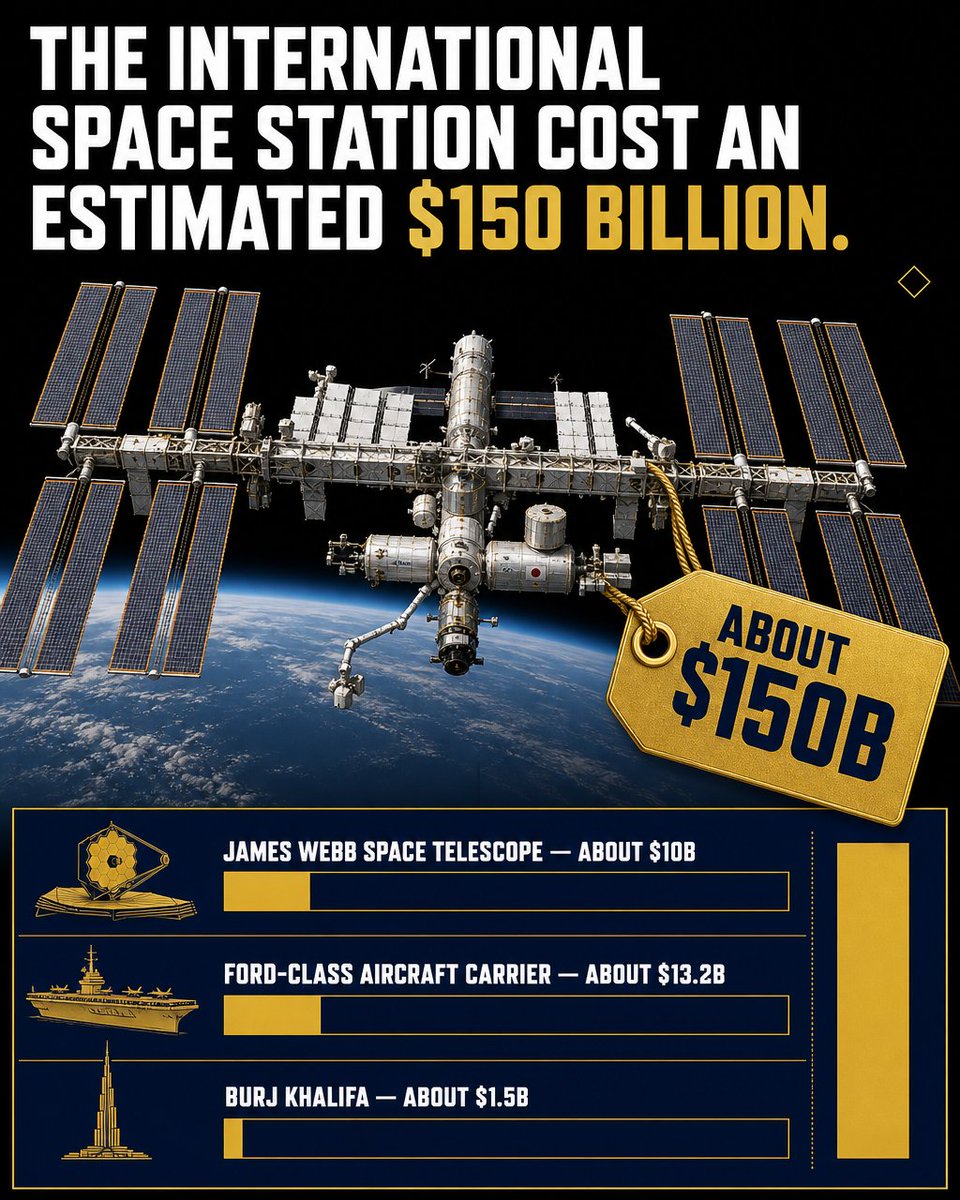
The International Space Station is commonly estimated at about $150 billion once development, assembly, launches and operations are counted. The total varies by methodology, but it remains the most expensive object humans have assembled.
Cassini's final camera image was taken on September 14, 2017 from 634,000 km away. The grainy monochrome view shows the site on Saturn's night side where the spacecraft would enter the atmosphere only hours later.
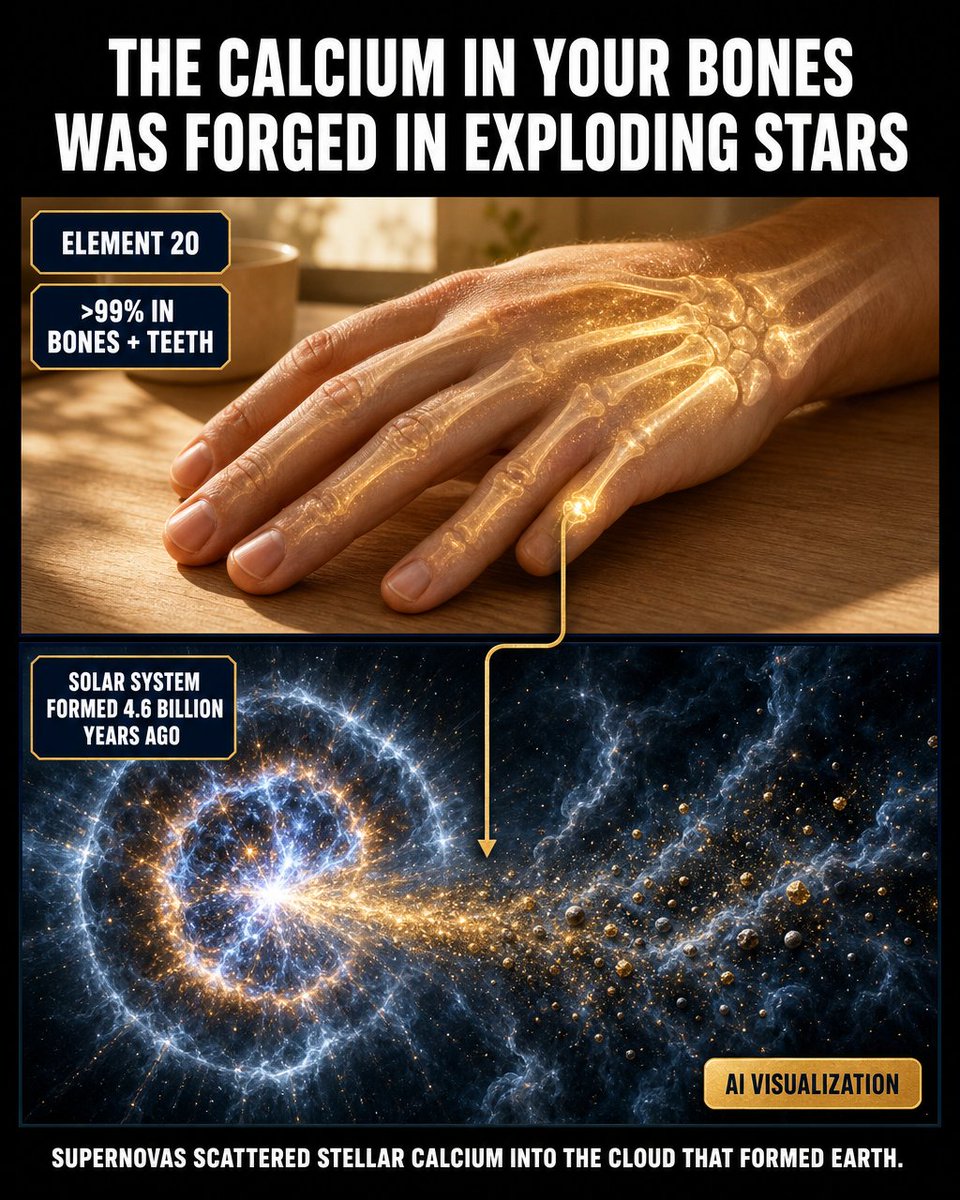
More than 99 percent of the calcium in your body is stored in bones and teeth. Those atoms predate Earth: exploding massive stars and white dwarf explosions scattered calcium into the cloud that formed our solar system 4.6 billion years ago.
Betelgeuse will eventually explode brightly enough to be visible in daylight. It is hundreds of light-years away, far beyond the range where a supernova could threaten Earth, and astronomers do not expect the blast for roughly another 100,000 years.
MYTH: The asteroid belt is a packed obstacle course. A NASA Dawn estimate put the average gap between asteroids at least one mile wide near 1.9 million miles, almost eight Earth-Moon distances. Spacecraft routinely cross it safely.
Apollo 13 was 200,000 miles from Earth when an oxygen tank exploded on April 13, 1970. The crew shut down the command module, used the lunar module as a lifeboat and made it safely back to Earth four days later.
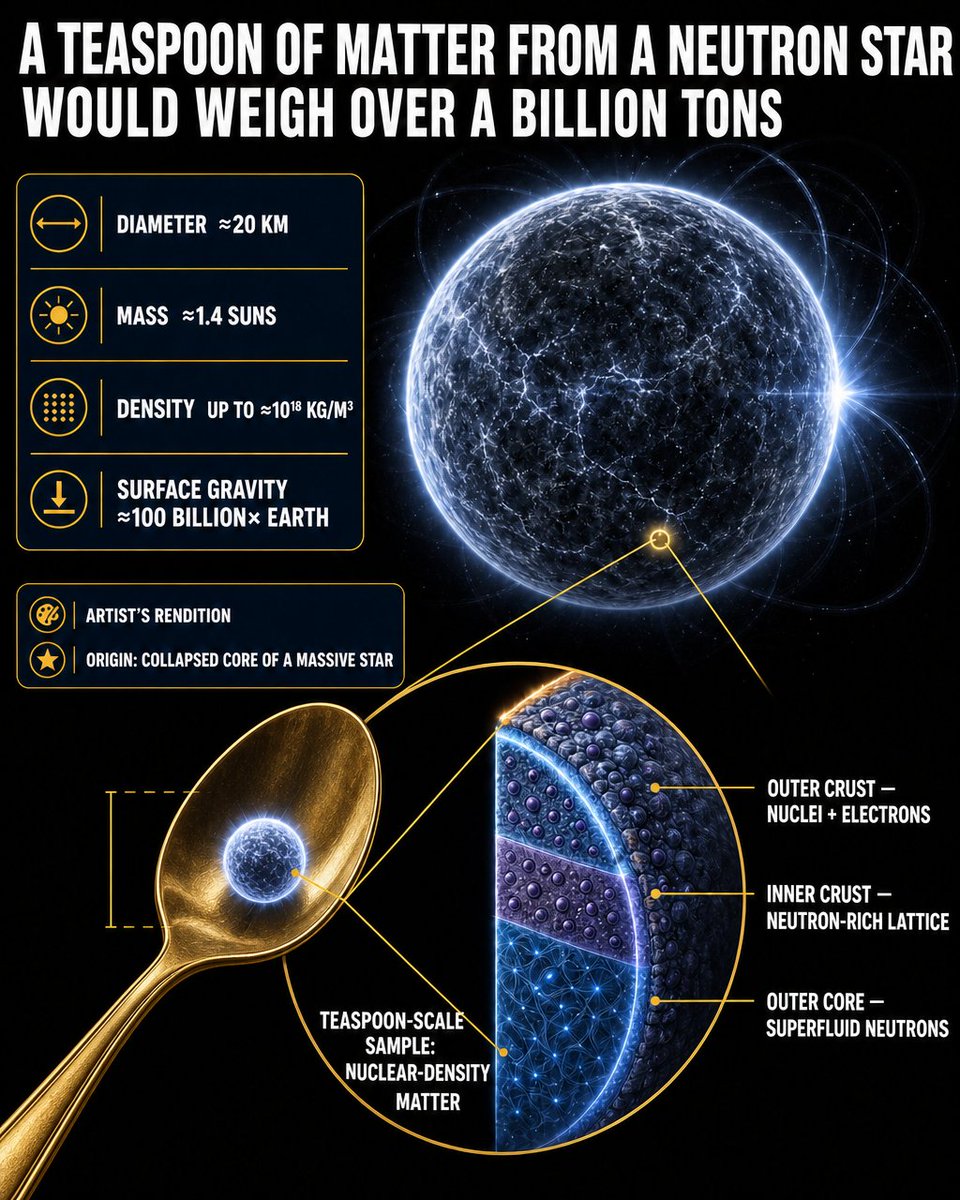
A typical neutron star packs roughly 1.4 Suns into a sphere about 20 km wide. At representative densities, a teaspoon of its material can weigh on the order of a billion tons on Earth.
Ganymede is wider than Mercury: about 5,268 km versus 4,879 km. Mercury still has more than twice the mass, with 3.30 x 10^23 kg versus Ganymede's 1.48 x 10^23 kg, thanks largely to its enormous metallic core.