EPMA is a consulting firm that partners with business leaders to address challenges through management consulting, workforce management and leading technology
46% of enterprises are managing 6 or more external workforce vendors. 17% are managing 10 or more.
Almost none of them designed it that way.
The current workforce model at most organizations was not designed. It accumulated. One urgent requisition, one specialized initiative, one regional expansion at a time. And the costs of that accumulation are showing up in places most executives are not measuring: administrative drag at the hiring manager level, rate confusion across comparable roles, context loss (because no vendor knows you deeply), compliance exposure spread across 10+ relationships.
The MSP response consolidates vendor management but often introduces different problems: a race-to-submit dynamic that produces quantity over quality, a barrier between hiring managers and vendors, and a margin-dictation problem that breaks specialist economics.
The answer is not fewer vendors in total. It is the right few per category.
Full breakdown of why vendor sprawl happens, what it costs, and what a designed workforce model actually looks like - https://t.co/MQhJXZXOHQ
43% of mid-market leaders say efficiency gains from cost-cutting have hit their limit.
Only 12% still name cost reduction as a top priority. 47% have moved on to prioritizing top-line growth.
So where does the next efficiency gain actually come from? Most mid-market operations answer by buying another tool. Capital One's 2026 research found them spending $2 on technology for every $1 on employee training. The assumption underneath: tools will produce the efficiency that cost-cutting cannot.
That assumption is usually wrong.
Seven places where mid-market operations are either producing operating leverage right now or quietly losing it: planning quality, portfolio discipline, client communication, tool utilization, decision velocity, governance, and meeting discipline. None of them have a vendor pushing them. All of them cost less and compound more than the next SaaS line item.
Read more here 👉 https://t.co/SVwpOgDavg
#MidMarket #Operations #Leadership
Five times on the Inc. 5000.
The 2026 list ranks EPMA at No. 1969 with 174% three-year revenue growth.
And honestly, the number that matters most to us isn't the ranking. It's the five. Making this list once takes a specific set of conditions to align. Making it five times says something different about how a firm is being built.
Sustained growth in professional services is not an accident. It is the compounding effect of relationships, discipline, and a willingness to say no to work that doesn't fit.
To the clients whose partnership has made this recognition possible, and to the team whose work has earned it, thank you. There is more to build.
Check out the announcement here 👉 https://t.co/5MgSOQc9gE
#Inc5000 #Growth #Leadership
Are you really taking a cautious approach to hiring or are you acting reactively?
72% of leaders report skills gaps on their teams. 65% are actively paying above their planned salary range to secure candidates with scarce skills.
That's not cautious hiring. Cautious hiring is disciplined, patient, and planned. What's actually happening is desperate, reactive, and premium-priced. And the salary premium is the smallest cost.
The real costs: internal equity issues, higher turnover on rushed hires, consulting and vendor spend to backfill the gap, and an underlying workforce planning problem that never gets solved.
Why companies keep telling themselves they're being cautious when the data shows they're being reactive.
Read the article here 👉 https://t.co/7pRSLfamvZ
#Hiring #Workforce #Leadership
If an AI provider refuses these requirements, do not treat it as a failed negotiation.
Treat it as the risk assessment.
Complete board brief, checklist, and provider questionnaire—free: https://t.co/Q8aKUimTbf
No FORCE. No deal.
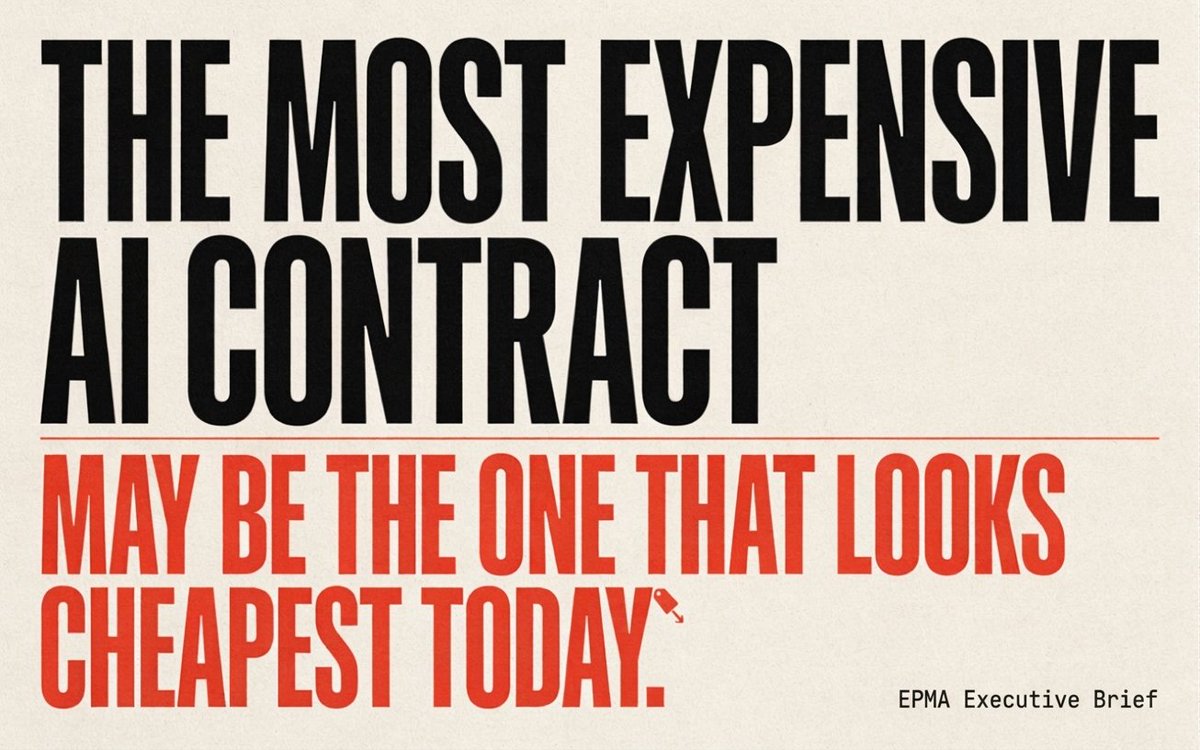
The most expensive AI contract your organization will ever sign may be the one that looks cheapest today.
Once AI learns how your organization thinks, you are no longer buying software.
You are transferring cognitive infrastructure.
Today we're releasing FORCE. Free.
Egress is not exit.
Egress means the provider gives you files.
Exit means another system can inherit what you built and your organization can continue operating.
A folder full of JSON files is not an exit plan.
Privacy is not sovereignty.
Your data can be encrypted and tenant-isolated while your provider still controls:
the model,
the administrative plane,
the behavioral changes,
the accumulated context,
and whether you can meaningfully leave.
FORCE
F — Fiduciary Custody
O — Operational Continuity
R — Resilience Against Monoculture
C — Control & Organizational Autonomy
E — Egress & Exit
Before signing, ask:
Can we inspect it?
Preserve what it learns?
Prevent silent changes?
Move its memory?
Operate without the provider?
Leave without rebuilding the organization?
If not, you do not have an AI strategy.
You have an unmanaged dependency.
Research across tens of thousands of large projects shows the average budget overrun is well over 70%. Only about a third of projects finish on time, on budget, and with full scope. And these aren't cases of companies skipping the planning phase. Everybody plans. The failures come from HOW planning gets done.
Five patterns keep showing up across technology, engineering, manufacturing, and cross-functional programs: compressed timelines, missing execution-level input, no lessons-learned integration, unmanaged cross-functional seams, undocumented assumptions between groups.
Each one is fixable. None of them get named as the actual cause.
Read more here 👉 https://t.co/yqG3p0zZAq
#ProjectDelivery #PMO #Operations
Straight Talk from EPMA, week 4.
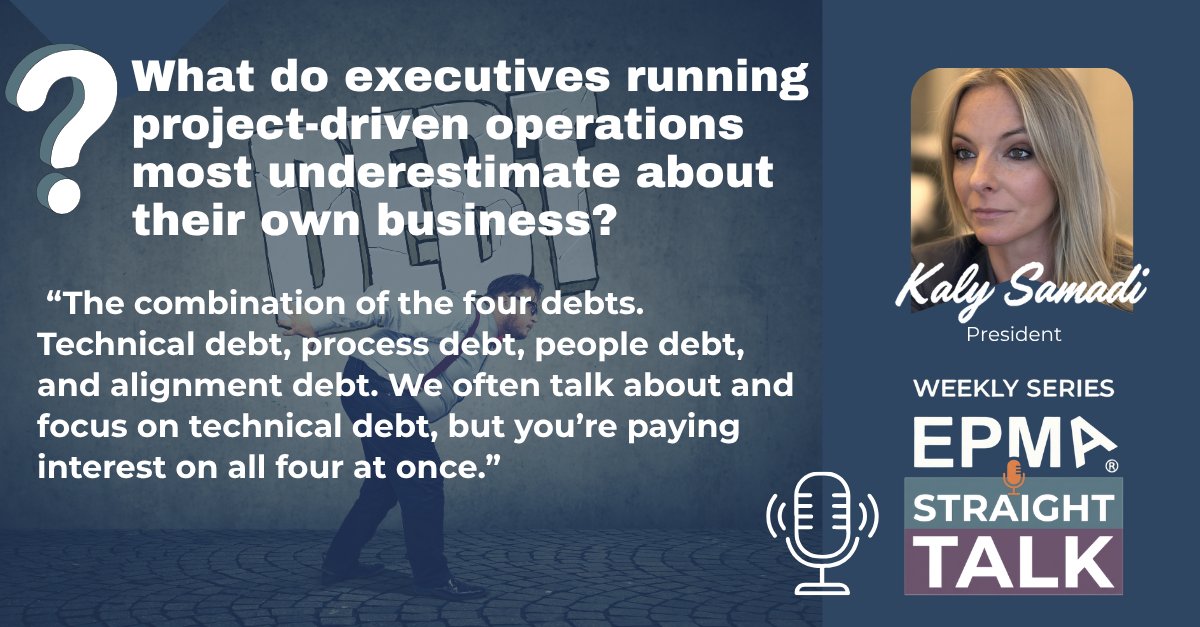
Back to Kaly this week. Question: what do executives running project-driven operations most underestimate about their own business?
A: There are four types of debt most organizations are carrying. And often times, only one is ever talked about.
Most understand technical debt. They know that choosing short-term software fixes over integrated long-term design creates a bill that comes due later. What they don't see is that they're carrying three other kinds of debt at the same time. And together the four compound in ways that determine how well the organization executes.
Technical debt. Tools bought in different eras for different problems. Systems that don't talk to each other. Short-term fixes layered on short-term fixes. Every year the administrative overhead grows because nobody has funded the integrated solution the operation actually needs.
Process debt. Approval chains built for a different scale. Reporting cadences set by a different leadership team. Governance layers added after incidents nobody remembers. Each one made sense when it was created. None of them get questioned. Together they consume a meaningful percentage of your organization's productive capacity.
People debt. Doing more with less can work. Doing it without discipline can't. Lean teams succeed with crystal-clear priorities and methodical ways of working. Without those, half your team's productive time gets consumed switching contexts, and high-priority work falls through the cracks. You're paying for capacity you never actually get.
Alignment debt. The missing golden thread through the organization. Executives are constantly driving change. New strategies, new priorities, new initiatives. Real change management is what carries the why of that change all the way down through the organization so everyone at every level understands the reason behind it, how their piece contributes, and how it benefits them personally. When that golden thread is missing, people execute tasks without understanding why. They stay because it's safer than leaving. But they've checked out of the work. That's the direct line between alignment debt and what everyone is calling job hugging.
None of these show up on your balance sheet, yet all of them accrue interest. Any of these surprise you or make you think about it in a different light?
What would you want one of our leaders to answer honestly? Drop your questions in the comments.
#StraightTalkFromEPMA #Leadership #Operations
Workers aren't settled in 2026.
They're trapped.
Search intent collapsed from 93% of workers planning to search in 2025 to 43% in 2026. On paper, hiring managers finally have the leverage back they lost in 2021. In practice, the workers who won't search are also the ones drawing the hardest lines they've ever drawn on employer terms.
That combination looks captive and behaves rigidly. And it's costing hiring managers the specific candidates they actually want.
Here's the hiring paradox of 2026, and what to do about it.
Read the full article here 👉 https://t.co/JJbq1IAqA0
#Hiring #Workforce #Leadership
Mid-market companies aren't behind on AI adoption. They're behind on being able to prove what their AI investment is producing.
Adoption isn't the gap. Defensible value is: https://t.co/dludlluvL9
Hiring feels harder than ever in 2026.
The natural assumption is talent shortage. The actual problem is that your process contradicts your own stated urgency.
Here's what's actually happening: https://t.co/ANToxaUPYg
Most hiring plans in 2026 still treat every open role as a build-vs-buy decision.
Hire someone permanent or engage a contractor. Pick one.
The companies actually solving talent gaps this year are blending both. Contract for immediate coverage while permanent hires ramp up. Permanent for critical roles that need institutional knowledge. Upskilling for internal capability that AI is making more valuable.
The blend works because no single mode covers the whole problem. Permanent-only means you can't respond fast enough when needs shift. Contract-only means you never build institutional knowledge. Upskilling-only means immediate gaps stay open for months while your team learns.
The companies still stuck on "we don't use contractors" or "we don't invest in upskilling" are the ones getting outmaneuvered by competitors mixing all three deliberately based on what each specific need requires.
The build-vs-buy question is 2020 thinking. The market has moved past it.
#Staffing #Hiring #Talent
"Delivery excellence is necessary, but no longer differentiating. Executives expect reliable execution. What they reward is strategic contribution."
If your PMO's value story is still built on "we deliver on time and on budget," you're answering a question executives stopped asking.
Here's what they're rewarding instead.👉https://t.co/ZhSOkpkjiv
Straight Talk from EPMA, week 2.
This week we hand the mic to Gareth Whitla, our AVP of Staffing, who has spent decades watching hiring processes succeed and fail up close.
Anyone who has run an interview with a team that couldn't agree on what they were actually looking for will recognize this one.
What would you want one of our leaders to answer honestly? Drop your questions in the comments.
#StraightTalkFromEPMA #Hiring #Leadership
Complex project failure just nearly tripled. Skills-based hiring is mostly theater. Engagement collapsed from 88% to 64% while retention held.
Three trends worth reading together, not separately: https://t.co/jUdnoBOYhM
One of the more expensive habits in mid-market operations:
Solving today's problem in a way that creates tomorrow's problem.
A new process gets added to fix a data quality issue, but nobody prunes the old process, so now the team is doing both. A new tool gets bought to solve a reporting gap, but the old tool doesn't get retired, so now there are two sources of truth. A workaround gets built to handle an edge case, but the edge case becomes normal, and the workaround becomes permanent.
Operational complexity accumulates faster than it gets removed. That's how organizations end up with technical debt AND process debt.
#Operations #ProcessImprovement