Tesamorelin is genuinely unusual: it's the rare compound studied and approved for shrinking a specific fat depot rather than overall body weight.
The distinction it targets matters more than most men are told. Subcutaneous fat is the soft layer you can pinch. Visceral fat is packed deep in the abdomen around the liver and intestines, and it's metabolically active tissue that pumps inflammatory signals and free fatty acids straight into the liver through the portal vein.
Across the Phase 3 program, visceral fat fell roughly 15% over 26 weeks on CT imaging, while the placebo group's crept upward. Subcutaneous fat barely moved and lean mass held.
Here's what makes it interesting: total body weight barely moved in many participants. The scale can't distinguish deep fat that strains the liver from fat under the skin that does far less harm. The effect only shows up on imaging.
And here's the fact that reframes everything above. The effect is not durable. The visceral fat tesamorelin removes tends to return over the months after injections stop. That makes it an ongoing therapy rather than a one-time correction: the benefit lasts roughly as long as the treatment does.
Two more things the online chatter skips. The approval is narrow: excess abdominal fat in people with HIV-associated lipodystrophy. That's the population the pivotal trials studied and the only labelled use. And IGF-1 rose roughly 80% from baseline, which is both the sign the mechanism is working and the reason it needs supervision.
The peptide can move the fat. It doesn't, on its own, keep it gone.
The simplest way to understand retatrutide is to count receptors. Semaglutide hits one. Tirzepatide hits two. Retatrutide hits three, adding the glucagon receptor.
That third one sounds backwards, because glucagon is known for raising blood sugar. It works because glucagon also pushes the body to spend more energy and mobilise stored fat, while the GLP-1 and GIP arms keep its glycaemic effect in check.
Which makes it a different model rather than a stronger version of the same one. Single and dual agonists work mostly on intake. The body defends its weight partly by lowering how much energy it burns as you lose. That's the wall people hit. The glucagon arm is aimed at the output side of that equation.
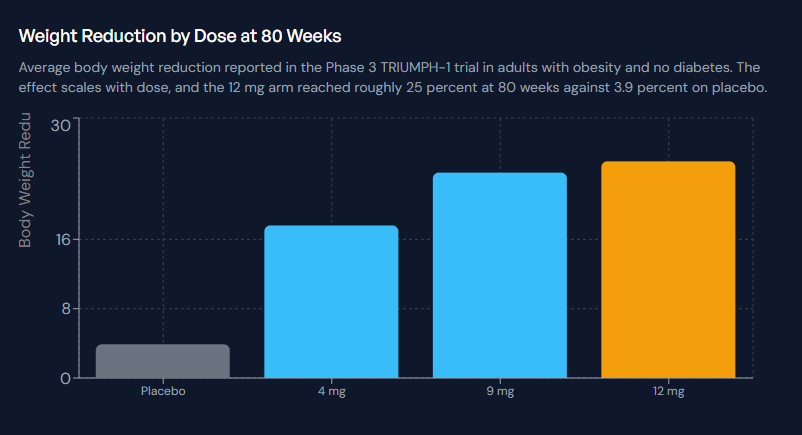
TRIUMPH-1 reported out in May 2026: 2,339 adults with obesity or overweight and at least one weight-related condition, 80 weeks. Average reduction was 17.6% at 4 mg, 23.7% at 9 mg, and 25.0% at 12 mg, against 3.9% on placebo. In the pre-specified 104-week extension the 12 mg arm reached roughly 30%.
Two things worth holding onto. The curve kept bending downward well past a year rather than flattening early. This is a long arc, not a quick cut. And tolerability scales with dose: nausea ran 42.4% in the 12 mg arm, with diarrhoea, constipation and vomiting all following the same dose-related pattern.
The legitimate version of this argument, without the marketing around it.
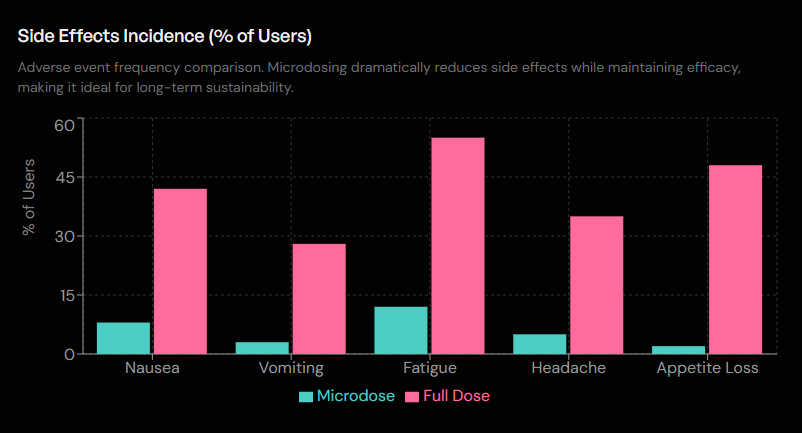
Every GLP-1 label includes a titration schedule, because tolerability is dose-dependent. That's not incidental. It's designed in. And receptors aren't passive switches: hit hard and often, cells tend to pull them off the surface and quiet the response, which is part of why a dose that worked at first can feel weaker later.
So the question microdosing advocates raise is real. Those starting doses were designed as a ramp, not a destination, and nobody ran the trial asking what a sustained sub-label dose does over years, because that wasn't the regulatory objective.
Two things that follow are well documented. The most common reason people stop GLP-1 therapy isn't that it fails. It's that side effects wear them down. And a treatment only helps if you can stay on it, which makes tolerability a driver of outcomes rather than a comfort issue.
Cost belongs in the same conversation and rarely gets discussed honestly. For something people often want to run for a year or more, the spread compounds in a way that changes who can realistically access it at all.
What is not established: what sub-label dosing does to lean mass, metabolic rate, hormones, or long-term outcomes. Those trials don't exist. Anyone quoting precise figures for any of it is extrapolating, and the honest ones say so.
That's not an argument against the approach. It's an argument for pursuing it with a clinician who monitors, and for treating the open questions as open. The right dose is a decision with a prescriber, not something to reverse-engineer from a blog.
Most peptides discussed in men's health come from the nucleus, the cell's main library of genes. MOTS-c is written into the separate genome your mitochondria carry, the one inherited only from your mother.
That detail isn't trivia. It means mitochondria aren't just power plants burning fuel in the background. They're talking back to the rest of the body, sending peptide messages that influence how you handle sugar, how you burn fat, and how far you can push before running out.
MOTS-c is sixteen amino acids. For comparison, insulin is fifty-one and growth hormone is one hundred ninety-one. That small size is part of why it can travel and even slip into the nucleus to change how other genes behave, which it does mainly when the cell is stressed, during exercise, fasting or a glucose shortage.
The metabolic effect that shows up most consistently is improved insulin sensitivity, apparently through AMPK, the same energy-sensing pathway that responds to exercise and to metformin. AMPK is the cell's low-fuel alarm. When it fires, cells shift toward burning fuel rather than storing it.
Researchers call it an exercise mimetic because mice given MOTS-c ran significantly longer on a treadmill, and the effect held in older animals.
Now the honest part, because it matters more than the finding. Almost all of the strong data is cells and rodents. Human research is early and small. Dosing isn't standardised, long-term safety isn't characterised, and even measuring it in blood is still being refined, which complicates basic questions like who is actually low.
The most valuable thing about MOTS-c right now may be conceptual: hard evidence that mitochondria are active communicators, not silent batteries. That reframing is changing how researchers think about metabolic aging, well ahead of anything you could buy.
Full Blog: https://t.co/02JpNcHsdX
Cortagen was never meant to be a heart peptide. It was built to heal nerves. Then researchers looked at what it was doing inside cardiac tissue.
The Khavinson bioregulators are a family of very short peptides, most only two to four amino acids, developed over decades in St Petersburg, each aimed at a specific organ. They work through an unusual idea: that a very short chain can slip into a cell, reach the DNA, and gently change which genes are switched on. No classic receptor being blocked or activated. Closer to editing the volume on specific genes.
A microarray study of mouse heart tissue ran a five-day course of Cortagen and read out more than fifteen thousand gene transcripts. 110 genes shifted, and they moved in both directions, some up, some quieted down. That bidirectional pattern is what you'd expect from a regulator rather than a blunt on-switch, and it's the whole point of the bioregulator idea.
Which genes moved is where it gets interesting: heat shock protein 70, a stress-protection protein that helps heart cells survive strain, alongside mitochondrial energy production, calcium handling, and structural proteins. The genes that got louder were the ones tied to survival, energy and resilience under pressure.
The crossover isn't a fluke, either. Many peptides in this family show effects beyond their headline organ, because the gene programs they touch are shared across tissues.
The honest read: this evidence is early, mostly cell and animal models, and thin on the large controlled human trials that turn a promising signal into an established therapy. What exists is consistent and mechanistically sensible. That's enough to make it genuinely interesting and not enough to call it proven.
You sourced a clean vial, drew the exact dose, stayed consistent for eight weeks. Before blaming the peptide, look at the hours around the injection.
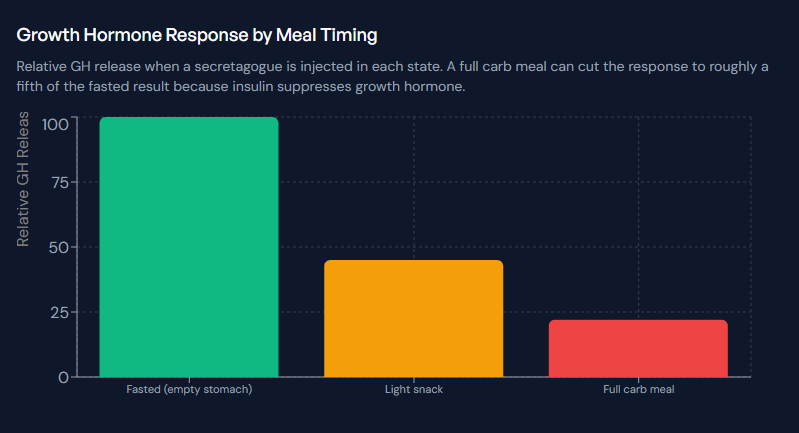
Eating too close to the shot. Insulin is a powerful suppressor of growth hormone, so a GH secretagogue injected after a meal is a match struck in the rain. Measured against a fasted baseline, a light snack drops the response substantially and a full carbohydrate meal drops it much further. This applies to the GH-releasing category specifically; healing peptides work through a different mechanism and don't require it.
Shortchanging deep sleep. The majority of natural GH output is released in a single burst during slow-wave sleep. A secretagogue is built to ride that wave. Fragment the wave and you've handed it a smaller pulse to amplify.
Drinking during a cycle. Alcohol suppresses nocturnal GH pulses and shrinks slow-wave sleep in the second half of the night, the exact window the pulse lives in. It hits the same target twice.
Loose timing. Different categories want different clocks. GH secretagogues are timing-sensitive and want a fast. Healing peptides are flexible. Weekly agents care about the day, not the hour.
Storing the vial wrong. This is the leak nobody sees, because degraded peptide looks identical to fresh peptide. Dry powder is forgiving; the moment you add water, shelf life drops from months to weeks. Never freeze a reconstituted vial. A solution turning yellow usually signals oxidation.
Notice the pattern: diet, sleep and alcohol all converge on the same nighttime hormone window. Protect that window and three of the five close at once.
The most-discussed recovery peptide, and a straight account of what's behind it.
Thymosin beta-4 isn't exotic. It's a small actin-sequestering protein found in nearly every cell, which the body reaches for whenever tissue is injured. TB-500 is the acetylated active fragment built around the LKKTETQ sequence, easier to synthesise than the full 43-amino-acid molecule.
The mechanism is coherent and that's what makes it interesting. It binds G-actin and helps route it where cells need to move and reshape. That fans out into several pathways: migration of repair cells toward the injury, angiogenesis, which matters enormously because blood supply is the rate-limiting step for slow-healing tissue like tendon and ligament, and dampened inflammatory signalling during the repair phase.
The key distinction: unlike growth hormone or IGF-1, it doesn't push overall growth. It targets the injury environment. It's a signal, not a fuel.
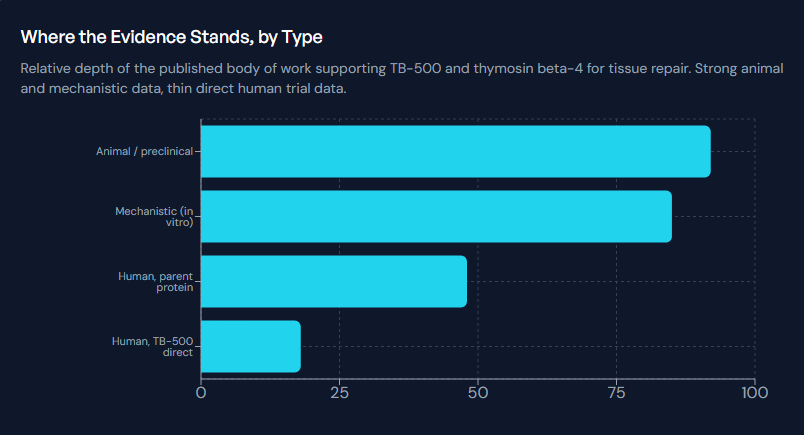
Now the limitation, stated plainly. A recent scoping review found that most studied interventions used the full protein rather than TB-500 itself, and that direct human TB-500 evidence remains very limited. The encouraging human work exists mostly on the parent compound in settings like diabetic foot ulcers and dry eye, not athletic injury. There is no approved product and no official human dosing.
That's a real gap, and it's different from the compound not working. But "hundreds of studies" and "proven in humans" are not the same sentence, and they get used interchangeably constantly.
For most of the last century a peptide was something your body made quietly and then forgot about, a short chain of amino acids, gone in minutes, too fragile to bottle. That version of the story is ending, and two shifts explain why.
The delivery wall is coming down. Peptides have always had the same problem: swallow one and your stomach treats it like food. For decades that meant almost every peptide drug arrived through a needle, which quietly limited who would ever take one. In December 2025 a once-daily semaglutide tablet became the first oral GLP-1 approved for weight loss. A peptide you swallow rather than inject isn't a small convenience, it's the difference between a treatment thousands try and one millions do.
And the molecules are starting to be designed rather than found. For most of history, finding a useful peptide meant searching: test thousands of natural sequences, tweak the promising ones, wait years. Generative models turned that search into design. Researchers now describe a target and let the model draw a binder that has never existed. The first AI-designed drugs have entered human trials.
Which shifts the bottleneck. When you can design a plausible binder in an afternoon, the hard part is no longer imagining the molecule, it's proving in the lab and the clinic that it does what the model promised.
That's the honest frame for the next five years. The molecules exist. The delivery routes are opening. The design tools improve weekly. What remains is the slow, unglamorous work of proving safety and efficacy at scale.
For anyone considering these compounds today, that gap between what exists and what is proven is exactly why sourcing, supervision and honest expectations still matter more than excitement about any single molecule.
These two get discussed as competing options. They're answering different questions, which is why they so often end up in the same protocol.
CJC-1295 is a modified analogue of growth hormone releasing hormone, the natural signal the hypothalamus sends to start a GH pulse. Ordinary GHRH clears in minutes; CJC-1295 is engineered to last. A 2006 study in the Journal of Clinical Endocrinology and Metabolism reported that a single injection raised GH severalfold for about six days and lifted IGF-1 for nine to eleven days, with the pulsatile rhythm preserved rather than flattened into a constant drip.
Ipamorelin comes through a different door. Rather than mimicking GHRH, it imitates ghrelin and binds the growth hormone secretagogue receptor, triggering a sharp immediate release peaking around 40 minutes with a half-life near two hours. Its reputation rests on selectivity, it lifts GH without meaningfully raising cortisol or prolactin, which older compounds in the family tended to do.
One holds a floor. The other lands a spike. Neither shape is better in isolation: the sustained curve asks how high the baseline sits across the day, the sharp pulse asks how forcefully the pituitary can be triggered in a single moment.
Worth being straight about the evidence. Most of the human data measures hormone levels, not long-term outcomes like strength or quality of life, and the trials are small. These compounds sit in a grey regulatory zone and are not approved for anti-aging or performance.
A peptide amplifies a system that's already working. It doesn't replace one that isn't.
Most of what men reach for when focus fades pushes the accelerator. Caffeine, nicotine, the harder stimulants: same throttle, same crash, same tolerance curve.
Semax is a different kind of thing. It began as a fragment of ACTH, the pituitary stress hormone, with the part tied to brain effects kept and the adrenal cascade left behind. What's left reads less like a chemical whip and more like a message to the brain's maintenance crew, the signals that went up in tissue were the ones tied to keeping neurons healthy, BDNF chief among them.
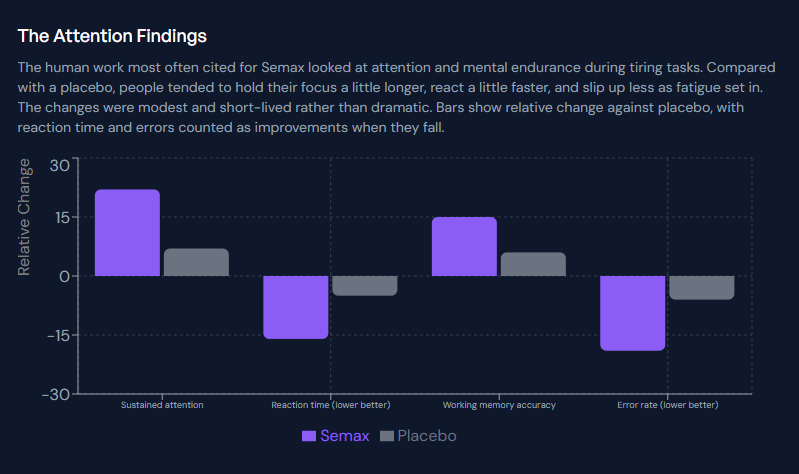
The human evidence people cite most looked at attention during long, tiring, error-prone tasks. The treated group held focus a bit longer, reacted a bit faster, slipped less as fatigue set in. Real but small: the edge you might notice on a hard afternoon, not a transformation.
Two things about its shape. It's taken as nose drops, reaching the brain in minutes rather than through the gut. And the signals it raises climb over a few hours and settle back within a day. It behaves like a window that opens and closes, not a switch that stays flipped.
Now the context that changes how to read all of it. The research is mostly Russian, mostly small, and the compound has decades of clinical use in one country and no approval in the US. Intranasal is where essentially all the human data sits, injected use in forums is borrowing evidence from a route that was never studied that way.
A stimulant makes a tired brain feel awake. Semax, if it does what the studies suggest, helps a working brain stay steady a little longer. Neither replaces sleep, training, sunlight, and not being chronically overloaded in the first place.
There's a moment, usually a few weeks into a protocol that was working, when the effect starts to thin out. The instinct is to add more. That instinct is almost always the mistake.
Peptides bind receptors and send a signal. Send that signal without pause and the cell does what any overwhelmed system does, it turns down the volume. Receptors get internalised, pulled off the cell surface, and the same dose produces a smaller response.
The clearest case is the GH secretagogue family. GHS-R1a receptors begin measurable downregulation within roughly 10 to 14 days of continuous activation, and need weeks of ligand absence to rebuild baseline density. Once that happens, receptor availability, not how much you inject, is the limiting factor. You can escalate all you want. There's nothing left to bind to.
Which means the fix is structural rather than chemical. A defined period on, a defined period off. The dips during an off phase look like losses in the moment; they're the reset that keeps the next on-phase from landing on a dead receptor.
One rule matters more than any specific number. Switching from one GH peptide to another does not reset the clock if both hit the same pathway. Sermorelin to Ipamorelin still stimulates the same axis. To rest a receptor, the off phase has to be an off phase for that receptor, not just a different label on the vial.
That's the mistake that quietly defeats otherwise careful protocols, because it feels like a break while the receptor never actually rests.
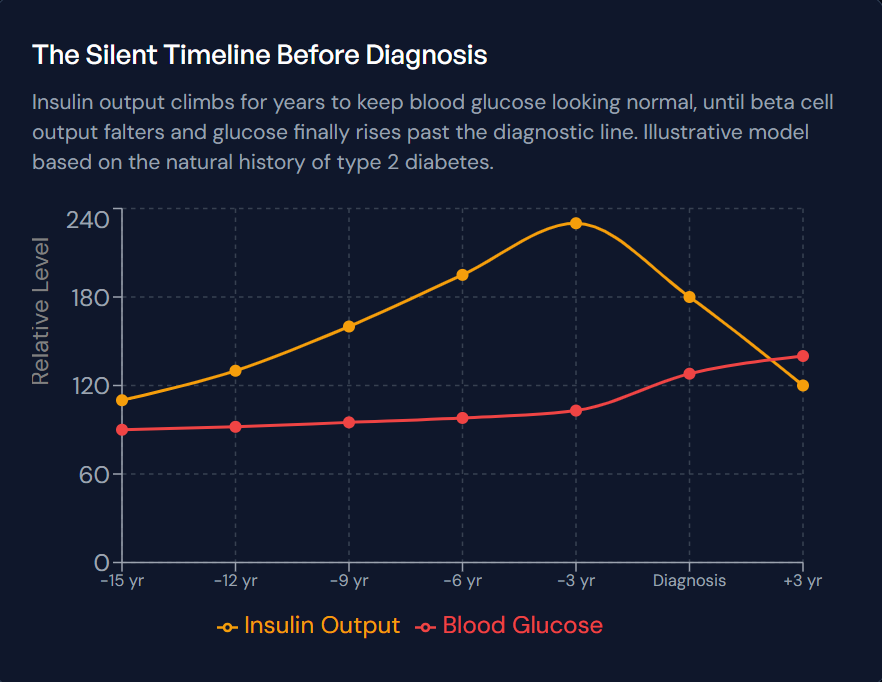
By the time a lab report reads type 2 diabetes, the body has usually been working around the problem for ten years or more.
The mechanism is a race between two curves. Insulin output climbs year after year to keep glucose looking normal on paper. The pancreas is compensating, and the compensation is expensive. Then the beta cells falter, output falls, and glucose finally crosses the diagnostic line.
Which means a standard test catches it after the phase that responded best to change has already been running for a decade.
The scale of the blind spot is the part most people don't know. Roughly 97.6 million American adults have prediabetes, about 38% of the adult population. More than 8 in 10 of them have no idea. Among adults 65 and older, nearly half meet the criteria.
And this is the window where intervention works best. In the Diabetes Prevention Program, structured lifestyle change cut progression to type 2 diabetes by 58% over about 2.8 years. Metformin cut it by 31%. The lifestyle arm beat the drug, and the effect was still visible at 22 years.
The lifestyle arm wasn't exotic: a 7% reduction in body weight and at least 150 minutes of activity a week. That was the whole recipe.
A fasting glucose and an A1C are inexpensive and widely available. They're also the only way to see what your blood is actually doing.
A framework worth more than any individual compound: more is not more.
When two peptides act on the same receptor or the same signalling cascade, you aren't doubling an effect. You're paying twice for one signal. The doorbell rings once regardless of how many hands press the button.
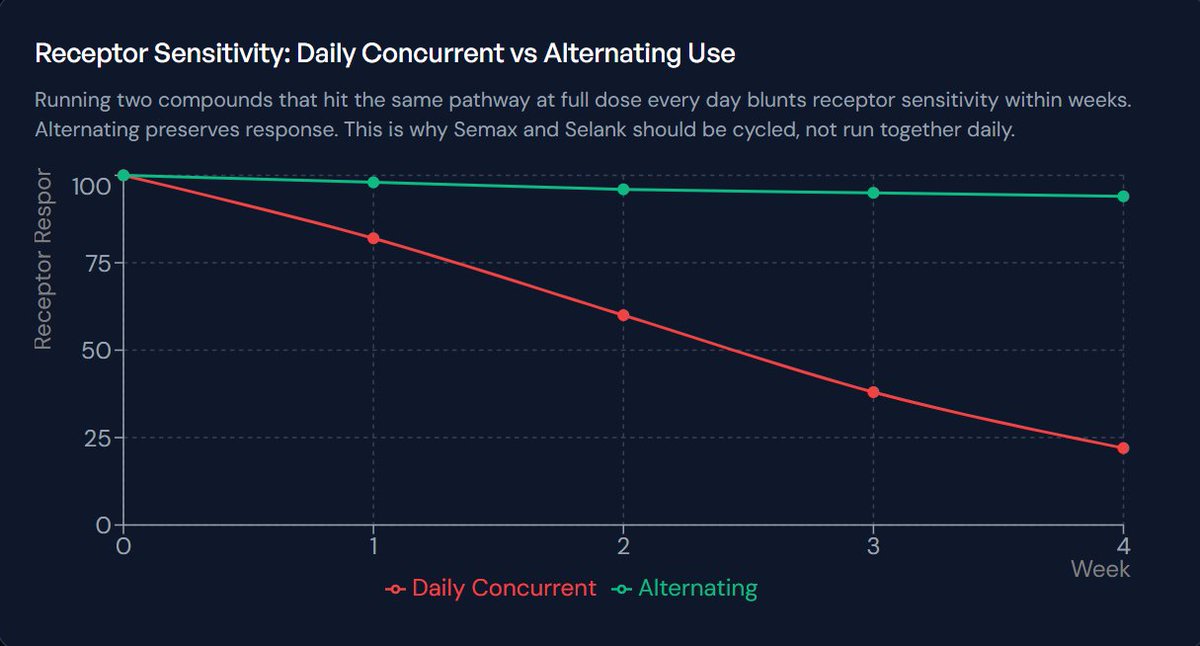
The second failure mode is subtler and more expensive. Two compounds hitting the same pathway at full dose every day produce tachyphylaxis, receptor response falls off within weeks, and both compounds drift toward doing very little. Alternating them preserves the response. It's a scheduling problem that presents as a product problem.
The discipline that follows: one goal per cycle, and every compound in the stack should reach that goal through a genuinely different mechanism. If you can't name the two distinct pathways, you don't have a stack. You have one pathway and two invoices.
Everything in this category sits outside FDA approval, source quality varies enormously, and none of it belongs in a protocol without a clinician and baseline bloodwork.
The peptide this publication is named after, and a straight account of what is actually known about it.
Epithalon is a four-amino-acid peptide, Ala-Glu-Asp-Gly, a synthetic version of a pineal gland extract, developed by Vladimir Khavinson in the 1980s. The claim attached to it is telomerase activation, switching back on the enzyme that rebuilds the protective caps on chromosome ends, which is largely silenced in adult somatic cells.
What the evidence actually consists of:
Cell culture work, where human fibroblasts treated with epithalon expressed telomerase, extended their telomeres, and kept dividing past the point untreated cells stopped. That finding has been reproduced, most recently in 2025.
And longitudinal cohorts run by Khavinson's group in St Petersburg, reporting lower all-cause mortality in treated older adults across roughly fifteen years.
The limitation is the same for both, and it's worth stating plainly: the human data comes almost entirely from one research lineage, accumulated over decades, and has not been replicated at scale by independent institutions outside Russia. That is not the same as being wrong. It is also not the same as being established.
Epithalon is not FDA-approved. The standing theoretical concern with any telomerase activator is that some tumour cells exploit the same enzyme, which is why a cancer history makes someone the wrong candidate.
The defensible position is neither dismissal nor enthusiasm. It's that this is one of very few multi-decade human datasets on a telomerase-active compound, and it deserves the replication it still hasn't had.
https://t.co/LEb2I82378
There's a gland the size of a grain of rice at the centre of your brain, and it's among the first things to age.
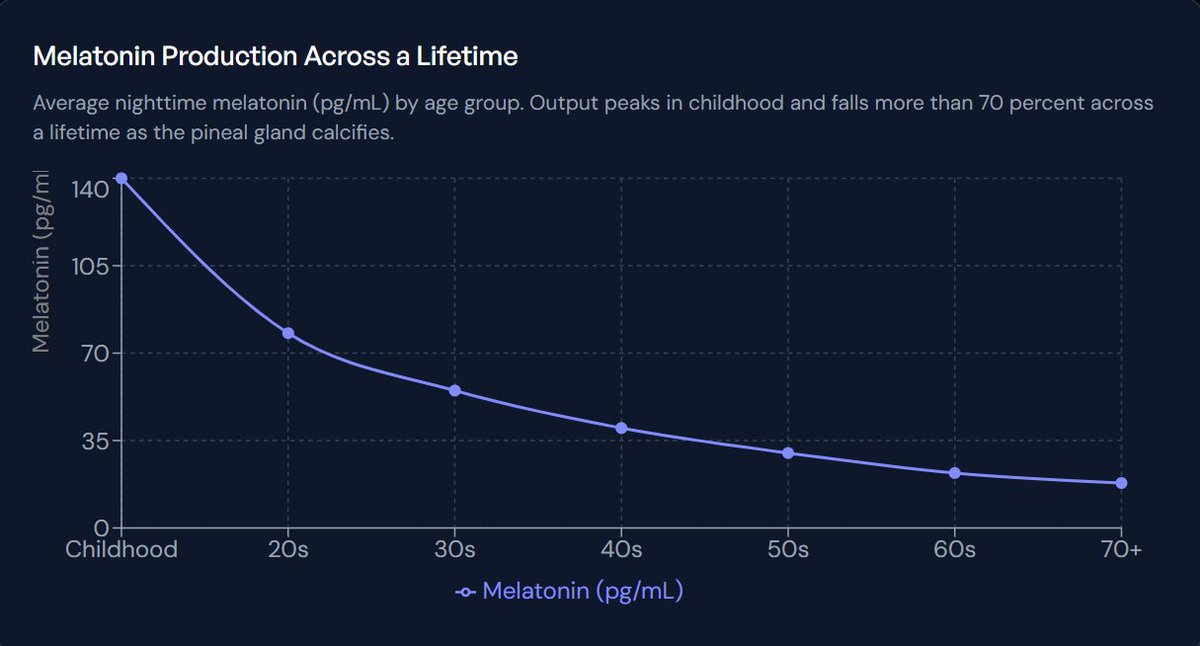
From the mid-thirties the pineal gland begins to calcify. By 60, roughly 40% of people show significant deposits. Melatonin output tracks that decline closely, 70 to 80 pg/mL in young adults, 20 or below by 70.
Filing melatonin under "sleep hormone" badly undersells it. It's an antioxidant more potent than vitamin E, it modulates immune function and core body temperature, and essentially every cell in the body carries a receptor for it. It's a systemic timekeeper, not a sedative.
Which is the part worth sitting with: older adults don't wake at five in the morning because the clock is broken. They wake at five because the clock lost its signal source.
There's a version of hormonal decline that doesn't appear on a hormone panel.
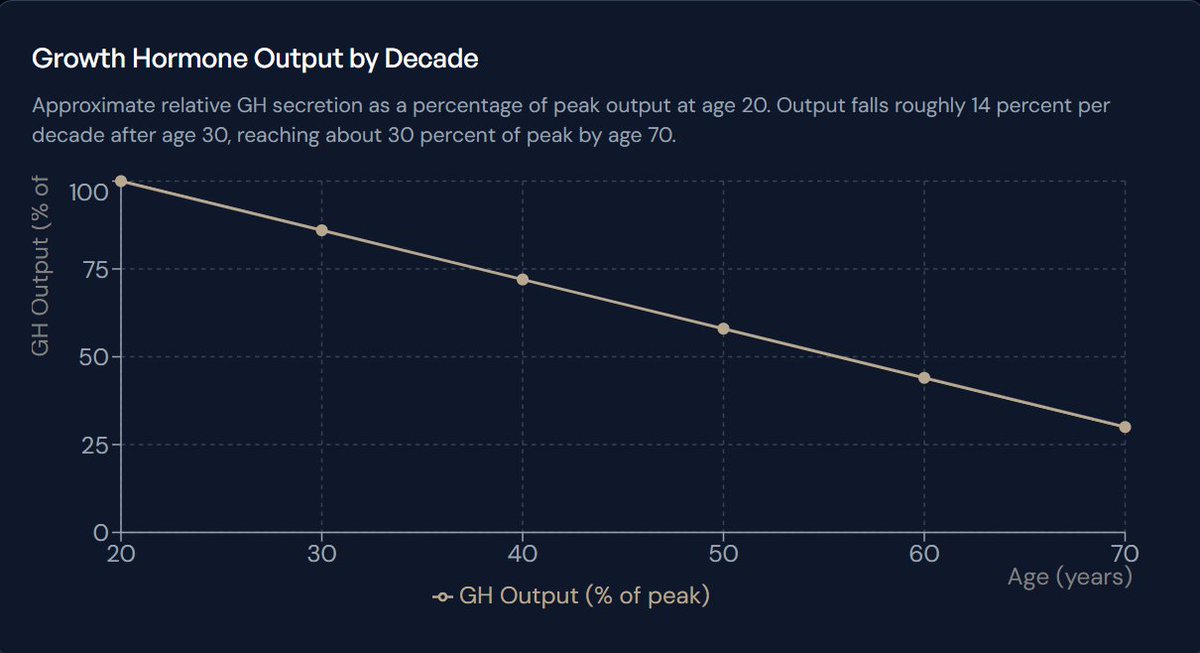
Receptors desensitise. Same principle as drug tolerance, the signal is unchanged, the response isn't. Growth hormone output falls roughly 14% per decade after 30, and by 60 the hypothalamus has lost a meaningful share of its sensitivity to the body's own signals.
So bloodwork can read normal while the lived experience is decline, because the receiving end of the conversation quietly turned its volume down.
It's the more interesting question in the field right now: not how much hormone is circulating, but whether the system can still hear it. It is also much harder to measure, which is why most of the evidence here is still mechanistic rather than outcome data.
Men come to growth hormone secretagogues for fat loss. The mechanistic literature suggests fat loss may be the least interesting thing happening.
Visceral fat isn't inert storage. It's an endocrine organ, and one of the most inflammatorily active tissues in the body, it secretes the signalling molecules that keep chronic low-grade inflammation running. Shrink the depot and you quiet a source, not just a waistline.
But several of the mechanisms have nothing to do with fat at all. Growth hormone receptors sit on macrophages, the cells most responsible for driving chronic inflammation. GH supports intestinal barrier integrity, and a large share of systemic inflammation begins with what crosses a permeable gut. And these compounds are most active during deep sleep, which is when the body does its inflammatory cleanup anyway.
Worth being precise about what's established and what isn't: the pathways are well described, the effect sizes in this specific context are largely estimates rather than trial endpoints. The defensible claim is that the scale is the wrong instrument here, not that the numbers are settled.
Almost every "optimise your hormones" piece assumes the goal is more. For IGF-1 that's wrong, and the shape of the curve is why.
The relationship between IGF-1 and health is a U. Too little and you're frail. Sustained too high, the epidemiological cancer signal clusters above roughly 250–300 ng/mL and you've traded one risk for another. The lowest combined risk sits somewhere around 150-180.
Which reframes what a low reading means. It's an instruction to fix protein, sleep and training first, not a reason to reach for something. And a high number driven up aggressively isn't a trophy. It's a thing to bring back down.
Context matters as much as the number. IGF-1 raised by training and adequate protein sits inside the body's own feedback loops. Forced up from outside, it doesn't.
IGF-1 is a setpoint, not a dial.
"Your testosterone is normal" can be both true and useless.
Total testosterone measures everything in circulation. But sex hormone-binding globulin rises with age, and SHBG-bound testosterone is biologically inactive, it cannot enter a cell. Free testosterone, the fraction that actually does the work, therefore falls faster than the total does.
A man sitting at the low end of normal with elevated SHBG can have free testosterone in the range that defines severe deficiency, on a lab report that tells him he's fine.
The symptoms don't arrive in the order most people expect either. Reduced morning erections tend to show up first, often two to three years ahead of anything else. Cognitive changes, word retrieval, sustained concentration, precede the physical symptoms by twelve to eighteen months. Libido is a mid-stage marker, not an early warning.
If you're told the numbers are fine, ask which number was measured.
Full breakdown: https://t.co/acdAG4oHRi
Your injection works once a week. Your sleep works against it seven nights a week.
Under seven hours, ghrelin climbs while raptin, a satiety hormone produced during sleep, identified in Cell Research in 2024, drops by up to 30%. The medication is now swimming upstream against your own biology.
Three more that compound it:
- Short slow-wave sleep lowers insulin sensitivity, and the cortisol rise that comes with sleep debt makes it worse. A dual agonist cannot override cortisol.
- Blue light blocks melatonin for up to two hours and suppresses the growth hormone pulse that deep sleep depends on. 54% of adults scroll in the last 30 minutes before bed.
- Shifting bedtime by two hours on weekends is enough to move metabolic risk markers, even when total sleep hours look fine on paper.
The drug handles appetite. Sleep decides what your body does with the deficit.