Two strange stories told by Putin, about Schubert and about orcas hunting polar bears, have unusually close literary predecessors. This article traces the strongest matches and the limits of the hypothesis. https://t.co/OFw9PjJQIv
Addendum 29.08.2026
A few days after the publication of the so-called Sberbank “analytical note”, the same channel, Black Mirror, clarified the details. This is not a corporate product. It is the work of German Gref himself, or more precisely of the AI model for which he or someone else wrote the prompt. The Sberbank pseudo-analytics turned out to be part of the personal correspondence between Gref and Metropolitan Tikhon (Shevkunov), whom analytical discourse calls Putin’s confessor.
.
Russian managers are now running Russia through models trained on Euro-Atlantic assumptions about a normal state. The output comes back fluent and wrong, and gets passed upward as analysis. https://t.co/redYTtD2hY
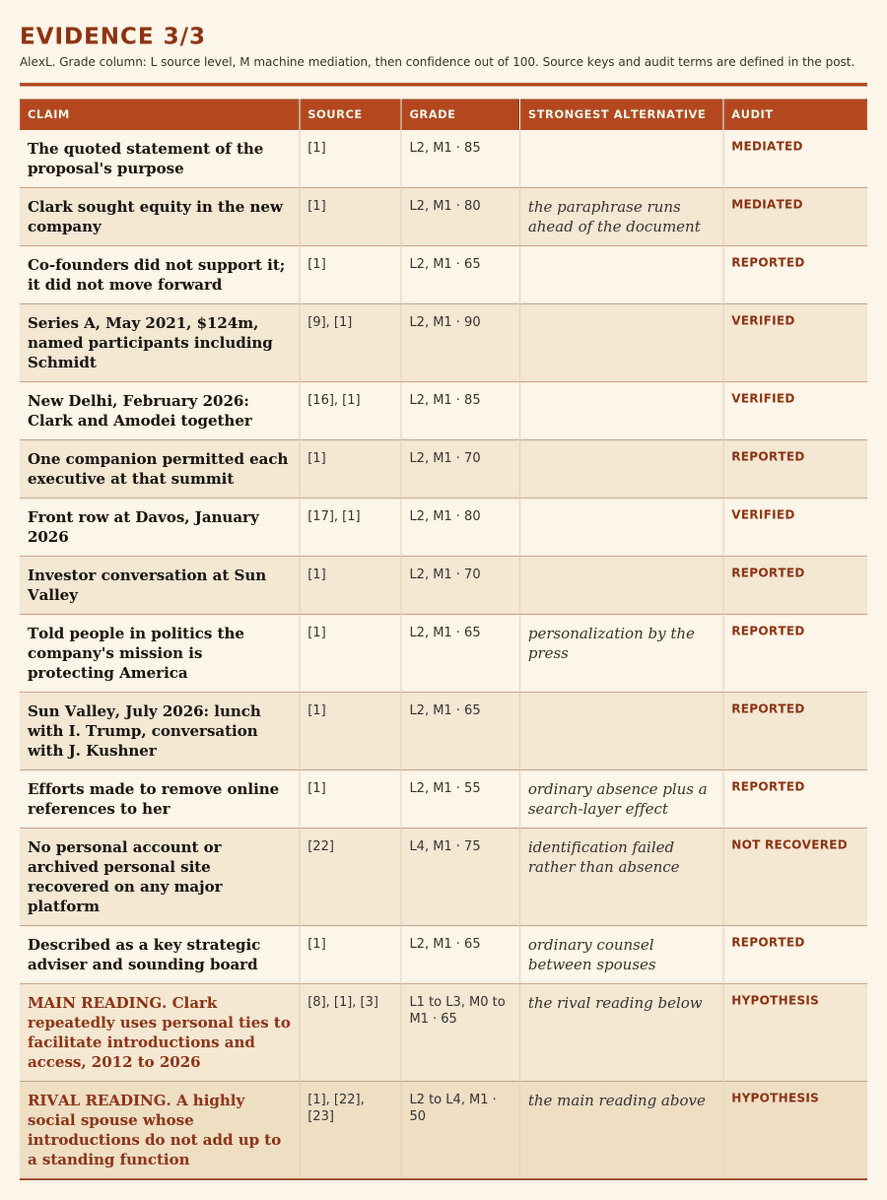
Cami Clark: a source-graded reconstruction from the available public record, covering biography, ventures, Eric Schmidt, Epstein correspondence, and the reported role around Dario Amodei and Anthropic.
https://t.co/bGUNcs5Oba
@yarotrof Then the question arises: after such a massive spread of this narrative about Putin's threat, is it possible that he will back down and listen to the warnings? The obvious answer is that this is most likely impossible.
No freezing of offshore money belonging to Putin and his team, no real damage to European countries and the US, not a single attempt at the physical elimination of Putin and his inner circle in almost five years of war—only the endless media hyping of the "threat to humanity." But what a surge in sales for "Mad Vlad"!
@michaeldweiss The wildly inflated narrative around the visit C.I.A. director far outweighs its actual value.
Just another bubble to hype up Putin in Europe and the US.
3/ Another question is, could Putin win a future conflict against the European countries and the United States, who have warned him? The answer to this question is the same: it is impossible.
1/ The narrative about warning Putin not to attack the Baltic states has been spreading incredibly fast in the global media over the past two days. It is also being said that Putin is ready to launch tactical nuclear strikes on Ukrainian territory. 🧵
2/ Then the question arises: after such a massive spread of this narrative about Putin's threat, is it possible that he will back down and listen to the warnings? The obvious answer is that this is most likely impossible.
It is hard to believe, but within the propaganda and regime-serving discourse, there is a debate about the role of Lenin and Stalin in Russian history. And it's not entirely clear whose side Putin's speechwriters are on, since Putin himself is hardly capable of formulating a clear historiographical and ideological position on Russia's past.
5/ Mikhail acquires none of his brother’s demonic features and keeps the role of an eccentric scientist. Yuri, who has said almost nothing in public, at times becomes the demiurge, Putin’s gentleman of the bedchamber.
https://t.co/teUZ09vSpl
4/ Mikhail speaks publicly, at length and willingly. These speeches do not belong to Yuri, but the field abhors a vacuum, and attribution flows from the one who talks to the one who does not.
🚨 Former MI6 chief Sir Alex Younger delivered brutal Brexit truths last year:
“Putin would’ve been absolutely delighted by our decision [to leave the EU] and so would Xi.”
“We’ve made ourselves irrelevant.”
“France has effectively eclipsed us.”
“Brexit has marginalised us.”
Brexit wasn’t Britain taking back control. It was Britain voluntarily surrendering influence, while Putin and Xi watched with delight.
The impossible dish
Putin’s Russia remains exactly as ideologically eclectic as it was under Yeltsin and in Putin’s early years. When Moscow’s situational, thoroughly mendacious, alogical propaganda gets equated with an “ideology,” a tornado starts in my head.
Where, in their rewritten constitution or in the textbooks, is there even one unifying idea? One that most Russians, if not all, could sign under?
“Traditional values”? The list runs to 18 items, they contradict one another, and human rights and freedoms sit among them, by the way.
“Loyalty to Putin and the Moscow center”? A good half of the Z crowd has long and insistently hated the Moscow regime and Putin personally, and would break into dance the moment the obituary was read.
“Orthodoxy”? That has nothing to do with actual Russia: Russians en masse are either atheists or hypocrites poorly mimicking Christians. Real Christians there amount to fractions of a percent, tenths if you are generous.
“Hatred of the West”? It is proclaimed. Underneath it sits a deep love: look at the consumption standards of the elite and of ordinary Russians alike, and at their attention to life in Europe and the US, distorted by propaganda but attention all the same.
Authoritarian regimes resembling Putin’s, bankrupt states where every institution has been captured by mafia and bandits, exist in abundance. But a cultural analogue, where a single pot holds ice cream, borscht, pelmeni, pickle brine, fried cockroaches, vodka, and watermelon, does not exist anywhere.
And yet both the authors of this eclecticism and their shallow critics remain convinced that Russia and Putin have an “ideology.”