@tojulius Isn't this somewhat already: https://t.co/t3xss2s2xJ - I think they are based out of India, might have changed their models since I last evaluated
🇪🇺 eu/acc
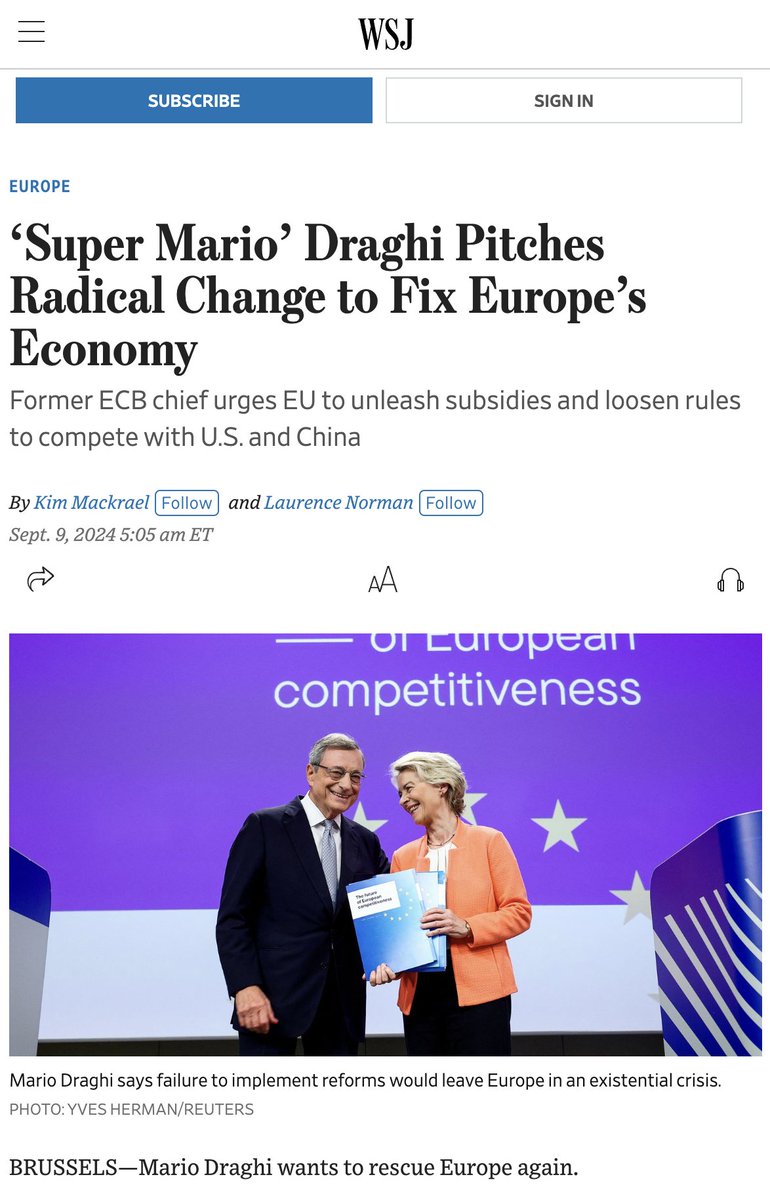
A few weeks ago Mario Draghi asked my recommendations for his report that came out today about European competitiveness
I had a call with him and summarized my problems with doing business in the EU
I wrote this which is included in the report presented to the European Union today:
1. Minimum revenue cut offs for current and new regulation
Exempt small businesses with annual revenues below €10 million from complex regulations like VATMOSS, GDPR, the EU AI Act, and certain labor laws. This approach encourages innovation and growth by allowing startups to focus on product development and market validation without the heavy burden of regulatory compliance. Once these businesses surpass €10 million, they will have the resources to comply with regulations, ensuring that growth is not stifled.
2. Simplify starting a pan-EU business with an EU-wide Incorporation (Inc.) business form
Currently, starting and operating a business across the EU is complex due to 27 member states, each with its own company registration requirements. To streamline this process and make it easier for entrepreneurs to operate across Europe, there should be a single, standardized business entity that applies uniformly across all EU countries. I call this the European Inc.
3. Start an EU business fully online, no physical offices, notaries, lawyers etc
To continue, right now starting a business in most EU member states it’s complicated, very time and resource intensive, and often involves lawyers and notaries. Instead, it should be as simple as going online to a centralized EU website, where entrepreneurs can register their business and details in just a few clicks. The entire process should be streamlined and efficient, allowing businesses to start operating immediately.
The EU government taxes and bookkeeping of this business should also be fully online in an EU portal/dashboard.
4. 0% corporate tax for first 3 years of any new business
Countries like Singapore have successfully attracted new businesses from around the world by giving them a massive tax discount during the first 3 years of business. Because they know that’s the most difficult time of a business: figuring out what product it makes and if there’s a market for it. That takes pressure off startups and business founders that they can focus on creating a great product and innovating.
5. Change tax on stock options: don't tax when a stock option is exercised, but tax it when the stock is sold
The current tax policy in the EU taxes stock options at the time they are exercised, creating a significant financial burden on employees who have not yet realized any tangible financial gain. This approach stifles innovation, discourages entrepreneurship, and places the EU at a competitive disadvantage compared to other regions like the United States.
I propose a simple change: Tax stock options when the stock is sold, not when the option is exercised.
6. Don’t see tech or AI as an enemy, but as a burgeoning and essential industry
The most popular companies in tech are focused on AI right now for a reason. It’s the next frontier of computing. The European Union seems to consider AI the enemy. Any technology can be used for good or bad. By regulating it even before Europe has made much contributions (Europe has almost no tech companies leading in AI), it has stifled any potential innovation in AI from the start.
Apart from the regulation itself, the optics of it make the EU look bad on a global scale. Why would tech founders move to Europe to start a business if the EU is actively positioning itself as Anti-AI?
AI has gigantic potential to be used for good: think of the medical field for diagnosis of diseases, generally in programming (it helps programmers to create software faster/better), etc.
This goes further than AI. The same applies to tech in general. It seems the EU is on a crusade against technology while not being able to compete in it itself. It feels a case of sour grapes: if we can’t build great technology in EU, nobody is allowed to do so!
7. Teach tech/coding/AI topics in all schools and unis
It would help a lot if the EU has a focus on teaching AI and tech in schools and universities. Making the new generation competitive in this field instead. To secure the future prosperity of the European Union, we must prioritize education in technology, coding, and AI across all levels of schooling, from primary education to universities. This strategic focus is not just an educational reform—it’s a critical investment in the future competitiveness, innovation, and economic resilience of the EU.
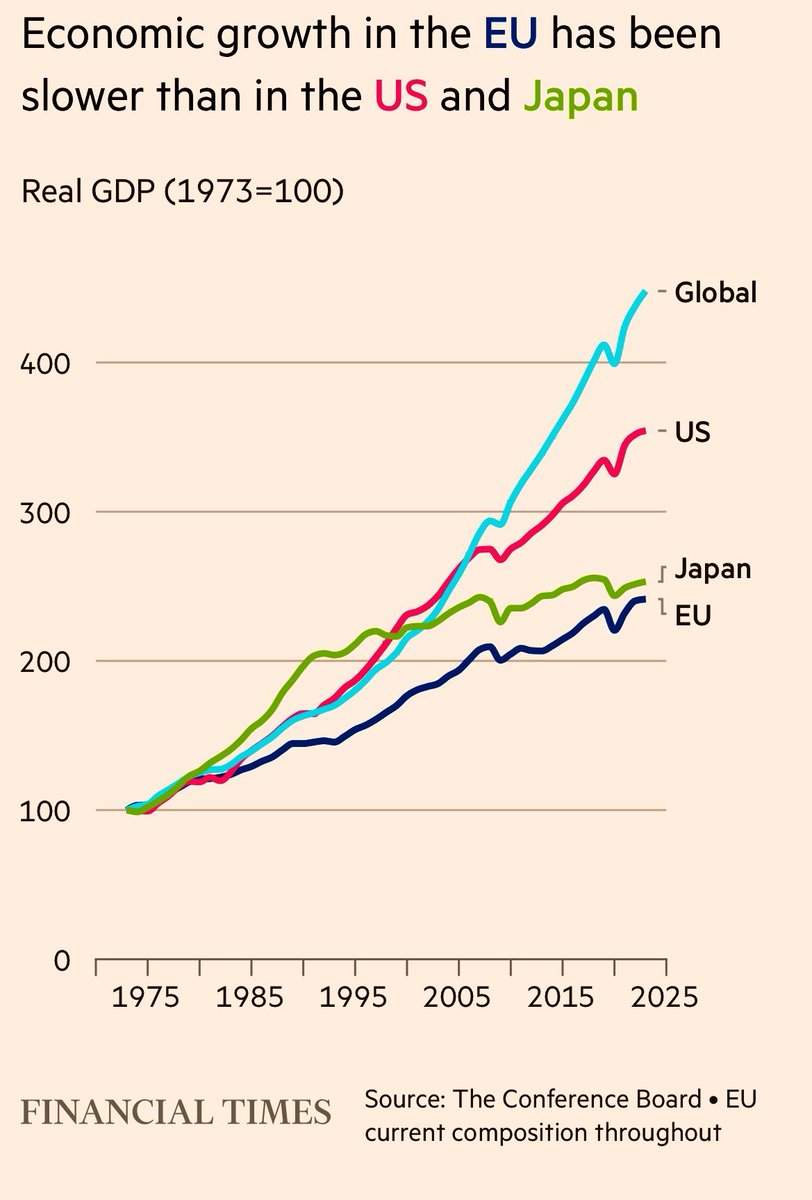
The most concerning part about this is that most Europeans don't realize how stagnant Europe has now become
Europeans are literally blue-pilled and are mostly concerned with climate change, immigration and the Ukraine war
Nobody in Europe is thinking why increasingly everything they use is made in China running on American software
The knee jerk reaction is to proudly pass regulation against American tech
The chad reaction would be to reduce regulation so that European entrepreneurs would actually stay in Europe to build European startups increasing Europe's GDP and making Europeans richer!
I am European and I have regular conversations about this with people here, it's just not on top of mind AT ALL! While it should be because Europe's GDP is stagnant and the real innovation now happens in US and China and elsewhere, not in Europe
People in Europe do love to complain about rising cost of living and the increasing unaffordability of living, but they don't realize why. They point at foreigners/immigrants as the problem, which can't be the whole story
Other Europeans I talk to get visibly upset if I ask them about stagnant GDP numbers: "why should everything be about money?" they say in a thick German accent
The whole story is that Europe has made it very difficult for people to start a business, raise capital, innovate and get the reward for taking that risk, so why would anybody?
And for the Europeans that do, it's way easier to open a US Delaware company, raise capital in US, sell your stock or IPO in the US, because why even do that in EU, where it's too hard? The proof is in the pudding, if it was so easy in EU then why is startup funding in US $270B AUM with 330 million people vs $44B AUM with 746 million people? That's almost 14x bigger startup funding market per capita
Why doesn't EU have ANY trillion dollar companies? While US has six? Why isn't there any European company in the top 10 of largest companies? While 80% is American?
Why is Stripe, a company founded by two Irish brothers, an American company and not a European one? It could have been
Very few Europeans will agree with this post because they can't see it, if they would've seen it, we wouldn't be here in the first place!
What's the role left for Europe in the future?
Signed,
- A techno-optimist European who'd love to see Europe become wealthy again
I would like @spotify to let me ask for recommendations like this 'a song that will talk about happiness when I am down' based on my history / trends. You guys are working on this right? 🙏
@educatorCWilson @businessbarista@immad I will check it out. I think it would be wonderful if learners could 'gift' their lesson to others who cannot afford it just by opening up their privates to +1 in their communities. Had not thought of it, but it would be very purposeful and impactful for everyone involved.
@businessbarista@immad Thanks for the encouragement, that's what I needed today to push! Indeed the platform would also help teachers and coaches who can charge a bit more for semi-privates for the same amount of time spent.
Anyone notice that OpenAI did the exact opposite of what YC preaches?
1. Raised a ton of money pre-product
2. Built for years before launching
3. Built waterfall vs agile
4. Hired big staff pre-revenue
Solving complex problems requires money & time. Not a one size fits all.