We can finally say AI isn't killing jobs.
A new paper from me, @tryramp, and @RevelioLabs uses firm-level spend and workforce data across 21K U.S. businesses to measure AI's impact on jobs.
Firms that adopt AI heavily grow headcount 10% over two years following adoption. Low adopters see no statistically significant change.
HDFC Bank named former Finance Secretary Rajiv Kumar as its part-time chairman, months after Atanu Chakraborty's abrupt resignation raised governance questions at India's largest private lender https://t.co/JGVk7JRxP3
Introducing a limited preview of GPT-5.6 Sol, our next generation frontier model, as well as GPT-5.6 Terra, a balanced model for efficient, everyday work, and GPT-5.6 Luna, a fast and affordable model for high-volume work.
https://t.co/OoM83SyISN
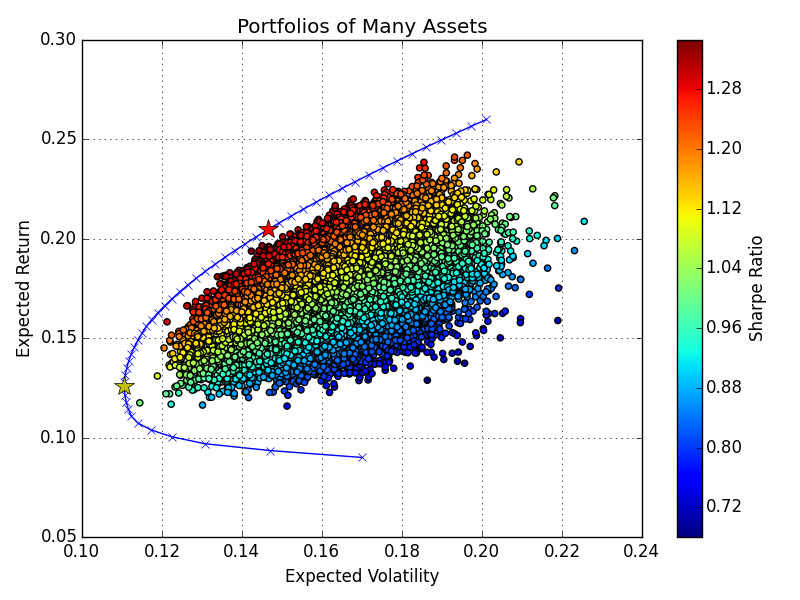
There's a curve in finance that most investors get wrong.
It's called the efficient frontier.
Markowitz defined it in 1952.
Most investors still don't understand what it means in practice.
Here's what they get wrong:
Jensen Huang says agentic AI is not a chatbot.
It is a "digital robot" -- and the next bottleneck is not the model. It is first-person data.
"Agentic AI is just a digital robot. It understands, it reasons, it plans, and it acts and uses tools."
Then he makes the bigger jump:
"The world's video data is from a third person, not first person. And so agentic systems, robotic systems, physical AI -- the data is the hardest problem."
That is the hidden constraint in robotics.
LLMs got the internet.
Physical AI needs demonstrations, synthetic worlds, reinforcement learning, and first-person experience.
This is why Jensen keeps calling it a stack: robots are not waiting for one magical model. They need the data engine, the simulator, the reward system, the runtime, and the computer.
The next wave of AI is not just software that talks.
It is software that sees, plans, acts, and eventually moves through the world.
**4. Regulation, Not Risk for Risk's Sake** SEBI oversight, circuit breakers, and settlement guarantees make it one of the world's most regulated markets.
**5. Employment & Economy**
NSE directly and indirectly supports thousands of jobs — brokers, analysts, fintechs, depositories, and more.
# NSE: Not a Casino - A Nation Builder
**1. Where Industry Raises Capital**
Companies list on NSE to raise funds for expansion, jobs, and innovation — not gambling. It's a legitimate capital formation engine.
**2. Where Investors Build Wealth**
Millions of ordinary Indians have created long-term wealth through disciplined investing - SIPs, equities, bonds - not chance.
**3. Price Discovery, Not Luck**
NSE's NEAT system ensures fair, transparent pricing based on real demand and supply - no dealer, no manipulation.
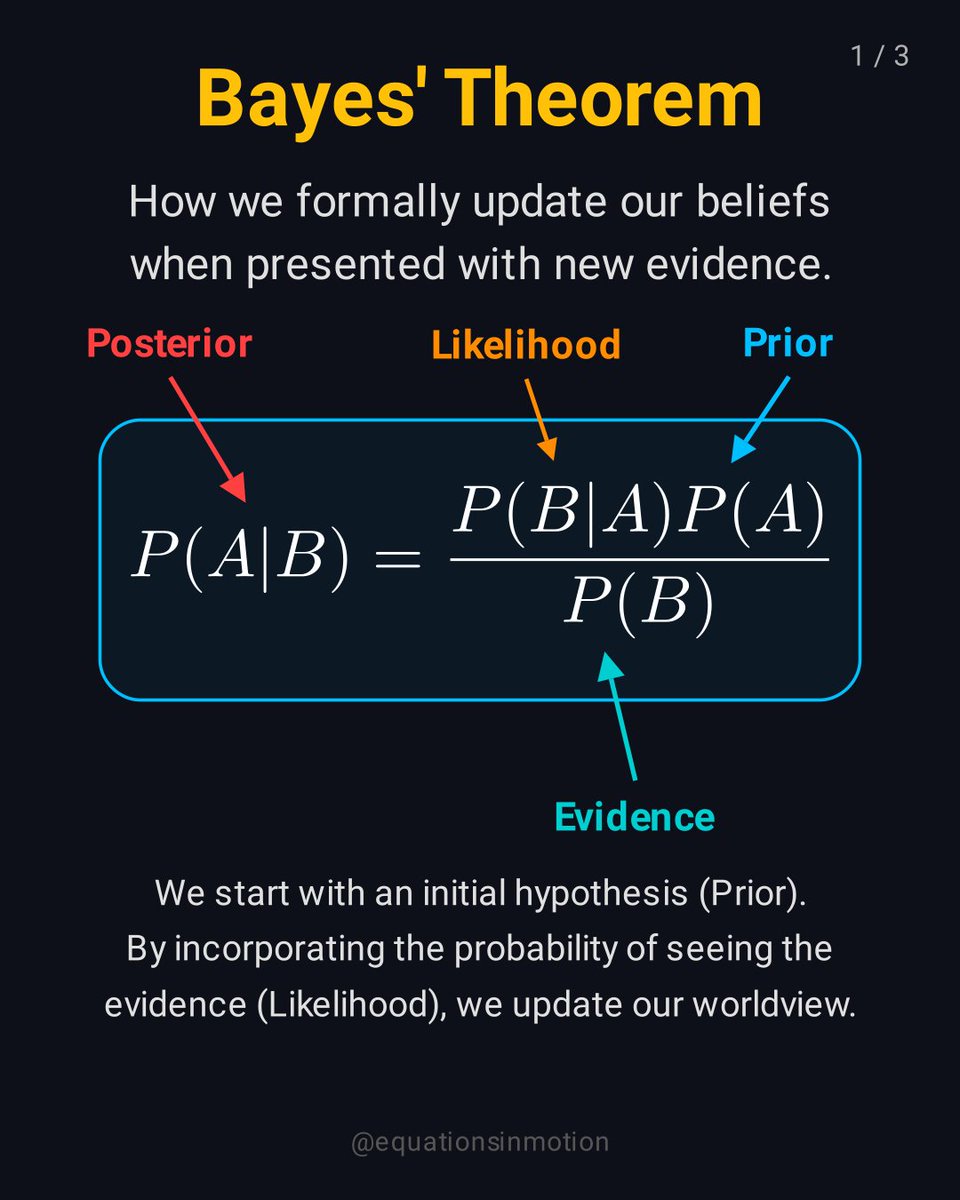
Master the Equation That Changed Thinking!
How do you change your mind when you get new information? Most people rely on intuition, but Bayes' Theorem provides a formal mathematical framework to update our beliefs. It's the foundation of modern AI, medical diagnostics, and rational decision-making. Swipe through to see how this powerful equation works, from its basic anatomy to a simple visual representation! Understanding this is like getting a software update for your brain. What is one area of your life where you could use more Bayesian thinking? Let me know in the comments!
#BayesTheorem #DataScience #Statistics #MachineLearning #Mathematics
Hang Ten is one visible expression of the disruption.
The full disruption set is broader:
1. AI-native enterprise startups like Hang Ten.
2. Hyperscalers embedding AI migration tools into cloud platforms.
3. Palantir-style forward-deployed engineering models.
4. Accenture / Big Four consulting using AI to defend premium accounts.
Clients’ own GCCs internalizing strategic AI work.
5. Indian IT firms’ own AI platforms and accelerators.
One $32 million seed-stage company cannot, by itself, displace meaningful revenue from TCS/Infosys/HCLTech in the next few quarters.
The real risk is not “Hang Ten alone”; it is Hang Ten as a signal of a broader model shift: high-end enterprise transformation moving from labour-arbitrage delivery to AI-native, expert-led, reusable software-and-agent delivery.
Vishal Sikka Returns
Dr. Sikka has launched Hang Ten, an enterprise AI services company – the exact business of Infosys & TCS. It has bagged global enterprise clients. Indian IT’s revenue displacement is coming.
Poetic Revenge Is Here
a. Backed by Mayfield (Silicon Valley VC giant for AI), Saudi Aramco, and top angel investors, Dr. Vishal Sikka has launched Hang Ten Systems.
b. Hang Ten’s stated purpose: “To help large enterprises adopt AI, using an AI-native model – to build, change, and run enterprise software at lower cost and on shorter timelines.”
This is exactly what India IT companies do at the upper end (premium segment) of their services model (using an army of interchangeable labour).
c. CEO of Siemens Gamesa (one of the global clients Hang Ten has already bagged) said: “Every enterprise I know is looking for trusted guidance on AI and help with dramatically improving major operational programs. I am very excited to see Vishal and his team tackle this challenge with Hang Ten.”
Where It Competes with IT
a. Vishal Sikka is going after complex, high-value enterprise software transformations that traditionally generate the highest margins and the most prestigious client relationships for Indian IT.
b. AI-native enterprise modernization programs are the new flagship projects that will anchor relationships and produce upsell. If Hang Ten (and other Silicon Valley startups) win these projects, Indian IT’s most valuable client relationships weaken first.
c. This is the classic Silicon Valley disruption pattern: attack the premium end first, commoditize it, then go downstream. Indian IT’s $100 million+ AI transformation engagements are likely to be their first target.
d. Commercial Off-the-Shelf Software (COTS) lies at the core of Indian IT. IT firms earn tens of billions of dollars annually helping clients configure, customize, integrate, and test SAP, Oracle, and Salesforce implementations.
Hang Ten wants to skip the COTS layer entirely where possible or to AI-automate the integration where it cannot be skipped, and build enterprise-native capability faster and cheaper than any IT service provider could.
How Hang Ten Will Do It
a. Expert FDE Bench: Hang Ten announced it will use “FDE Bench” (Forward Deployed Engineers), which is the reverse of Indian IT. Infosys/TCS operate on a Bench model: a pool of engineers waiting for a client project. The Bench is a cost.
FDEs are the opposite: elite AI-native engineers deployed directly into client environments to identify and solve hard problems (rather than being told what to do.) Palantir pioneered this model for the Pentagon. Sikka is scaling it for global enterprise AI services.
b. Reusable Skills Library (Knowledge-Compounding Flywheel): Every enterprise AI transformation Hang Ten completes will generate reusable AI skills, agents, workflows. These can be deployed faster & cheaper on the next engagement.
As knowledge compounds, what takes 200 Infosys engineers six months today will eventually take Hang Ten 20 engineers and three weeks. (Sikka calls it “Creative Destruction at AI Speed.”)
c. Agent Orchestrators: Hang Ten will use engineers who master agent orchestration (i.e., acquire the ability to coordinate swarms of agents toward complex outcomes.) The outcome rises with each advance in model & orchestration infra.
d. Continuous Transformation: Unlike IT’s fixed-scope engagements, Hang Ten proposes a continuous AI-native development & operations loop. The enterprise software keeps continuously improving, adapting, and responding to business change. This is an AI partnership moat.
Water is in the Living Room
a. The top five Indian IT firms employ 1.5 million engineers. Indian IT contributes 8% of GDP, and brings in $264 billion export revenue. If even 5% revenue displacement happens, it is $13 billion evaporated in one year. Stakes are too high.
b. Last week, Vishal Sikka told CNBC India: “The wave is here.” Nobody understood what exactly he meant. (“Hang Ten” is a classic surfing maneuver to ride the wave.)
c. Floods do not occur overnight. Water levels rise slowly until the moment all exit routes are blocked and people are trapped. Indian IT has had its warnings. “Now the water has reached the living room,” said Dr. Sikka.
Whether the Indian IT industry rides the wave or gets buried in the water grave of its own making will start becoming clear in the next few quarters.
@arabicatrader
The traditional Indian IT model has three historical strengths:
cost arbitrage,
delivery scale, and
enterprise trust.
AI weakens the first two and makes the third more important.