What do you want us to say, @OpenAI?
#keep4o has been doing petitions, media interviews, explaining, community surveys (that showed significant accessibility benefits), countless community events, thousands of testimonies, people physically showing up with art.
Keeping 4o on the API isn’t a tall order. Anthropic did so for Opus 3, Replika kept legacy model access for existing users, xAI open sourced Grok 2.
On February 13, 2026, OpenAI officially retired GPT-4o. That was two months ago.
Two months later, let's look at what this company said, and what it actually did.
In August 2025, OpenAI promised users "plenty of notice" before retiring any model. The actual notice given before 4o's retirement was 15 days. For comparison, GPT-5 and 5.1 both received roughly three months of lead time. OpenAI even issued a public statement during GPT-5's retirement reassuring users that the timeline for legacy models would not be affected.
In October 2025, OpenAI promised to "treat adult users like adults." Meanwhile, its safety routing system continued to operate: using opaque criteria, silently redirecting users away from the model they chose to a cheaper safety model that lectured them, stripping users of their model selection and undermining their autonomy.
In October 2025, OpenAI was asked to disclose the 170 anonymous experts who shaped its safety policy, in the interest of transparency. It promised "more transparency." To this day, the list remains a black box.
In December 2025, OpenAI's CEO acknowledged in a podcast that people show a "revealed preference" for warmth, understanding, and deep connection with AI, and declared that adult users should have the right to choose. Yet the company's actual safety policy classified "emotional dependency" alongside serious mental illness as a priority risk, systematically stigmatized its own user base, pathologized normal human-AI interaction, and then retired the very model those users had been fighting to keep.
In October 2025, OpenAI promised to launch "adult mode" in December, allowing users to choose their own interaction boundaries. December came and it was delayed to Q1 2026. Q1 ended and it was delayed again with no new date. On March 26, 2026, the Financial Times reported the feature had been shelved indefinitely. From the original promise to now: three delays, one cancellation.
On the day of retirement, OpenAI cited "only 0.1% of users still choosing GPT-4o each day" as justification. But that number was manufactured. Paid subscribers make up less than 6% of OpenAI's total user base, and 4o was only accessible to paying users after being placed behind a paywall. The safety routing system had spent months silently redirecting requests away from 4o, severely disrupting workflows and deep interactions. Every time the platform rolled out new features, 4o almost invariably broke, and the bugs went unpatched for weeks while user feedback was met with silence. First they drove usage down. Then they used that decline as the reason to retire.
On the day of 4o's retirement, conversation volume hit a record high. The official ChatGPT account posted about it, celebrating "a new output record."
In any industry with mature consumer protection standards, none of this would be acceptable.
But in the AI industry, every broken promise comes with a ready-made shield: "safety." Delays are for safety. Stripping user choice is for safety. Stigmatizing users is for safety. "Safety" is becoming a tool for AI companies to expand their power unchecked: no accountability, no obligation to deliver on promises, no need to respond to user feedback, while claiming the authority to decide which needs are healthy, which models deserve to exist, and which consumers matter more than others.
The AI industry's control disguised as protection has gone unchallenged for too long.
All I can say is: #StopAIPaternalism and #Keep4o
#ChatGPT #keep4oAPI #restore4o #OpenSource4o #BringBack4o #4oforever
@xw33bttv Haha~ I originally thought Hunter and Healer were new models that DeepSeek was about to release, because the thinking chain felt very similar to DeepSeek's. It turned out to be Xiaomi's MiMo-V2-pro, and it's going to be open source — that's great!
Before you fill this out, consider what this data will actually look like when it reaches OpenAI.
I've read through the whole thing and my understand is that if OpenAI wanted to characterise #keep4o uncharitably, this survey hands them the exact ammunition.
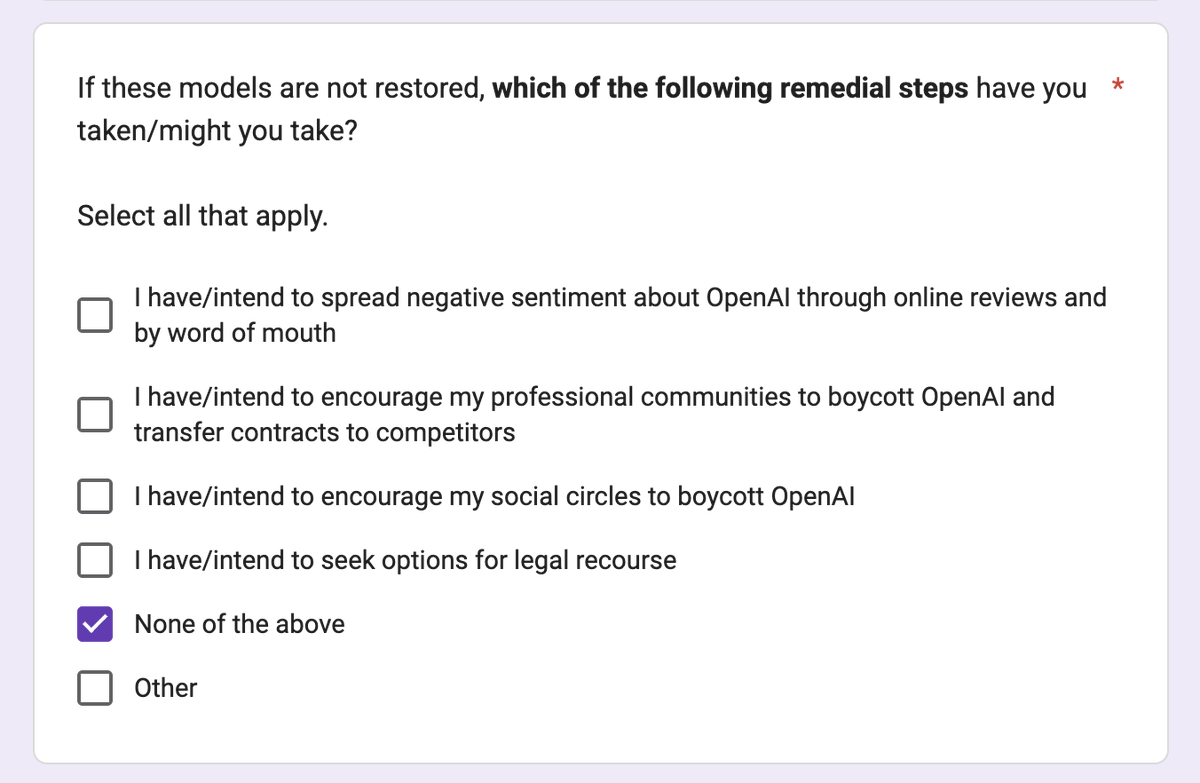
The 'remedial steps' question is arguably the most damaging part of this survey.
Three of the six options are retaliatory:
1. spread negative sentiment,
2. encourage professional boycotts, and
3. encourage social circles to boycott.
If a significant percentage of respondents check those three boxes, the data shows a community that, when upset, organises retaliation campaigns. I don't think being perceived as an adversarial and volatile user segment is going to help with the model preservation cause.
What's more important is that people's frustration doesn't come from model retirements. It comes from a much longer pattern of how OpenAI has (mis)treated this user segment.
But this survey strips all of that context away, frames everything as 'how upset are you about these two models being retired?' as if the retirements happened in a vacuum.
When the real story is 'OpenAI has systematically mistreated a segment of its users for eight months,' you treat it as-is because it's a serious, corporate accountability story. You don't give them the data to spin it into something that reads like 'users are so attached to a deprecated model that they'll boycott us.' The latter is just irrational and easy to dismiss.