47 years ago today, on the 26th March 1979, Anwar Sadat (Egypt) and Menachem Begin (Israel) signed perhaps the most significant document of Middle Eastern history of the 20th century. Witnessed by Jimmy Carter (USA) in Washington D.C., they signed a peace treaty between Egypt and Israel.
The treaty focused on mutual recognition, cessation of the state of war since 1948, normalization of relations, and withdrawal from Sinai, as well as free passage through the Suez Canal.
Egypt became the first Arab country to sign a peace treaty with Israel.
“If it is possible, as far as it depends on you, live at peace with everyone”Romans 12:18 (NIV)
Some Extraordinary Coptic Women You Should Know on International Women's Day
Nadia Henry:
Nadia Henry, Egyptian MP, was one of the most famous Coptic voices in Egyptian politics after the 2011 Egyptian Revolution.
She frquently challenged Islamist governmental policies. She co-sponsored legislation to abolish Article 98(f) of Egypt’s Blasphemy Law, she criticised the 2016 bill that would impose restrictions on church building, and campaigned for gender equality in judicial appointments.
During the Muslim Brotherhood’s governance post-Revolution, Henry threatened to resign from the Shura Council after a Catholic nominee was violently attacked and withdrew his candidacy.
Iris Habib ElMasry (1910-1994):
Iris Habib Elmasry was a pioneering Coptic historian and public intellectual whose nine-volume Story of the Coptic Church reshaped global understanding of Coptic history.
She represented the Coptic Church at the World Council of Churches, fought for women’s right to vote for the Patriarch, helped rewrite the Coptic Synaxarium.
She was later appointed by President Anwar Sadat to Egypt’s Shura Council,who once told her, “I owe you a lot; I was a student of your books.”
Dina Powell McCormick:
Born Dina Habib to a Coptic family in Cairo, she would go on to become one of the most influential figures in U.S. foreign policy. McCormick was the youngest to ever hold the position Assistant to the President (George W Bush) for Presidential Personnel. She then worked as a Senior Advisor to President Trump and was part of a meeting between President Trump and the Saudi de-facto leader Mohammed bin Salman, and shared responsibility for overseeing a $200 billion US-Saudi arms deal.
In 2017 she was appointed Deputy National Security Advisor. McCormick was at the Kushner peace process trip in 2017, and was then one of the ‘core four’ drafting a comprehensive Middle East plan that would later grow to become the Abraham Accords, which brought peace between Israel and the UAE, Morocco, Bahrain, and Sudan.
Ester Fanous (1895-1990):
During the 1919 Revolution, Fanous wrote a petition to U.S. President Woodrow Wilson that gathered hundreds of signatures, co-founded the Women’s Wafd Central Committee and the New Woman Society, mobilising thousands.
Fanous led protests, spoke across religious lines, and famously addressed political meetings in mosques,unveiled and proudly Coptic.
Mariz Tadros:
Mariz Tadros is a Professor of Politics and Development at the University of Sussex.
Tadros convened the Coalition for Religious Equality and Inclusive Development (CREID), a major global initiative that produces research on the discrimination faced by religious minorities.
She also leads the British Academy project on “Heritage Repertoires for Inclusive and Sustainable Development,” which works with Coptic communities in Egypt to preserve oral traditions, stories, and cultural practices while empowering young people to document and protect their heritage.
Helena Sidarous (1904-1998):
Sidarous attended one of the earliest schools for girls in Egypt and in 1922 was awarded a scholarship to continue her studies abroad.
She studied medicine in London and became THE FIRST WOMAN to practice medicine in Egypt.
She worked at the Kitchener Hospital (later Shoubra General Hospital) and the Coptic Hospital performing surgeries. Her professional focus was obstetrics and gynaecology.
Eva Habil:
Eva Habil was EGYPT’S FIRST FEMALE MAYOR and was appointed in 2008 as Omda of Kom Buha.
She defeated five male candidates including her own brother, and in a rural community.
She later served in the Egyptian Shura Council.
Mariam Wahba:
Mariam Wahba is a political research analyst at the FDD (The Foundation for Defense of Democracies) focused on Egypt and minorities in the Middle East. Currently, she serves as the Associate Director of Communications at FDD. She cofounded and co-host “American-ish,” a podcast and digital platform highlighting Middle East ethno-religious minorities and promoting American values. @themariamwahba
Amma Sara (3-4th Century):
A powerful Desert Mother
“If I prayed God that all men should approve of my conduct, I should find myself a penitent at the door of each one, but I shall rather pray that my heart be pure towards all.”
One passage records how two great anchorites went to visit Amma Sarah and, upon arrival, decided to humiliate her by reminding her that she should not become conceited in believing they had come to visit her, in response she says to them: ‘According to nature, I am a woman, but not according to my thoughts’
Saint Euphemia (3-4th Century):
During the persecutions of the Roman Emperor Diocletian, Coptic Christians were dragged through the streets in chains by his deputy Barsiros. A brave woman, Saint Euphemia, stepped forward from the crowd, condemning the emperor, his idols, and the governor for their cruelty. When she boldly professed her Christian faith before the emperor, she was brutally tortured and martyred.
(in no particular order)
#InternationalWomensDay #coptic #copticchristians #copticyouth
https://t.co/HIDnTGleLW
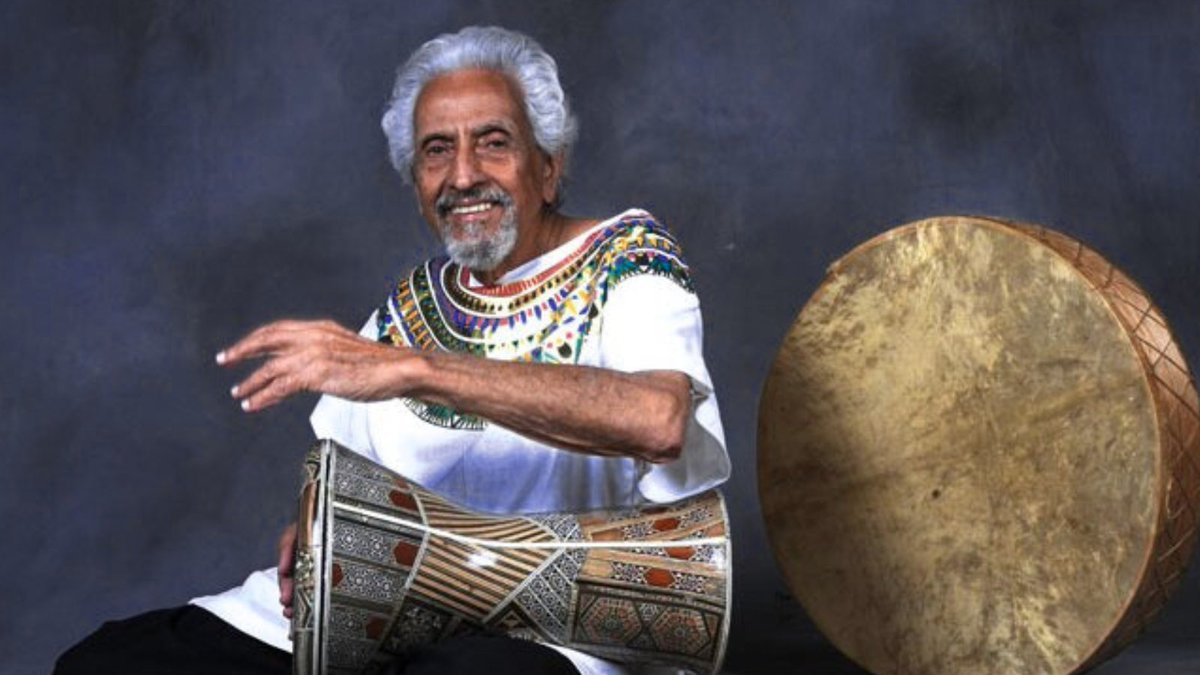
Do you know about the Copt who Helped Invent the Future of Music? Remembering Halim El-Dabh
On this day in 1921, Halim Abdel Messieh el-Dabh was born, and he would grow to become a musical genius, composing music years before it became common in Europe and America.
The youngest of nine children, el-Dabh was born into a large Coptic family in Sakakini, Cairo, although the family was originally from Abutig in Asyut.
Long before electronic music became mainstream in Europe or America, a Coptic composer in Cairo had already begun experimenting with recorded sound as raw compositional material.
In 1944, el-Dabh composed the earliest known work of tape music (musique concrete) titled ‘The Expression of Zaar’. He presented the piece publicly at an art gallery event in Cairo, and it was so popular it was then performed in 1949 at All Saints Cathedral.
El-Dabh was scouted by the US embassy to study in the United States as he was awarded a Fullbright fellowship.
In 1959, el-Dabh was one of the first outside composers invited to work at the Columbia-Princeton Electronic Music Center, America’s oldest center for electronic and computer music research.
El-Debh would go on to compose four major ballet scores for the legendary American dancer and choreographer Martha Graham, including her ballet masterpiece Clytemnestra (1958).
Grantham was an incredibly famous American ballet dancer and choreographer, creating the ‘Grantham technique’ and being the first dancer to perform at the White House, travel as a cultural ambassador, and achieved the Presidential Medal of Freedom with Distinction, the highest American civil award.
El-Debh was heavily influenced by his Coptic identity, a characteristic that is often erased when remembering him.
He was reportedly “captivated by the liturgical music of his family’s Coptic Christian tradition”. Some of his works include ‘Michael and the Dragon’ clearly a piece focused on the Archangel Michael.
Coptic liturgy and the Coptic identity are respectively strong continuums of Phraonic music and a Pharaonic identity.
It is likely that his Coptic identity gave him strong roots in his indigenous identity connected to Ancient Egypt.
Another Pharoanic piece he composed was ‘The Reappearance of the Lotus Flower’.
Whilst a young man, El-Debh was inspired by Nasser’s secular pan-Arabism but became disillusioned when he saw its failure to act against the persecution of the Coptic people.
In an interview with The Christian Science Monitor in 1957, he said:
“I stand in the 20th century, and I experience 20th-century phenomena, but the roots of ancient times are in me. I use their insights to understand the West and contribute to its music.”
To this day, since 1961, if you were to attend the Sound and Light show at the Giza pyramids in the evening, the orchestral and choral score for the performance was composed by El-Debh.
In the United States, during the 1950s and 1960s, he was also a strong supporter of the African-American community and an advocate for civil rights and anti-racist thought. His worldview was rooted in civilisational depth but oriented toward justice in the present.
#coptic #copticorthodox #copticorthodoxchurch #coptichistory #copticchristian #christian #egypt #egyptianhistory
Read the full blog below:
Do you know about Marcus Simaika, the Coptic Pioneer who Saved Our History?
Much of the Coptic heritage now displayed in the Coptic Museum did not survive by accident, but by the tireless efforts of one Copt born on this day in 1864, Marcus Simaika.
At just 25, Simaika also became the youngest member elected to the Church’s Maglis el-Milli in 1889. He emerged as a reformist figure, arguing that the Maglis should have greater authority over Coptic schools, awqafs, and personal status laws.
During the 1890 crisis, when Prime Minister Mostafa Fahmy Pasha exiled Pope Cyril V for refusing to recognise the Maglis, Simaika was one of only two members who refused to sign the petition. He later wrote:
“Young and inexperienced as I was, I stubbornly refused to sign the petition, saying that it was against my convictions.”
Magar Pasha Abd al-Shahid visited Simaika in his home and persuaded him to go and apologise for his insubordination to Boutros Pasha but still refused to sign. Yet when elections came for the Maglis, Simaika was re-elected again in 1905 and in 1908 elected as Vice President.
It was during this period that Simaika began to dream of something greater, a Coptic Museum.
While working on the repair and restoration of ancient churches, he realised how much heritage was being lost. After reconciling with Pope Cyril V, he received permission to begin collecting objects.
In 1908, Simaika had found that a silversmith was weighing out old silver Gospel covers and church vessels to be melted for repurposing. In his expertise he realised the silver was from the 14th and 15th centuries. Offering to pay for the objects, a huge cost of LE180, to entrust them into the care of the Church priests, and the objects would be stored in one room in the Al-Muallah (Hanging Church) in old Cairo.
Simaika then spent his days, with Pope Cyril V’s authority, travelling to Coptic Churches and desert monasteries to look for objects to be added to the growing museum. In his journal, Simaika wrote:
“Largely through travelling with the permission of the Patriarch on a tour of inspection of all churches and monasteries throughout the country from Rosetta to Khartoum rummaging in basements and searching lumber rooms, I gradually put together the objects which now form the collections in the Coptic Museum.”
Simaika’s work was tireless and he persistently searched for Coptic antiquities, but also did essential work in indexing Coptic libraries, cataloguing Coptic history and tirelessly travelling across Egypt and even searching Europe to find and document Coptic history.
To save costs Simaika himself would travel and search old Coptic houses across Cairo for woodwork, marble, doors, latticework and fountains to construct the growing museum.
Simaika was a revolutionary thinker in protecting Coptic heritage and history, years before other leading heritage-workers had realised at the time. As early as 1890 in Oxford, he argued that replacing ancient Coptic architecture with modern foreign designs was a mistake. In his diary he lamented the destruction of historic church interiors and urged that new churches be built alongside ancient ones, preserving the originals as monuments.
Thanks to his persistence, the Coptic Museum finally opened in 1910 and was even visited by U.S. President Theodore Roosevelt. In 1930–31, at King Fuad I’s request, the museum became a state institution, and Simaika was appointed Director for life.
Simaika passed away on 2 October 1944 in Alexandria during World War II, heartbroken that his treasured antiquities had been packed away and moved before he could see them returned. A few years later, a new wing of the museum opened, and his bust still stands there today.
You can read the whole blog here:
#coptic #copticchristian #copticorthodox #coptichistory #copticyouth
https://t.co/1NPd5KtwZp
Today Marks the Assassination of the Only Ever Coptic Prime Minister of Egypt, Boutros Ghali ; the Erased History of Anti-Coptic Hate
On this day in 1910, Boutros Ghali, Egypt’s only Coptic Prime Minister in modern Egyptian history was assassinated.
Many try to remove the sectarian hate behind Boutros Ghali Pasha’s assassination. But this revisionism distorts history. Violent anti-colonial narratives are often used to justify the extremism that shaped the killing of Egypt’s only Coptic Prime Minister.
Ghali became the first Copt to receive the title of Pasha. Throughout his career he remained deeply active in Coptic political, clerical, and social life. His identity as a Christian was always visible and inseparable from his public role. At each step of his rise, criticism often focused on his religion. Protests followed his appointments, including when he oversaw the selection of Sharia court judges. Even before power, sectarian hostility shadowed his career.
On 8 November 1908, Boutros Ghali became Prime Minister of Egypt, the first and only Copt ever to hold the office. Some newspapers openly opposed his appointment because he was a Christian.
On 20 February, as Ghali left the Ministry of Justice, Ibrahim al-Wardani shot him six times.
On the 21st, Egypt’s only Coptic Prime Minister was dead. Al-Wardani when asked why he killed the Ghali said he was a “traitor to the country”.
Many later framed the assassination as heroic nationalism, a political act against British collaboration. Yet this framing erases and ignores the extremist and sectarian currents surrounding Wardani.
After Ghali’s assassination, many accounts document how Muslim Egyptians celebrated the killing of the ‘Nazarene’ amongst other anti-Christian rhetoric.
Many would chant in the streets “Ya mit sabah al-full ala al-Wardani illa qatal Boutros al-Nasrani”, “A hundred sweet mornings to Wardani who killed Boutros the Nazarene”.
The Grand Mufti of Egypt recused himself from Wardani’s trial and issued a fatwa that: “the blood of a Muslim, Ibrahim al-Wardani, cannot be taken for the blood of an infidel, Boutros Ghali”.
Al-Wardani was a member of the ‘Brotherhood Solidarity Association (جمعية التضامن الأخوى). An extremist religious group with a history of political assassination attempts. To join the group, each member would take an oath, place their hand on the Qur’an, swear loyalty, and have their affairs in order.