Second for second, @tylercowen packs more substance into a talk than anyone I'm aware of. This is a clear, non-hysterical, and somewhat soothing discussion of our AI future.
Super excited to share joint work with @axiommathai that kicks off a broader project of formalization in economics.
Aumann's celebrated theorem says we can't "agree to disagree."
But what does that actually mean – formally? 👀
50 yrs ago, Nobel-Prize-winning economist Robert Aumann proved that rational agents can't "agree to disagree."
We formalized this famous theorem in Lean. Strikingly, AxiomProver made an implicit underlying assumption explicit.
Today we announce EconLib.
@skominers@HarvardHBS
@mean_field_zane Systems thinking and complexity science are quite interesting in some instances, but they're also among the loudest yet least fruitful research programs.
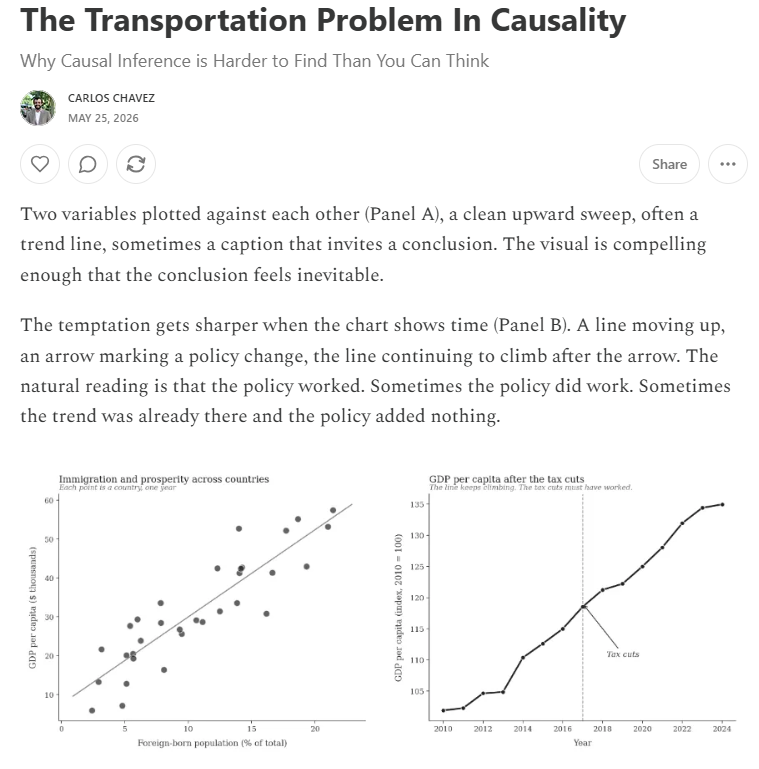
Why is causality harder to find than you think?
People see a correlation chart, or a time-series with an arrow marking a policy launch, and read it as causal evidence. But it almost never is.
New essay on the Transportation Problem in Causal Inference: https://t.co/F3AbqKlj4a
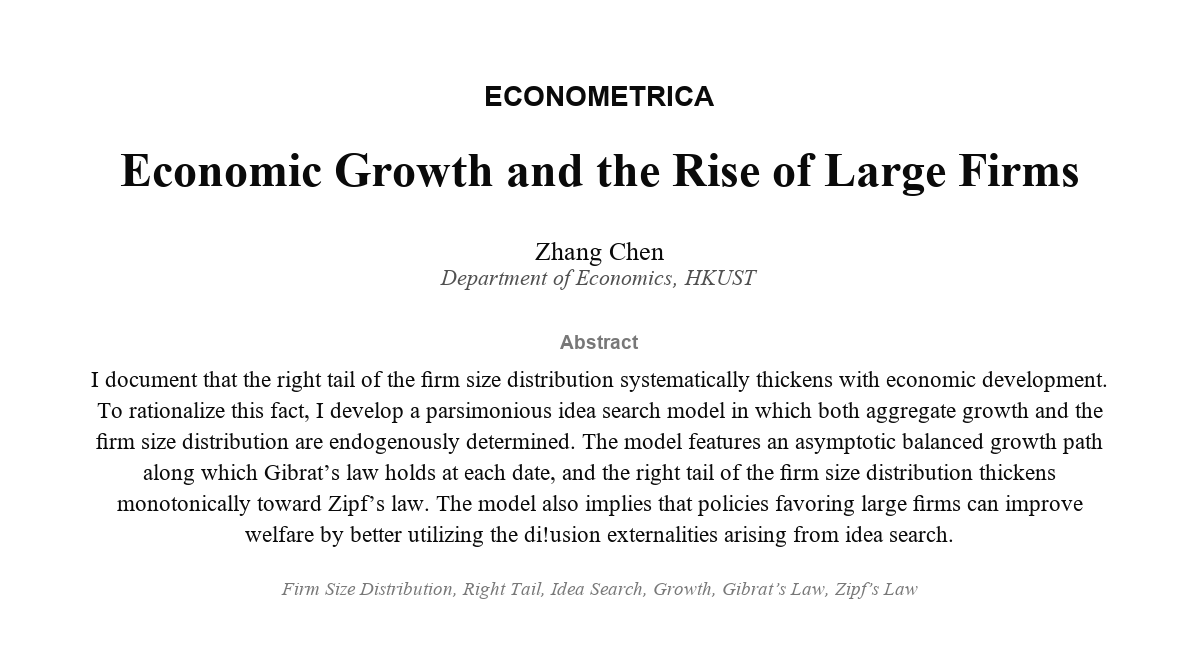
Why do richer economies have more very large firms? This paper shows that the upper tail of the firm size distribution thickens as economies grow. A model of idea search explains why, showing how growth itself can produce rising concentration.
https://t.co/ocOxbeV3Ww
Following up on the suggestion from Will Sawin, here is an illustration of the new configurations that disprove Erdos' unit distance conjecture (made with the help of ChatGPT 5.5 Thinking).
Wild that an LLM autonomously disproved the unit-distance conjecture 🤯
But it’s also striking to me that, almost immediately after seeing the construction, a human mathematician was able to improve it further.
Speaks to the potential of human–AI collaboration in math, QED 🔲
Finally: The Solow paradox—where are AI-driven productivity gains? A similar delay happened with electricity: the dynamo arrived in 1882, but productivity grew just 0.5% annually for the next 35 years. After 1917, output growth >doubled. Organizational adaptation takes time. /5