SAY IT LOUDER BEN MULRONEY!! LOUDER @BenMulroney
This is 100% RACISM!!
Government job postings that openly say “BIPOC only” and explicitly state “Caucasian not permitted to apply.”
Your tax dollars — from every single Canadian, including white Canadians — are good enough to take, spend, and waste.
But YOU are not good enough to even apply for the job because of the colour of your skin.
This isn’t “equity.”
This isn’t a “remedy.”
This is straight-up anti-white racism, government-sanctioned and taxpayer-funded.
And the Liberals defend it like it’s normal.
Call it what it is: RACISM.
Pure. Simple. Disgusting.
Who else is done with this anti-white double standard? 👇
#cdnpoli #Racism #CanadaFirst
The Calgary Chamber of Commerce wants Albertans to believe independence talk scares investors.
Wrong.
Investors are scared by unstable rules, delayed approvals, blocked infrastructure, and federal policies that punish Alberta’s industries.
That uncertainty comes from Ottawa.
FOR IMMEDIATE RELEASE
Let Alberta Decide Responds to Calgary Chamber: “The Real Economic Risk Is Alberta Staying Under Ottawa’s Control”
Calgary, Alberta, June 24, 2026 — Let Alberta Decide is responding to today’s Calgary Chamber of Commerce news release by saying the Chamber has focused on fear while ignoring the larger economic reality: Alberta’s economy has been held back for more than a decade by federal policies that have driven away investment, constrained resource development, and limited Alberta’s potential.
Keith Wilson, K.C., co-lead of Let Alberta Decide, said the Chamber’s release misses the central issue.
“The Chamber is measuring fear, not opportunity,” said Wilson. “It is warning Albertans about hypothetical uncertainty from independence while ignoring the real uncertainty Alberta businesses have lived with under Ottawa. The greatest threat to Alberta’s economy is not Albertans having a democratic vote on their future. The greatest threat is allowing Ottawa to keep blocking, capping, taxing, delaying, and politicizing the industries that built this province.”
Wilson said Alberta remains one of Canada’s strongest economies despite federal policies that have discouraged investment in energy, infrastructure, agriculture, and resource development.
“Alberta’s farmland is not moving. Alberta’s oil and gas reserves are not moving. Our skilled trades, engineers, entrepreneurs, service companies, infrastructure, and young workforce are here,” Wilson said. “Alberta is not a branch office economy. Alberta is a producing economy.”
Let Alberta Decide says the Chamber’s release also ignores the massive capital flight Canada has experienced under the current federal policy environment, with recent economic analysis reporting that more than $1 trillion in investment left Canada between 2015 and 2024.
“Businesses do not leave because a people debate their future,” Wilson said. “Investment leaves when governments make the rules unpredictable, and Ottawa has done that to Alberta for more than a decade. That capital did not leave Canada because Albertans were discussing independence. It left under the current federal system.”
Wilson said independence would give Alberta authority over resource regulation, taxation, immigration policy, infrastructure approvals, trade policy, pipeline approvals, and market access.
“Albertans should be making the decisions that shape Alberta’s economy,” Wilson said. “Those decisions determine whether projects get built, whether jobs are created, and whether young Albertans can build their futures here at home.”
Wilson rejected the Chamber’s reliance on Brexit as a comparison.
“Brexit is the wrong analogy,” Wilson said. “The UK moved away from its largest market. Alberta independence would allow Alberta to negotiate directly with our largest and most important market—the United States—without Ottawa sacrificing Alberta’s interests to protect Central Canadian priorities.”
Let Alberta Decide noted that the Chamber’s survey was not a representative poll of Albertans or Alberta businesses. It was a survey of Chamber members who chose to respond. Even then, the Chamber’s numbers show that a majority of respondents did not say they would relocate if Albertans voted to begin the independence process.
“If the Chamber wants its poll treated as evidence, it should release the evidence,” Wilson said. “Albertans deserve to see the questions, sample size, response rate, and methodology.”
“Alberta has the resources, institutions, workforce, and economic capacity to be a successful independent country,” Wilson said.
Media Contact:
Let Alberta Decide
[email protected]
The Fraser Institute says Canada’s equalization program is “badly broken” and needs major overhaul.
Albertans already knew that. In 2021, over 62% voted to challenge equalization. Ottawa ignored us.
This is the problem with “Lead Not Leave”: Alberta has tried asking, voting, writing, negotiating and leading. Ottawa still treats Alberta as an ATM.
A referendum is not a distraction. It is the only way to force a real negotiation over Alberta’s future and Alberta becoming an independent country.
"Canada’s equalization program is broken and requires major overhaul" https://t.co/HzWZXYFfpR
"Treason."
That's the word LCol. (Ret.) David Redman uses when talking about Canada's immigration policies.
A serious accusation—and he explains exactly why.
Watch the full episode on YouTube.
https://t.co/LKapU6Ne7q
@FrontierCentre@DavidRe09886944
I am so glad @Harry__Faulkner asked @ikwilson that question, and in such a way which highlights the reason why Albertans feel severely disenfranchised from the rest of Canada, particularly east of Saskatchewan
Too many Canadians feel entitled to an “inheritance” of the wealth from Alberta, while condemning the way Albertans earn that wealth, without any respect for giving Albertans a say in how that wealth is spent.
Eastern Canadians decide our Federal Government long before polls in the west are closed
We are called traitors for resenting that and wanting to separate.
Alberta is told to shut up and be grateful that we get to keep funding provinces east of Saskatchewan, and this is supposed to make Albertans feel privileged to be Canadian.
Although Alberta’s oil and gas industry is a key reason that we know we will succeed as an independent nation, it is not the whole reason we seek independence. It is not just about a pipeline. Premier @ABDanielleSmith is misguided in thinking that a new pipeline will assuage all of our concerns. Not even close.
➡️Taxation without representation
➡️Equalization inequity
➡️High debt, uncontrolled spending
➡️Inflation, unaffordable cost of living
➡️Uncontrolled Immigration
➡️Attack on Christianity
➡️DEI & Woke policies
➡️Immigrants receiving more than Seniors who have paid taxes for 50 years
➡️Egregious abuse of MAiD
➡️Gun Grab
➡️Bills to restrict free speech
➡️Corrupt Judiciary and RCMP
➡️China interference & infiltration
➡️Carbon tax increases for a Globalist WEF Net Zero fantasy
➡️New World Order
Opponents are telling Alberta we can’t leave but not one person can give a valid reason why Alberta should want to stay in Canada
FYI, I don’t think other Canadians can just move to Alberta and a couple weeks later vote in our referendum. They have to be a registered voter with Elections Alberta and produce identification of residency that goes with that.
Premier Smith had better stipulate strict voter identification and residency in a taxpayer election list for our referendum, or she will have a civil revolt. And she will face a resounding defeat of confidence at the November @Alberta_UCP AGM
This must be an Alberta referendum for Albertans to decide our future in a democratic vote
Other Canadians do not have an “inherited” say in our future. We’ve had 121 years of that.
Albertans are done with Eastern Canadian entitlement
The Canada we loved no longer exists
With atmospheric CO₂ hovering around 430 ppm, nature is thriving in regions once completely inhospitable.
The vegetation is marching back into the world’s most hostile environments. Earth's biosphere is quietly demonstrating a profound, measurable benefit from higher CO₂. It's become a more resilient and greener world, one that is also more water-efficient. Fresh green cover is actively reclaiming the arid fringes of the Sahel (the Sahara’s southern edge), the Middle East and the Australian Outback.
An 8% reduction in the Sahara Desert's expanse since the 1980s alone means 700,000 square kilometres of formerly barren sand wastes have turned green. This is a literal reincarnation of Earth's famed living deserts. It's the natural world fighting back.
Since 1960, global food production has increased by over 250% to 390% (depending on the index). Most of this is from the Green Revolution—the arrival of fertilisers, tractors and genetics. But atmospheric CO₂—rising from 315 ppm to 430 ppm—is a silent yet profound tailwind behind every new hectare being harvested.
It's the ultimate irony: a climate change agenda that treated CO₂ as an agent of starvation. Instead, it has become the primary engine of agricultural abundance and drought resilience.
When you break down the plant science, the results are spectacular:
* C3 plants (95% of plant species): Rice, wheat, soybeans and potatoes have increased yields by 30% to over 50%. Their photosynthetic mechanisms are structurally starved at lower baseline levels; extra CO₂ accelerates their growth directly.
* C4 plants: Maize (corn), sorghum and sugarcane have increased yields by up to 10%, alongside massive efficiency gains during dry spells.
* Root and tuber crops: Potatoes and sweet potatoes show explosive underground growth, because they have a massive subterranean capacity.
Studies compiled by organisations like the USDA Agricultural Research Service show potato yields increasing by 50% to over 100% under elevated CO₂ when water is abundant. Across almost all major crop varieties, this atmospheric enrichment triggers a 10% to 40% reduction in plant water loss because leaf stomata don't need to open as wide to take in carbon.
CO₂ isn't the disaster they warned about—instead it is a massive insurance policy for global food security.
A man in Canada met up with a doctor at a Tim Horton’s. Not for coffee, but to discuss the option of MAID. The man was suffering from Crohn's disease and depression. The doctor 'evaluated' him outside the coffee shop in a parking lot and decided he was a candidate for MAID.
But here's the even crazier part that I haven't heard the media talk about.
After texting the patient a personal euthanasia plan, the doctor DROVE the man to an industrial morgue, injected him, and killed him. Paperwork done. On to the next one.
This is SICKENING, Canada.
Climate has been repurposed to prop up one of the greatest money laundering schemes in history.
It shouldn't matter if temperatures go up by a modest degree or two. The IPCC has already ditched its 5-degree doomsday scenario. Temperatures have varied by up to 1.4 degrees since the start of the Industrial Revolution beginning in 1769 - when the world's population was around a billion; most people lived in rural villages. But that rise has already happened. So it becomes meaningless for humans, who have shown that they can live anywhere in any conditions.
Climate refers to the study and description of long-term regional weather patterns in particular areas, usually over a 30-year period. It became a convenient metaphor for environmentalism. Nor can anyone predict some future climate crisis decades in the future. Meteorologists have trouble with a couple of days. This is the argument underpinning a 40-year propaganda campaign that is dismantling the economies of many Western nations. So far, it has cost $147 trillion (McKinsey Global, 2022).
The down side; western electricity costs are among the highest in history.
Some basic scientific facts for you.
CO2 is 0.04% of our atmosphere.
Mankind's entire CO2 emissions are just 3% of that (0.0012%).
The UK's entire CO2 emissions are just 1% of that (0.0000012%).
CO2 is harmless plant food, not the planet's climate control knob.
The world has spent roughly $147 trillion so far - on an experiment to transition the world away from its bedrock of affordable and reliable energy.
The gain so far is exactly nothing. There is still $128 trillion left to spend out of the $275 trillion price tag (McKinsey Global). This staggering outlay is not just the proliferation of wind turbines and solar panels, scarring our wilderness, scenic, rural and coastal landscapes. It represents a total global price tag to replace the entire - still functioning - physical assets and energy and land-use systems for an unknown Net Zero transition.
This transition has been framed by McKinsey Global at $275 trillion by 2050. This is what that will be buying:
* Complete rewiring and upgrading every global electricity grid (this will cost $21 trillion).
* Overhauling industrial systems (like the essential production of steel and cement).
* Changing agricultural practices and vehicle fleets (possibly replacing all heavy mining vehicles, road transport, shipping and agricultural equipment with EV alternatives).
* So far, the essential battery technology does not exist.
We were told to get rid of all our affordable and reliable fossil fuels. Yet there are centuries of these fuels still untapped in the ground.
* Coal: 1.06 trillion tonnes (approx. 132 years remaining).
* Gas: 7,299 trillion cubic feet (approx. 143 years remaining).
* Oil: 1.65 trillion barrels (approx. 53 years remaining).
The actual volume could be two or three times as much, lasting centuries. We haven't even bothered with nuclear energy, which would easily power the world for thousands of years. This superabundance challenges the very nomenclature of 'fossil fuels'.
The hidden trap isn't just the scale of the upfront capital; it’s the looming 2040s logistics bottleneck when the first massive waves of un-recyclable composite blades hit landfills and demand a complete mining and manufacturing rerun.
We were told the transition experiment would be a one-time capital investment to secure 'free' energy. But to support a global wind capacity that just cleared 1,299 GW, the world has initiated a rolling thunder of 20-year structural replacement cycles. We must keep replacing hundreds of thousands of massive scale industrial turbines - for no gain in energy.
Every turbine and the bulk of solar panels will have to be rebuilt again and again in 20 to 25 year cycles. This creates an endless treadmill of ceaseless decay and replacement, a global nightmare in dealing with ever growing volumes of discarded renewable components, like massive turbine blades in the millions.
It's impossible to imagine the strains this treadmill will place on landfill and our shrinking ability to recycle rising volumes of ever-rarer, complex and hybrid metallic components. The pressures will keep rising on mining efforts to replace the vanishing rare metals and other components, like copper, steel, cement and plastics
It highlights the rashness of launching this front-loaded, capital-intensive experiment of trying to build a new system from scratch while centuries of high-energy-density fossil fuels remain in the ground. It's already taken us to the brink of failing economies, and our hollowed out cities sinking into stagnation.
This is the monumental scale and institutional momentum of our 'transition' away from a world that was recently thriving on reliable, cheap and available power.
We are told that hydrocarbons are a stain on history. But before fossil fuels, humanity was entirely at the mercy of a harsh world.
Life before modern energy was exactly as Thomas Hobbes described it: 'solitary, poor, nasty, brutish, and short'. Coal and oil are the core reasons modern civilisation exists at all. They ended the backbreaking human servitude and primitive toil, provided reliable warmth and built the physical infrastructure that protects humanity from the elements today.
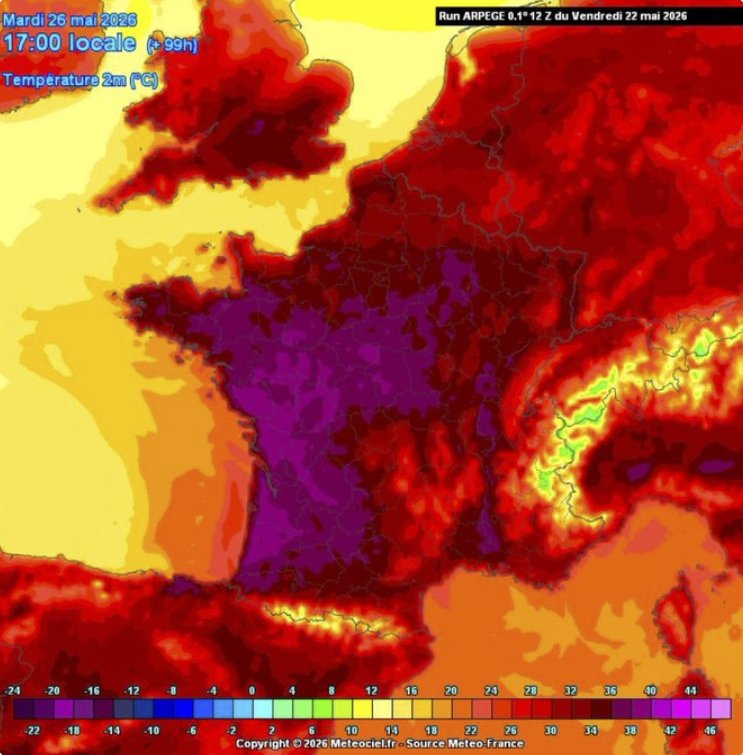
When you see maps of Europe painted in apocalyptic blood-red, accompanied by insults for anyone who asks questions, you are looking at pure marketing - this is not science. Behind the panic dialogue lies a profound ignorance of deep geological time and human history.
The transition to modern energy didn't corrupt a pristine world; it lifted human hope out of subsistence poverty. It built modern medicine, sanitation and transport, and paradoxically made us vastly more resilient to a harsh world.
The irony runs deep. Carbon dioxide, now labeled a pollutant, was the foundation for the rise of life, the catalyst for oxygen production and blind architect of the miracle of photosynthesis. Without it, multicellular life would not exist.
Look at the actual data. For the vast majority of the Phanerozoic Eon (over the past 541 million years), Earth's average temperature sat between 18°C and 26°C. Today's global average is around 15°C. Geologically speaking, we live in a remarkably 'cool' era.
We are also still living in the Quaternary Ice Age, enjoying a brief, 11,700-year warm holiday climate known as an interglacial period. The roughly 1.4°C rise seen since 1850 was a natural recovery from the brutal icy depths of the Little Ice Age - not the ignition of a planet.
Yet, the institutional campaign of absolute climate panic—now roughly 38 years old—has successfully morphed a complex scientific inquiry into a massive, centralised economic torrent. The futility of fighting these natural cycles comes at an astronomical economic cost.
According to global consulting firms like McKinsey, the forced top-down transition to Net Zero is projected to cost $9.2 trillion every single year through to 2050. That is a staggering global total of $275 trillion.
This isn't about saving the planet. It's a massive, top-down redistribution of wealth away from sovereign nations and into an opaque, tangled bureaucratic web of managed funds. It is being driven by a self-serving activist hardcore within the UN.
Fear has been hijacked to replace physics, fracturing global stability for an outrageous multi-trillion-dollar quest for power.
"Did they vote for this in the last provincial election? No, they didn't."
That line from @MarkJCarney deserves to be framed and hung on a wall somewhere, preferably over the entrance to the "National Museum of Political Nerve & Hypocrisy."
Because now I have questions.
⁉️ Did Canadians vote for #Carney to pivot Canada toward a more European economic and defence model?
🙅🏼♀️ No, they did not.
⁉️ Did they vote for him to start loosening Canada from its most important trading relationship with the United States after campaigning as the only adult in the room who could handle Trump?
🙅🏼♀️ No, they did not!
⁉️ Did they vote for new strategic partnerships with China?
🙅🏼♀️ No, they did not!
⁉️ Did they vote for a revived industrial carbon pricing regime and carbon markets dressed up as competitiveness?
🙅🏼♀️ No, they did not!!
⁉️ Did they vote for "no Pathways, no pipeline" as national energy policy?
🙅🏼♀️ NO, THEY DID NOT!
Apparently #democracy only requires itemized voter consent when #Albertans want to ask an #Alberta question.
When #Ottawa changes the direction of the country after election day, they call it leadership.
When citizens want a direct say on the future of their own province, suddenly it is reckless, divisive and dangerous. Does this clown pretending to lead FOR Canadians even hear himself?
People asking people what people think.
Terrifying stuff.
#cdnpoli #CarneyIsALyingHypocrite #WesternAlienation
https://t.co/DN2vTrQnhL
International bureaucracies are retreating from their formerly 'iron-clad' fixation on immediate global climate collapse.
As their worst-case computer models evaporate under the weight of real-world data, the goalposts are shifting. Realising they can no longer defend the rigid targets used to drive public anxiety, institutions like the IPCC are quietly pivoting to 'overshoot' mode to manage the damage.
This retreat is happening because empirical data from NASA satellites is telling a vastly different story of planetary resilience. The Sahara Desert, of all places, has shrunk by roughly 8% since the 1980s. This isn't a computer model simulation, it's the visible reality captured by NASA’s AVHRR and MODIS satellite instruments.
Satellite data reveals that 25% to 50% of Earth’s vegetated lands have shown significant greening. This is an expansion of biomass equivalent to twice the continental United States. Carbon dioxide fertilisation is responsible for roughly 70% of this growth.
Higher atmospheric CO₂ is also allowing marginal plants to use water more efficiently. Leaf pores (stomata) don't need to stay open as long to take in carbon, drastically cutting water loss and boosting natural drought resistance. This biological efficiency is allowing vegetation to march back into the world’s most hostile environments.
Green cover has been actively reclaiming the arid fringes of the Sahel (the Sahara’s southern edge), the Middle East and Australian Outback. An 8% reduction in the Sahara's desert expanse means over 700,000 square kilometres of formerly barren sand wastes have transitioned to green cover.
With CO₂ now hovering around 430 ppm, nature is using this extra airborne fuel to thrive in regions once completely inhospitable.
Centralised policy platforms remain focused on worst-case scenarios and economic penalties. But the biosphere is quietly demonstrating a profound, measurable benefit from higher CO₂. Earth is becoming greener and more water-efficient - where it matters most.
No one expected this.
This isn't just a pile of debris - it’s the future of green energy waste hidden in plain sight.
Millions of solar panels are hitting their end-of-life cycle, and the world is completely unprepared for the coming toxic avalanche. By 2050, the International Renewable Energy Agency projects up to 78 million metric tons of solar e-waste. Where is it all going to go?
The industry boasts that solar panels are '95% recyclable'. Technically, yes - because they are made of glass, aluminum and copper. But economics always trumps physics. In Australia and the US, it costs roughly $20 to $28 to properly disassemble and recycle a single panel, but only about $4 to dump it in landfill.
Because there is no financial incentive, up to 90% of decommissioned panels go straight into the ground.
Each solar panel is an industrial 'sandwich' bound tightly by heavy polymers. To extract the microscopic amounts of valuable silver and high-purity silicon requires energy-intensive chemical and thermal baking.
When they are crushed or left to fracture in landfills, heavy metals like lead and cadmium can leach into the surrounding soil and groundwater, turning 'clean energy' into a multi-generational hazardous waste problem.
The crisis is accelerating faster than models predicted. Because solar cells degrade and lose efficiency, and because newer, cheaper panels hit the market, consumers and solar farms are ripping out functional systems at least a decade early to upgrade.
This compressed lifecycle destroys the narrative of a long-term, stable asset and creates an endless loop of unrecyclable industrial trash.
It is profoundly disturbing to watch you and your party advocate for silencing citizens who participated in a lawful democratic process simply because you disagree with the issue being raised.
It is literally your job to listen to citizens, especially when they are using the very democratic processes established by law to have their voices heard.
This is not even about debating the pros and cons of independence. This is about an organized effort by elected officials to silence citizens from participating in a lawful democratic process, and that should concern everyone.
You do not have to support independence to recognize how dangerous that is. Once governments, political actors, and courts begin deciding which citizen-led issues are acceptable to discuss, democratic participation stops being a right and becomes a permission granted by those in power.
Today it is this petition. Tomorrow it could be any issue the political class finds inconvenient.
Citizens do not hold institutional power. Their voice is their power. And when lawful democratic processes are undermined to prevent citizens from even being heard, public trust in democracy itself begins to collapse.