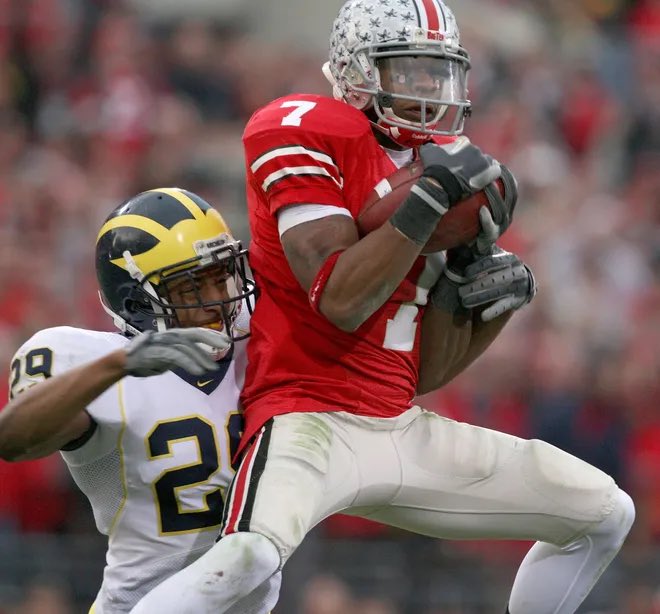
The problem with college football today is every game DOESN’T matter anymore. You can lose and still get another shot. It’s becoming the NFL.
Boise State, West Virginia, Louisville, Oregon—you got upset, your season changed. That pressure made Saturdays special.
Give 2008 USC a 12-team playoff and they might’ve beaten everybody by 2 TDs 😂
The chaos mattered because the consequences were REAL. That’s what made college football different from every other sport.
Coors Field will have one of the highest attendances in baseball again this year.
This will not stop.
I’m very serious when I say #Rockies fans should BOYCOTT OPENING DAY AT COORS FIELD.
DO NOT GO TO THE GAME.
SEND A MESSAGE.
THERE IS NO END IN SIGHT.
#FlashbackFriday: In arguably the biggest hit in college football history, Michigan's Daydrion Taylor collides with Penn State's Bob Stephenson in the 1997 Michigan-Penn State game.
Neither ever played another down of football.
Let’s talk about the biggest problem Colorado State football is facing.
It’s not quarterback; it’s not Jay Norvell’s play calling; it’s not a defense that gave up 50 points. Nor is it the inability to sell out a 36,500-seat stadium to host a Power 5 program in Washington State.
The cliches are still there for CSU football this season. The goals still achievable: Winning the Mountain West, getting back to a bowl game, blah blah … losing the opener to Washington State isn’t going to change that. It also doesn’t change CSU’s immediate chances of getting into a better conference; it just feels that way because realignment is the buzz right now.
But that could change.
CSU’s trajectory is the worst it has been since Earle Bruce stopped the slide in 1990. The Rams have gone five seasons without a bowl, their longest drought since the Raisin Bowl to the Freedom Bowl. And while that may not seem like a lot — Power 5 schools such as Vanderbilt, Kansas, Rutgers and even CU have gone through worse stretches fairly recently — there couldn’t be a worse time to have a bad football program.
TV networks control college football. This isn’t a new revaluation (ESPN has owned most bowl games for a while now), but we are starting to see the greater impact of that with this summer’s conference reshuffling with every Pac-12 school trying to get to a league that has a better media rights deal. SMU went so far as to play the long game and forgo Tier 1 media rights in the ACC for nine years, just to not be stuck in a G5.
What a TV network thinks of you is important to whether a conference wants to extend an invite. If you don’t bring value on screens across the country on Saturdays, you don’t bring any value. As we sit here today, networks see little value in CSU.
That’s a problem.
Last week was a perfect example. CSU and Wyoming were hosting Power 5 schools in the same time window, and CBS opted to go to Laramie for its nationally televised network game and sent the CBSSN crew to Fort Collins. (Ultimately the right decision.) Adding insult, rather than switch over from a WKU-USF game that was already decided, CBS Sports Network decided to wait and join coverage of CSU in the second quarter, not even going through the effort of streaming the first quarter online through their app. Five of the Rams’ 11 remaining games lack TV coverage as of writing this.
Meanwhile, Air Force runs one of college football’s most boring offenses and has TV secured for 10 of its next 11 (including a CBS game), and CU goes back-to-back weeks with Fox’s Big Noon Kickoff.
No matter how it works out for Coach Prime and the Buffs, CU has made itself relevant to TV networks. So have Air Force and Wyoming. That matters.
CSU? The networks don’t care.
At this point, why should they?
With a Pac-12/Mountain West merger likely, I see no risk of CSU missing out. But we all know that’s a bandage, and any smart school will still be looking to move up and out before college football breaks off from the NCAA.
By the time that happens, will Colorado State have a football brand that’s worth anything?