I’m starting my journey as an indie AI founder.
Right now:
$0 MRR
0 users
My targets:
$3K MRR in 4 months
$20K MRR in 12 months
From today, I’ll build in public and share the real journey—products, distribution, mistakes, and numbers.
Let’s see how far I can take it.
I used Codex today to set up an automated blog job for BeatAPI.
The output quality is really high.
That's not from "write me a blog." It's the research, Firecrawl for the extra context, and a local knowledge base of our own product so the draft has real details.
I think a product is features plus distribution. Features are in a place I can live with. Distribution for me starts with SEO, social, ads, and developer communities. This pipeline is step one.
Next I want to keep putting real opinions in front of developers, and see if the product earns any recognition.
Forgot to post the August recap.
BeatAPI made $20 last month.
Today: 3 new signups, and 1 paying user who paid $10.
Small numbers. Good start. Let's keep going in September.
Spent almost the entire afternoon on BeatAPI's UI.
I think UI is where a product's design philosophy and brand actually show up. For an API infrastructure, it should feel stable and high-quality.
That's why I leaned into cool gray — that premium tone. Hope people enjoy using it.
Features are still the real work from here. I'll spend more time there next.
I made $1,124,723.78 in August 2026.
But SEO is dead right?! 😂🤣
☔️ Rainmakers - $64,359.78
🕵️♂️ Parasite Pages - $12,883
💻 Portfolio - ~$5,840
🔗 PressWhizz - ~$1,000,000
🔎 Consulting - $26,773
👨🏫 CF Training - $9,769
💰 SEO Affiliate - ~$5,000
🧑🍳 Gumroad - $99
I also agreed to sell my shares in a SaaS, but haven't got the cash for that quite yet.. I mostly stayed inside my house for the entire month grinding out this launch though 😅
@blarckat Thanks for the welcome and the solid advice! "Progress than perfection" — love that.
I know there'll be plenty of failures ahead, but I'm counting on them to be fuel for the journey.
Open source is becoming the default — not out of ideology, but because it's the most efficient acquisition channel.
AI coding has commoditized software. Features you spent months building can be replicated overnight.
The real moat isn't the product — it's underneath: API infrastructure, token consumption, and vertical data flywheels.
This is already happening: OpenSEO, Open Design…
We're building BeatDesign with the same thesis. Using tools like Higgsfield and OpenArt, I kept hitting the same friction: too many features I don't need, missing the ones I do. Every creator's workflow is different.
So instead of another all-in-one product, we're making a local-first, open-source AI creative canvas — where creators plug in exactly the modules they need.
https://t.co/nm1kKewYZt
The emerging pattern: general-purpose Agents own the entry point. Vertical tools survive as open-source plugins in their ecosystem.
Open source isn't idealism. It's a survival strategy.
Everyone is open sourcing everything right now.
Why? AI made software a commodity.
So you don't sell the software anymore, you sell everything around it: the hosting, the support, the enterprise tier, the trust, and the community.
Open source is the default now!
A potential partner asked for a referral link before our referral system was live.
That’s the good kind of problem — the happy trouble of actually building. I just wasn’t caught up yet.
Working remotely with my engineering partner, we also hit the unglamorous part: the PR was behind, and it stalled the work.
The win and the mess show up together. You just keep working through both.
Both tools used in this workflow are open source:
BeatDesign — a local-first node canvas for AI image and video workflows
https://t.co/EeXhgRAltz
Depth Video Studio — turn any reference clip into a depth video for motion guidance
https://t.co/3T68ilz51C
After recreating around 300 AI videos, I found two ways to keep motion consistent:
1. Kling Motion Control: drive motion from the source video. It keeps timing and audio, but costs more.
2. Seedance 2.0 + depth video: isolate motion first, then rebuild the character and scene.
Outbid's first-week numbers are wild:
1.36M visitors. A $17K top bid. $221K in revenue. Plus 4.4M impressions on the launch post.
But the more interesting part isn't the revenue — it's that Outbid turned transactions into distribution.
A lot of projects are running the same playbook right now.
Warmap made all 194 countries on a world map claimable. It's now 194/194 occupied, with $6,854 shown as plundered.
Brand My Mac split a not-yet-owned MacBook lid into 10 sponsor spots. The live auction shows €2,768 in bids, with the top spot at €650.
Wplace, meanwhile, lets everyone fight over pixels on a world map.
The recipe is the same: create a limited space, then make it public who owns each spot, what they paid, and what it costs to take it from them.
Every bid, takeover, and counterattack becomes new content.
Content brings spectators. Spectators make the next spot more valuable.
Competition becomes distribution.
Today marks one week of https://t.co/ZElVA2hguv.
A few crazy numbers:
👀 1.36M visitors
💰 $17k top rank bid
📈 $221k total revenue
🧬 300+ outbid clones
👥 13k new X followers
🚀 Launch post got 4.4M impressions
Meet BeatDesign.
Closed AI tools lock you into their workflow. Your projects, assets, and history stay in their account. You can't inspect it, self-host it, or reshape it.
BeatDesign is open source and local-first. Studio + a node Canvas for image and video. No login. No subscription. Projects stay on your machine.
Inspect it. Self-host it. Reshape it.
Beat complexity. Design freely.
https://t.co/nm1kKewYZt
Smart move. In the age of AI agents — Claude, Codex, etc. — agent infrastructure is becoming one of the best distribution channels for SaaS.
Meet users where their agents already are.
How to get your first Saas users in 2026:
1. Expose your product as an MCP server
2. Implement OAuth so it connects in one click
3. Submit to the Claude connector directory
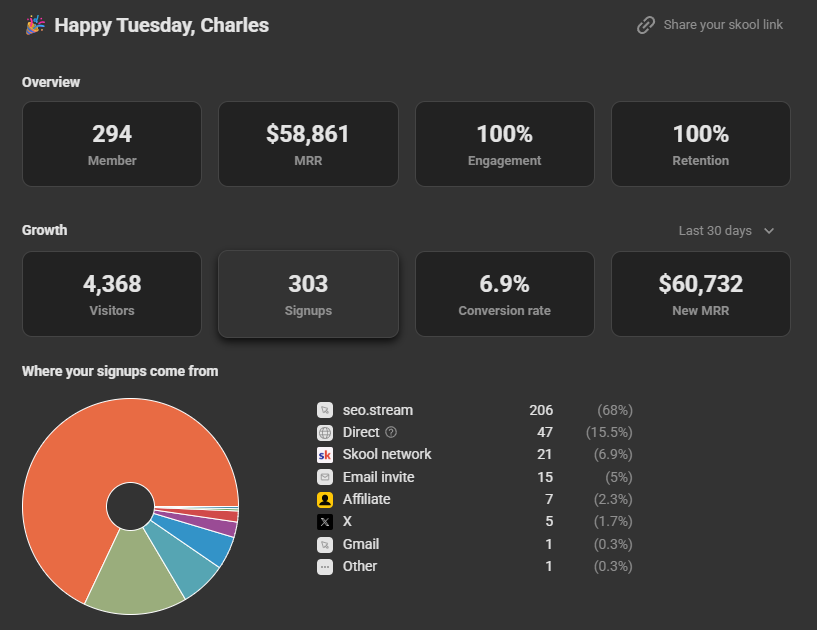
Did this Saturday. 109 visitors, 41 signups, 13 paid trials by Sunday. $0 spent.