ERICANABE is a Non-profit humanitarian Org. Founded in Toronto in 2016 by Humanitarian like minded people to support the people with vis/non-visi disabilities
New updates mean while...
Statement of the Chairperson of the African Union Commission on security developments in the Red Sea | African Union https://t.co/8Z2unnzyKr
@EthiopianNewsA ",,,pointing out that for much of its history the country was not landlocked."
With Due respect which #Ethiopia RUreferring prof.?Please don'tB misguided b/n Seeking LEGAL ACCESS 2z SEA&z ILLEGAL PROVOCATIVE THREAT2 UNDERMINE SOVEREIGNTY OF OTHERS eg.🇪🇷 @tewerwari_1@SirakBahlbi
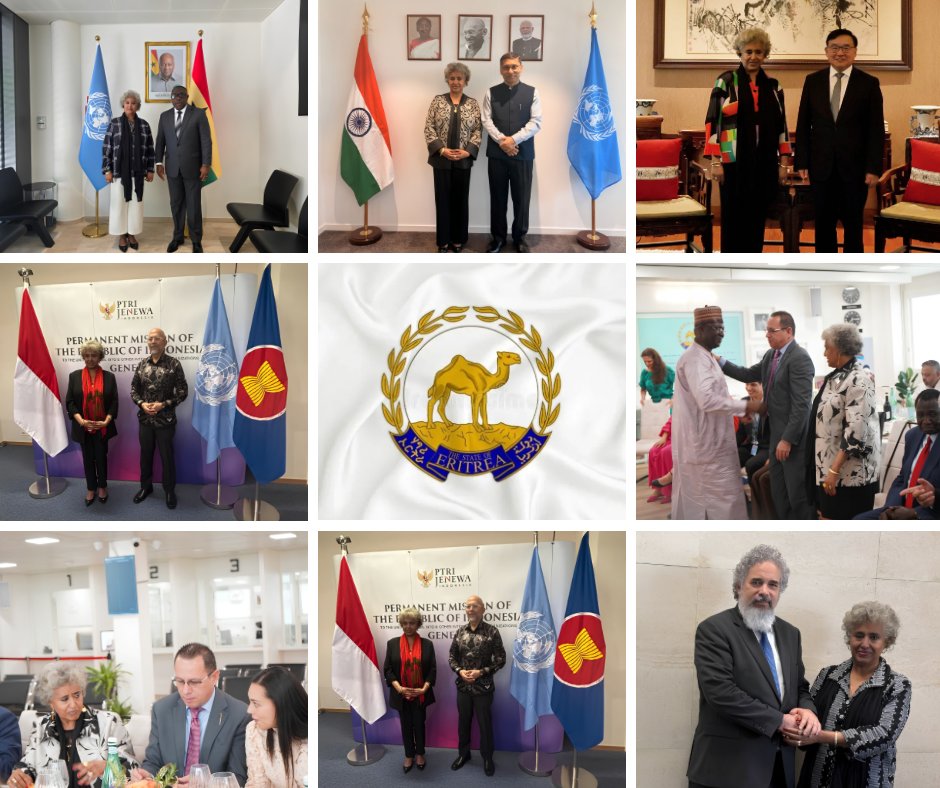
On the margins of the 62nd Session of the UNHRC, Eritrea's delegation has held a series of bilateral meetings with Permanent Representatives of several countries and also addressed the Africa Group.
The delegation further participated in the meeting of the Group of Friends in Defense of the Charter of the United Nations.
The critical issue is of course whether the penholders (essentially the EU under the prodding of some Member States) will again persist in their unwarranted campaign of harassment against Eritrea for the defunct geopolitical motives that we all know.
Equally important is whether other members of the Council will shed diplomatic inertia, and/or, discard narrow political horse-trading to reject the obsolete draft resolution without equivocation.
New Bureau of African Affairs Assistant Secretary Frank Garcia enjoyed meeting the African diplomatic corps. He thanked African chiefs of mission for the warm welcome and spoke about advancing our mutual interests in peace and prosperity to keep America safer, stronger, and more prosperous.
Rabbi shockingly brags about Israel’s kidnapping of hundreds of Yemenite babies.
He admits these babies were sold to US families and used for medical experiments. Israel also leveraged the babies during trade deals with the US for nuclear power agreements.
Today, the flag rises, but so do the cries of a nation that has forgotten how to heal, forgive each other and failed to compromise. Independence without justice, unity, and dignity is only a memory of draped in blue.
May the tears of Somalis succeed where the speeches of their leaders have failed.
🚨 This is the man who officiated Belgium vs Senegal today.
Saíd Martínez (Honduras)
He was in charge of the game where Senegal got robbed again — questionable decisions, soft penalties, and VAR that only worked in one direction.
African teams keep fighting on the pitch while these referees decide the outcome from the sidelines.
Name them. Shame them. This isn’t refereeing anymore. It’s robbery with a whistle.
When the Barcelona Grand Départ inspires a beautiful new look 🤩
Check out our stunning new @scottsports colorways that will feature on our Foil RC and Addict RC bikes at this year’s @LeTour 🩵 🧡
#WeAreNSN#ScottSports#NOSHORTCUTS
This is the speech that won us 63% of the vote at Denver county assembly, beating DeGette for the first time in 30 years.
A better world is within our reach, so let’s honor the organizers and dreamers that came before us and build it together.
Congratulations Melat.
@MelatKirosCO lost her job for speaking up against genocide in Gaza, but unseated AIPAC backed a 15-term incumbent Democrat in Colorado @RepDianaDeGette.
زار سعادة السفير علي إبراهيم أحمد، سفير دولة إرتريا لدى دولة قطر وعميد السلك الدبلوماسي اليوم سعادة عبدالله بن حمد العطية، وزير البلدية، في مكتبه.
وجرى خلال اللقاء بحث سبل تعزيز العلاقات الثنائية بين البلدين الشقيقين ومناقشة أوجه التعاون المشترك في المجالات ذات الاهتمام المتبادل.
Today we commemorate 1 July 1960—the historic day when the independent State of Somaliland and the Trust Territory of Somaliland united voluntarily to establish the Somali Republic. The light that shone in Mogadishu and Hargeisa reached every corner of the Somali nation, inspiring generations with the ideals of unity, freedom and dignity. That dream remains alive, and we remain committed to completing the unfinished struggle for the freedom and self-determination of all Somali people. Happy Union Day. 🇸🇴
#1July1960 #SomaliRepublic #UnionDay #SomaliUnity #SelfDetermination
Eritrea’s National Service: A “Convenient Target” for Political Harassment
Bana Negusse
In recent weeks and months, Eritrea’s National Service has once again become the subject of renewed scrutiny in certain quarters. Yet the timing, intensity, and selective nature of this attention raise fundamental questions about the motives driving the campaign. Far from reflecting a genuine concern for the welfare of the Eritrean people, the renewed focus is part of a broader – and increasingly well worn – pattern in which Eritrea’s policies and institutions are politicized and instrumentalized to justify external pressure, hostility, and unwarranted interference.
To begin, any serious discussion of Eritrea’s National Service must be grounded in the country’s historical experience in the immediate aftermath of independence and the security realities that shaped its early state-building choices. The National Service programme, which in statutory terms is limited to 18 months, was established pursuant to Proclamation No. 82/1995, building on legislative foundations laid shortly after independence. It was conceived not only as a military arrangement in Eritrea’s new security architecture in the new optimistic regional setting, but also as a comprehensive national programme designed to address interconnected challenges of security, development, nation-building, and social cohesion in a diverse, developing state emerging from three decades of armed struggle.
From the outset, Eritrea’s approach to National Service was shaped by a broader process of post-independence demobilization and defense restructuring. In fact, the first phase began in 1992, when the Government launched a large-scale demobilization programme that reduced the liberation army by approximately 65 percent. This reflected a strategic shift toward a smaller professional standing force of roughly 35,000 personnel, supported by a reserve component. Within this framework, National Service was introduced as an eighteen-month programme consisting of six months of military training and twelve months of service in critical sectors of national development.
At the time, and in a regional environment initially characterized by general optimism and relative cooperation, this structure was designed on the assumption that Eritrea’s security environment would remain stable and that national resources could be directed toward reconstruction and development rather than prolonged military preparedness. National Service thus functioned as a supplementary mechanism within a broader post-war transition from liberation force to conventional state institutions.
Sadly, this trajectory was disrupted by Ethiopia’s war of aggression, rooted in territorial aggrandizement, launched in May 1998, which necessitated the mobilization of National Service members and fundamentally altered the country’s security calculus. The assumptions underpinning the early post-independence framework were consequently overtaken by events.
In the aftermath of the Algiers Agreement, which formally ended the war, Eritrea initiated a second phase of demobilization in 2001, intended to consolidate peace and further reduce military obligations in line with the anticipated implementation of an internationally binding settlement. However, the subsequent failure by Ethiopia to fully implement the Eritrea–Ethiopia Boundary Commission (EEBC) ruling – which was cynically overlooked, if not quietly sanctioned by its Western backers – combined with continued regional tensions emanating from Ethiopia’s entrenched irredentist policy objectives, prevented the full realization of this process and contributed to the extension of National Service obligations beyond their original scope.
Notwithstanding the prolonged security environment and a range of associated challenges, the Government of Eritrea has continued to implement a range of measures aimed at managing and adapting National Service within prevailing conditions. The majority of National Service members have been deployed in civilian public-sector roles, while substantial administrative adjustments have been periodically introduced to improve the functioning of the programme within the broader constraints of the national context. In parallel, reforms in public sector management and remuneration have been undertaken over time as part of wider state-building and institutional development efforts.
Against this wider backdrop, this politically orchestrated smear campaign reflects a selective reading of history that detaches National Service from its governing context and ignores basic ground realities. Rather than engaging with the full record, it isolates the programme as a standalone issue, abstracted from the circumstances that produced and sustained its evolution. In doing so, it replaces historical and legal complexity with a simplified narrative that serves political framing rather than objective assessment.
To be sure, the renewed “interest” in the program does not arise from any genuine or benevolent concern for Eritrea or its people. It is instead increasingly advanced as part of a recurring pattern of external pressure in which Eritrea’s national policies and institutions are instrumentalized as a convenient point of political leverage. In this regard, it is quite telling that National Service, which has been central to Eritrea’s security, cohesion, and development, has frequently been singled out in external discourse as a target.
What also cannot be overlooked is how those who now position themselves as arbiters of concern were, at critical junctures in Eritrea’s modern history, either directly complicit in or indifferent to the erosion of its decolonization rights and the geopolitical decisions that led to huge, indeed bloody, consequences for Eritrea and its people. In the post-independence period, they also failed to meaningfully deter or address repeated violations of Eritrea’s sovereignty, including wars of aggression and persistent territorial disputes rooted in territorial irredentism.
Viewed in this light, the ongoing campaign of criticism amounts to a sustained pattern of politically motivated scrutiny, driven by an agenda that bears little relation to the welfare of Eritreans or regional stability. It reflects instead a continuation of longstanding approaches that have consistently sought to exert pressure on Eritrea through selective narratives and fragmented interpretations of its internal policies.
Ultimately, any credible discourse about Eritrea’s National Service must be firmly grounded in the country’s full historical and security context. Anything less exposes the exercise for what it truly is: a malicious ulterior agenda cynically packaged as principled concern, with little bearing on the welfare of Eritreans or the pursuit of genuine regional peace and stability
Beyond Diplomacy: South Africa Sees Eritrea as a Strategic Partner for Africa's Next Era of Growth
The conversation between Eritrea and South Africa is no longer limited to diplomatic goodwill it is increasingly focused on building real economic partnerships.
Asked about the most promising sectors for expanding cooperation, South Africa's Ambassador, Perseverance Mbuzeli, outlined a vision centered on investment, industrial growth, and knowledge sharing.
He identified mining as one of the strongest opportunities, noting Eritrea's significant mineral potential alongside South Africa's long experience in the mining industry. By combining Eritrea's natural resources with South African expertise, both countries stand to strengthen their economies through genuine partnership.
The Ambassador also highlighted energy as another strategic sector for future cooperation, emphasizing that sustainable development depends on reliable infrastructure and long-term investment.
Infrastructure itself was another major priority. From roads and railways to ports, he explained that South Africa has accumulated valuable experience that could support Eritrea's development ambitions. He pointed to port modernization and infrastructure expansion as areas where both nations can work together to unlock regional trade and economic integration.
His message was clear: this is not about dependency it is about Africans investing in Africans, sharing expertise, and building prosperity through cooperation based on mutual benefit.
When African nations combine their strengths instead of competing for aid, they create something far more valuable: a future built on shared capability, shared investment, and shared success.
#Eritrea 🇪🇷 #SouthAfrica 🇿🇦 #AfricanUnity #TradeNotAid #Mining #Infrastructure #EconomicDevelopment #AfricaRising #RegionalIntegration