🔥 After a fire is extinguished, the real danger may just be beginning.
I just dropped a new YouTube Short — "What's in your home after a fire?" — and it covers something that doesn't get nearly enough attention: what's actually left behind in a property after a fire, and whether anyone is making sure it's safe before families move back in.
Here's what we know:
⚠️ Lead, asbestos, heavy metals, VOCs, and SVOCs don't disappear when the flames go out. They can settle into walls, floors, dust, and air.
⚠️ There are no universal, health-based standards for testing residential properties after fire events. That means families, including children, can return to homes that have never been properly assessed.
⚠️ Children are especially vulnerable. Their developing systems are much more vulnerable to chemical exposures than adults, and contamination at levels considered "acceptable" for adults can cause lasting harm to kids.
This isn't a fringe issue. It affects wildfire survivors, structure fire victims, and entire communities. The evidence is clear even when the policy hasn't caught up.
The conversation is starting to change. Legislators, public health advocates, and communities are beginning to demand better — and they should.
Watch the short. Share it with someone who needs to hear it. And ask the question: who's protecting families when the smoke clears? and why aren't there health-based standards?
👇 Link in comments.
#FireSafety #PublicHealth #IndoorAirQuality #Asbestos #LeadExposure #WildfireRecovery #EnvironmentalHealth #HomeAfterFire
More info on fires, health, and safety: https://t.co/xFeU3Wahcu
@thsottiaux Hard to get open/local models working with Codex. For example, LM Studio errors on tools namespaces, and Bedrock has other tools issues. Would be nice to have a compat flags or more config to make this work. Keeps me on OpenCode when I want to move.
Still talking with households impacted by the wildfires.
Lead and asbestos inside homes from wildfires.
LA County explicitly warned everyone lead and asbestos would be released from wildfires.
So, one could say it is professional malpractice to not test for lead/ asbestos when investigating building indoor contamination post fire.
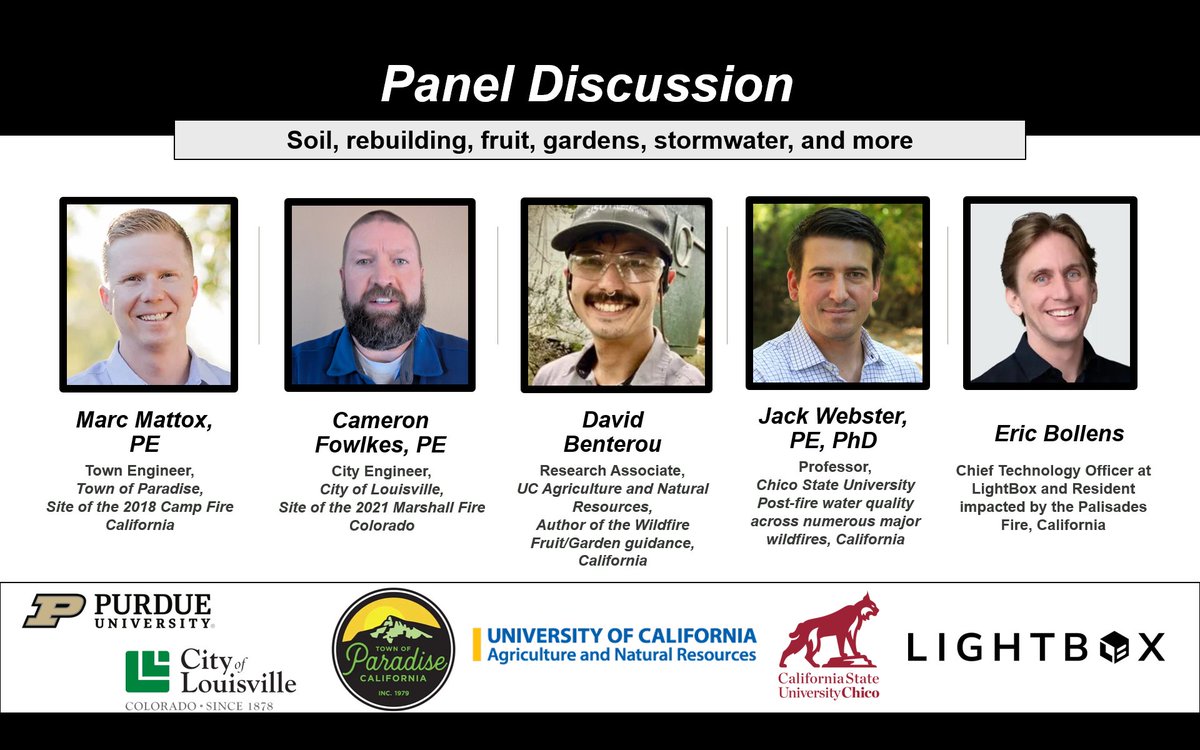
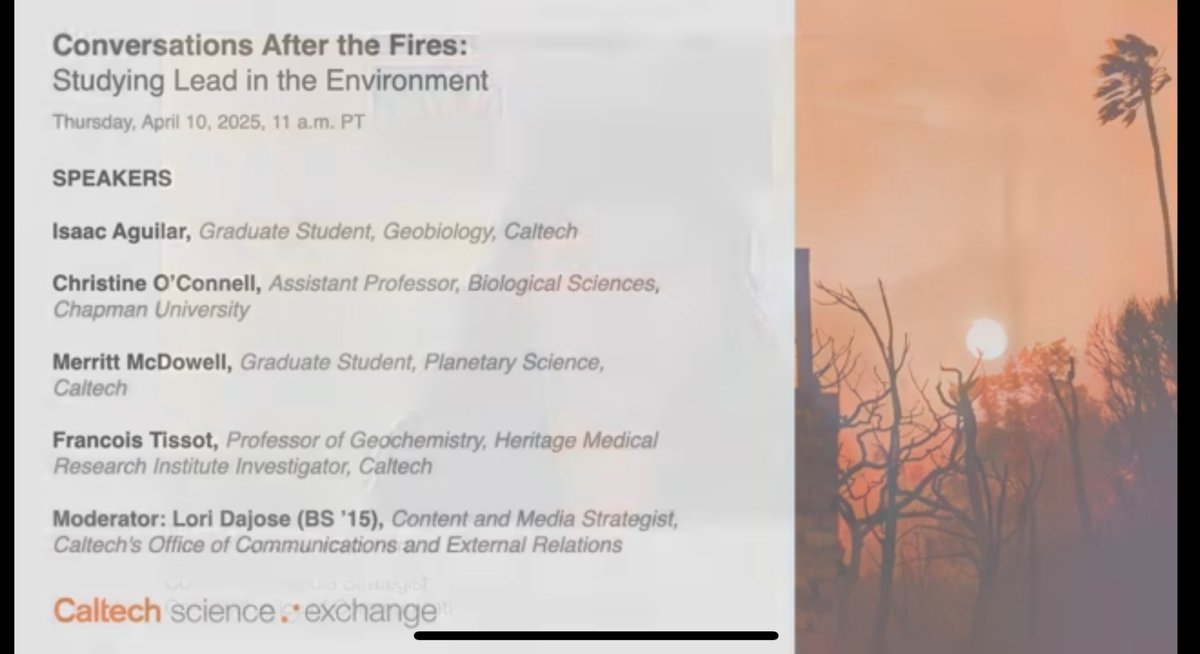
‼️‼️‼️Cannot wait for tomorrow's panel discussion about #wildfire recovery and rebuilding.
An amazing slate of experts from a variety of areas.
Sharing perspectives, experience, and resources for impacted households and businesses.
https://t.co/w5xfKCxwnj
🚨🚨Our new RED series guidance document is out!
After the #Wildfire: Building Environmental Testing
The document was developed based on our 2023 #EastPalestine chemical spill/fires disaster rapid response and ongoing work after the 2025 January wildfires in the #LosAngeles area.
👉🏻👉🏻Access here: https://t.co/cJYZvKzf0o
This is part of our #Resilience for Emergencies and Disasters (RED) series.
The document...
🟢helps establish a basic understanding of environmental #contamination sampling and testing for fire impacted buildings.
🟢was penned specifically to make knowledge accessible to property owners as well as local and state health officials and many often are challenged to find info on this topic.
🟢content includes information we have been asked by property owners who have experienced fire contaminated #buildings and knowledge we discovered while reviewing 100s of #home environmental testing reports.
🟢has value to inspection, testing and sampling companies as well as #insurance companies.
Having helped many property owners recover from a #fire and other #disasters, this information can empower their decisions and that of #publichealth officials.
Work funded by @NSF and @PurdueEngineers
It was great to help coach EFRU and PostFireLA community groups in advance of last nights #chromium webinar.
Overall it went well.
The researchers shared critical new details about their chromium in air study which were not shared in the prior marketing or preprint. This information helped put people at ease.
Professor Kleeman at UCDavis (lead study author) did an exemplary job with risk communication. All should be commended.
@resilientpali While important confirmatory results for a hazard we knew to expect, there are significant issues with the accompanying recommendations, as well as questions regarding methods and missing content in the pre-print. See our feedback for more details: https://t.co/4xbTyrXwMU
💡UPDATE: The new California Post-#wildfire Residential #Soil Sampling Guidance document encourages properties impacted by the #EatonFire and #PalisadesFire to be allowed to have 50x the (total) chromium level than the California Code of Regulations #hazardouswaste limit.
Allowed in new "residential" document= 125,000 ppm
California Code of Regulations for hazwaste= 2,500 ppm
In 2024 after the #MountainViewFire the neighboring county allowed a maximum of 36,000 ppm total chromium (It is unclear why it was greater than the #hazwaste limit, but this level is still ~3.5x lower than the State's NEW much higher recommendation).
Governor Gavin Newsom's Administration was notified Monday and this, along with other problems should be corrected.
No one or organization should be encouraging people to follow that document as it is written knowing what we know.
To help, Governor Newsom was provided a list of solutions: https://t.co/9FgXW4QRFK
"By not conducting soil testing, the federal government and state government have made the decision that leaving contaminated properties -- and not informing the homeowners about how much contamination remains -- is OK," said Andrew Whelton, a professor of civil, environmental and ecological engineering at Purdue University who has studied environmental disasters.
https://t.co/GMStqLw0AH
🔥 How Can #Engineers Learn/Apply Knowledge About the Recent #Wildfires in Los Angeles? 🔥
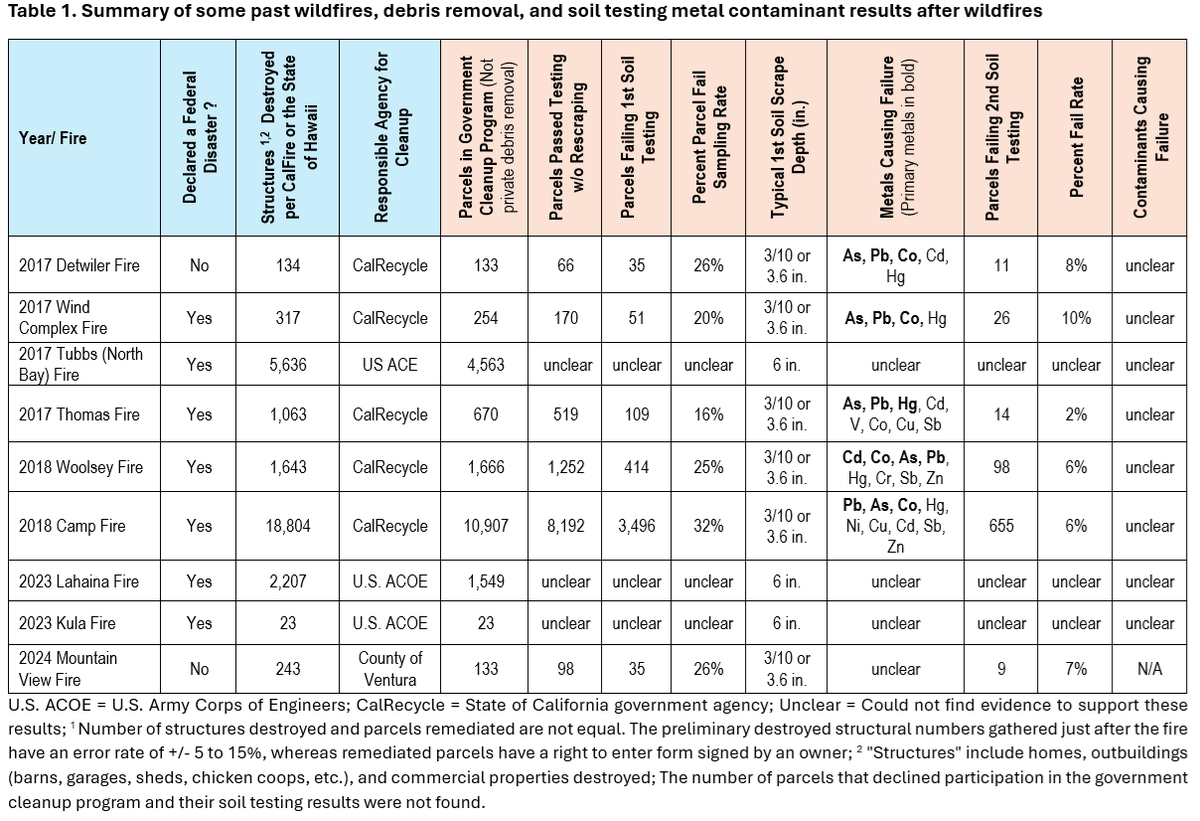
In light of the disaster debris cleanup after the #EatonFire and #PalisadesFire in California, a course problem was created. This problem is based on current events and also past test soil testing results from prior fires (see the Table below).
🚧 Problem Summary🚧The course problem (see next post) provides background information for the student about past fires, prompts them to review real environmental soil testing data that represent standing homes and properties where debris removal has been carried out in each fire zone, and asks them to estimate the number of properties that can be supported (and will not be supported) by #LACounty's recent decision to make $3,000,000 available for soil testing. Finally, based on all the information the students have, the students are asked to consider the ethics of their decisions when asked for advice from their client, families, and other members of the public.
(continued)
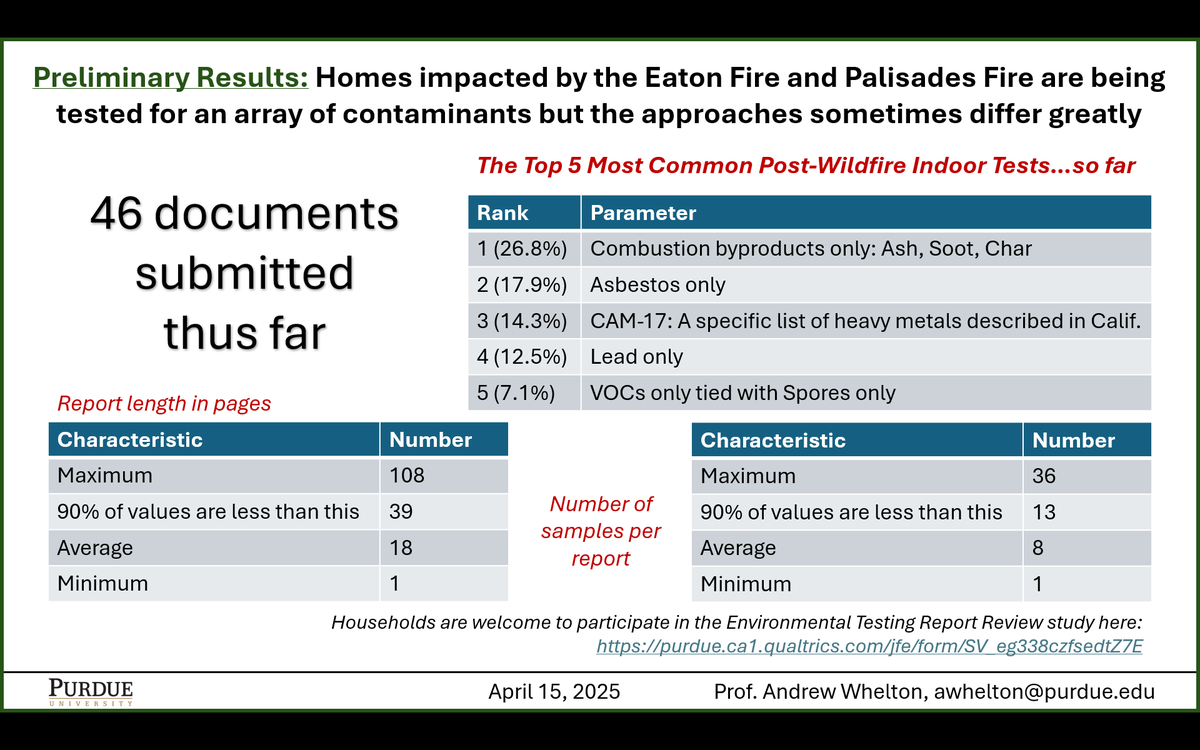
🚨Preliminary results🚨 from our Environmental Testing Report study in response to the 2025 #EatonFire and #PalisadesFire in California.
⭐️Big Takeaways Thus Far⭐️
Very different approaches to investigating and addressing indoor chemical contamination in standing homes are being applied.
🟢Some consultants just test for combustion byproducts, use their nose and eyes......others take samples for a variety of chemical samples analyzed by a commercial laboratory.
🟢Reports given to households range from 1 to 108 pages in length.
🟢The number of samples per home varies from 1 to 36.
🟢Some consultants recommend ALL soft goods (blankets, pillows, mattresses, etc.) be discarded - and if they are not, then the property owner must sign a waiver releasing the consultant of liability. Other consultants recommend cleaning soft goods, not throwing them away. There is no mention of a liability waiver.
🟠We plan to examine and compare the actual testing results across reports (=homes) to see what the ranges are being detected.
🟠Note for everyone, when you run a TO-15 test for VOCs in air, benzene isn't the only thing you should be looking for.
Impacted households are welcome to participate in the Environmental Testing Report Review study here: https://t.co/jzdpLzxGEU
@LeonardFiles this issue continues to rear its head. Wondering if you would be open to discussing it on your After The Flames podcast? Hundreds, if not thousands, being told to “clean” by insurance carriers. Important for #publichealth to get word out. DM me to discuss further.
Many residents told by CA FAIR Plan to “clean” fire contamination with vacuums and rags. Our lead results were 6,141 μg/ft^2 vs EPA target of 5 μg/ft^2. Toxic substances abatement requires equipment, training and protocols. DON’T DO THIS YOURSELF. #PalisadesFire#publichealth
Last night I had the opportunity to listen and hear questions and concerns from households in the Pacific Palisades and surrounding areas. This community was impacted by the 2025 #PalisadesFire.
Together, the guests shares updates about recovery progress and advice about environmental testing.
✅ Traci Park, Councilmember LA City
✅ Lindsey Horvath, LA County Board of Supervisors
✅ Panelists
➡️Tracy Quinn, President and CEO or Health the Bay and community member
➡️ Eric Bollen, @ericbollens community member and environmental data professional
➡️ Prof. Sanjay Mohanty at @UCLA w/ https://t.co/cuHNHtFbwI
➡️ Prof. Andrew Whelton at @LifeAtPurdue w/ https://t.co/cuHNHtFbwI
❤️❤️❤️Thanks to Lawrence Vein and Pali Strong™️!!
@AndrewHires@GavinNewsom In addition to 6,141 μg/ft^2 lead, we also found 2,293 μg/ft^2 arsenic, 2,711 μg/ft^2 chromium, and 27,000 μg/ft^2 barium. This is not "fire ash and debris" from a forest fire. This is contamination typically seen only in urban waste scenarios, and it's a brewing health crisis.
@hazhoosier@AndrewHires@GavinNewsom The science here is clear. Abatement needed, full stop. Not rags and vacuums.
You raise an important 2nd point. Those same contaminants outside, and no support to remediate non-dwelling spaces (even USACE is ash footprint only). Remediation is only as good as its weakest link.
Many residents told by CA FAIR Plan to “clean” fire contamination with vacuums and rags. Our lead results were 6,141 μg/ft^2 vs EPA target of 5 μg/ft^2. Toxic substances abatement requires equipment, training and protocols. DON’T DO THIS YOURSELF. #PalisadesFire#publichealth
For those of you new to the #wildfire drinking water contamination world, welcome.
Here's a study co-authored by State of California researchers in 2022 and published in the American Chemical Society's @EnvSciTech journal.
Weirdly, this study often isn't talked about in the drinking water sector by some groups.
It's a good study.
One of their major conclusions:
"The findings support hypotheses that wildfires can contaminate drinking water systems both by thermal damage to plastic pipes and intrusion of smoke"
https://t.co/PzPJpcgq0U
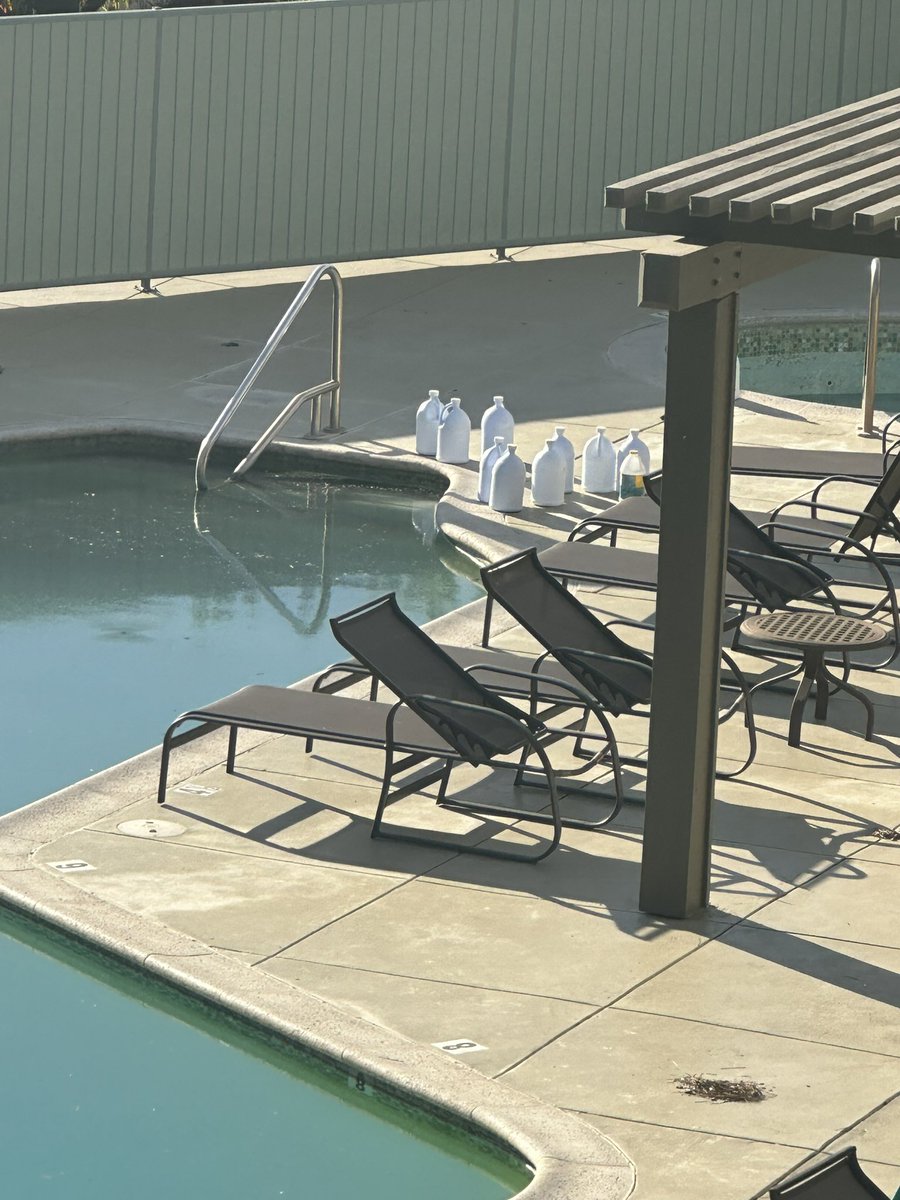
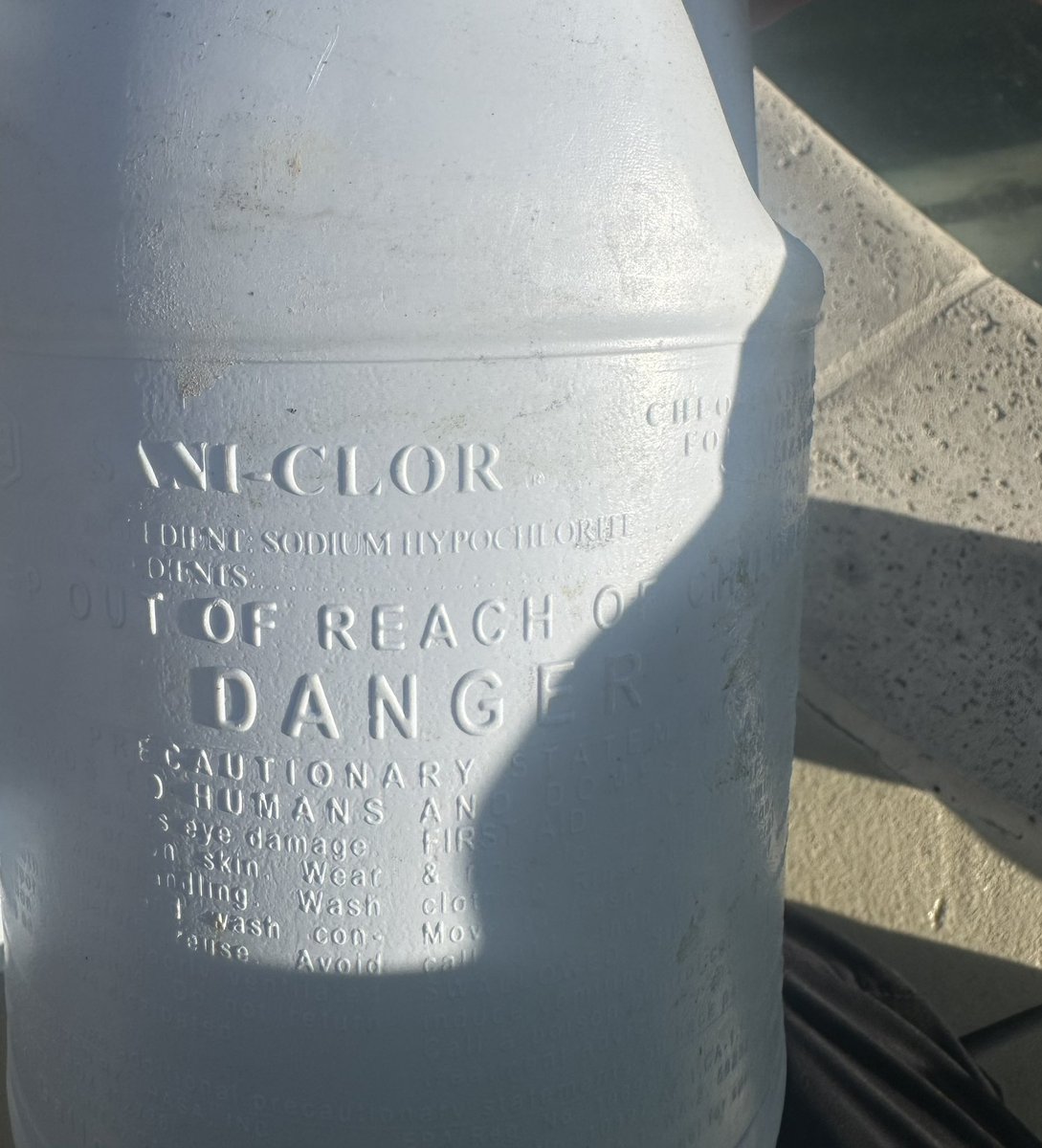
And here’s a picture of pool tech who said he was following @lapublichealth and @LACitySAN instructions. No testing, no organic vapors respirator, no eyewear. If VOCs suspect, either test to ensure workplace safety @OSHA_DOL or drain without any chemical treatment #palisadesfire
The study cannot come soon enough.
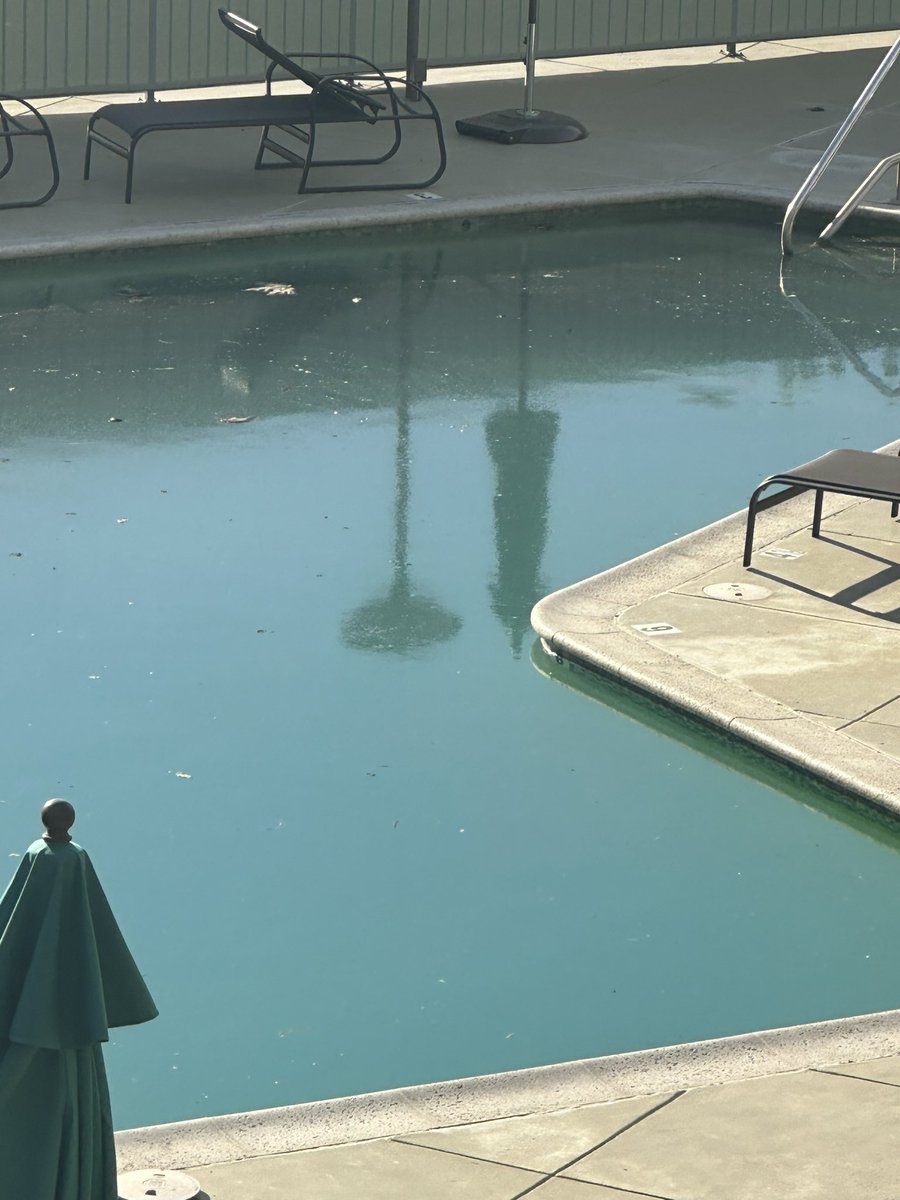
@lapublichealth if any doubt why metals and other contaminants are a concern after #palisadesfire , here’s a solar panel array that burned right above this pool. If its constituents are in that pool, you can’t fix with chlorine and a vacuum.
When there is no data all opinions go unchallenged. To err on public safety one should presume the water IS harmful and act accordingly.
A https://t.co/22F6ajb1rq pool study is coming soon.