agree, reminds me of @poteto's point regarding organic architecture here: https://t.co/NN9wh4ZmOI
of course that was intended to be coding-centric but the principles of setting up guardrails, planting seeds of how things should be done, and allowing for 'organic' growth apply in ~all domains
this is a nice system. But a few components here that I think will be especially hard, but exciting, to build well -
- curator agents that exhibit judgement around what data/examples are relevant and when to ask for input
- proper HITL
- designing human organizations around knowledge factories
- a good data strategy... (a tale as old as time)
all our agents at langchain (internal GTM & content agents, LangSmith Engine) have a learning loop with similar pieces
wrote about what we think makes up a "knowledge factory" https://t.co/xaAZb5i79q
The new /teamwork feature in Antigravity is making me feel like a true middle manager.
I assign a bunch of agents to a task, tell them it's time sensitive, and then make it impossible for them to get anything done because I'm constantly asking for status updates.
The team has been working hard to make our new models really excellent at legal tasks - can’t wait for folks to try it in @harvey soon
@douwekiela@shikibmehri@khermann_ 🚀🚀🚀
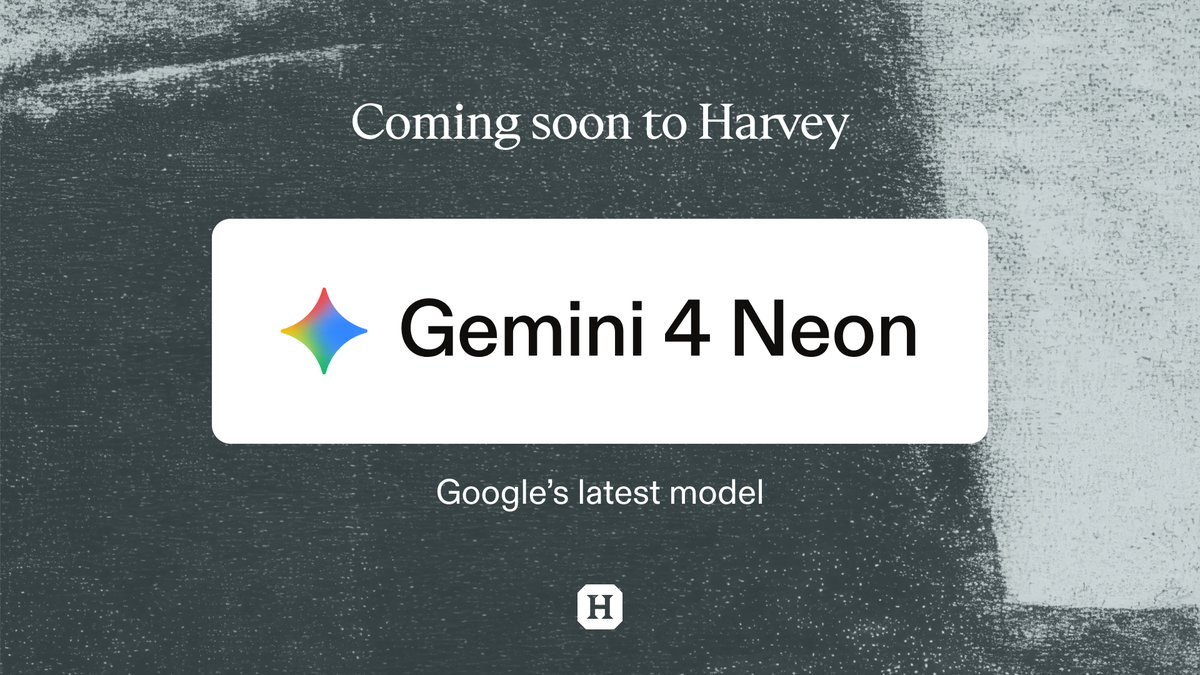
Coming soon to Harvey: Gemini 4 Neon, @Google's latest model.
In our early testing, Neon was especially strong on analysis and review work, with gains over Gemini 4 Hydrogen in bankruptcy and restructuring, insurance, and tax.
New on the Google desktop homepage globally: we’re rolling out a collapsible sidebar to easily find & jump back into your recent AI searches.
People are coming to Search with more questions that aren’t just one and done – and in testing, this sidebar made a big difference for making progress & continuing to explore the web.
A much simpler way to pick up where you left off.
Really great work by the Chrome security team here - Mirror Dimension was critical to our quality sprints for Gemini in Chrome and Gemini Tasks (flea Spark!)
Can’t wait to see how this further unlocks more progress in CUA
Testing browser agents like @googlechrome auto browse on the live web is tricky: sites change, side effects persist & testing prompt injection on live pages isn't safe!
So our team built a "Mirror Dimension": a hermetic, synthetic web to safely test agents! 🪞🤖
🧵
The team really worked hard to improve on the behaviors and capabilities that mattered for specific knowledge work verticals like finance!
Efficient, accurate, and with excellent judgement
1. Gemini leads on finance, while using ~68% fewer output tokens.
On DAYJOB: Finance, which evaluates 80 realistic financial assignments including credit memos, valuation models, covenant tests, and stress tests:
• Gemini 4 Neon: 50.5%
• GPT 6.2 Astra: 45.8%
• Claude Fable 5.2: 43.7%
Neon outperforms Fable by 6.8 percentage points while generating just 205K output tokens, compared with Fable's 644K.
That's approximately one-third the output tokens for a higher success rate.
Google DeepMind's Gemini 4 Neon debuts at #2 on the Vals Index (70.9%), 0.4 points behind Claude Fable 5.2 at less than half the cost per task.
It also takes #1 on our Finance and Legal Indexes, Tax Agent and Legal Research.
@ericbsaunders I love this take - would love to pick your brain about how you think this market will shape up over the coming years! Let me know if you're down for a quick call sometime
I used to have 50 PRs a week, now I have 1,900.
Three weeks ago, I built an AI bot called SuperJenny that works with ~20 AI teammates.
They ship Monster Walk every week: builds, QA, store reviews, release notes, analytics. I 6x'd my mobile game studio's revenue by automating myself.
Today I'm sharing my exact setup, free: SuperJennyStack 👇
At all times, I have my team working on:
🧭 SuperJenny: delegates and compiles asks under her - also trained with my personality and quirks
📋 SuperPM: ranked daily fix list from metrics + reviews + trends
🚀 SuperRelease: weekly build, Friday ready to submit new version
🧪 SuperQA: real-device tests with video proof
💬 SuperSupport: drafts every store review reply for my OK and helps players out when I sleep
I check in 4x a day from my phone and chat with SuperJenny about what I like and what I want to see next. The rest is handled in the cloud.
Super honored to say it's in the Template Library today if you try @cognition 's devin bot. I'd love to see what you create with SuperJennyStack!! If you share something you've done with SuperJennyStack, I'll RT the ones I see and like :D
Knowing things → doing things → finding ways to save you time and money
We’re expanding Tasks in Gemini free of charge to hundreds of millions of people in six countries. Powered by Gemini 4 Hydrogen, Tasks lets you hand off everyday life admin directly:
- Forward emails to [email protected] to RSVP and add it to your family calendar
- Have Gemini call local businesses to compare price quotes and check inventory (with full transcripts + approval before dialing)
- Check out securely via Google Pay (uses the Agent Payments Protocol - AP2)
- Seamlessly sign in via Google Password Manager
We wanted to make this helpful + secure, we’re also partnering directly with major websites and security providers so it works well for site owners and agents.
Introducing our latest research: Environment Optimization (EnvOpt).
An agent's cost and performance depend on
1. The model 2. The harness and 3. The environment structure. There is a lot of work on optimizing 1 and 2, but here we study how the environment presents information to the agent, and how that affects performance and cost.
For example, a company's Slack workspace, documents, databases and code repos can be given to an agent in different ways: Slack can sit behind a remote server, accessible via MCP or exported in plain text files that can be read and searched with grep. This choice alone can significantly affect how much work the agent needs to perform to solve a task.
Environment optimization is only meaningful in what we call stationary environments: These are environments with large collections of artifacts that remain the same across many tasks. We propose optimizing stationary environments as a third axis for improving LLM agents, alongside model training and harness optimization. This optimization can be amortized over multiple tasks and can be combined with harness and model optimization techniques.
Across five benchmarks covering workspace tasks, data engineering and software engineering, ENVOPT reduces the cost of the target agent on unseen test sets by an average of 48%, with higher or similar pass rates. On AutomationBench, ENVOPT outperforms
Meta-Harness by 9.67% with only 15% of its cost.
We also show that ENVOPT constitutes an optimization direction orthogonal to harness optimization and parameter tuning in two ways:
(1) the environments optimized for the target agents can transfer to other agents, even with different
harnesses and models (2) we combined ENVOPT with Meta-Harness, showing similar cost reductions and 16% improvement in pass rate, outperforming either Meta-Harness or ENVOPT alone.
Read more in our blog: https://t.co/xMXzoBY2Dj
paper: https://t.co/yPYxufbZVi