Thomas Massie just fired back at Mike Johnson for accusing him of exposing the Epstein files for “attention.”
“Did it get attention?”
“Damn right.”
“It got the attention of the billionaires.”
“It got the attention of royalty in Europe.”
“It got $32 million spent against me.”
“I won’t be coming back.”
“That’s why … I’m working as hard as I can until the end.”
“What attention did it draw?”
“Two dozen CEOs resigned in the face of these files.”
“The President of Harvard resigned.”
“Prince Andrew, well, we can’t call him that anymore.”
“We saw him lose his titles, his castles, and all of his special privileges.”
“We saw the British Ambassador to the United States … lose his job.”
“We saw the former Prime Minister of Norway indicted.”
“We saw the former Minister of Culture in France receive the same fate.”
“It wasn’t to get attention for me.”
“We got attention for the survivors.”
“They’d never been given an opportunity to speak together at the Capitol.”
“And we had the biggest press conference in the 14 years that I’ve been here.”
“Were we seeking attention for ourselves?”
“Hell no.”
“We were trying to get attention to the travesty of justice that those women had been dealt for decades.”
“It hasn’t drawn the attention of our own Attorney General, though.”
“No prosecutions.”
@RepThomasMassie
These are both dumb takes.
Anthropic isn’t the only one going to public markets. Google issued new shares to fund its AI ambitions. The reason both are giving access to public investors is that they need a mountain of money and the only way to get it is via public investors.
Tyler Cowen thinks that if Anthropic leadership believed transformative AI was imminent, they wouldn’t IPO and give away part of the super valuable company they own.
I think that’s a naive take. While Anthropic is a private company, the trillion-plus dollars that is Anthropic is extremely vulnerable because it mostly belongs to a relatively small number of unlikable nerds in the Bay Area. If the federal government woke up and started taking the past statements of Anthropic leadership seriously, they could just immediately bring the hammer down and do very hardcore Situational Awareness type stuff, and the economic damage would be pretty contained.
Once Anthropic IPOs, damaging Anthropic means damaging a much broader-based coalition of ordinary American rich people, and suddenly there are a bunch of powerful stakeholders with a vested interest in preventing Anthropic from getting nationalized or otherwise wrecked.
I think that the IPO is exactly what you would expect from a company that plans to roll the dice soon and wants to make it as difficult as possible for anyone to stop them.
Are state insurance regulators up to the job of keeping an eye on Wall Street's aggressive push into the industry? Some are starting to say, no. https://t.co/s3aKW9PuuF
Exclusive: “What Should the Leader Say?”: Hakeem Jeffries Staffer Built an AI Program for Surveillance and Advice
The custom program dubbed “Caucus Pulse” was designed to monitor factions of the Democratic caucus and suggest messaging for Jeffries using AI.
The program paid X to download tens of thousands of tweets posted by lawmakers using lists made by an anonymous account linked to Jeffries’ team: @Baseball_Fan_56.
Story: https://t.co/xYtEXzoU52
Note to editors: You don’t actually have to publish untrue things just because anonymous government officials say them. We can use our common sense. Do you really think Iran is planning a yellow cake attack or whatever? This is deeply embarrassing to the entire profession.
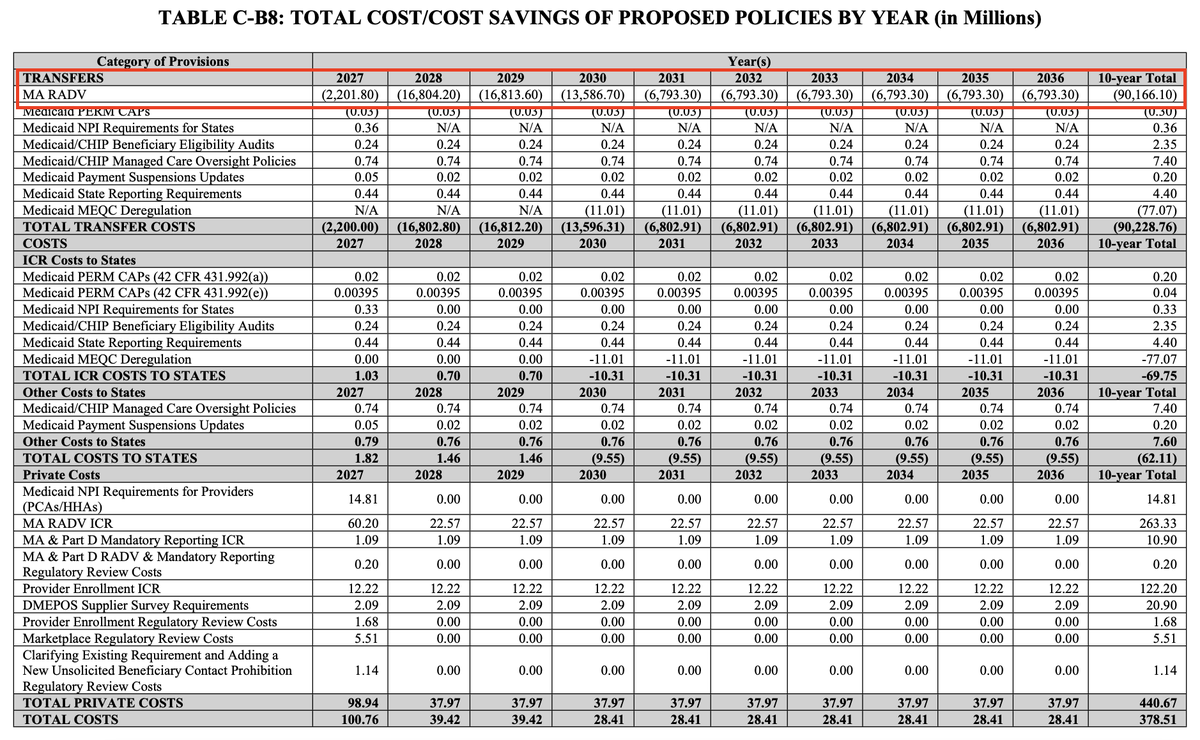
Interesting use of the word "fraudsters." Literally all $90 billion of savings from this rule would come from more aggressive audits of Medicare Advantage plans. https://t.co/E3VMgc9ESa
“Nvidia’s board basically looks like it was fine and perhaps appropriately unremarkable for a well-regarded $40bn company mainly known for creating high-end graphics cards for computer gamers — Nvidia a decade ago — but hilariously underpowered and somnolent for a nearly $6tn company that is powering the global economy and driving humankind towards the singularity.” https://t.co/fwoYPUfvfP
NVIDIA does not have mandatory return-to-office nor free food. Yet the parking lots fill up by 9:30am. Thats the work culture that @JensenHuang built up brick by brick. Jensen called us employees “volunteers”, because we chose to work at NVIDIA from just the pure love for the work.
This entire administration is a parade of dipshits.
We got beef tallow and measles. We focused on testosterone and weirdos and beardos. They got us stuck in a war, wrecked the economy. And now they can’t get planes in the air.
Morons of the highest order.
I never read sapiens, and I just assumed the author was smart cause the book had a big influence.
Then I listened to an hour interview with him talk about AI with the Economist and I realized he’s one of the dumbest people on the planet.
Yuval Noah Harari thinks smaller countries are about 10 years from becoming AI vassal states.
His example is the Czech Republic, with hospitals, airports and the military running on AI that "can be shut with a button from Washington."
He says the country can't afford its own, so the choices are the US, China, or a much tighter Europe:
I actually think AI is incredibly useful and transformative tool.
my concern is that tech companies are extractive and are implementing it in harmful ways. my other concern is that the government rolling it out in the public sphere is incompetent.
https://t.co/5S5wR4anND
My favorite thing about building research tools like https://t.co/svAYhwbirs is when someone else does something great with them. Glad I could help Coffeezilla with this one; it’s a really clear explanation of how Trump is getting rich off the presidency.
this is so dumb and @jaxoncoder is a charlatan.
the goal of these systems is iterative price testing to determine the highest a retailer can price, without cratering demand.
This is from a patent for a major system.
THEY LITERALLY FILTER OUT WEATHER EVENTS FROM THE DATA.
How the surge algorithm works and why it targets your work schedule.
Grocery stores operate on razor-thin net margins of roughly 1.7 to 2.5 percent. For years, executives have searched for a way to extract higher margins without scaring away customers with permanently high sticker prices. Dynamic pricing solves their problem by taxing urgency instead of raising the baseline price.
When an algorithm controls the shelf, prices respond to real-time demand triggers. Local weather APIs feed directly into the store server, allowing the system to nudge up the price of ice, sports drinks, and charcoal on a hot Friday afternoon, or raise the price of rock salt, batteries, and canned soup the moment a winter storm warning hits your zip code.
Even worse is the commuter penalty. Working parents almost always shop between 4:30 PM and 6:30 PM on weekdays or on Sunday afternoons. A retired shopper who buys groceries at 9:30 AM on a Tuesday sees the baseline price, while a working parent buying the exact same loaf of bread at 5:30 PM pays a rush-hour markup.