An excellent analysis by @FourPillarsFP@xparadigms on the accelerating adoption of JPYC, and the work done by @noritaka_okabe and the @jpyc_official team.
The transition from absolute issuance to functional onchain capital is the true indicator of product-market fit for regulated stablecoins in Japan.
As the regulatory landscape evolves to support settlement hubs and machine-to-machine payments, robust underlying infrastructure becomes critical. We are seeing this institutional and retail demand materialize directly onchain.
Kaia is currently the second-largest network for JPYC with over 250M+ in circulating supply, and the trajectory toward 300M is rapidly accelerating. Through our integration with @unifi_x, we are capturing a significant share of this growth to support the next phase of programmable money in Asia.
The foundation for Japan's onchain economy is being built right now.
Stablecoins flow smoother on @KaiaChain.
Fiat on-ramps are a temporary patch, not a permanent financial foundation.
Kaia CSO and @RatioFX Founder @Iam_JohnCho joined @AleaResearch's @stefanosanabria to detail how enterprise stablecoin adoption will soon eliminate traditional PSPs and reshape the onchain economy.
Is the $30B RWA market fundamentally broken?
Right now, only 9% of RWAs are actually being put to work onchain.
@Xangle_official explains how @KaiaChain and KIP are fixing this massive inefficiency by targeting the high-yield Asian private credit market with Yield8.
Kicking off our Kaia Technical Roadmap Deep Dive series with Part 1: Permissionless Kaia.
"Permissionless" doesn't mean what it used to. As institutional capital moves onchain, major chains are taking different approaches to validator participation, governance, and tokenomics.
Some restrict entry for accountability. Others stay open to preserve public-infra credibility.
Our take: public financial infrastructure must be permissionless. But permissionless can't become another word for irresponsibility.
So here's our approach: Accountable Permissionlessness.
It means:
- Open participation.
- Separate roles.
- Measure performance through the system.
Institutional-grade doesn't mean closing the validator set. It requires opening more precisely.
Full deep dive ↓
Open participation. Institutional accountability.
Public infrastructure shouldn't mean closing the doors to scale. This is why we are building Accountable Permissionlessness.
Dive into Part 1 of the Kaia Technical Roadmap below. 👇
This week of events in Seoul made one thing clear:
The Korean market is done with theoretical discussions about stablecoins. The temperature has shifted from policy debates to technical execution.
Our thesis at @KaiaChain is that maintain financial sovereignty, Korea needs its own onchain financial infrastructure, as relying entirely on foreign-issued assets is not a viable long-term strategy.
To close out this narrative, Chairman @seo_sangmin delivered his final keynote of the week today to a packed audience at the @CIS_2060 Retail Festival. He walked through the practical steps Kaia is taking to deploy a secure KRW stablecoin, detailing everything from the underlying smart contract architecture to real-world retail integration via @unifi_x.
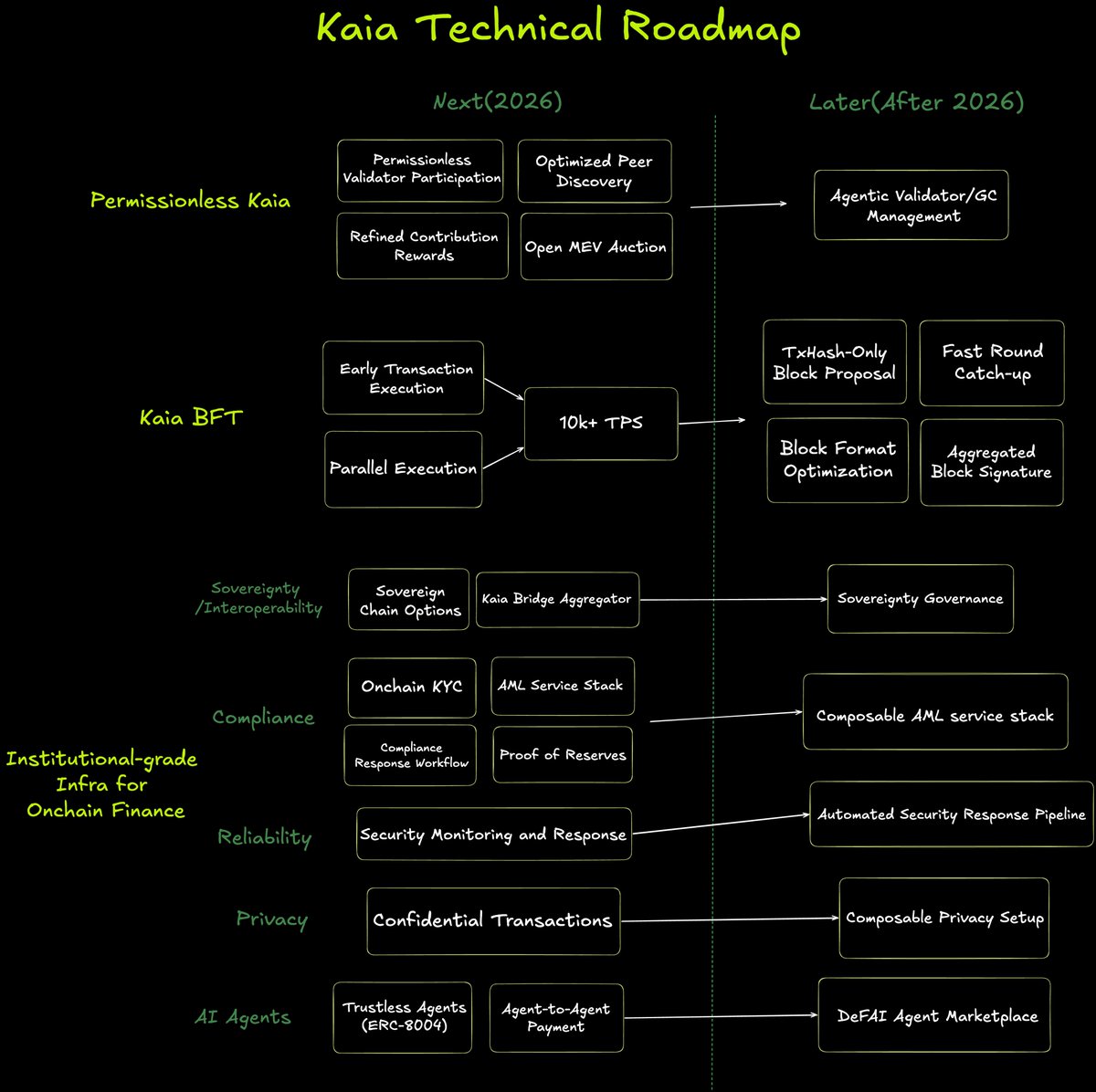
We're publishing the Kaia Technical Roadmap today.
Every upgrade and partnership ahead of us is building toward this picture. Onchain finance. Stablecoin orchestration. The infrastructure layer where institutional capital settles, not just experiments.
Why now?
Regulation is catching up, stablecoins have crossed from crypto-native experiment into mainstream payment flows, and institutions stopped asking whether to touch this. They're asking how. That's what Kaia is building toward, and pushing forward.
The roadmap is a direction, not a final blueprint. It will shift as research lands and as the community pushes back. We're putting it in the open so builders can see where the road goes and help us refine it.
The roadmap is built on three pillars:
1. Permissionless Kaia: Open up participation, tokenomics, and governance of the Kaia ecosystem so it stays fair, sustainable and accessible as it grows.
2. KaiaBFT: A performance and reliability upgrade of the network, designed to move stablecoins and tokenized assets at scale with settlement institutions can plan around.
3. Institutional-grade Infrastructure for Onchain Finance: The technical foundation that onchain financial services actually need when building on Kaia with real choices on sovereignty, compliance, privacy, and agentic optimization.
All three point to the same goal: making Kaia the base infrastructure for onchain finance.
Over the coming weeks, we'll deep-dive into each pillar. Each article will cover not just what we're building, but how the industry approaches these challenges today and the reasoning behind Kaia's approach.
Follow along. Build on Kaia.
The evolution of onchain trading has arrived.
Join us for an X Space with @grvt_io, @AlphaSec_Trade and @coinboy717 to discuss the shift to CLOBs, AI-driven trading, and Kaia’s role as Asia's liquidity engine.
📅 April 9, 2026 | 9 PM KST
📍 Live on @coinboy717 [KR]
1/3
The KRW stablecoin conversation is shifting from theory to execution.
As the industry navigates regulatory frameworks, Kaia is actively defining the technical architecture required for implementation.
Read the full KRW stablecoin blueprint from @tiger_research below.
Secure your assets. Maximize your yield.
@KaiaChain is teaming up with @DCENTwallets to make moving your stablecoins onchain faster, cheaper, and more rewarding than ever.
We've got 4 ways for you to win while making the switch to Kaia.
Here's how: ⤵️
1/7
[Reminder] Kaia v2.2.2 Hardfork is coming on Apr 7.
The bytecode at address(0) will be removed. After the upgrade, address(0) will behave as a regular EOA.
What changes:
• Calls to address(0) → succeed (currently reverts)
• isContract(address(0)) → false
• KAIA transfers to address(0) → succeed
Most apps won't be affected, but if your contracts depend on the previous behavior of address(0), review and update before the hardfork.
Full details & migration guide below:
[Reminder] Kaia v2.2.2 Hardfork is coming on Apr 7.
The bytecode at address(0) will be removed. After the upgrade, address(0) will behave as a regular EOA.
What changes:
• Calls to address(0) → succeed (currently reverts)
• isContract(address(0)) → false
• KAIA transfers to address(0) → succeed
Most apps won't be affected, but if your contracts depend on the previous behavior of address(0), review and update before the hardfork.
Full details & migration guide below:
We’ve teamed up with @grvt_io to bring fast, low-cost USDT deposits to perps.
Make Kaia your primary deposit network, drive your trading volume, and tap into a $15,000 USDT reward pool + exclusive Ambassador perks.
Here’s how to win:👇
1/7
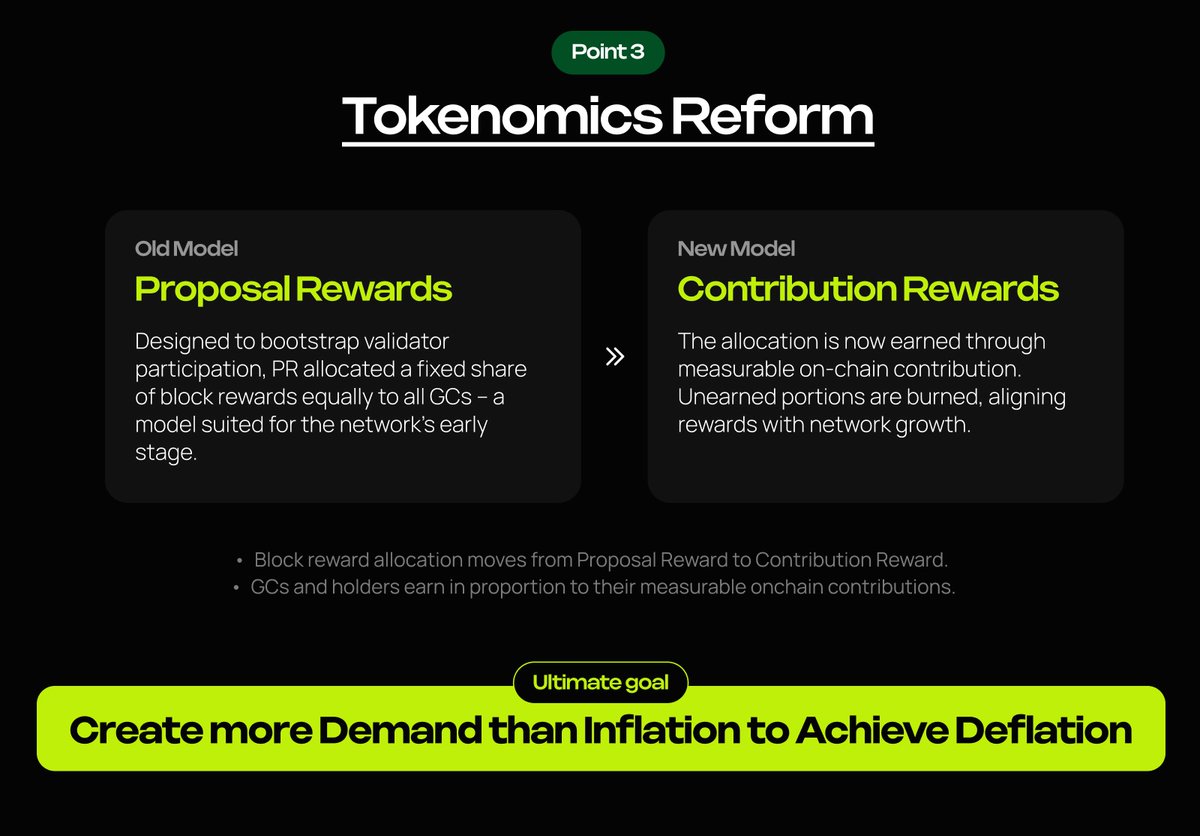
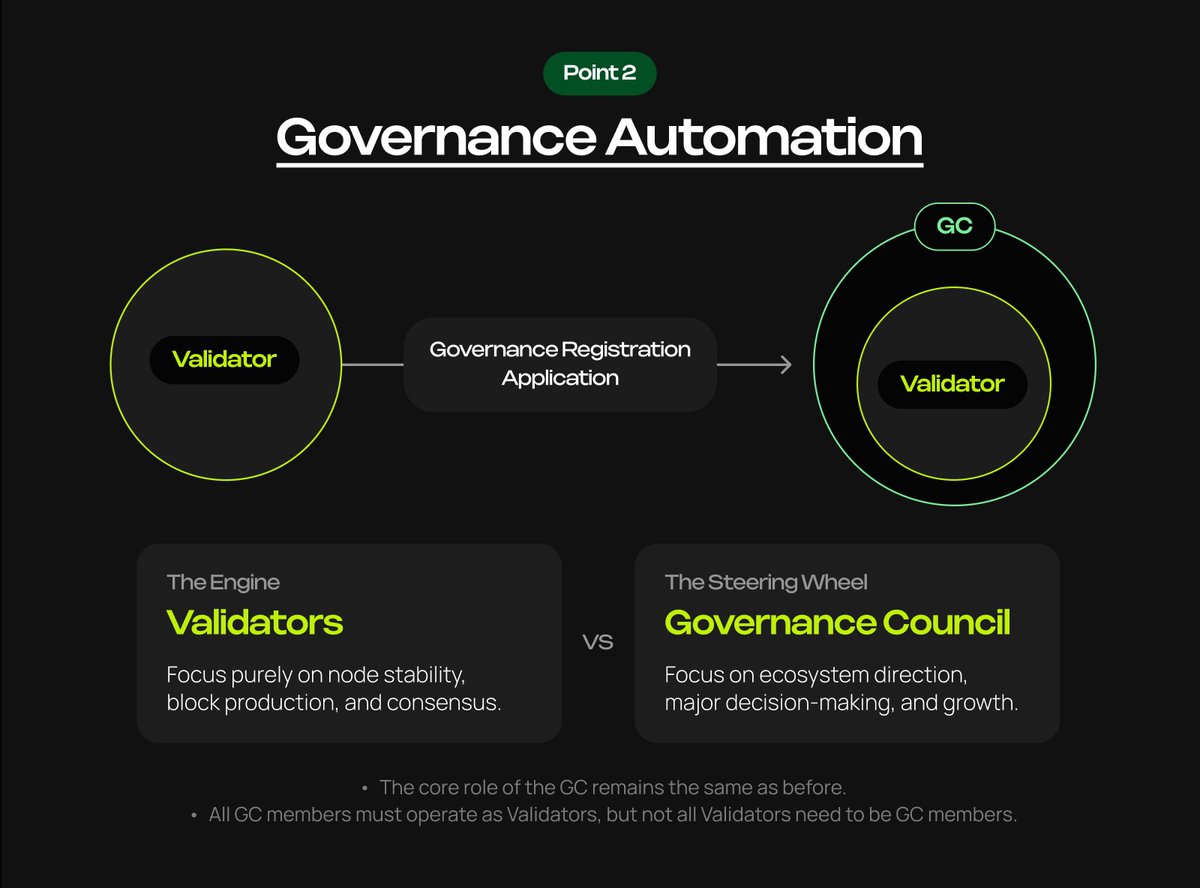
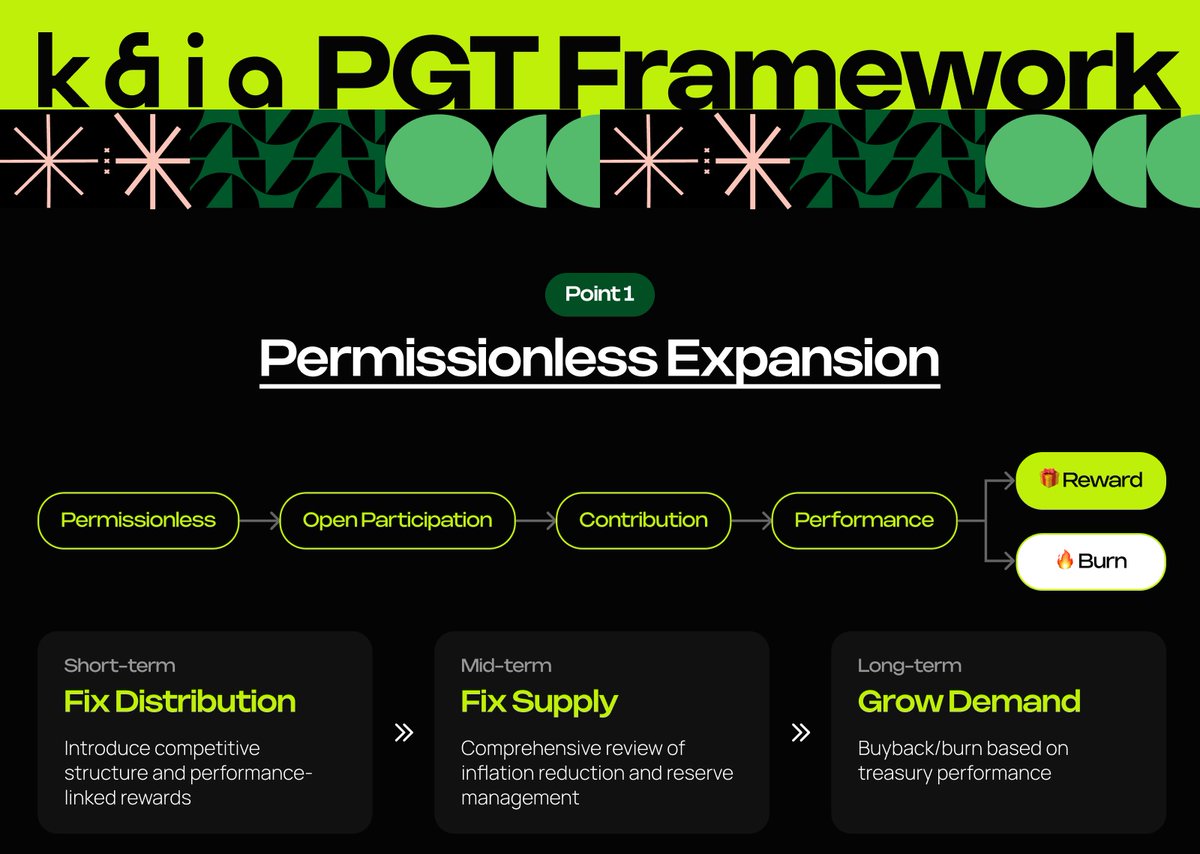
5 hours until we open our tokenomics AMA for all to join.
Review the PGT infographic for a quick primer, join the space, and make sure your voice is heard before the upcoming vote.
Further details in the thread below ⤵️
The Kaia NEXT Builders Program has officially wrapped up.
We selected winning teams from two hackathons in 2025, Korea Stablecoin Hackathon and Kaia Wave Stablecoin Summer Hackathon. And we supported them through the Kaia NEXT Builders Program to help them grow into full-fledged projects in the Kaia ecosystem.
Last week, 5 teams presented at Final Demo Day:
The future of the Kaia ecosystem is being built right now.
Dive into the thread below to meet the 5 teams who presented at Demo Day and successfully completed the Kaia NEXT Builders Program. ⤵️










![KaiaChain's tweet photo. The evolution of onchain trading has arrived.
Join us for an X Space with @grvt_io, @AlphaSec_Trade and @coinboy717 to discuss the shift to CLOBs, AI-driven trading, and Kaia’s role as Asia's liquidity engine.
📅 April 9, 2026 | 9 PM KST
📍 Live on @coinboy717 [KR]
1/3 https://t.co/8bPLBSqUGq](https://pbs.twimg.com/media/HE9YGC9aoAAz5h8.jpg)