@albinowax@voorivex@gregxsunday 4️⃣ $1000 Bounty: Scaling a self-redirect to XSS in a Web 3.0 system
@erickfernandox documents how they turned a low-impact self-redirect into a full XSS by chaining it with a Web 3.0 platform's authentication flow, landing a $1,000 bounty.
https://t.co/7aaXv97wB7
We just dove into our shelf of archived bug bounty write-ups from the most notable hackers! 🤠
In this issue, we selected 5 compelling articles (that are still relevant today) to share with you, from which you can learn something new! 😎
🧵 👇
My first vulnerability capable of compromising accounts on a social network.
Yay, I was awarded a $15,000 bounty on @Hacker0x01! https://t.co/5mQ3hnJARF #TogetherWeHitHarder
🚨 WARNING: A 0day vulnerability in Adobe Acrobat Reader is being actively exploited in the wild for 4 months now.
Simply opening a malicious PDF can lead to data theft and potentially full system compromise.
Adobe has not released a patch for this vulnerability.
@cyberx00t Next, I generated a token using the OAuth code, and the generated token was an Amazon Cognito JWT. Using any regular user's Amazon Cognito token, I could access resources in any company system that user had access to.
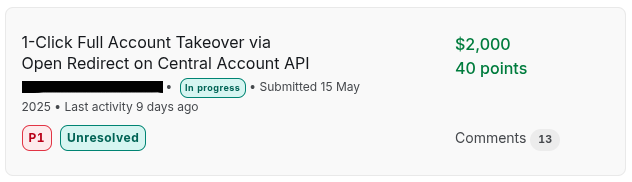
A simple open redirect can wreak havoc.
Simple open redirect -> misconfigured OAuth authentication flow -> privilege abuse using Amazon Cognito token
#bugbounty#bugcrowd