Disappointed to see $LULU tap former $NKE executive Heidi O’Neill as its next CEO.
Given Nike’s incredibly weak performance and loss of momentum lately, bringing their leadership over to Lululemon feels like a massive misstep.
As I outlined in my report last fall, Lululemon is an "undervalued champion poised to outperform"—but unlocking that value requires forward-thinking leadership, not borrowing from a struggling competitor's playbook. Let's hope this doesn't derail their potential.
Currently long $LULU but this merits a review.
Read my full thesis from last fall here: https://t.co/LRMLIYEXKJ
WSJ:
Incredible market verdict:
(1) Tim Cook announces he is transitioning out as $AAPL CEO → market largely absorbs it.
(2) $LULU announces former $NKE executive Heidi O’Neill as CEO → stock down ~12% (over $2B of value destruction).
That is an extraordinary indictment of the board’s choice.
Lululemon needed a credible turnaround operator with brand, product, and culture urgency — not a leadership import from a competitor whose own brand momentum deteriorated sharply.
Still long $LULU, but this appointment materially weakens the thesis unless the strategy reset is far stronger than the résumé signal.
Disappointed to see $LULU tap former $NKE executive Heidi O’Neill as its next CEO.
Given Nike’s incredibly weak performance and loss of momentum lately, bringing their leadership over to Lululemon feels like a massive misstep.
As I outlined in my report last fall, Lululemon is an "undervalued champion poised to outperform"—but unlocking that value requires forward-thinking leadership, not borrowing from a struggling competitor's playbook. Let's hope this doesn't derail their potential.
Currently long $LULU but this merits a review.
Read my full thesis from last fall here: https://t.co/LRMLIYEXKJ
WSJ:
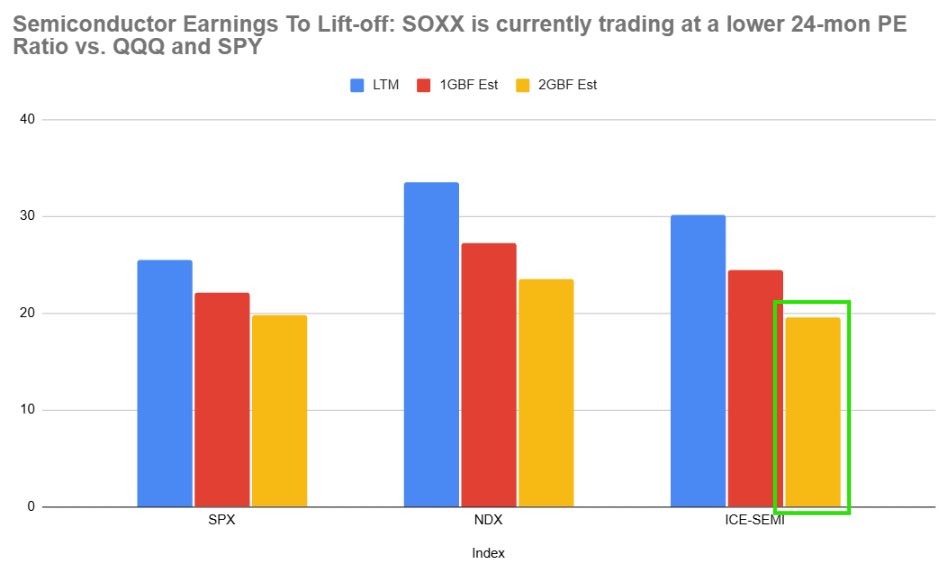
Re-up: $SOXX just made a new intraday ATH. Meanwhile, $QQQ and $SPY are still ~5% and ~3% below their highs.
Semis remain the cheapest liquid AI proxy. Market is starting to price it, but still room for semis to run
Green box on chart: semis are the cheapest “AI proxy” available.
On 2Y forward, $SOXX / ICE Semi is ~high-teens P/E — below $SPY and way below $QQQ.
Given the massive CAPEX hikes we just got from the hyperscalers, you can expected consensus earnings to go up. There’s likely room for further multiple expansion across SOXX.
Reposting this since now the @WSJ reports $JPM “decided to wait to sell around $5 billion in debt for #Qualtrics” as investors requested “reams of statistics proving that customers aren’t going anywhere.”
Ironically, a company built on surveys and data products may have hit a delay because it still needed to assemble the data for investors.
See my old post RE why Qualtrics could be a case study in PE-owned SaaS meeting AI disruption. My point then was simple: Qualtrics is an “easy-ish” business to vibe-code a similar product.
Reposting this from Silver Lake ��
$XM (Qualtrics) going private in 2023 increasingly looks like a case study in PE SaaS + AI disruption risk.
When Qualtrics was built, survey platforms were multi-year, enterprise-grade software efforts. In 2026, that assumption no longer holds.
We just walked through what it would take to “vibe-code” a Qualtrics / SurveyMonkey-like product, product-only, no enterprise GTM, security, or compliance:
Scenario A — Fast & Scrappy MVP (2–3 weeks)
• Core survey builder
• Logic / branching
• Links + response collection
• Basic analytics
Enough to run real surveys immediately.
Scenario B — Polished SMB MVP (4–6 weeks)
• Clean UX
• Templates
• Dashboards + exports
• Billing
Competitive with SurveyMonkey paid tiers.
Scenario C — “Qualtrics-lite” v1 (8–12 weeks)
• Multi-survey projects
• Question banks
• Stronger analytics & workflows
Still missing enterprise governance—but very usable.
Key takeaway: Survey solutions are now a weeks-long coding problem, not a multi-year one.
Which means the moat for legacy SaaS survey platforms like $XM or $SVMK is no longer core product functionality—it’s enterprise trust, sales motion, and switching costs. The XM / Press Ganey roll-up to double down on healthcare increasingly makes sense — HC will pay a premium for data governance / enterprise level security.
PE ownership helps optimize cash flows. AI compresses software moats.
That tension is the real risk and may not be reflected in privately held asset values.
Revenue and user-growth points are fair — though I tie a good chunk of that growth to the IPO-window Stripe partnership (another sequoia portco). We’ll see the real, organic growth rate soon as KlarnaXStripe is lapped. I think it will be meaningfully lower than ~28%.
The “$10/share in cash” point is not the right way to model KLAR. That is gross balance-sheet cash, not tech-co-style excess cash available to equity. Klarna is a deposit-funded lender/bank: $3.803B cash, but also $13.003B of consumer deposits, with cash held for liquidity and regulatory purposes. This is a funding/credit/economics debate, not a cash-box story.
Sweden is a small market and I have no doubt Klarna will continue winning it.
Good chunk of TTM growth is the IPO-window expanded Stripe partnership (likely coordinated via Sequoia Cap)…
If you normalize growth wo/ that one-off partnership expansion the organic rate is much lower—hard to justify a lofty valuation.
$200 isn’t on my bingo card but best of luck
1/3: My bearish report on $KLAR is live.
The short thesis is broader than one headline:
1.earnings-quality / receivables-sale optics
2.partner/channel-driven growth optics
3.promo-shaped KPI interpretation
4.lock-up / governance signaling
5.funding + credit normalization risk
6.cyber / disclosure credibility risk
Full report pinned to my profile.
Issues inventory:
You’re calling it ‘US-market centric,’ but what part of the IFRS analysis is actually GAAP-centric? Klarna is an FPI. Reviewing a U.S.-listed FPI through its IFRS filings and FPI disclosure regime is not a category error; it’s basic file-reading. If there’s a substantive miss, let me know.
New report out: $KLAR
Confidence signals can support a narrative. They do not resolve the economics beneath it.
Our latest work on Klarna examines channel optics, how the story is being framed, and the key questions investors should be asking beneath the surface.
Link below; see disclosures:
https://t.co/KF8eP9mOsC
@mastersinvest I’m surprised those names are still called “small caps” after an 18.6-year weighted average holding period and 18% CAGR.
Mandate drift???
3/3: Then there is the login-control incident.
Per BI’s reporting, Klarna’s response appears to have been framed initially through the lens of merchant impact, partner sensitivity, and commercial fallout before broader trust-and-remediation framing took over.
That sequencing matters. It suggests revenue protection may have outranked consumer protection.
My full $KLAR report is pinned to my profile.
2/3: Take the eBay example.
$KLAR / $EBAY messaging emphasized ~3x AOV. But the coupon mechanics were threshold-based: spend more, get more off. That is exactly the kind of setup that can inflate basket size without proving durable product pull.
Promotional lift is not the same thing as normalized economics.
And investors should not price them the same way.
A SoFi lawsuit against @muddywatersre would not be costless theater. It would likely open $SoFi itself to discovery on the precise accounting, disclosure, internal controls, and internal communications challenged in the report. Short seller reports often get substantial protection when they tie opinions and inference to disclosed facts. Unless SoFi has a narrow, provably false factual statement and can meet the actual malice bar (give MW the chance to correct and they refuse) litigation could create more exposure for Sofi and its shareholders than benefit.
Not legal / financial advice.
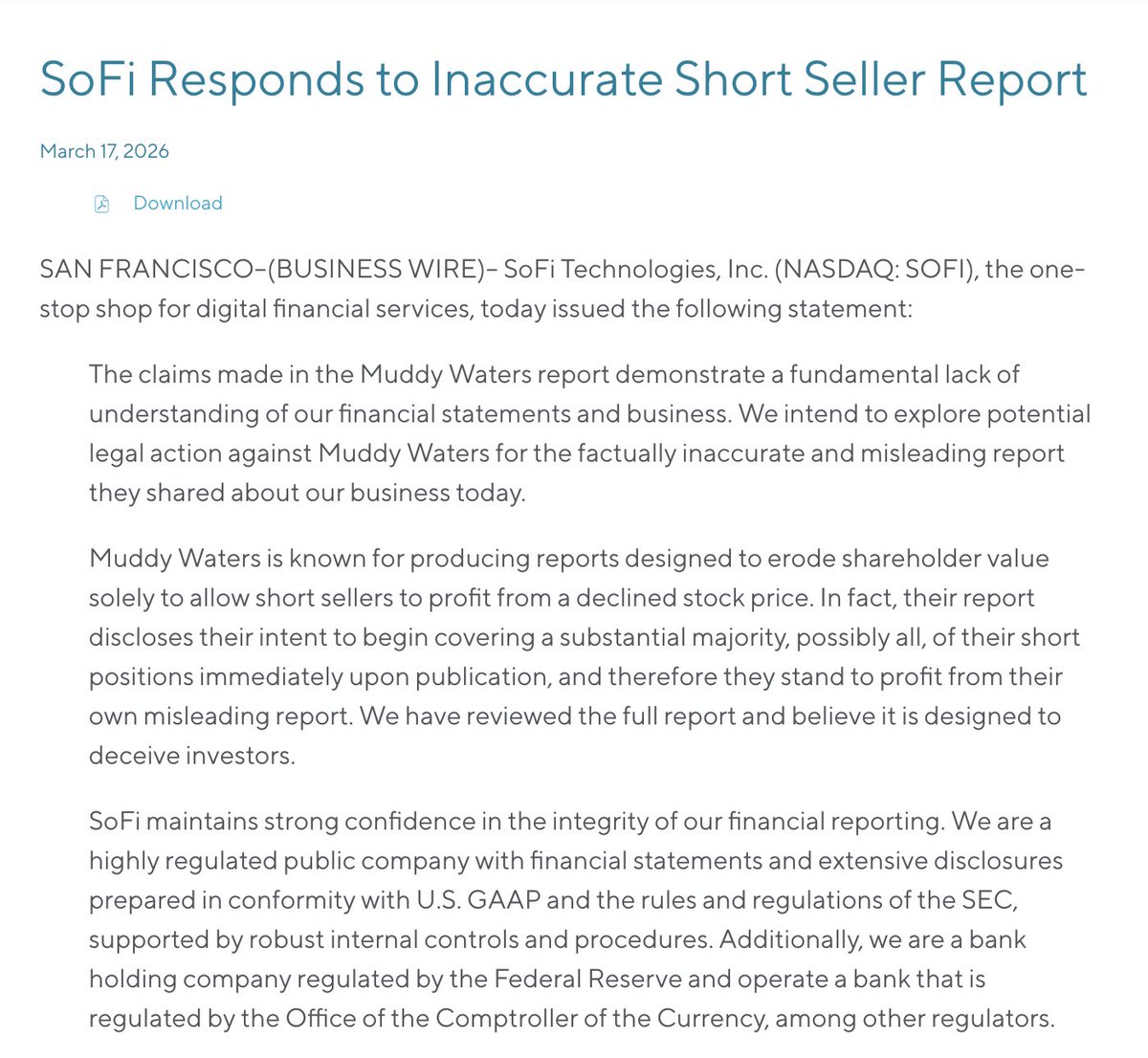
$SOFI just responded to the short seller report from today
"The claims made in the Muddy Waters report demonstrate a fundamental lack of understanding of our financial statements and business. We intend to explore potential legal action against Muddy Waters for the factually inaccurate and misleading report they shared about our business today.
Muddy Waters is known for producing reports designed to erode shareholder value solely to allow short sellers to profit from a declined stock price. In fact, their report discloses their intent to begin covering a substantial majority, possibly all, of their short positions immediately upon publication, and therefore they stand to profit from their own misleading report. We have reviewed the full report and believe it is designed to deceive investors.
SoFi maintains strong confidence in the integrity of our financial reporting. We are a highly regulated public company with financial statements and extensive disclosures prepared in conformity with U.S. GAAP and the rules and regulations of the SEC, supported by robust internal controls and procedures. Additionally, we are a bank holding company regulated by the Federal Reserve and operate a bank that is regulated by the Office of the Comptroller of the Currency, among other regulators."
AI is collapsing the gap between retail and institutional data workflows.
One example: use recurring agentic tasks to scrape daily product-page view data from e-commerce sites like Hoka (owned by $DECK), track the top ~25 core SKUs plus key launches, and build a proprietary demand monitor. Then run 3%–12% conversion sensitivities to frame unit volume, mix, and revenue cadence ahead of reported results.
This is not a substitute for fundamental work. It is an accuracy multiplier for it.
The edge is increasingly not who has access to data. It is: who puts in the work to get available data, asks better questions, structures the workflow correctly, and compounds the signal faster.
Pink box:
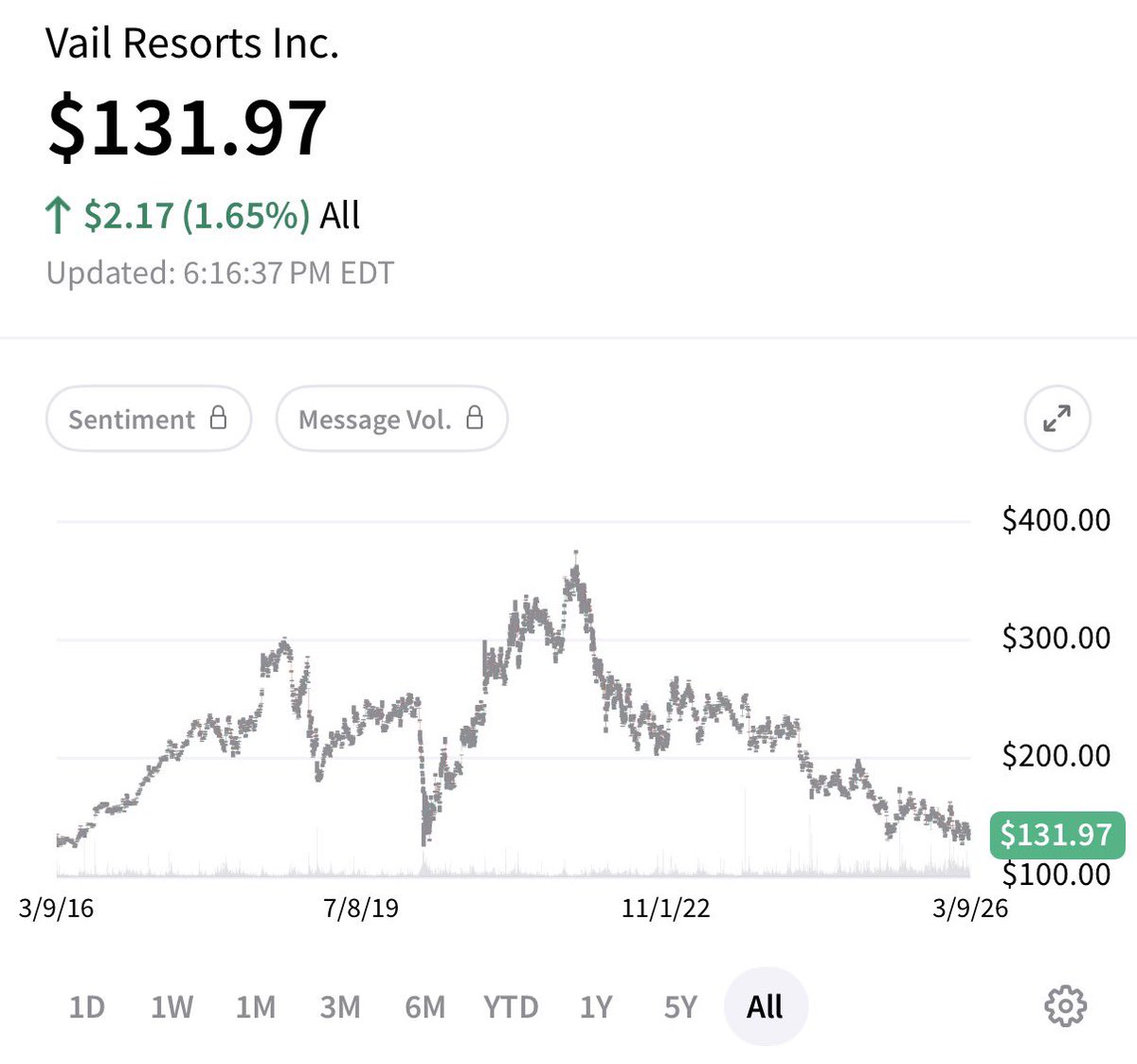
Agree. $MTN should sell hotels & go more asset-light. FY25 lodging EBITDA was just ~$23m on ~$334m rev. A lot of the ski land isn’t owned outright anyway: Vail/Breck/Keystone are USFS; Whistler is Crown land; Park City is leased. Very long (100-year) leases make it REIT-like, but $TPL is up ~10x last decade with no operating overhead on Permian land…
Vail Resorts ($MTN) likely to open tomorrow down to where if you invested 10 years ago you’d have done as well putting your money in a hole. It’s time for a change to become more asset-light, sell off resorts, and allow character and differentiation to return to skiing.
$EA remains below $200 despite the $210 takeout. Even right after the announcement, shares only got to ~$203—clear evidence the market has long assigned meaningful deal risk.
Now: JPMorgan is shifting more of the EA debt financing toward junk bonds: https://t.co/yq35VgO8mo