Google just shipped DESIGN.md — a portable, agent-readable design system file. That's the real announcement.
Everyone's covering "vibe design" and the canvas. But Stitch now has an MCP server that connects directly to Claude Code, Cursor, and Gemini CLI. Your coding agent can read your design system while it builds.
Google already shipped official Claude Code skills for this. The pipeline works today.
A PM describes the business objective. Stitch generates the UI. The coding agent reads DESIGN.md and builds against it. No Figma export. No spec document. No "the developer interpreted the design wrong."
PRD → design → code used to be three teams and three handoffs. Now it's one loop with one context file.
1/ Ever want to bring all kinds of ideas, content, and examples together to create something new? Check out Mixboard, and experiment in Google Labs. It helps you visualize your ideas in a very creative and engaging way.
https://t.co/250yfHeQQM
3/ I work with public sector... what does this have to do with that industry? It might not look like something that's immediately relevant, but I keep coming back to the fact that people need more hands on experience with AI to really grasp what's possible and where it's going in order to map ideas back to their day-to-day work. That's why I'm sharing things like this. I do think there are use cases for a tool like Mixboard in public sector, but this is more about getting the "reps" in with AI.
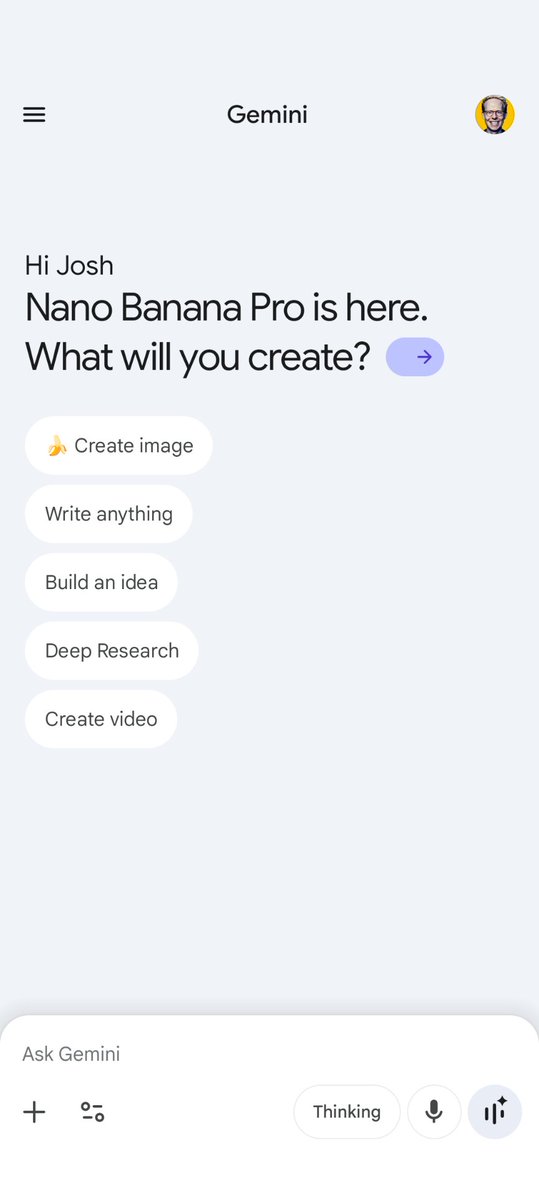
The 🍌 is back, and it's bigger and better! It's remarkable for infographics, slides, scenes, or anything that calls for text or multiple characters. Enjoy!
Our TPUs are headed to space!
Inspired by our history of moonshots, from quantum computing to autonomous driving, Project Suncatcher is exploring how we could one day build scalable ML compute systems in space, harnessing more of the sun’s power (which emits more power than 100 trillion times humanity’s total electricity production).
Like any moonshot, it’s going to require us to solve a lot of complex engineering challenges. Early research shows our Trillium-generation TPUs (our tensor processing units, purpose-built for AI) survived without damage when tested in a particle accelerator to simulate low-earth orbit levels of radiation. However, significant challenges still remain like thermal management and on-orbit system reliability.
More testing and breakthroughs will be needed as we count down to launch two prototype satellites with @planet by early 2027, our next milestone of many. Excited for us to be a part of all the innovation happening in (this) space!
AI efficiency is important. Today, Google is sharing a technical paper detailing our comprehensive methodology for measuring the environmental impact of Gemini inference. We estimate that the median Gemini Apps text prompt uses 0.24 watt-hours of energy (equivalent to watching an average TV for ~nine seconds), and consumes 0.26 milliliters of water (about five drops) — figures that are substantially lower than many public estimates.
At the same time, our AI systems are becoming more efficient through research innovations and software and hardware efficiency improvements. From May 2024 to May 2025, the energy footprint of the median Gemini Apps text prompt dropped by 33x, and the total carbon footprint dropped by 44x, through a combination of model efficiency improvements, machine utilization improvements and additional clean energy procurement, all while delivering higher quality responses.
See the blog or technical paper for more about our methodology and ongoing efforts.
Blog:
https://t.co/CoMm5gV9SR
Link to detailed paper: https://t.co/UBi9rd6gEC
Great software feels like an extension of you. We're building @GeminiApp to be the most PERSONAL, PROACTIVE, and POWERFUL assistant.
👀Here's the strategy:
1/ PERSONAL: The best assistant gets you. It starts by knowing your past chats (launching soon), but we’ll go further: we’ll make it easy for you to bring in all of your @Google context (Gmail, Photos, Calendar, Search, YouTube, etc.) - with your permission! On the team, we call it “pcontext” (personalized context) and we’re testing it internally with our own info already.
2/ PROACTIVE: The best assistant anticipates. @GeminiApp will offer insights and actions before you ask, freeing your mind and time for what truly matters. Less prompting, more flow.
3/ POWERFUL: The best assistant turns your ideas into action. @GoogleDeepMind models (like 2.5 Pro) are exceptional - they can research, orchestrate, and create images, videos, and code. We’re in a new era of models, and a new era of user experiences are coming.
4/ Zooming out, @Google infrastructure & TPUs back all of this. It’s the kind of infra people dream about, but it actually exists here -- and it’s going to let us make all this FREE for everyone to try, especially students.
5/ One request: keep your feedback coming! We try to listen, build, and iterate fast. In the last ~3.5 weeks, we’ve shipped:
* Gemini 2.5 Flash
* Veo 2 for video generation
* Free Gemini plans for all U.S. students (more countries soon!)
* LaTeX support (top request)
* Upload and edit your images (started rolling out yesterday)
6/ @demishassabis and I will unpack all of this (and more) at Google I/O in <20 days! Let’s roll!
The Gemini team cooked hard with Gemini 2.5 Pro, it's an awesome model that continues to lead @lmarena_ai - huge congrats to the team! Try it for yourself in the @GeminiApp now. Can't wait for you all to see what else we've been cooking 👀