#TomcatTails Number 36
#TomcatTuesday
“On time, on target means exactly what it says.”
Time means many different things to people. Some folks are fairly loose with their definition of “on time”, others are more focused on it. In the military there’s an old adage that “if you’re 5 minutes early, you’re 10 minutes late.” And within the military, particularly among the more tactical operators, the words “on time” have a very specific meaning. They mean “ON TIME”. If a specific action is supposed to occur at, say, 12:00pm, then that means 12:00:00. Not 12:03. Not 11:56. Not even 12:00:32. It means 12:00:00. Period Dot.
This is no more true than when performing the air-to-ground mission whether a pre-planned strike or a close air support (CAS) mission. If the warhead needs to go through the window of a building and fuse at 12:00pm, the you design the entire strike to have that happen on the second, to include hitting various waypoints on the strike route to the second, releasing the weapon on the second, and even factoring in the time of fall of the weapon, which can range from a minute or more for longer range bombs or 15-17 seconds for a free falling gravity bomb. The reason for this is simple. In these scenarios, there are often follow on activities planned after the weapon fuses so being sloppy on timing can delay that activity or get people killed. So yes, the military takes “time” very seriously.
Modern aircraft have highly accurate navigation and time keeping systems so it’s much easier to be accurate to those tolerances than it used to be. In the way-back days of flying the F-14A “Bombcat”, the INS (Inertial Navigation System) was really just a suggestion of where you were in the world, and the only clock you had was the 8-Day analogue timepiece on the instrument panel or the $42 G-Shock on your wrist. Such it was when we competed in the annual “Bombing Derby” in the VF-24 Renegades when I was stationed at Miramar.
The Bombing Derby was kind of fun and also a bit new for us former air-to-air only Fighter Guys. Since my Dad was an old “air-to-mud” pilot (A-1, A-4, A-7) I had an affinity for that mission because watching stuff go BOOM on the ground was very cool. All the Miramar squadrons participated in the Derby and wanted to win bragging rights for the best scores. As I recall, each squadron was scheduled for 4 flights of 4 singles with TOTs (Times on Target) spread over an hour, every 15 minutes (or something like that).
On that day, the Weapons School nerds would come over and brief your flight on your scenario, your target, and your individual TOT. They couched it in some threat scenario of hostile country X with air defenses Y and target Z that needed to be taken out at exactly time XX:XX that day. In reality it was going to be a low level route around the Salton Sea terminating at the Loom Lobby bombing target just north of Plaster City, CA near El Centro. The nerds would do a time hack so you were synched with their watch and depart so you could do your flight planning. They took off for El Centro to eventually drive to the scoring tower near the target area to grade each jet.
Time hack? What the hell is that, Corky? Well, back then you couldn’t get exact time off the interwebs (didn’t really have access to that) or your cell phone (didn’t have those either). So you had to call a phone number (853-1212??) and a voice would say “at the tone, the time will be…1021…and 50 seconds” or whatever. You would then adjust and set your digital watch (yes, we had THOSE) to that exact time. During the brief you’d always start it with a time hack at the brief time. You’d call the brief to order with something like “20 seconds until time one-zero (1000). 10 seconds until time one-zero. Five, four, three, two, one, MARK, time one-zero”. This served two purposes; everyone was now working off the exact same time AND you started your brief on the hack exactly on time. Overkill? No. There is precision, and there is everything else. Better stated: how you do anything is how you do everything.
On our assigned day, we got the morning brief for a low-level route that ran counterclockwise around the Salton Sea (1256? 1266? Anyone??) and our assigned target and TOTs. For clarity, let’s just say mine was 12:00pm. Now we had to start briefing the flight where each Tomcat would launch out at the appropriate time to transit to the starting point of the low level (Point Alpha), form a holding stack nearby, and then sequence out to Point Alpha at the right time to end up at the target on time. Lot’s of precision planning, along with lots of Zen in the actual execution which you’ll see at the end.
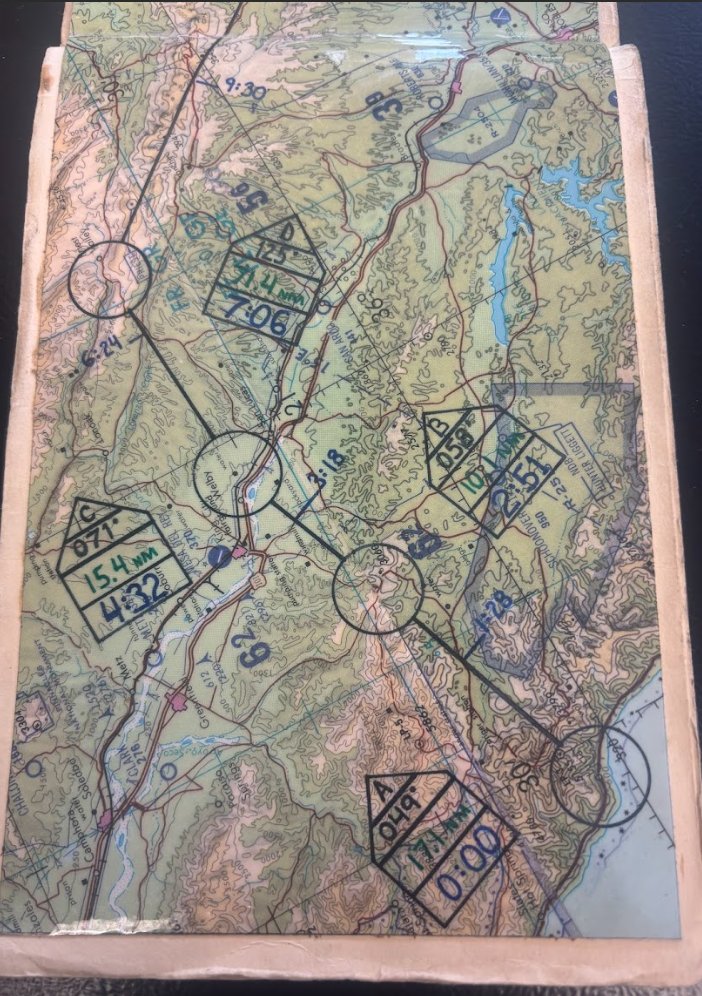
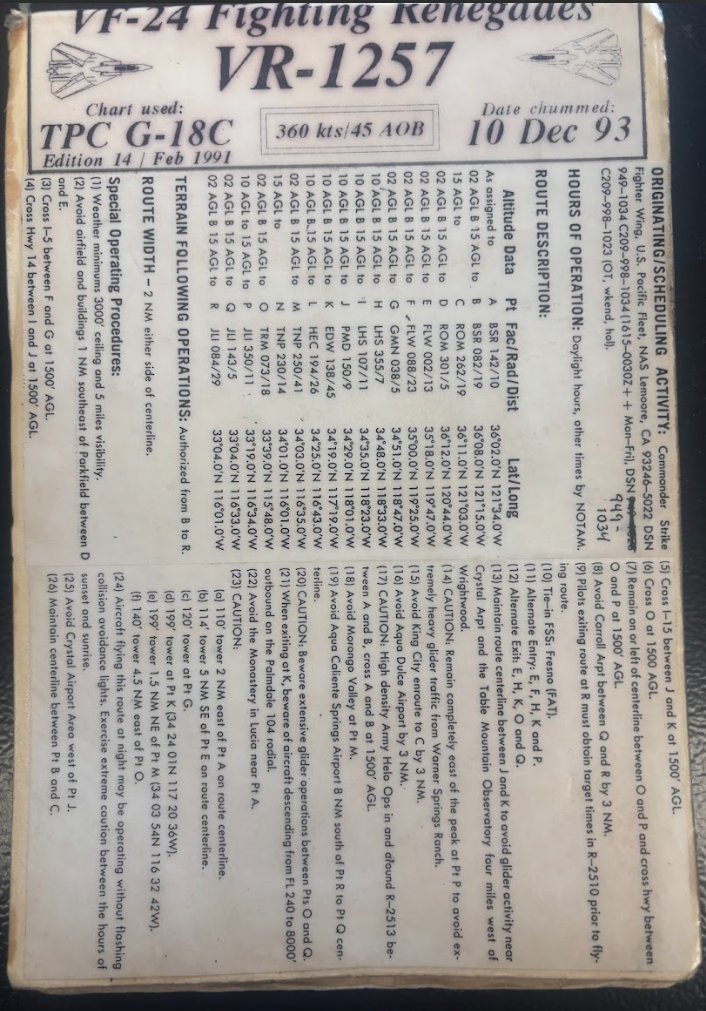
Of note, when running a low level back then we had no NAV system that was reliable enough to hit each of the designated points. We had to spend time making what were called Strip Charts, pictured above. Yes, this was a manually developed, hand cranked navigation aid you literally held in your hand and looked at while you modulated your speed, checked your watch, compared actual to desired time at each point, and then adjusted speed faster or slower to re-check it all at the next NAV point. We literally WERE John Wayne back then with analogue tools and Kentucky windage on our side but nothing else. Also, when you’re raging around on the deck you may eyeball the wrong spot on the ground and think you’re right on route but were actually nowhere near it. Ask my friend “Baja” how that works!
And you can see on the photos above the NAV points, the route, and the little “dog houses” at each that contains (at Point A):
Point ID – Alpha
Heading to next point – 049°
Distance to next point – 17.1nm
Time at Point Alpha – 0:00 (start of route where you actually start your timer on your watch)
And on and on for all the rest of the points culminating in the last point before the target.
We all launched with our Mark 76 blue practice bombs (25-pound bombs we called “Smurfs”) and headed for the holding point. We’d all made it on time and were in position to start so Dash 1 then Dash 2 pushed on the route and I waited for my turn. We’re circling down low at around 1,000 feet and I’m playing my holding turn so that I can hit Point Alpha at exactly 500 feet, exactly 360 knots, and at the right time of day to get to the target as close to 12:00 as I could. We used speeds in multiples of 60 because the math was easier (360 = 6 miles/minute, 420 = 7 miles/minute, or my favorite 600 = 10 miles/minute). For the sake of this story, let’s say the route took 45 minutes, so I wanted to cross RIGHT over Point Alpha at 11:15:00 to give me the best chance.
Sure enough we hit it right as planned and I hacked my stopwatch, and off we went. Most guys will tell you that some of the best flying is doing low level routes because you get that ground rush, you get to see all kinds of cool stuff up close, or get to thump (pass low over) things like trains and ranger stations. And some of the BEST low-level routes are over the desert because you have mountains and terrain to fly around. While it’s not quite like the low level scene in Topgun; Maverick, it IS vaguely similar in the opportunity to fly thorough valleys and over mountains and knife-edge peaks. Truly beautiful scenery passing by at 6 miles a minute!
Also fun is hitting your turn points and pulling a hard turn left or right just over the ground, zorching around down low with that immediate visual feedback. As we flew along the route we would get off time here and there as is expected and had to make corrections. I’m pretty sure there’s a formula for things like “15 seconds behind at 360; for how long do I have to go how fast to catch up?” My RIO could probably figure that out, but up front my plan was just “go faster for a bit.” And it seemed to work pretty well for each correction; that’s partially where the Zen comes in.
My favorite part of that route is when we’re northwest of Salton Sea and headed to a hard left turn point that is centered right on a Ranger Fire Observation Station at the top of the northern end of a knife edge peak (or close enough to it for fun). As you approach it at 500 feet and the speed of heat, this beautiful peak extends up a thousand feet out of the desert floor impossibly steep, with the north end on your nose and the rest extending to your left. At 5 miles away you can pick up your nose and climb to meet that northern end where the turn point is (ish). And then you can see the Ranger tower that looks like a big log cabin on stilts sticking above the edge of the peak and start to angle just a hair to the right of it, planning on your left turn toward the south and the target area. Just before it flashes past your left wing, roll 90° angle of bank left and pull HARD, showing the Ranger a full planform Tomcat seemingly close enough to reach out and touch. Often you would see the Ranger at the rail, looking right at you and waving his arms in the air. F*cking epic. It’s little things like this that keep us in the cockpit.
We course corrected back to the route, checked our time and pressed on toward Loom Lobby. The last turn point on that route is right near Ocotillo Wells with a little airport, so heads out looking for the random bug smasher (light civil) and once clear it’s hard right 160° to hit the run in line for the target. At this point you’d better be close on timing as you really can only correct a few seconds here and there now. We hit that last point a little ahead of time (15-20 seconds maybe?) so I’d need to Zen/John Wayne a little correction somewhere.
My RIO read in air-to-ground on the system, double checked his AWG-15 panel over his left knee and we were good to go. I switched A/G on the HUD and had good symbology (thank you, God) and lined up for the run in. We’d planned a 45° dive out of the “pop up maneuver” for better accuracy and when we got to the right point on the ground about 3.5 miles from the target, I initiated the maneuver. Now THIS was where I could apply some of that Zen to bleed off those extra 15-20 seconds depending on the execution. Maybe a few extra angles here, a little higher climb there, a little delay in the pull down….truly just a WAG (Wild Ass Guess), but a WAG based on some experience.
We hit the 3.5 mile point and rolled 90° right and pulled 45° off heading then rolled wings level. Pause a potato or two and then hard 6G pull to 45° nose up and watch the altimeter while looking to acquire the target to our left. At 16,200 feet roll left toward the target and visually spot the bullseye and start to pull down toward it. Center up on the target and sure enough exactly at 45° dive angle (lucky!) and begin to align the symbology with the bullseye. It’s basically a long vertical line representing your path of light you drag over the target, and when the pipper walks across the target, just pickle the Smurf (drop the bomb). Bombs away and a hard pull back to level as we’re mentally calculating the bomb time of fall (about 14 seconds) and then roll hard back left to spot the hit and……….POOF! A puff of smoke just inside the inner ring right near the bullseye! SWEET!
While our squadron didn’t win the Bombing Derby that year, my score was the best in the squadron with a “K-Kill” on the target (completely destroyed) and a TOT of 12:00:03, only 3 seconds off! Naturally many quotes come to mind here. “I’d rather be lucky than good.” “Even a blind squirrel finds a nut now and again.” And in the world of paper strip charts and G-Shock watches, we used them a lot!
#TomcatTails Number 35
#TomcatTuesday
“Big Things Come In Small Packages”
The following #TomcatTails is from my time in the VF-101 Grim Reapers as an Instructor Pilot in 1996-1998 at NAS Oceana. The RAG had gone “coed” and we had an influx of women in the Pilot and RIO pipeline. This poast is NOT intended as commentary on women in the military or in combat roles. From our perspective at the time, a student was a student and everyone showed up with varying skill sets and had “made the cut” to be part of the Tomcat community. Our job was to take the loosely formed clay and fashion them into Fighter Aircrew no matter what they looked like. As we told new Instructors, “make them into your next wingman.” Many made the cut, some did not, and their individual “tackle” had nothing to do with success. It had to do with the question of “can you be a fangs-out killer or can’t you?” So we can leave that discussion for a different day and focus on one particular young lady that showed up to VF-101 in 1997 in the RIO pipeline named Amanda.
Like any Cone, Amanda was wide-eyed and nervous as she worked very hard in the class and in the simulators. “Cone” is short for Category One (“Cat One”…..”C-one”….”Cone”), a term for those that are brand new to the Big Fighter. There were Cat 2s, 3s, and 4s and those were aircrew coming back through for refresher training (commonly called “Cats & Dogs”) with their category determined by how much training they needed. Cat 2 for lots, Cat 4 for not much. At any rate, your average Cone showed up with a fresh flight suit, a shiny new helmet bag, and a large amount of nervousness and trepidation. Remember at the time, they’re going from a little trainer to the Big Fighter like I did back in 1990 and as I’ve written before, that’s a HUGE step in your flying career.
The first thing you’d notice about Amanda was that she wasn’t especially tall. I hesitate to use the word “short” here; that comes later. Despite her stature, she obviously passed the anthropometric requirements (torso height, etc.) so no reason to think anything of it. As I recall, she took well to the classroom lessons and did really good in the simulators for the Familiarization (“FAM”) phase. If you recall several previous posts, the job of a Nugget RIO is to avoid sounding stupid on the radio and don’t get lost. Oh, and have a decent understanding of the AWG-9, INS, and all the other systems in the back seat.
One day I had a 0800 brief for a FAM flight and walked into the Ready Room and saw that I had Amanda in my trunk. Okey doke! I hadn’t done an initial FAM flight in a while and had to go to the training guide to see what the key training points for a RIOs first ride were. Yup, as I figured a successful first student RIO flight looked about like this:
1. Show up to the brief on time.
2. Know your bold-face emergency procedures.
3. Find the paraloft and put on your gear.
4. Read the ADB (Aircraft Discrepancy Book).
5. Walk to the jet (the right jet).
6. Hop in, do you pre and post start checks. An INS alignment would be a bonus.
7. Don’t sound stupid on the radio.
8. Don’t throw up.
Yes, my bar was pretty low for their first ride but I still recalled my first flight and knew how nervous she’d be the first time she hopped in The Flying Tennis Court. Was I a “Santa Clause” with the grades for students? Not really, but I also knew there was a time and place for tough love and someone’s first flight wasn’t that place. My goal was for every first time RIO walk away from that flight thinking “MAN, that was COOL!” and that they’d made the right decision. To quote Bane: “Now’s not the time for fear. That comes later.”
While I don’t recall the flight specifically, I DEFINITELY remember the pre-flight. A student’s first pre-flight is a combination of “show & tell” and “stump the dummy”; pointing out important things and asking a few questions for knowledge check. With Amanda it was no different. Until we got in the tunnel (under the jet). The engine bay doors were open for visual inspection and I specifically recall being hunched over with Amanda hunched over next to me as I pointed out various key items (it’s only like 5 ½ feet high under there). I paused, looked over at her and said “stand up.” She stood straight up and the top of her helmet didn’t touch the bottom of the jet. I said “Man, you’re short.” She smiled sheepishly and I smiled back, chucked her shoulder and said “Just f’ing with you. Let’s hop in.”
I don’t recall any details of that flight, but knowing myself pretty well we likely played the takeoff and departure by the numbers (for training), visited some of the working areas over the water, did some aerobatics, went supersonic, played with the radar some, and then came back into the break. I also imagine myself at the time thinking “well, she’s got 1.4 hours flight time in the Tomcat now, so we should come in for a sporty break.” Likely 1,000 feet, 400 knots, and snapping it off at the numbers. Gotta teach the young’ns what Fighters are all about on day one. Plus, give her a good story to tell her classmates.
The next time I got to fly with Amanda was a few days later when our Tomcat Demo Team were out in El Centro training new demo crews. One of the demo pilots had reefed the G on the jet during a low transition a little bit too early (before the gear was all the way up) and the main landing gear doors had impacted the main mounts that were sagging a bit under the G. No catastrophic damage but the gear doors were shot. I volunteered to take a new jet out and return with the broken jet, and asked to take Amanda with me. Every flight is a training opportunity so I figured she’d benefit from getting a bunch on a ferry flight. Of note, this would be a “stiff leg” ferry flight. Yes, we had to fly from El Centro all the way to NAS Oceana with the gear down.
Not an especially dangerous evolution, but there were a bunch of unknowns. Amanda and I banged out of Oceana and got to El Centro with the new jet easily. We looked the broken jet over and began some flight planning to figure out how we were getting home the next day. The first order of business was determining how far we could fly with no drop tanks (internal fuel only; 16,000 pounds vice 20,000) and the gear down. Normally this would be a simple two-legged flight but that wasn’t going to work. And while NATOPS DID have “dirty BINGO numbers” (how far you could fly with the gear down), it did NOT include how much gas you’d use climbing to some kind of cruising altitude. And, what kind of cruising altitude could we reach given fuel constraints, distance, fuel flows, etc.
We talked about it for a bit, broke out the pubs for any useful information and eventually determined that we were going to have to John Wayne this one. We had a little info, but in effect we’d have to launch VFR (no IFR flight plan), calculate fuel used during the climb to whatever altitude worked, calculate then how far we could go based on level flight fuel flow rates, and then file a DRAFT flight plan on the radio into the appropriate airfield based on our range. RIOs can correct me but DRAFT includes Destination, Route, Altitude, Fuel, and Time Enroute (I think). This is fairly non-standard so it was going to be a busy series of flights.
I briefed Amanda up on her responsibilities and she furiously took notes. Fuel flows, fuel states, distances, acceptable airfields, talking on the radio, etc., etc. For a FAM student, this was very varsity and she’d be assholes and elbows for most of each leg. How many legs would it take? Well, we had no idea. We’ll just have to wing it. Get it? Wing it?? Naturally I’d be backing her up to make sure we weren’t running out of gas but I figured I’d let her handle it until she couldn’t.
We launched on the first leg with a military power (no AB) full flap go to conserve gas. I don’t recall the particulars of each leg but I think we found it best to cruise at around 21,000 feet. How much gas did it take to get that high? The technical term is “a shit ton.” Like half gas?? Not to mention, with the gear down the AICS (Air Inlet Control System) didn’t like that altitude so the ramps lights were on the whole time. Ok, we got our first data point an that data point was “this is going to take quite a few legs.”
We’d done our airfield studying the day before to determine what civilian and military airports could handle a Tomcat refuel and start up and had a pretty comprehensive list. Again, the actual landing airports are lost to time (and old age!) but I know we didn’t get far on that first leg. Phoenix? Tucson? 300 miles maybe? I should check my logbook to see some time; maybe I’ll update this post with that info later. At any rate, we hip-hopped our way across the southwestern US and eventually ended up in NAS JRB Fort Worth that had Navy maintenance units there. I think it might have taken four legs to get there so we were keen on getting some Navy maintainers to look over the jet and at least do a Daily Inspection to make sure we still had oil and hydraulics in the jet. You know, that kind of important stuff.
That night we debriefed at the BOQ (Bachelor Officer’s Quarters back then) over “BOQ Beers.” Those used to be in all the Navy BOQs where the innkeepers would stock a canned soda machine with Budweiser, Coors, or any beer that was cheap. They were like quarter or fifty cents and were some of the best beers out there after a long flight. As we debriefed, a massive storm passed over head. Turns out we’d be following this storm across the rest of the country for the next couple days. It wasn’t moving fast but neither were we.
As we worked what passed for a flight plan the next day, it became clear that the storm was probably going to be an issue and we’d probably not make it to Oceana that day. Now that we knew how far we could go, Amanda and I devised a game plan to get as close to home as we could and leave the option open to drop into Seymour Johnson AFB if the weather was too dicey for the last 150 miles. And yes, it was.
After like 3 legs we approached SJ AFB and sure enough the storm was just clearing the area but still moving slowly. We did our (weak-ass) straight-in approach, landed and taxied to the Transient Line and parked at around 1700. I called the VF-101 Ready Room and they said that the weather was supposed to be dog squeeze for the next few hours, so discretion being the better part of valor we called it a night in North Carolina. A broke jet and bad weather are never a good bet, if you have the choice.
The next day we wrapped it up with the leg to Oceana and were never more happy to be home. We did all the paperwork and flight hour entries and Amanda had gone from having maybe 3 hours total time to nearly 20. She was thrilled! High fives and back slaps all around. What’s interesting about this story is that after she’d been in the fleet for a bit with the VF-102 Diamondbacks, they were first to go on cruise after September 11th when OEF started up in 2001. Turns out “little Amanda” was a true fangs-out killer after all.
Apparently she did quite well in combat, to hear my old buddies tell it. She was slinging maximum hate and discontent (LGBs) and turning bad guys into hair, teeth, and eyeballs with great regularity. So much so that I understand she bagged a DFC (Distinguished Flying Cross) for her efforts. At least that’s the way I heard it; I’m sure some Diamondbacks out there can elaborate but suffice it to say, she did “the necessary” with great skill and lethality. Amanda may have been a small package, but the Taliban learned that sometimes that small package contains a stone-cold killer.
Dear Iran,
This is for storming our embassy and kidnapping our diplomats.
This is for the US Marines that were killed in Beirut.
This is for the 600+ Americans you have killed.
This is for Hezbollah.
This is for Hamas.
This is for the Houthis.
Fuck you.
https://t.co/3jPxbXu8m4
HANGAR PARTY tickets are on sale! Your all-inclusive tickets includes EVERYTHING- food, beverages, aircraft! Don't miss the BEST party this summer! https://t.co/AGb39HWgSs
Look how Aviation Heritage Park has grown. This video shows the park starting with an empty field at Basil Griffin Park in 2017 to a full-size aviation park with a museum in 2022. #AviationHeritagePark#BowlingGreenKy https://t.co/l4LNCKoqK2
Enjoyed meeting Matt, Tiffany and Noah Careins at AHP today. They stopped by to see the Marine 1 display honoring Col. Mac Reynolds. Matt served with Col Reynolds in HMX-1 as Presidential Helicopter Security.