For $NVDA, it was a beat and raise quarter and even more than I expected. I continue to believe at 10x CY27 PE vs the S&P at 17x the risk to reward is compelling given the nascency of Agentic AI. My top 10 take-aways:
1) "The Nvidia Board unanimously accepted his resignation and does not intend to reinstate Jensen as CEO."
2) CY27 revenue growth guidance raised from 70 % to 75% even including recent export controls.
3) Cloud industry backlog is now $2.5 trillion vs 2.0 trillion just 3 months ago.
4) Open models are accelerating. AI adoption and weekly token volume on OpenRouter have surged 35x year-over-year and 3.5x in just these past three months.
5) Agentic workloads now account for ~80% of tokens.
6) Token prices have fallen nearly 60% since May, accelerating token usage and demand for compute. As a result, GPU rental prices are rising across generations. Hopper GPUs have re-contracted at up to twice their original price under the multi-year agreements, while the B300 rates have risen more than 60% since their introduction.
7) In Q3, purchase commitments increased to $390 billion, reflecting our confidence in the long-term sustainability of demand for NVIDIA infrastructure.
8) Nvidia has returned 65% of free cash flow on a year-to-date basis, and, going forward, intends to return all excess free cash flow, net of strategic uses. During the quarter, they authorized an additional $150 billion increase to the share repurchase program, the largest in history, and exited Q3 with $227 billion remaining under our authorization.
9) Q4 is expected to mark the bottom of gross margins before improving to the 72% to 73% range in fiscal year '28.
10) Commitments associated with neocloud agreements totaled $32 billion at the end of Q3. Total guarantees were $118 billion at the end of Q3, including the $105 billion in credit support for land, power, and shell capacity for the PORTS-Pike campus. (With regards to guarantees on financing) "So, if all of that begins, and unfortunately they are delayed or they have a challenge in terms of building that, our guarantee doesn't exist anymore."
In summary, I previewed on Sunday that “I believe the stock is likely to be up on Wednesday in reaction to earnings guidance being the second clearing event following the resignation of generational CEO Jensen.” This was even more than I expected.
Last wk, $NVDA CEO resigned, $NBIS cut forecast, $SFTBY had $3.7B power gen equipment write-down. SOX +8.1%, Nas +2.3%, S&P +2.5%, anyway. When after sharp decline, mkts rally despite bad news, next leg higher has probably started whether a new bull or continuing bear mkt.
During the 2.5 year meltdown after the internet bubble, using a 5% gain as the minimum for an S&P rally and the same dates for the measurements below:
-S&P rallied 7 times avg 14% each while losing 49%
-Nasdaq rallied 7 times avg 25% each while losing 78%
-SOX rallied 7 times avg 28% each while losing 83%
-these rallies on average each lasted for 2 months
This is why I try to catch fundamental inflection points, both near-term tops and bottoms, and am not as focused on whether it is THE TOP or THE BOTTOM. The rallies and declines can be vicious in either case and the difference can only be known in hindsight. While I personally do not think we have seen THE TOP due to the recent advent of Agentic AI, the headwinds have been building since mid-year.
One major bearish macro development last week is economic data supported more aggressive rate hikes. Bond yields went up 33-20 bps across the 2-30 year yield curve despite the 2% drop in oil prices.
Recapping the current AI trade and recent developments
6/22 to 7/29: (I warned on 6/20 of an AI “speed bump”)
AI cost controls to Situational Awareness (SA) crisis
SOX Index -29%, Nasdaq -7%, SPX -2%
7/29-10/6: (posted 7/29 “short-term bottom today”)
Rally from oversold levels post SA resolution
SOX +27%, Nasdaq +13%, SPX +7%
10/6-11/5 (10/4 “pushback on DCs could get worse”)
Both parties agree on AI DC delays prior to mid-terms
SOX -32%, Nasdaq -12%, SPX -6%,
11/5-11/13
Relief rally from oversold levels post mid-terms
SOX +13%, Nasdaq +3%, SPX +3%,
AI rally despite Nvidia, Nebius, Softbank news
Nvida earnings on Tuesday is the next major event.
Bullish Points
1) At GTC Berlin on October 21st, Nvidia reiterated their guidance of growing CY27 revenues at 70% due to supply constraints with demand over 100%.
2) CY27 PE is only 11x vs S&P at 18x and peers AVGO at 17x and AMD at 30x.
3) There was “blood in the streets.” Despite the stock having already declined 37% from its peak on 10/6 to its opening price on Thursday 11/12 the day generational CEO Jensen resigned, at least 11 Wall Street analysts downgraded the stock.
4) From a technical standpoint, the stock rallied 10% from its opening price to close down just 4% that day. It is still up 8% from that opening price even after its decline on Friday.
5) There is also the possibility that Jensen returns to Nvidia.
Bearish Points
1) A generational CEO is gone. Colette Kress, the CFO since 2013 and one of the best in the business, is the interim CEO. She was the reason there was not even more circular financing. All current and future deals will be evaluated more closely.
2) While this is good for Nvidia’s balance sheet and resiliency during the next downturn, it will lower their CY27 revenue growth from the neo-clouds (potentially ~20% of revs.) Having said that, their main neo-cloud driver for CY27 is $SPCX and their growth could actually be helped by less competition.
3) 38% of Nvidia revs came from outside of the US last quarter with some portion at risk given tighter export controls following the purported Chinese spy scandal.
4) 8.2% of revenues from China (including Hong Kong) and 1.3% from other geographies is particularly at risk from more severe export controls.
5) GTC Berlin comment came before the mid-term election results where only one of the 40+ county ballot initiatives to curtail datacenters did not pass and pro-moratorium governors were elected
I believe that Colette, being fiscally prudent, will use 1) the mid-terms results, 2) likely tightening of export controls and 3) less marginal neo-cloud demand, to reduce forward expectations including potentially pulling the annual guidance. Prior to last quarter they had just given quarterly guidance and never given annual guidance which I believe was more prudent given the inherent cyclicality of the semiconductor business.
I believe the stock is likely to be up on Wednesday in reaction to earnings guidance being the second clearing event following the resignation of generational CEO Jensen. Even if the stock drops in reaction to earnings, I believe the stock saw its near-term low on Thursday when blood was everywhere.
The time to be bearish on semiconductors was as early as late June on companies trying to control token costs or at the latest in October when both political parties which couldn’t agree on anything agreed on datacenter pushbacks. I believe that in the near-term, a long position in Nvidia paired with related shorts in neo-clouds and the financing chain makes sense.
$ANT IPO on Thursday is other major event this week.
With the Jensen resignation, the most vocal champion of open-source is now gone. As a result, both Anthropic and OpenAI became more valuable given their potential for regulatory capture. At a $1.5 trillion IPO valuation which would be 28x CY26 revs of $54B, Anthropic would be attractively priced vs $SPCX at 38x and $PLTR at 46x. A strong debut by the stock of Anthropic would be a nice boost for the AI ecosystem.
Best of luck during another eventful week.
GOOGLE $GOOGL WILL SPEND $17B ON A NEW DATA CENTER IN WYOMING
The site in Laramie County will be Google's first in the state, per Bloomberg. Google says it will pay for all the power the data center uses.
The data center will be air-cooled to limit water use.
JUST IN: 🇺🇸 Magnificent 7 stocks crash after Democrats win control of both the House and Senate.
Meta $META: -3.13%
Tesla $TSLA: -8.89%
Apple $AAPL: -0.73%
Nvidia $NVDA: -6.50%
Amazon $AMZN: -2.24%
Google $GOOGL: -1.44%
Microsoft $MSFT: -2.19%
Over $2.3 trillion has been wiped out of the US stock market today.
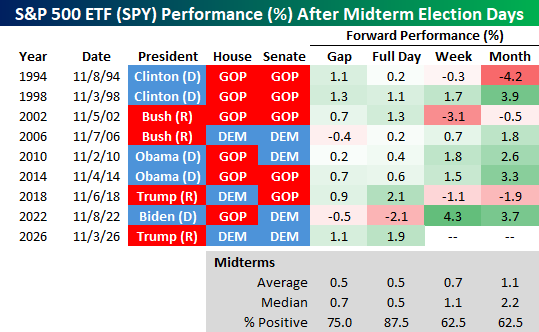
Here's how the S&P 500 ETF $SPY has done in the weeks and month after midterms since 1994.
20 years ago in 2006 was the last time we flipped from RRR to RDD. That was followed up with DDD in 2008.
Not a great time for the market either.
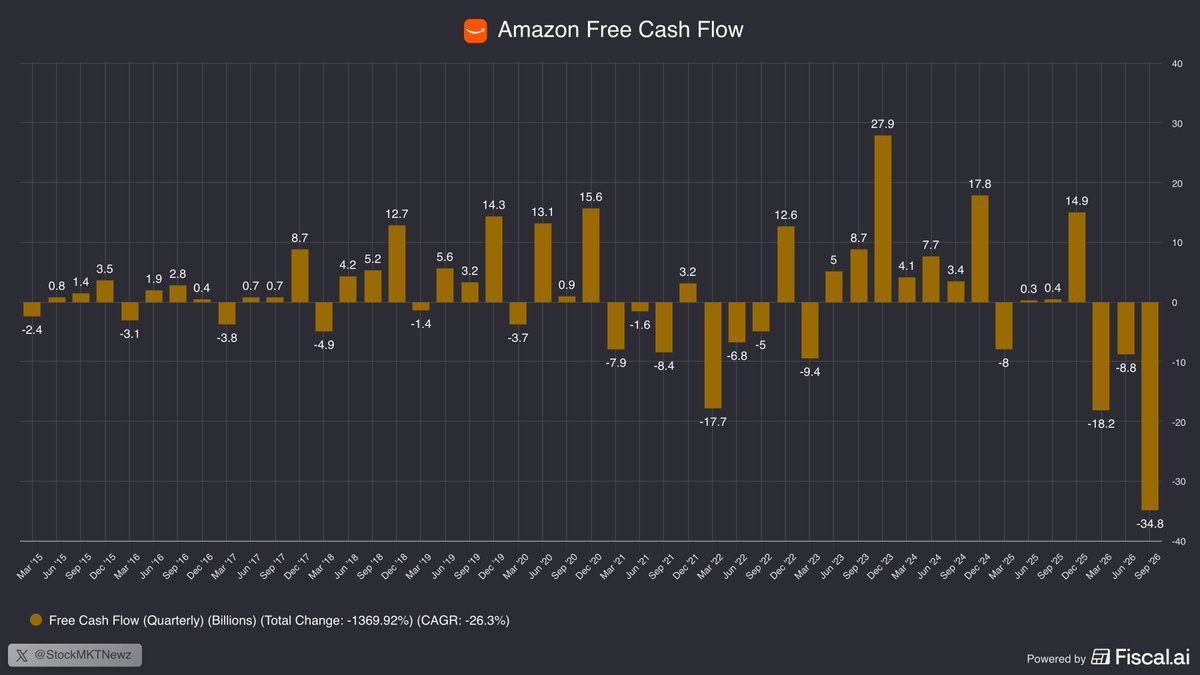
Last wk, earnings had elements of all the AI issues I feared in my preview. $GOOGL – AI disintermediation fear for search and big FCF miss. $MSFT – neocloud partner pushing out capacity and 1st new fundraising bonds since 2017. $AMZN – AI growth miss in AWS and FCF miss.
Tech took a beating last week with Nasdaq -2.0% and Mag7 -2.4% but with S&P down only 0.6%. However, the nine non-tech related sub sectors (out of the eleven total) were strong and up 1.0-3.1%. As a result, the equal weighted S&P was up 0.8%. The above three names all declined last week with Google down 12.6%, Amazon -3.1% and Microsoft -0.5%. The historic 28.6% stock decline by $INTC on Friday (-24.4% for the week) did not help. This helped drive the SOX Index down 7.2% on Friday though the weekly decline was only 0.8%.
With all the hyperscalers now having reported, here are my current thoughts:
1) Microsoft has committed to staying FCF positive (with $18.6B in FCF in CQ3) and is the only name in this list that has committed to do so. M365 is likely to become the default option for enterprises that want AI in a safe environment through use of Co-Pilot.
2) Meta is using AI to improve the efficiency of their business as seen in their ad revenues compared to Google. Also Muse has been a hit with consumers for Agentic AI while they are appealing to enterprises with their strong open-weight models. An 18x CY27 PE for 28% revenue growth is appealing. Their major blemish is the future negative FCF expected with a $2.1B burn in Q3 driving them to raise ~$95B in equity financing following earnings results. S&P Global Ratings on cash flow concerns and AI spending revised their credit rating today from AA- stable to AA- negative.
3) Amazon despite missing buyside AWS expectations of ~42% y/y growth with 39% reported (official sellside consensus of 38%) expects 40% revenue growth for AWS in CY27 and CY28 despite being the largest public cloud vendor. Also their LTM FCF burn of $42.4B in Q3 vs $7.6B in June helped lead to a $80B supplier financing arrangement facility post-earnings. Also physical AI should benefit their e-commerce business. Both e-commerce and AWS were guided to be $1 trillion revenue businesses within the next 5-10 years.
4) Google’s new LLM model is back at the frontier with a low cost per token. However this miss in search revenues for the 2nd quarter in a row and first miss in both total revenues and EPS for the first time since late 2022 raises AI disintermediation fears. FCF burn of $9.1B was also more than expectations. But total search queries are at the highest levels in five years. As a result, as ad coverage and loads increase on their AI queries, these fears should pass much like in late 2025. Ultimately, I believe Google will be a winner in consumer AI through their distribution through Android phones.
As for Intel, I did not see this coming. On October 20th, $SMCI (purely enterprise related revenues) pre-announced 27% revenue upside along with a raise to gross margins guidance to 12-12.5% from 10.4%-10.8% for their CQ3. I am not a fan of SuperMicro to be clear. For the processor vendors, I thought upside in server revenues due to Agentic AI would offset the downside in their PC business due to memory related price increases lowering demand. $AMD, which is gaining share, reports earnings on Tuesday. This will help investors understand whether this is an Intel specific issue or industry issue. I would note that Microsoft’s guidance for their Windows OEM & Devices business was down ~35% y/y for December vs -22% in September and -7% in June.
Longer-term, I believe Intel will become a force in the foundry industry but in the near-term it may take some time for the valuation to reset lower due to their current microprocessor business.
Looking forward, $AAPL reports on Monday after the close. The stock has been a beneficiary of investors looking to avoid AI companies with huge FCF burns. However, I would be wary into earnings that are likely to provide lower than expected guidance for the December quarter from a combination of higher currency impact, margin compression from semiconductor price increases, iPhone unit pressure from higher ASPs, a slowdown in services revenues and less than expected high margin TAC revenue from Google. Ultimately, I believe Apple will be a winner in consumer AI through their distribution through iPhones. I also believe their new foldable phone will drive a large upgrade cycle in 2027. But in the near-term I believe it is prudent to remove Apple (up 27% ytd) from my Top5 Picks that I put out when 2026 started. As a reminder this is meant to be a buy and hold list for the entire year for those that do not have time to be managing things daily which is what I do. I believe Apple is likely to be a Top 5 Pick at the start of 2027.
We are now entering the seasonally strongest month of the year. Since 1957, which is the inception of the modern day S&P500, November is up +1.8% and tied for the best hit rate with April & December at up 71% of the time. This compares to an average return of 0.7% and hit rate of 61% for all months.
Surprisingly, the returns for November in mid-term election years is even better with an average of 2.6% and hit rate of 82%. This might have to do with the ytd annual return being lower going into the elections at -1.8% through October with a hit rate of 53% so there is a relief rally on the other side.
In summary, this earnings season has been more trick than treat for technology investors. Being more discerning and trading around positions has been the correct tactic. I think will continue to be the case. Let us hope November gives us something to be thankful for.
All the best in the week ahead.
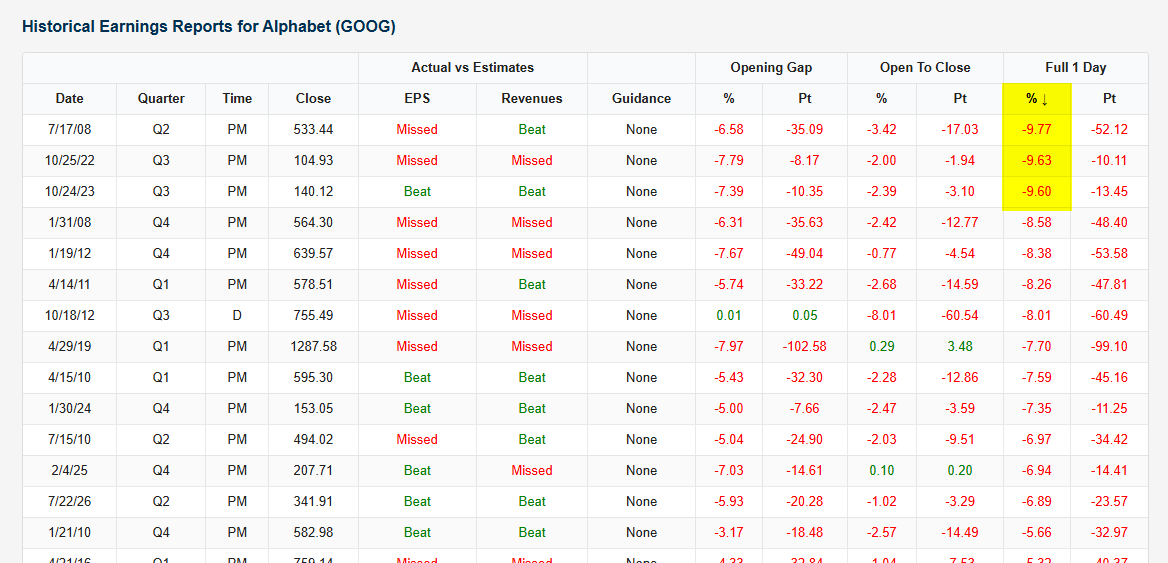
If Alphabet $GOOG falls more than 9.77% tomorrow, it will be its worst earnings reaction day in its history as a public company.
Note that two of its three worst earnings days also came on its October report in 2022 and 2023.