Ten years of hard work finally culminated into something:
https://t.co/KiAarfznGl
Thank you @BitcoinMagazine for publishing and all of the support I’ve had in getting it across the finish line!
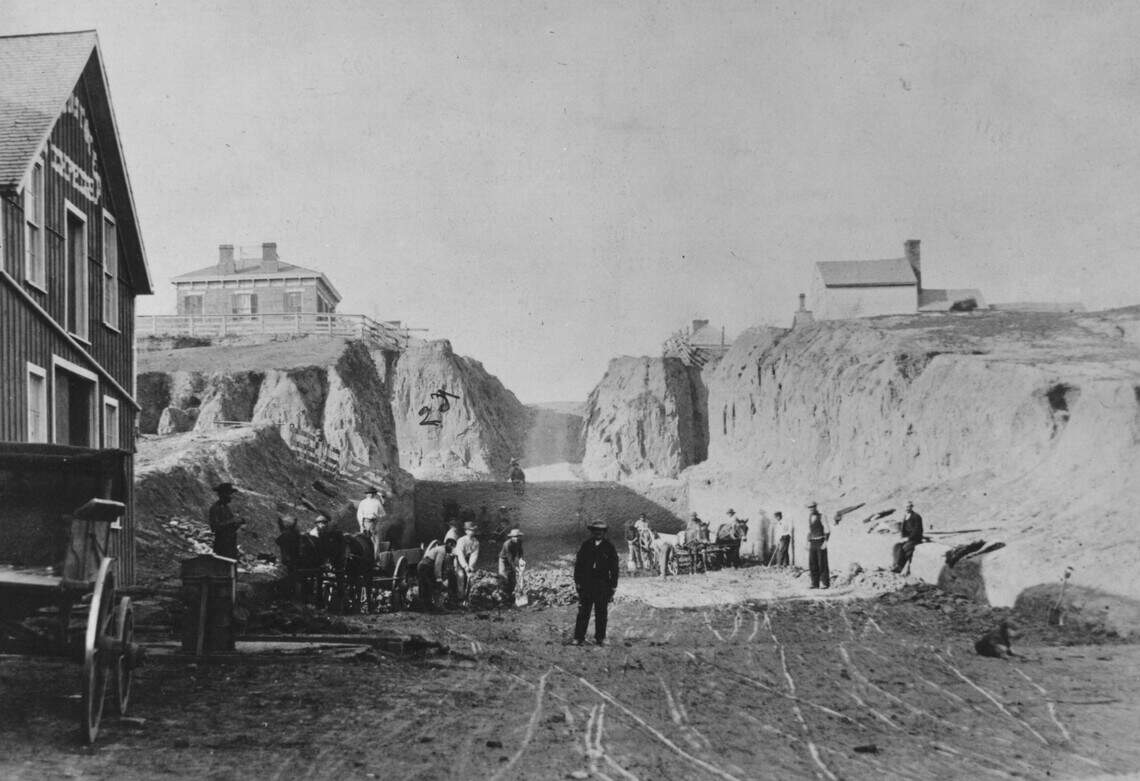
Most people have no idea that downtown Seattle used to have a hill the size of a 20 story building sitting right in the middle of it.
Denny Hill. 220 feet tall. The city looked at it and decided to just get rid of it. Not tunnel through it. Not build around it. Erase it completely.
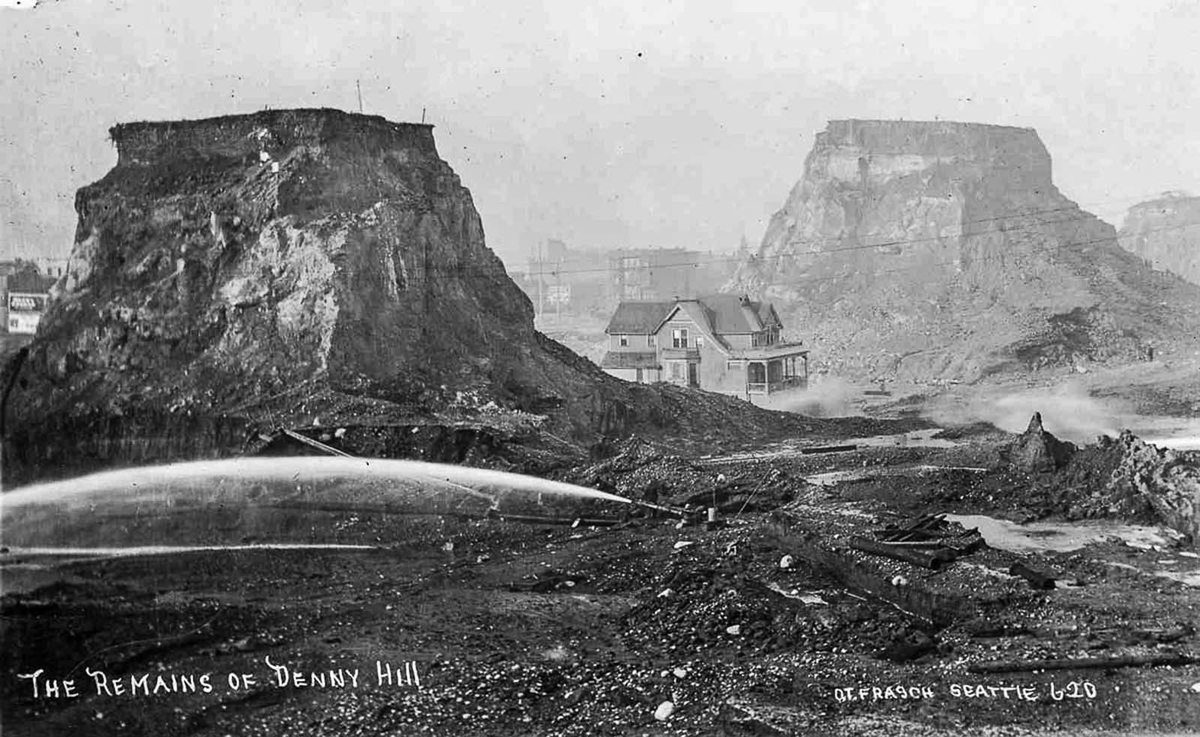
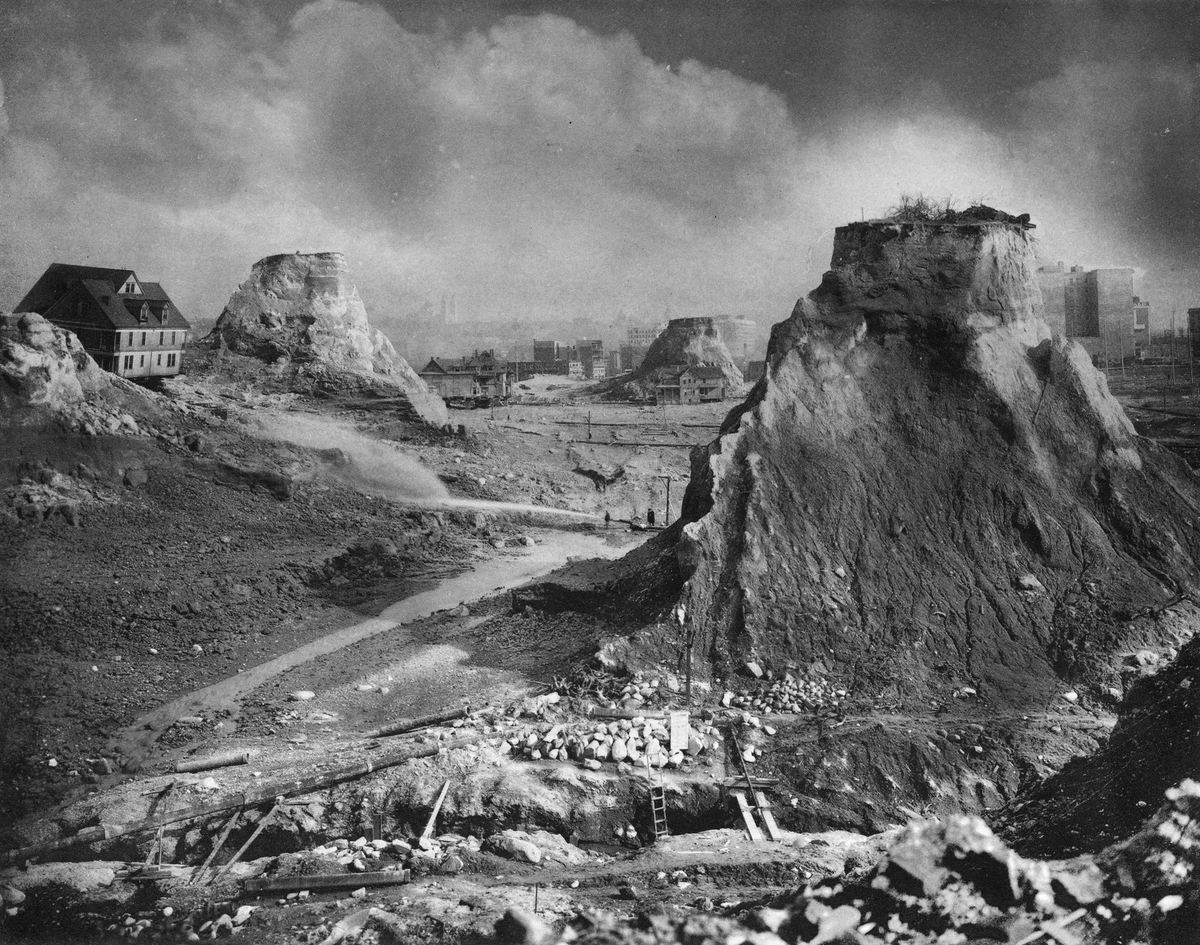
So they pointed giant water cannons at the hill and blasted it apart with pressurized water, then washed the mud down into Puget Sound. It took them from 1897 to 1930 and they moved more than 11 million cubic yards of dirt. An entire hill, hosed into the bay.
And here is the part that sounds made up. Some homeowners refused to sell. So the engineers just carved the hill away around them. That left houses stranded on top of skinny towers of dirt, some of them a full hundred feet in the air, reachable only by a long wooden staircase. People called them spite mounds. The holdouts all caved eventually, and those last pillars got washed away too.
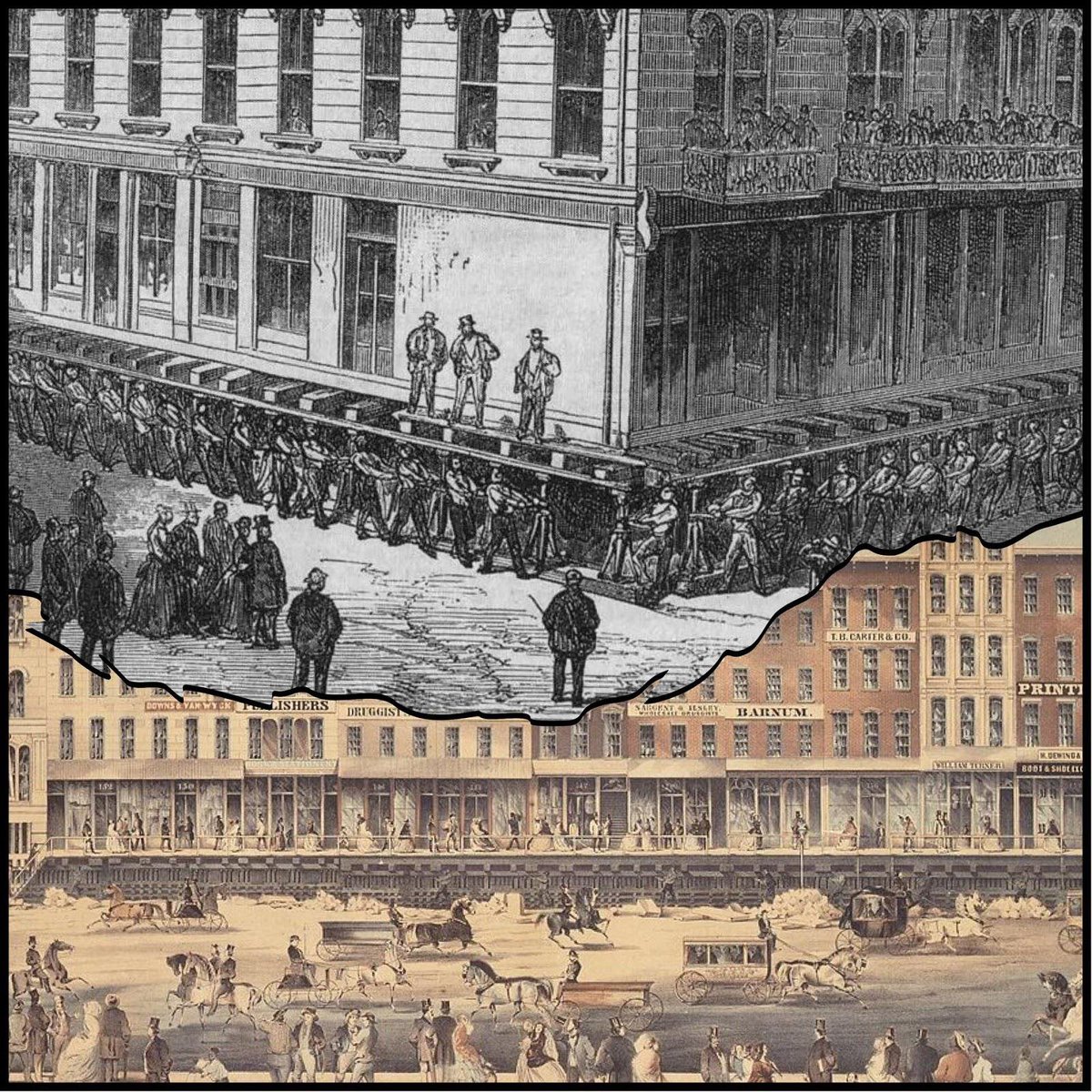
Now go to Chicago. In the 1850s the whole city was basically a mud pit with no drainage, so they made a decision that is hard to even picture. They raised the entire city. They put thousands of jackscrews under entire brick buildings and slowly cranked them up out of the mud, sometimes 6 feet or more. In 1860 they lifted half a city block, 320 feet of solid masonry weighing 35,000 tons, up almost 5 feet in five days, and the stores stayed open the whole time. People shopped inside while the building rose under their feet. They even jacked up a six story hotel with the guests still sleeping in it.
Boston did the opposite. The city was originally a bumpy peninsula with three big hills, which is why the main road is still called Tremont, from Trimountain. They sheared the tops off those hills, dropping the summit of Beacon Hill by around 60 feet, and used the dirt to fill in the harbor and the marshes. A huge chunk of downtown Boston is standing on ground that used to be the hills, and other parts are standing on what used to be open water.
Kansas City was so hilly and muddy they nicknamed it Gully Town, so they cut down bluffs 100 feet tall and dumped them into the ravines to flatten the place out. Los Angeles sliced whole hills out of its downtown to make room for the city core.
We walk around these cities assuming the ground was always shaped like this. It wasn't. Enormous parts of urban America were carved down, blasted apart, jacked up, and washed into the sea by men with hoses, shovels, and hand cranks, and most of it happened barely a hundred years ago.
The land you are standing on is not the land that was there.
Today nine institutions including BlackRock, Fidelity, Coinbase, and Strategy announced the Bitcoin Security Consortium (@BTCconsortium), pledging $15M toward Bitcoin security work over the next three years. I've agreed to help coordinate the group's work as a volunteer.
I said yes because supporting Bitcoin's developers and helping people understand their work are the two things I've spent my time in Bitcoin on, through Brink and Optech. This group wants to do both: fund the people already securing Bitcoin, and bring accurate information about that work to audiences it doesn't currently reach.
The group's first focus is quantum computing, a potential long-term threat that's reasonable to prepare for. Its true that a sufficiently powerful quantum computer would break Bitcoin's current signatures. What's usually wrong are the loudest "imminent doom" voices. The development community is already working on this.
These institutions want to help. I know exactly how "nine giant institutions form a group to 'help' Bitcoin" sounds, I had the same reaction. So before accepting, I spoke one-on-one with each company about their values and priorities, to judge whether this would actually be a productive initiative for Bitcoin. Two things mattered most to me, and I found the members already aligned on both:
- No pooled funding. Each member company funds who they choose, independently. The Consortium doesn't hold funds or pick recipients.
- No Consortium positions on protocol changes. Members speak for themselves.
I'm a volunteer, receiving no compensation from the Consortium. I continue to run Brink, independent of any Consortium member. I've committed to a year in this role, maybe I'd do two, but ultimately I see it as a seat that should rotate to other participants over time. My commitment is to Bitcoin, and that doesn't change.
My hope is that this effort results in more funding reaching more developers/researchers, on their own terms, and a measured counterweight to quantum panic, in both directions (no doomerism, but also no dismissal). Quantum is the first focus, but if this group works the way I think it can, there's room to support other security efforts down the road too.
More about the Consortium: https://t.co/BBjsalpm4J
I expect plenty of skepticism. Ask me anything.
OpenAI and Anthropic stole the entire corpus of human language and knowledge to train their models.
For them to accuse moonshot of theft is the pot calling the kettle black.
Unveiling the Presidio Bitcoin Visiting Member Program!
Want to spend 1-3 months in SF with ~30 builders, devs, and freedom-tech advocates?
Perfect if you're working on private AI, open source projects, or bitcoin.
Let’s get you here 👇
I want Elon Musk to give Mel Gibson $100 million to film an Odyssey adaptation with painstakingly historically accurate ships, armour, weapons, and casting, with all dialogue taken straight from the original poem and delivered in Homeric Greek.
Michael Millerman (@millerman) is taking the stage at the Open Source AI Summit as a bridge between classical political philosophy and the future of intelligence.
"Because of the comprehensiveness and intensity of AI as a topic....It won’t do to take a ‘merely technical’ approach to this technology"
SITUATION BREWING: The Trump administration is considering restricting cutting-edge Chinese AI models, with momentum reviving after the launch of Kimi K3, per Axios.
💥NYC BITCOINERS 💥
This Thursday we’re putting on a pretty special event at @PubKey
What Bitcoin Did Live w/ @americanhodl8, @Erikcason, Junseth & @tpacchia
Tickets are free, registration link👇
Aluminum @SeedSigner plus is here.
Case alone
Case and screen (PCB)
Or full DIY kit (pi zero, camera, microSD extension and screen)
Gold, Red, Black or Orange
Let me know if you want any custom engravings!
Which one is your favorite color?
The AI Surveillance State Is Already Here (with @Erikcason and @jesseposner)
Cypherpunk Bitcoin builders Jesse Posner and Erik Cason return to Hell Money to introduce Vora Aegis: a local-first, privacy-preserving personal AI device built on Bitcoin’s principles of self-custody and cryptography.
We discuss:
- Sovereign AI
- The state of frontier AI: Anthropic vs. OpenAI
- Digital ID and AI surveillance
- Prompt-injection defense
- The fight to keep access to AI outside of centralized control
TIMESTAMPS
0:00 Intro
4:56 Sovereign AI vs. frontier AI
7:43 AI psychosis
9:52 Is AI already the new power structure?
14:19 EU Chat Control and the US KIDS Act
16:05 The Banality of Evil: Facebook and mandatory digital ID
23:22 Anonymity, Operation Choke Point 2.0
30:08 AI telepathic hive mind
34:39 Bitcoin self-custody & sovereign AI
43:55 Introducing the Vora Aegis
48:32 How AI could save decentralization
49:47 How Vora Aegis works
1:13:04 Technical challenges building sovereign AI
1:17:00 Eschatology, sovereignty, and the future of AI
1:27:21 The new Gutenberg printing press
1:33:19 Non-state actors more powerful than governments
1:38:04 Vora Aegis pre-orders and launch timeline
Data centers haven’t been raising residential bills.
The sharpest increases are found in states that have pursued the country’s most aggressive climate policies, not those with the most data centers.
California, with some of the nation’s fastest-rising electricity rates, has seen relatively modest data-center growth. Virginia, where data centers consume more than a fifth of the state’s electricity, has experienced price increases near the national average.
@Shawn_Regan in the City Journal Substack: https://t.co/454zAKubNC
Tanya Verma (@t0nyav) is taking the stage at the Open Source AI Summit as a voice for verifiably private AI infrastructure.
AI is becoming the infrastructure that is always on, always helpful, yet always watching. Whoever owns the infrastructure of intelligence has power over the people who engage with it. - @TinfoilAI