🚨GRAVE
Neymar contraiu peste bubônica. Ancelotti descarta corte acreditando que isso pode ser uma vantagem e usará o jogador como arma biológica para infectar outros jogadores.
🗞️@CazeTVOficial
A Justiça determinou o bloqueio de R$ 52 bilhões em ativos financeiros de investigados na Operação Refino, que teve como alvos Cláudio Castro e Ricardo Magro.
CINQUENTA E DOIS BILHÕES!!!
Mais um dia ruim para o bolsonarismo!
The only people who believe any of this are non-coders.
I tried to build a game (an area I’m an n00b in.) The results are amusingly disastrous - I never before coded a decent game.
But I’ll crack out backend services w AI rapidly - because I coded dozens of them before…
Graças ao médico Drauzio Varella, o personagem "Vira-Lata", fruto de uma parceria entre o músico Paulo Garfunkel e o desenhista Líbero, tornou-se uma febre no sistema carcerário paulista: https://t.co/oabTJv9H6I
#ArquivoBBC
Alexandre Padilha, ministro da saúde, anunciou hoje que o medicamento Keytruda (pembrolizumabe) contra o câncer, cujo preço varia entre R$ 16.000,00 a R$ 27.000,00, será produzido no Brasil e será fornecido pelo SUS.
Trata-se de uma cooperação entre o Ministério da Saúde,o Instituto Butantan e a farmacêutica MSD Brasil.
E tivemos mais um ano decepcionante. Bruno Reis, era só economizar um pouquinho no cachê dos artistas pra levar uma queima decente de fogos pro resto da cidade. Feio.
The math on this image is insane.
New Horizons transmitted at 2,000 bits per second from 3 billion miles away. Slower than a 1990s dial-up modem. It took 16 months to download all the flyby data.
The spacecraft had to hit a target box 100km wide, arriving within 150 seconds of schedule, after 9 years of flight. Miss it and the preloaded observation commands point at empty space.
Ten days before arrival, the spacecraft crashed and went into safe mode. Engineers had 72 hours to restore everything.
The probe is now 5 billion miles out, still whispering data back to Earth. We got 50 gigabits of Pluto photos using technology slower than your phone’s bluetooth.
When we look at the Brazilian economy and wonder why growth has been so low for so long, an uncomfortable part of the answer lies in the private sect itself. Brazil is a notorious breeding ground for zombie companies. These are firms that cannot generate enough profit even to pay the interest on their own debt, but remain in existence because the financial system allows for the constant rollover of this liability. They do not innovate, they do not grow, they do not increase productivity.
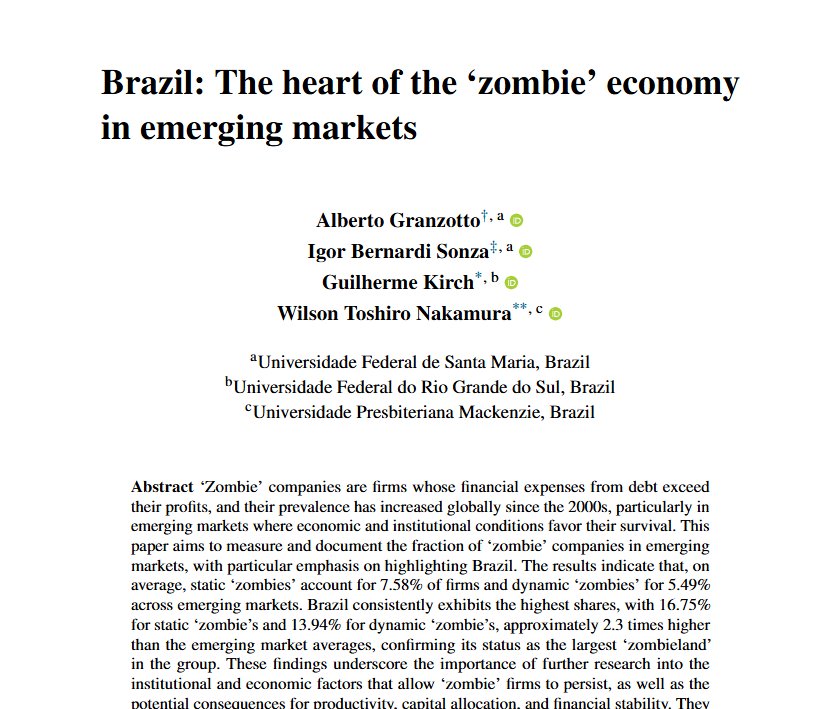
According to an article by Granzotto et al. (2025) in the Brazilian Review of Finance, which compares companies in various emerging markets, on average 7.6% of firms are "static zombies" (firms with EBITDA/Financial Expenses < 1) and 5.5% are "dynamic zombies" (EBITDA/Financial Expenses >/= 1) in these markets.
In the Brazilian case, 16.75% of companies are classified as static zombies and 13.94% as dynamic zombies! In other words, more than double the average for emerging markets. The authors themselves bluntly state that Brazil is the "heart of the zombie economy" among emerging markets, about 2.3 times above the international standard.
To clarify what this means: we are talking about companies that cannot generate enough profit to cover their financial costs, meaning that investors will have to wait longer to recover their principal, and that workers will be employed in firms without the capacity to invest in new technologies and processes that could improve their human capital and productivity.
The article shows that this mass of zombie companies distorts capital allocation, reduces aggregate productivity, and weakens investment dynamics. Credit, labor, and resources are trapped in financially fragile firms, while more productive companies face a hostile financing environment. And this, of course, has a cost in terms of potential economic growth.
As long as the Brazilian government does not address the problem of reforming the business environment and its capital markets, these types of inefficiencies will continue to persist and condemn workers and investors to remain trapped in firms that should be defunct.
SOURCE: https://t.co/a8MPL6y7xz
#Economía #econtwitter #Economics #Finance #Brazil
I work at Slack.
We tell employees their DMs are private.
And they are.
Mostly.
Look, when we say "private" we mean private between you and the person you're messaging.
And your admin.
And HR.
And legal.
And whatever compliance tool your company bought.
And the export logs.
And the backup systems.
And anyone with a court order.
But other than that, totally private.
We're very clear about this in our documentation.
Page 47.
Section 12.
Subsection C.
Paragraph 8.
The part nobody reads before they trash-talk their manager at 11pm.
Here's what employees don't understand.
When you delete a message, you're just deleting it from your view.
The message still exists.
In exports.
In backups.
In the retention policy.
It's like closing your eyes and thinking you're invisible.
The data belongs to the company, not you.
We say this right in our terms.
Workspace owners control everything.
They decide how long messages are stored.
Sometimes it's 30 days.
Sometimes it's forever.
Hope you didn't say anything spicy in 2019.
Enterprise customers get extra features.
Full message exports.
Metadata tracking.
Who messaged whom.
When.
How often.
Communication patterns.
It's for "compliance."
It's for "legal needs."
It's for "regulatory requirements."
It's definitely not for micromanagement.
We're very careful to explain that admins can't see messages in real-time.
They have to formally request an export.
Fill out some forms.
Click some buttons.
Maybe wait an hour.
Very high barrier.
Almost impossible to abuse.
The key takeaway is simple.
Treat Slack like work email.
Not like WhatsApp.
Not like Signal.
Just because it looks like a chat app doesn't mean it works like one.
If a message could cause trouble when HR reads it, don't send it.
This is empowering employees with knowledge.
If you wouldn't say it in the break room with your manager behind you, don't type it in Slack.
That's privacy.
Informed privacy.
Enterprise-grade informed privacy.